
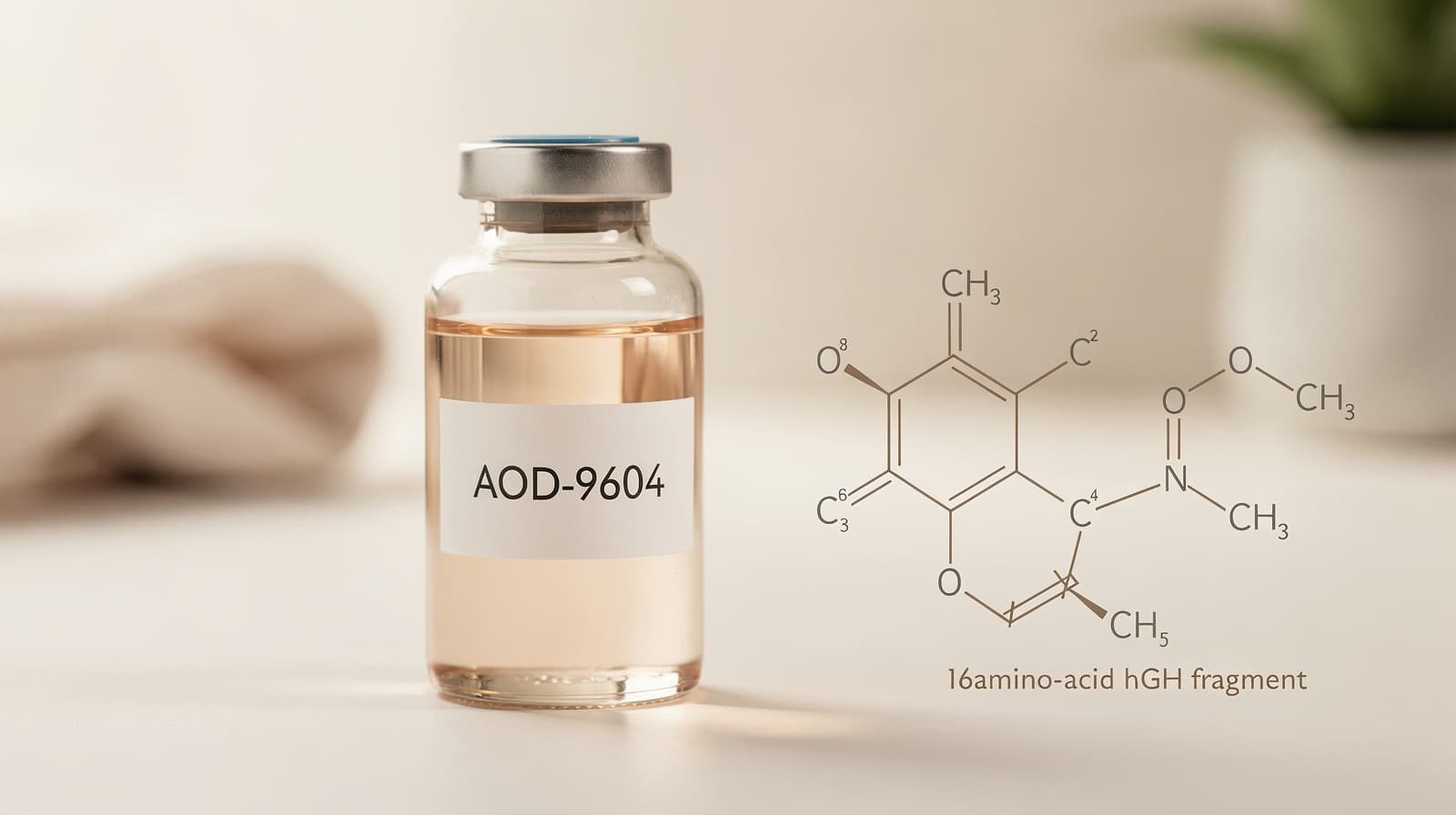
AOD-9604 occupies an awkward seat in the weight-metabolism conversation. The mechanism is elegant, the safety record is unusually long, and the headline efficacy numbers are smaller than the marketing suggests. This guide walks through what the six human trials actually measured, where the cartilage research is heading, and how to read the regulatory map before deciding whether the molecule belongs in a protocol at all.
Key takeaways#
- AOD-9604 is a synthetic 16-amino-acid fragment of the C-terminal region of human growth hormone (residues 176-191) with a stabilising tyrosine at the N-terminus.
- Across six randomised, double-blind, placebo-controlled trials in roughly 900 participants, the safety signal was indistinguishable from placebo and IGF-1 stayed flat.
- The largest 12-week Phase IIb produced an average weight reduction of 2.6 kg on 1 mg daily versus 0.8 kg on placebo. The longer 24-week follow-up trial did not hit its endpoint and development was terminated in 2007.
- Mechanism is selective: lipolysis via the beta-3 adrenergic receptor in adipose tissue, with no hGH-receptor activation and no measurable change in glucose or insulin sensitivity.
- AOD-9604 is on the WADA prohibited list at all times. It is not approved by the FDA, EMA, or Helsedirektoratet for any indication.
What AOD-9604 actually is#
AOD-9604 is a synthetic 16-amino-acid peptide fragment derived from the C-terminal domain of human growth hormone (amino acids 176-191) with a stabilizing tyrosine substitution at the N-terminus. It was originally developed by Metabolic Pharmaceuticals Ltd. in Australia during the 1990s as an "Anti-Obesity Drug," designed to harness growth hormone's lipolytic properties while avoiding broader metabolic and growth-promoting effects.
The naming creates persistent confusion. AOD-9604 and "HGH Fragment 176-191" are not interchangeable in a research context. HGH Fragment 176-191 has erroneously been presented as a lipolytic peptide fragment based on extrapolations of clinical data pertaining to AOD9604, a modified form of hGH frag 176-191. The tyrosine substitution matters: it is what gives AOD-9604 its stability profile and what the human trials actually measured.

How the mechanism is supposed to work#
The mechanism is what kept AOD-9604 in the conversation long after commercial development stalled. AOD-9604 mimics the lipolytic region of human growth hormone without binding to growth hormone receptors. When administered, the peptide preferentially accumulates in adipose tissue, where it interacts with beta-3 adrenergic receptors on fat cell membranes and initiates metabolic signaling cascades. This activation leads to increased intracellular cyclic AMP levels through adenylyl cyclase stimulation. Elevated cAMP activates protein kinase A, which then phosphorylates and activates hormone-sensitive lipase. The activated lipase breaks down stored triglycerides into free fatty acids that can be released into the bloodstream and oxidized for energy.
The beta-3 dependence is not theoretical. Heffernan et al. (2001), published in Endocrinology, tested AOD-9604 in beta-3 adrenergic receptor knockout mice. Animal studies have shown that when beta-3 adrenergic receptors were genetically removed, chronic AOD-9604 treatment produced no changes in weight or lipolysis, confirming the importance of this pathway. Research suggests the peptide also restores beta-3 receptor expression in obese mice toward levels seen in lean controls.
What the molecule does not do is just as defining. Studies have shown AOD-9604 does not stimulate IGF-1, does not activate the hGH receptor, and does not measurably alter glucose tolerance. That separation is the entire point of the design.
What the human trials actually found#
The clinical paper trail is unusually thick for a non-approved peptide. A safety review in the Journal of Endocrinology and Metabolism by Stier, Vos and Kenley (2013) summarised six randomised, double-blind, placebo-controlled trials. The first three clinical trials were single-dose treatments (METAOD001 to METAOD003); the longest was a phase IIb clinical trial (METAOD006) with a four-week run-in phase, followed by a six-month treatment phase and a 30-day follow-up phase.
The two pivotal efficacy studies are worth naming:
METAOD005 was a Phase IIb randomised, double-blind, placebo-controlled study assessing efficacy, safety and tolerability of 12 weeks treatment with daily oral doses (1, 5, 10, 20 or 30 mg AOD9604) in 300 healthy clinically obese males and females of non-child-bearing potential, with a BMI of at least 35 kg/m².
METAOD006 was a Phase IIb randomised, double-blind, placebo-controlled study assessing efficacy of 24 weeks treatment with different doses of AOD9604 tablets (0.25 mg, 0.5 mg, 1 mg, or placebo) in 502 obese adults.
The 12-week trial generated the number that gets quoted everywhere. In a 12-week randomized clinical trial involving 300 obese adults, participants receiving 1 mg daily of AOD-9604 lost an average of 2.6 kg compared to 0.8 kg in the placebo group. This represents an average additional fat loss of about 1.8 kg over 12 weeks attributable to the peptide.
That signal did not hold up. Despite completing six human clinical trials involving over 900 participants, AOD-9604 failed to achieve statistical significance in its largest Phase IIb trial and development was terminated in 2007. The peptide lacks regulatory approval from any major health authority worldwide.
The honest framing: AOD-9604 has been shown to produce a small, real, statistically detectable weight reduction in shorter studies, and a clinically underwhelming result in the longer trial that would have decided commercial fate.
How the safety profile reads#
The safety database is the most defensible part of the AOD-9604 story. Across the six trials in roughly 900 participants, no significant changes or obvious trends in the OGTT in any treatment group were observed, suggesting that AOD9604 supplementation does not deteriorate glucose control or induce insulin resistance. In contrast, treatment with AOD9604 seemed to have a positive effect in subjects with impaired glucose tolerance.
Preliminary evidence on antibody formation was equally reassuring. The research, published in the Journal of Endocrinology and Metabolism, found that the peptide had no effect on serum IGF-1 levels, no negative effect on carbohydrate metabolism, and no anti-AOD-9604 antibodies were detected in any patients.
Two caveats matter. First, the longest trial ran six months. There is no public long-term human safety data beyond that window. Second, "indistinguishable from placebo on safety" is not the same as "indistinguishable from placebo on efficacy", and conflating the two is the most common error in clinic marketing copy.
How AOD-9604 compares to GLP-1 medications and HGH#
The comparison most readers actually want is the one the data does not flatter. Modern GLP-1 and dual-incretin medications are associated with double-digit percentage weight reductions in their pivotal trials. AOD-9604's best human result is approximately 1.8 kg of additional weight loss over 12 weeks. They are not in the same efficacy tier and should not be positioned as substitutes.
Against full-length human growth hormone, the comparison is more interesting. AOD-9604 does not produce the side effects associated with full growth hormone therapy, including insulin resistance, fluid retention, carpal tunnel syndrome, joint pain, or acromegalic changes. It does not suppress the hypothalamic-pituitary axis, does not affect thyroid function, and does not alter reproductive hormones. That selectivity is the molecule's actual selling point: not "more weight loss than hGH" but "the lipolytic signal isolated from the rest of the cascade".
Compared with cagrilintide or retatrutide, which work through appetite and incretin pathways, AOD-9604 is appetite-neutral. It does not change how much food a person wants to eat. Whether that is an advantage or a limitation depends entirely on what is driving the individual's weight trajectory.
For protocol design and conversion math across peptide classes, the peptide calculator handles the unit work; how Klarovel works explains where the protocol layer sits.

The cartilage research: a second life worth watching#
After commercial obesity development stalled, AOD-9604 reappeared in regenerative orthopaedics. The most cited preclinical signal comes from Kwon and Park (2015), in Annals of Clinical and Laboratory Science. The study investigated AOD9604 intra-articular injections with or without hyaluronic acid in a collagenase-induced knee osteoarthritis rabbit model. Intra-articular AOD9604 injections using ultrasound guidance enhanced cartilage regeneration, and combined AOD9604 and HA injections were more effective than HA or AOD9604 injections alone.
Preclinical data points to chondrocyte proliferation and type II collagen synthesis as plausible mechanisms, distinct from the lipolytic pathway. In a rabbit study using a model of knee osteoarthritis, intra-articular injections of AOD9604 enhanced cartilage regeneration. The peptide is now grouped alongside other compounds being studied for joint repair and bone health, though this research is still in early stages and has not been validated in large human trials.
This is a research signal, not a clinical recommendation. There is no published large-scale human osteoarthritis trial that would justify treating AOD-9604 as a joint therapy.
Dosing, administration, and what the literature actually says#
Klarovel does not publish prescriptive dosing. The trial-derived ranges below describe what the published studies measured, not a recommendation for individual use.
The Phase IIb trials tested oral doses ranging from 0.25 mg to 30 mg daily. The 1 mg daily oral dose is the figure most commonly referenced in the efficacy literature. Subcutaneous dosing in clinical settings has been described in the 250 to 500 microgram per day range, but this comes from clinical practice reports rather than registration-grade trials. Clinical trials utilised doses ranging from 1 mg per day up to 30 mg per day in divided doses for various administration routes. Starting at lower doses allows assessment of individual tolerance and response before potentially increasing the dose.
Administration timing in the cited trials was typically morning, on an empty stomach. Cycle lengths in the published research ran 12 to 24 weeks. There is no robust human data on cycling on/off patterns; that is folklore from clinic protocols, not from the trials.
For protocol planning and cross-checking units against the published doses, see the peptide calculator. The disclosures page explains how Klarovel's curation layer is structured and its research-only positioning.
The honest summary#
AOD-9604 has been studied more than most peptides in the weight-metabolism conversation. The mechanism is selective and well characterised, the safety database is unusually long, and the efficacy is real but modest. Until comprehensive efficacy data becomes available, AOD-9604 remains primarily a research tool rather than a validated therapeutic intervention.
The cartilage signal is the more interesting frontier. Preliminary evidence from animal models suggests a regenerative role distinct from the lipolytic mechanism, and that line of research is still active.
For anyone weighing AOD-9604 against modern incretin therapies on weight loss alone, the data does not support equivalence, a contrast the broader guide to peptides for weight loss lays out across the whole class. For anyone interested in the molecule for its actual differentiator, isolated lipolysis without IGF-1 elevation, the case is more defensible but still unproven in approved use.
Direct comparisons: AOD-9604 vs tirzepatide.
Where Klarovel fits#
Klarovel does not sell, source, or fulfil AOD-9604; obtaining research-grade material is the researcher's own responsibility. What Klarovel adds is the protocol structuring, dose-conversion tooling, and source-cited education that turns a peptide name into a defensible plan.
If AOD-9604 belongs in a personal research framework, the work is in matching the mechanism to the actual goal, not in chasing the marketing arc. Create an account to build a structured protocol, or run the numbers first with the peptide calculator.
Frequently asked questions
Keep reading

Peptides for Men: What Works by Goal and Evidence Stage
Men search peptides for seven goals: muscle, fat loss, libido, hormones, recovery, hair, longevity. Here is the FDA status and trial evidence behind each.

Peptides for Women: What the Female Trial Data Shows
Most peptide trials enrolled mostly men. This guide sorts every compound by whether women were actually studied, from PT-141 and GLP-1s to BPC-157.

Peptides for Skin: What the Human Evidence Supports
Most skin peptides are cosmetics, not medicines. This pillar separates the one approved melanocortin drug from tanning analogues and topical actives.