
Bacteriostatic water is sterile water for injection with 0.9% benzyl alcohol added as a preservative, and it is the default diluent for most lyophilized peptides because it can be drawn from repeatedly for up to 28 days after the first puncture. Plain sterile water has no preservative, so it is a one-session diluent. Knowing the difference is what lets a protocol run cleanly instead of forcing you to discard vials you haven't finished.
What bacteriostatic water actually is#
Bacteriostatic water (often abbreviated BAC water or BW) is, in the words of the FDA-approved Hospira label, "a sterile, nonpyrogenic preparation of water for injection containing 0.9% (9 mg/mL) or 1.1% (11 mg/mL) of benzyl alcohol added as a bacteriostatic preservative," supplied in a multiple-dose container with a pH of 5.7 (range 4.5 to 7.0). The base is the same as plain sterile water for injection. The addition is benzyl alcohol, an antimicrobial preservative that limits bacterial growth when the vial is repeatedly punctured.
The label lists intravenous, intramuscular and subcutaneous routes, and carries two warnings worth knowing. It is not for use in neonates, because benzyl alcohol has been associated with toxicity in newborns; where water is needed for a newborn's medication, only preservative-free sterile water should be used. And it must be made approximately isotonic before intravenous use, because plain water given IV can cause hemolysis. For adults, the label notes that adverse reactions to 0.9% benzyl alcohol by IV, IM or subcutaneous injection "are not known to occur in man," and animal studies have shown that an estimated IV volume of up to 30 mL may be given safely to an adult.
The key practical property: once a multiple-dose vial is punctured, it should be dated and discarded within 28 days unless the manufacturer states another date. That is the CDC injection-safety rule, and it mirrors the 28-day beyond-use date USP chapter 797 assigns to opened multiple-dose containers with antimicrobial preservatives. The rule is about sterility. It does not mean every peptide dissolved in BAC water is chemically stable for 28 days; that depends on the peptide, and the BAC water label itself says not to store reconstituted solutions unless the drug's manufacturer directs it.
Why not sterile water or saline?#
Sterile water for injection is identical to BAC water except for the benzyl alcohol. Without the preservative, the vial is single-use. After one draw, the remaining solution has no antimicrobial protection and should be discarded. For peptide protocols that dose two or three times a week from the same vial over 28 days, sterile water is impractically wasteful.
0.9% sodium chloride (saline) is used in hospital contexts for IV reconstitution of certain biologics. Plain saline usually carries no preservative, so it has the same single-session limit as sterile water, and research has shown that ionic strength can change how some peptides dissolve or aggregate (this varies by peptide). BAC water is the usual default unless a product sheet explicitly requires saline.
Tap water or distilled water is not an option. Neither is sterile, nonpyrogenic or preserved. The infection risk is not theoretical.
How much BAC water to buy for a typical protocol#
The math is straightforward once you know your reconstitution volumes.
Scenario: single-peptide, 12-week protocol#
A typical BPC-157 protocol uses a 5 mg vial reconstituted with 2 mL of BAC water, with a fresh vial reconstituted every 28 days. Over 12 weeks that is three reconstitutions, so three peptide vials. Each needs 2 mL of BAC water, so the protocol uses 6 mL of BAC water over 12 weeks.
Volume is not the constraint here; the 28-day rule is. A punctured 10 mL BAC water vial would cover the whole run by volume, but it should be discarded 28 days after first puncture, so a 12-week run opens three BAC water vials and uses 2 mL from each. Smaller vials waste less.
Scenario: two-peptide protocol (e.g., BPC-157 + TB-500)#
Same cycle length, but now two peptides each reconstituted with 2 mL. That's 4 mL every 28 days and 12 mL over 12 weeks. If you reconstitute both peptides on the same day, one BAC water vial per 28-day window still covers it, so the count stays at three. Staggered reconstitution days can push it higher, because each newly opened BAC water vial starts its own 28-day clock.
Scenario: GLP-1 or larger-dose protocols#
Compounded or research-grade semaglutide and tirzepatide vials are often reconstituted with larger volumes (2 to 3 mL is common). The FDA-approved pens and single-dose vials come ready to inject and need no BAC water. Weekly dosing changes the math: a reconstituted vial delivers about four doses inside its 28-day window. A 10 mg tirzepatide vial covers four weeks at 2.5 mg but only two weeks at 5 mg, so a 12-week titration uses several peptide vials, not one.
For the per-vial question (how much water to add so each dose lands on clean syringe units), use the Klarovel BAC water calculator. Enter your vial size and dose and it recommends a water volume.
What to buy and what to look for#
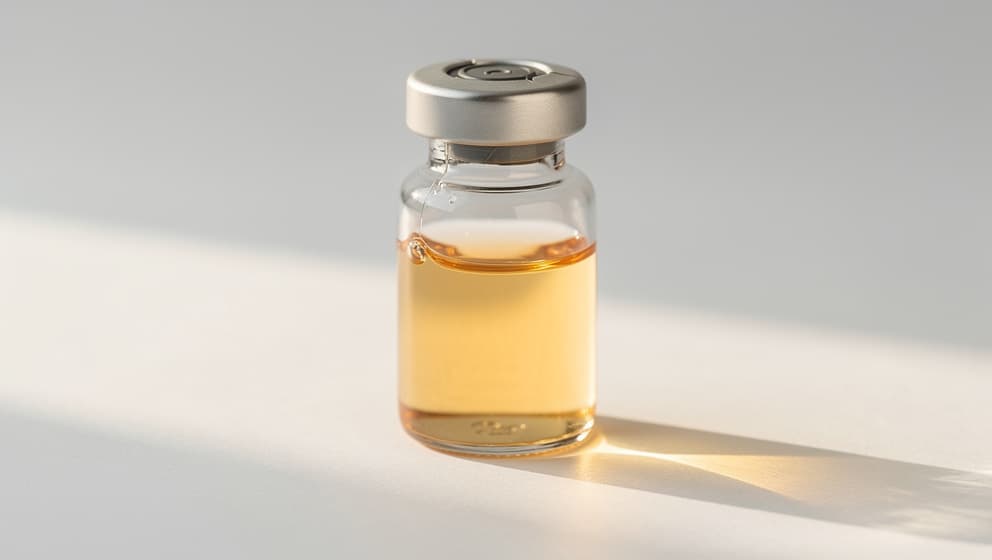
When choosing BAC water, look for three things:
- USP-grade labeling. The letters "USP" indicate the product meets United States Pharmacopeia standards for sterility and purity. This is the same grade used in pharmacy compounding.
- 0.9% benzyl alcohol concentration. This is the standard. A 1.1% version also exists (Hospira has supplied a 20 mL glass vial at 1.1%), but 0.9% is what most peptide math assumes.
- A sealed multiple-dose vial with a puncturable stopper. The seal should be intact at purchase and the vial labeled "multiple-dose." The material is not the tell: Hospira's FDA-approved 30 mL vial is a semi-rigid polyolefin plastic vial. An unsealed bottle, or anything not labeled for injection, is.
The decision tree#
Three questions answer every BAC water decision:
- Am I reconstituting a lyophilized peptide? Yes → BAC water is the default.
- Will I draw from the same vial more than once? Yes → BAC water over sterile water.
- Does the peptide's product sheet specify saline? Rare, but if yes, follow that. Otherwise BAC water.
For choosing a water volume, the BAC water calculator takes your vial size and dose and recommends how much to add. For the reconstitution procedure itself, the peptide calculator handles the concentration and unit math. Klarovel's intake questionnaire builds the full protocol, peptides, doses, cycling, in one pass.
Getting the diluent right isn't glamorous, but it's the difference between a clean protocol and a vial you end up discarding at day 20 because something went wrong. It sits inside the bigger picture of what peptide therapy involves, where reconstitution is just one of several foundations. BAC water is the boring part. That's the point.
Frequently asked questions
Keep reading

Wegovy Pill Dosage Chart: Why 25 mg Is Not a Misprint
The oral Wegovy ladder runs 1.5 to 25 mg daily; the standard injection ladder runs 0.25 to 2.4 mg weekly. Same molecule, different scale, often conflated.
MOTS-C peptide dosage chart: doses, cycles and goals
A MOTS-C peptide dosage chart by experience level: starting dose, target, ceiling and frequency from Klarovel's curated dose table, plus timing and cycle.
Wolverine peptide stack: definition, doses and duration
The Wolverine peptide stack means BPC-157 plus TB-500. Some clinics extend it to four compounds. Dosing tables for both readings, and the cycle length.