
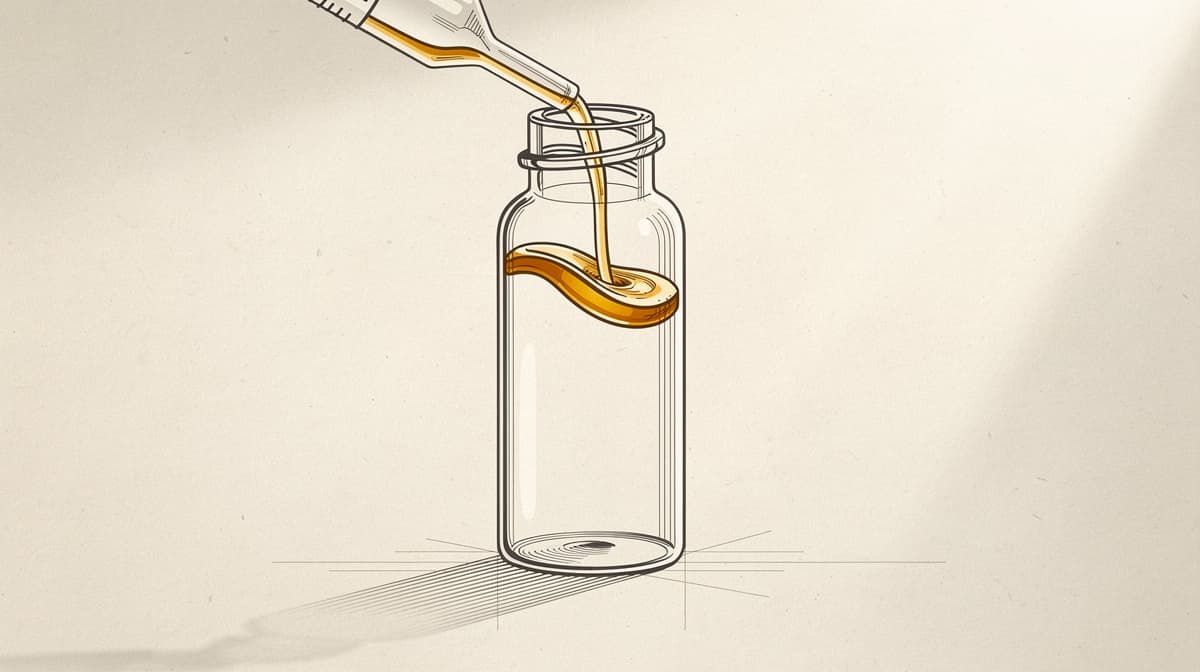
Peptide reconstitution is the step where most avoidable mistakes happen. The chemistry is simple. The procedure is straightforward. The math is elementary. What trips people up is ambiguity about sterile technique, the volume of bacteriostatic water to use, and how to turn a vial's mg into a syringe's units.
What bacteriostatic water is and why it's the correct diluent#
Bacteriostatic water (BAC water) is sterile water preserved with 0.9% benzyl alcohol. The preservative limits bacterial growth across repeated punctures, which is what makes a multiple-dose vial possible.
Sterile water (without the benzyl alcohol) is an alternative, but it's single-use. After the first draw from a sterile-water vial, there's no antimicrobial defense against introduced bacteria, and the remaining solution should be discarded. That's wasteful for a peptide you dose two or three times a week.
Saline (0.9% sodium chloride) is used by some protocols, but plain saline has no preservative, and added salt can change how some compounds dissolve. BAC water is the default for a reason: a preservative, a known composition, and minimal interaction with most peptides.
The 28-day rule is a sterility convention, not a measured expiry for each peptide. CDC injection-safety guidance says an opened multiple-dose vial should be dated and discarded within 28 days unless the manufacturer states otherwise, matching the beyond-use date USP chapter 797 sets for punctured multiple-dose containers with a preservative. Research suggests chemical stability varies widely by peptide, and some degrade sooner. If a reconstituted vial has been in the refrigerator longer than 28 days, discard it and start fresh.
The five-step reconstitution procedure#
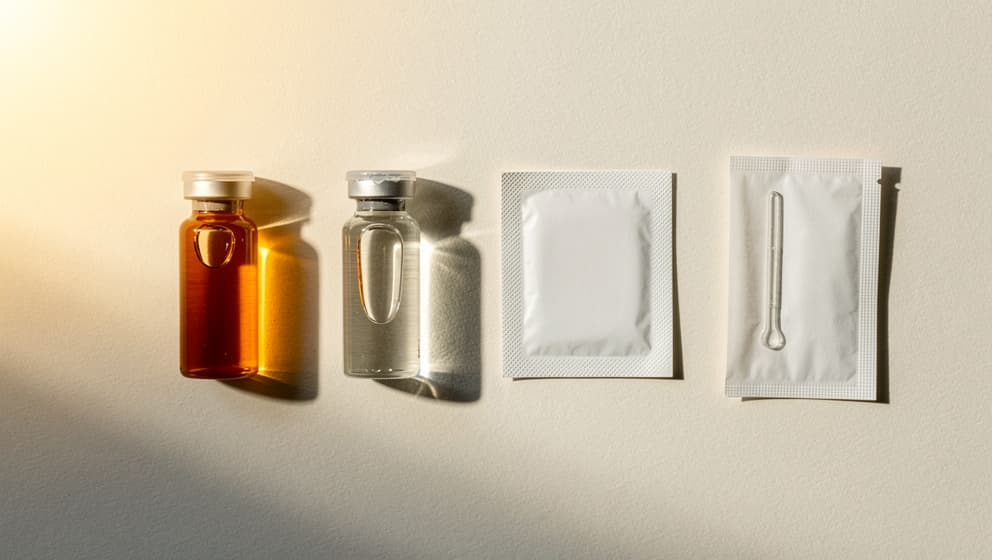
Every reputable peptide reconstitution protocol converges on the same steps.
1. Prepare the workspace. Clean a surface. Have the peptide vial, the BAC water vial, an alcohol wipe, a sterile larger-bore needle (18G to 25G) for drawing BAC water and a U-100 insulin syringe, typically 28–31G, for dosing, and a disposal container within reach.
2. Wipe both rubber stoppers. Swab the peptide vial's rubber stopper with a 70% isopropyl alcohol wipe and let it air-dry completely. Do the same for the BAC water vial. This is non-negotiable.
3. Draw the chosen volume of BAC water into the syringe. Typical reconstitution volumes are 1 mL, 2 mL, or 3 mL. The choice sets the final concentration, see the math section below. Insert the needle through the stopper at a slight angle to avoid coring. Withdraw the target volume plus a small amount to account for air.
4. Transfer the BAC water into the peptide vial slowly. Angle the needle so the water runs down the vial wall rather than splashing onto the peptide powder. Spraying the powder directly causes foaming, which can damage fragile peptides. Do not inject forcefully.
5. Let the vial rest. Do not shake. Vigorous shaking causes foaming, and agitation at air-water interfaces has been shown to make some peptides and proteins aggregate and lose activity (shaking does not break peptide bonds, but aggregation is enough to matter). Gentle swirling, or a 30–60 second rest at room temperature, is usually enough for the powder to dissolve completely. Once clear, refrigerate at 2–8 °C.
The math, broken down#
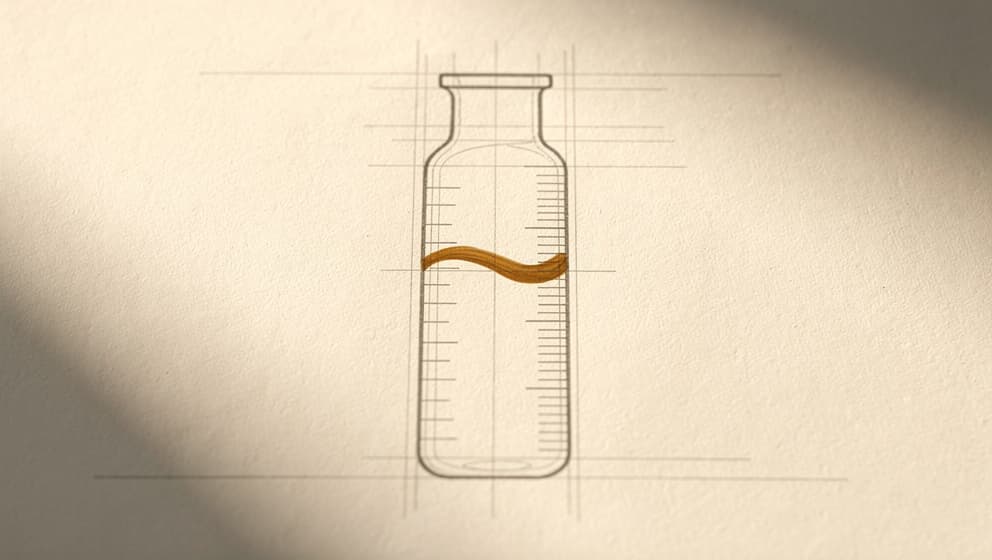
Reconstitution math is two equations. That's it.
Concentration equation:
concentration (mcg/mL) = peptide in vial (mcg) ÷ BAC water volume (mL)
Syringe-unit equation (for any U-100 insulin syringe, where 100 units = 1 mL):
units to draw = target dose (mcg) ÷ concentration (mcg/mL) × 100
Worked example#
A vial contains 5 mg (5,000 mcg) of BPC-157. You add 2 mL of BAC water.
- Concentration = 5,000 mcg ÷ 2 mL = 2,500 mcg/mL
- For a 250 mcg dose: units = 250 ÷ 2,500 × 100 = 10 units on the insulin syringe
- For a 500 mcg dose: units = 500 ÷ 2,500 × 100 = 20 units
Why the BAC water choice matters#
A 5 mg vial reconstituted with 1 mL gives 5,000 mcg/mL, each 20-unit draw is 1,000 mcg. That's a concentrated solution where small errors produce large dose swings.
The same 5 mg vial reconstituted with 5 mL gives 1,000 mcg/mL, each 20-unit draw is 200 mcg. More dilute, more forgiving on measurement, but uses BAC water faster.
The practical default: reconstitute to a concentration where typical doses fall between 5 and 25 syringe units. Below 5 units is hard to measure accurately; above 25 units means a larger injection volume than you need. The Klarovel BAC water calculator recommends a water volume for any vial size and target dose combination.
Sterile technique rules that matter most#
Three rules do the heaviest lifting:
- One entry, one new needle and syringe. CDC injection-safety guidance is a new sterile needle and syringe for every entry into a vial. A reused needle can carry bacteria into a vial you will draw from for weeks.
- Stopper cleaning between draws. Every time you pierce the rubber stopper, wipe it first with alcohol and let it air-dry. Wet alcohol pushed into the vial isn't the same as cleaned rubber.
- No freezing, no direct light. Most reconstituted peptides are kept at 2–8 °C (36–46 °F). Freeze-thaw cycles can make peptides aggregate. Light can accelerate degradation of light-sensitive compounds. A labeled dose of the vial in the back of the fridge, not the door, is the right storage location.
Storage, labeling, and the 28-day rule#
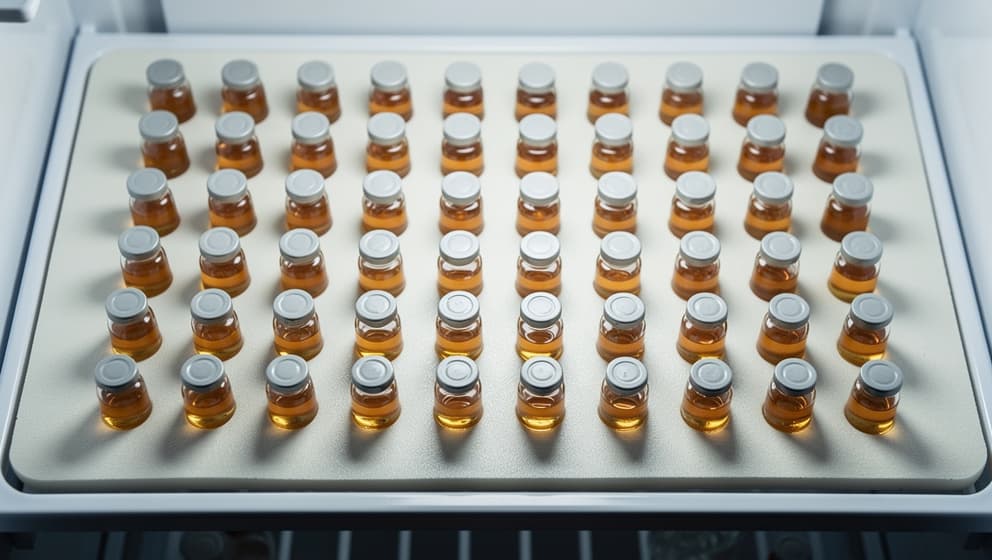
Reconstituted peptides go straight into the refrigerator (2–8 °C, 36–46 °F) after the powder has dissolved. Klarovel recommends a dedicated container inside the fridge to keep vials upright, away from raw food, and out of the door where temperature fluctuates most.
Label every reconstituted vial with the date of reconstitution. A small piece of tape with the date written in permanent marker is sufficient. At day 28, discard. If a vial is close to day 28 but the product isn't finished, that's a signal the reconstituted volume was too high for the dose schedule, next time, use less BAC water.
BAC water itself has its own clock. Once a BAC water vial is punctured, discard it 28 days later, the same multiple-dose rule. Unlike the peptide, the BAC water vial is labeled for storage at room temperature, 20 to 25 °C (68 to 77 °F), per the FDA-approved label. The Klarovel BAC water calculator recommends how much water to add per vial.
The one-sheet summary#
Print this or screenshot it. Every reconstitution follows the same frame.
- Clean workspace, wipe both stoppers.
- Decide on BAC water volume. Prefer one where typical doses fall between 5 and 25 syringe units.
- Draw BAC water with a larger needle, transfer into peptide vial gently against the glass wall.
- Rest the vial 30–60 seconds. Swirl, don't shake. Refrigerate once dissolved.
- Label with date. Discard at 28 days.
For the math on any specific peptide and dose, the peptide calculator takes your vial size, water volume and target dose and returns the syringe units; the BAC water calculator works the other way, from vial and dose to a water volume. The titration calculator builds an escalation schedule on top of that. Those two tools cover every reconstitution decision worth making.
Peptide protocols work when the foundation is tight. Reconstitution is the foundation, and it sits alongside the other building blocks covered in the overview of what peptide therapy means.
Frequently asked questions
Keep reading
Wegovy Pill Dosage Chart: Why 25 mg Is Not a Misprint
The oral Wegovy ladder runs 1.5 to 25 mg daily; the standard injection ladder runs 0.25 to 2.4 mg weekly. Same molecule, different scale, often conflated.
MOTS-C peptide dosage chart: doses, cycles and goals
A MOTS-C peptide dosage chart by experience level: starting dose, target, ceiling and frequency from Klarovel's curated dose table, plus timing and cycle.
Wolverine peptide stack: definition, doses and duration
The Wolverine peptide stack means BPC-157 plus TB-500. Some clinics extend it to four compounds. Dosing tables for both readings, and the cycle length.