

"Are peptides safe?" has no single answer, and anyone who gives one is skipping the part that matters. A weekly semaglutide injection prescribed for obesity and a vial of an unapproved peptide bought online both get called "peptides," but their safety profiles sit at opposite ends of the evidence. The honest answer depends on three things: which peptide, where it came from, and who is taking it. This guide works through all three.
The honest answer depends on which peptide and where it came from#
The word "peptide" covers a wide regulatory range, and safety is not uniform across it. As covered in the guide to what peptide therapy actually means, the term spans FDA-approved peptide medicines, compounded peptides prepared under pharmacy oversight, and peptides distributed without an approved clinical use. The safety question has a different answer in each case, because the amount of human evidence behind each is different.
For approved peptide medicines, safety has been measured directly. Semaglutide and tirzepatide have been studied in trials enrolling tens of thousands of participants, with adverse events counted, graded, and published. For peptides that have not completed that pathway, the human safety record is thinner, and what is known often comes from preclinical or animal studies rather than controlled human trials. That is a statement about how much evidence exists, not a verdict that any single compound is dangerous. Research suggests the practical safety of a peptide protocol depends less on the molecule in isolation and more on three controllable factors: the regulatory status of the product, the quality of its sourcing, and whether the individual has a contraindication. The rest of this guide takes those one at a time.
Approved peptide medicines have characterized safety profiles#
The clearest safety data belongs to the GLP-1 class, because it has been through the full approval process. The Wegovy (semaglutide) label and the Zepbound (tirzepatide) label document the adverse-event profile in detail, which is what makes these medicines the reference point for any honest safety discussion.
The dominant adverse events are gastrointestinal. Across the trials, nausea, diarrhoea, vomiting, constipation, and abdominal pain each occur in at least 5% of users, with nausea reaching close to 29% at the higher tirzepatide doses. Most of these events are mild to moderate, concentrate during the dose-escalation phase, and ease at maintenance, which is the reason every label builds in a slow titration. Studies have shown this gastrointestinal pattern is the single largest driver of people stopping treatment.
The serious signals are rarer and are spelled out on the labels. Acute pancreatitis appears at low rates, and the class is associated with gallbladder and biliary disease: a meta-analysis of 76 randomised trials found a pooled relative risk of 1.37 for gallbladder or biliary disorders, which is a real but small absolute increase. Both approved labels also carry a boxed warning for medullary thyroid carcinoma, based on dose- and duration-dependent thyroid C-cell tumours in rodents; the human relevance has not been determined, and the medicines are contraindicated in anyone with a personal or family history of medullary thyroid carcinoma or MEN2. These are the kind of specifics that only exist because the compounds were studied to approval.
The side-effect profile is real, dose-dependent, and mostly gastrointestinal#
For the approved peptides, the side-effect conversation is well-mapped, and the comprehensive peptide side-effects guide covers it in depth. The short version is that the profile is dose-dependent and front-loaded. Appetite changes and the first GI effects typically appear within the first weeks of escalation, and a class safety overview describes how most events resolve as the body adjusts to the maintenance dose.
For peptides used outside an approved indication, the side-effect picture is harder to state with the same precision, because the controlled human data that would quantify it often does not exist. Research suggests that the absence of large trials is itself the relevant safety fact: it means side effects, interactions, and long-term effects have not been systematically catalogued the way they have for approved medicines. An honest safety guide names that gap rather than filling it with reassurance.
Who should never take peptides: the contraindication checklist#
Some safety questions do not depend on the molecule at all. They depend on the person. Certain conditions are contraindications strong enough that the peptide should not be used regardless of how well-tolerated it is in the general population.

- Pregnancy and breastfeeding. The approved GLP-1 medicines are contraindicated in pregnancy on the basis of animal fetal-harm data, and the labels advise stopping well before a planned pregnancy. This caution extends to growth-hormone-axis peptides on precautionary grounds.
- Personal or family history of medullary thyroid carcinoma or MEN2. This is an absolute contraindication to the GLP-1 class per the labels above.
- Active or recent cancer, for growth-hormone-axis peptides. Peptides that raise IGF-1 warrant particular caution here, because elevated IGF-1 is an established risk factor across several cancers in a study of nearly 400,000 people, and there is mechanistic plausibility for tumour promotion.
This is not the full list, and it is the reason a structured contraindication screen matters more than a generic "ask your doctor." The contraindications guide covers the class-level rules in detail.
Sourcing is the variable most people underestimate#
Two vials of the same peptide are not necessarily the same product. For approved medicines dispensed through a pharmacy, identity, purity, and dose are controlled. For peptides bought through informal channels, none of that is verified, and this is where a large share of real-world risk actually sits.
The scale of the grey market has grown quickly. A 2025 LegitScript analysis found that advertisements for problematic peptides rose 308% in 2024 compared with 2023, with marketing that routinely disguises a product's unapproved status. Products sold "for research purposes only" sit outside the quality controls that apply to medicines, which means contamination, mislabeling, and dose imprecision are real possibilities rather than theoretical ones. Research suggests that for peptides obtained outside regulated channels, the sourcing question is at least as important to safety as the choice of molecule. The practical implication is simple: where a product comes from is part of whether it is safe.
In Norway, injectable peptides without authorisation are not permitted#
The legal picture shapes the safety picture, because legality in Norway tracks how a peptide is delivered. DMP's working rule is that an oral peptide is treated as a supplement, a topical peptide as a cosmetic, and an injected peptide as a medicine, which means injectable peptides need marketing authorisation to be legal.
DMP has warned directly about injectable peptides, stating that unapproved injectable peptides are not permitted to be imported, produced, or sold in Norway and pointing to risks including contamination, incorrect doses, and serious harm. Personal import does not provide a workaround: DMP cannot issue import permits for medicines containing substances on the doping list, and many peptides fall under the S2 peptide-hormones group. The legal status of specific compounds is covered in the peptides legal status in Norway guide and, for the copper peptide specifically, the GHK-Cu legality guide. The approved GLP-1 medicines, by contrast, are authorised and available by prescription, which is the regulated end of the same spectrum.

What 2026's regulatory shift does and does not change#
There is genuine regulatory movement in 2026, and it is easy to misread. In the United States, the FDA has opened a process to reconsider whether a number of peptides should be available through compounding pharmacies, with a Pharmacy Compounding Advisory Committee meeting scheduled for 23 to 24 July 2026 and a public docket open for comment (RAPS coverage).
The important point for safety is what this is not. It is a proposal under review, not an enacted change, and even if finalised it would govern compounding access in the United States, not the safety evidence behind any peptide. It also does not change anything about Norwegian or EMA status. A peptide becoming easier to compound in one jurisdiction does not generate the human safety data it lacks, and it does not make an unauthorised injectable legal in Norway. Reading the headline as "peptides are now approved" would be a mistake.
A safe peptide decision starts with your health profile#
The thread running through every section above is that peptide safety is not a property of the word "peptide." It is the product of a specific molecule, a specific source, and a specific person's health profile. The approved medicines have characterized profiles and clear contraindications. The peptides outside that channel carry the added uncertainty of thinner human data and unverified sourcing. The individual's contraindications can override both.
That is why Klarovel's approach starts with a structured health profile rather than a product. The health questionnaire screens for the contraindications above, surfaces the questions a safe decision depends on, and frames any recommendation around the individual rather than an average. The full regulatory framing for unapproved and off-label products is set out on the disclosures page. For readers who want to go deeper on any single thread, the guides below cover each in detail.
- Are Peptides Legal in the US? FDA & DEA Status in 2026: The legal status of peptides in the US is layered, fast-moving, and easy to misread.
- GHK-Cu Legal Status in Norway: What Researchers Need to Know: GHK-Cu sits between cosmetic ingredient and prescription peptide in Norway.
- Buying Peptides in Norway: Customs and Legal Reality: Norwegian law bans mail-order medicinal products.
- Peptide Bloodwork Panel: The Baseline Labs That Matter: A research-grade guide to peptide bloodwork panels: which markers to draw, when to retest, and how to read IGF-1, lipase, and metabolic shifts safely.
- Who shouldn't take peptides: contraindications guide: Peptides aren't for everyone.
- Peptide Drug Interactions: What Research Actually Shows: Peptide drug interactions remain understudied.
- Peptide Side Effects: A Comprehensive Safety Guide 2026: Side effects across BPC-157, semaglutide, tirzepatide, melanotan II, ipamorelin and more.
- Peptides on the Doping List: A 2026 WADA Reference: Which peptides are banned for tested athletes on the 2026 WADA list, how USADA and the NCAA apply it, S0 and S2 classes, and where GLP-1s stand.
- Are peptides legal in Norway? The 2026 regulatory answer: Peptides in Norway are mostly unlawful to import privately.
- SARMs vs Peptides: How the Two Compound Classes Differ: SARMs hit androgen receptors and carry liver and cardiovascular risk; peptides act as targeted signaling molecules.
Related safety and compliance guides: SARMs vs Peptides, Are Peptides Legal in the US? FDA & DEA Status in 2026, Peptides on the Doping List, Peptide Drug Interactions, Peptide Bloodwork Panel, Buying Peptides in Norway.
Frequently asked questions
Keep reading
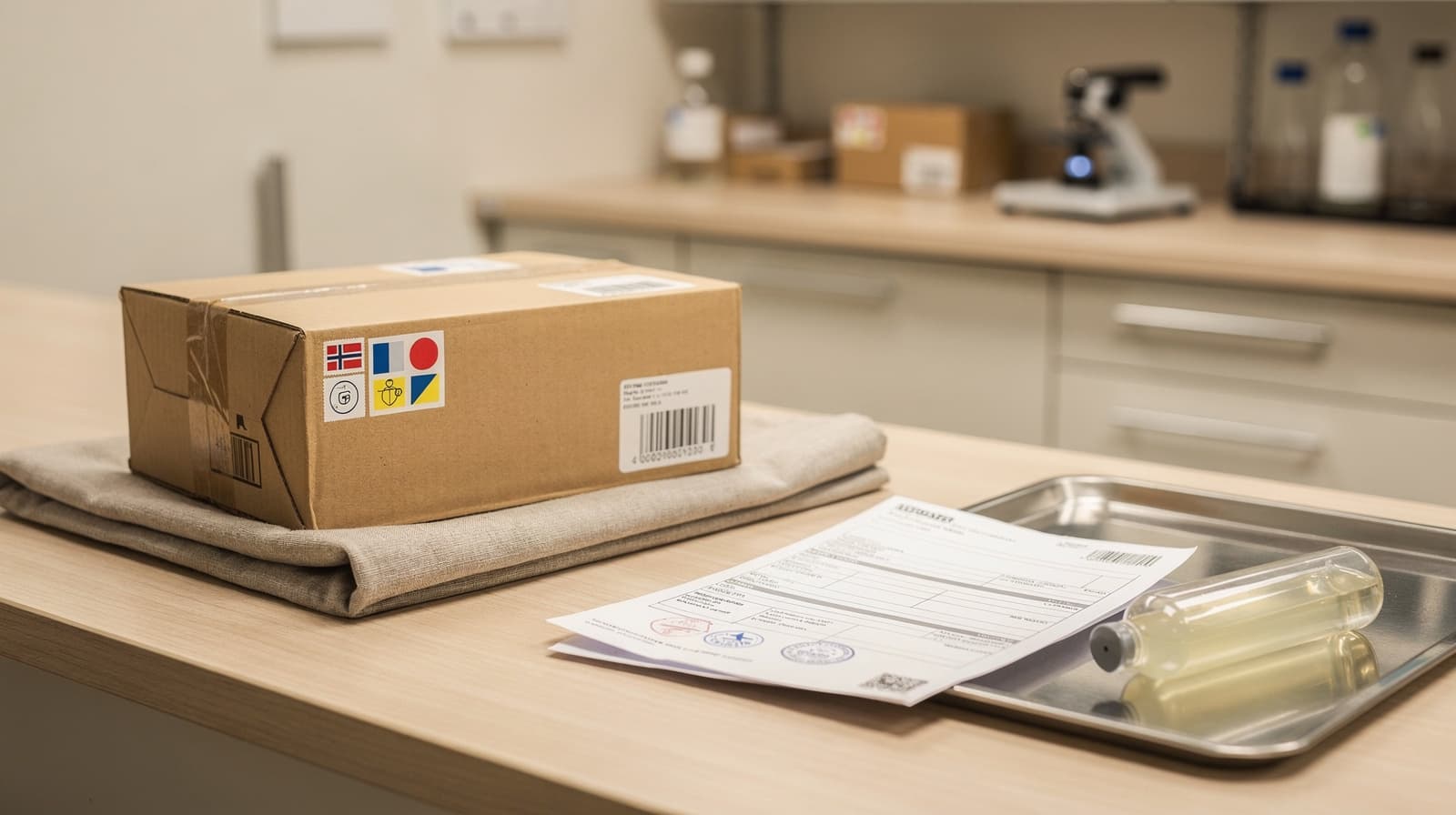
Buying Peptides in Norway: Customs and Legal Reality
Norwegian law bans mail-order medicinal products. Here is what Tollvesenet actually seizes, which peptides are on the doping list, and how to stay compliant.

Wegovy Side Effects: How Common, How Long, How Serious
What the Wegovy label and pooled STEP data actually report: incidence per side effect, median duration in days, and the one that does not fade.

Peptide Drug Interactions: What Research Actually Shows
Peptide drug interactions remain understudied. Here is what current research suggests about GLP-1 agonists, GH secretagogues, and repair peptides.