

GHK-Cu occupies an unusual position in Norwegian regulation. The exact same molecule can be a legal cosmetic ingredient on the shelf at a Norwegian apotek and an illegal pharmaceutical in a vial seized by Tolletaten, depending entirely on the format, the route of administration, and the claims attached to it. This guide explains where the line sits in 2026.
Key takeaways#
- Topical GHK-Cu in cosmetic serums and creams is legal in Norway under the EU Cosmetics Regulation (EC) No 1223/2009, with no concentration cap when used as a non-therapeutic cosmetic ingredient.
- Injectable GHK-Cu and "research chemical" vials shipped from abroad are not legal to import for personal use; the Direktoratet for medisinske produkter (DMP) and Tolletaten classify them as unapproved medicinal products.
- DMP issued a formal warning in 2026 against injectable peptides ordered from foreign websites, citing safety risks and explicit illegality under Norwegian medicines law.
- GHK-Cu is not named on the WADA 2026 Prohibited List, but injectable use may fall under the S0 catch-all for unapproved substances or the growth-factor-modulator clause, so elite athletes should check before any non-cosmetic use.
- Klarovel does not sell, source, or fulfil GHK-Cu; it curates the protocol and reconstitution layer only.
Norway treats GHK-Cu through two completely different regulatory lenses#
Most confusion about GHK-Cu in Norway comes from collapsing two separate frameworks into one question. The molecule itself, glycyl-L-histidyl-L-lysine bound to a copper(II) ion, was first isolated by Loren Pickart in 1973 and exists naturally in human plasma. GHK is present in human plasma, saliva, and urine but declines with age, from about 200 ng/mL at age 20 down to 80 ng/mL by age 60. That biological footprint matters because Norwegian regulators do not assess the molecule in isolation; they assess the product.
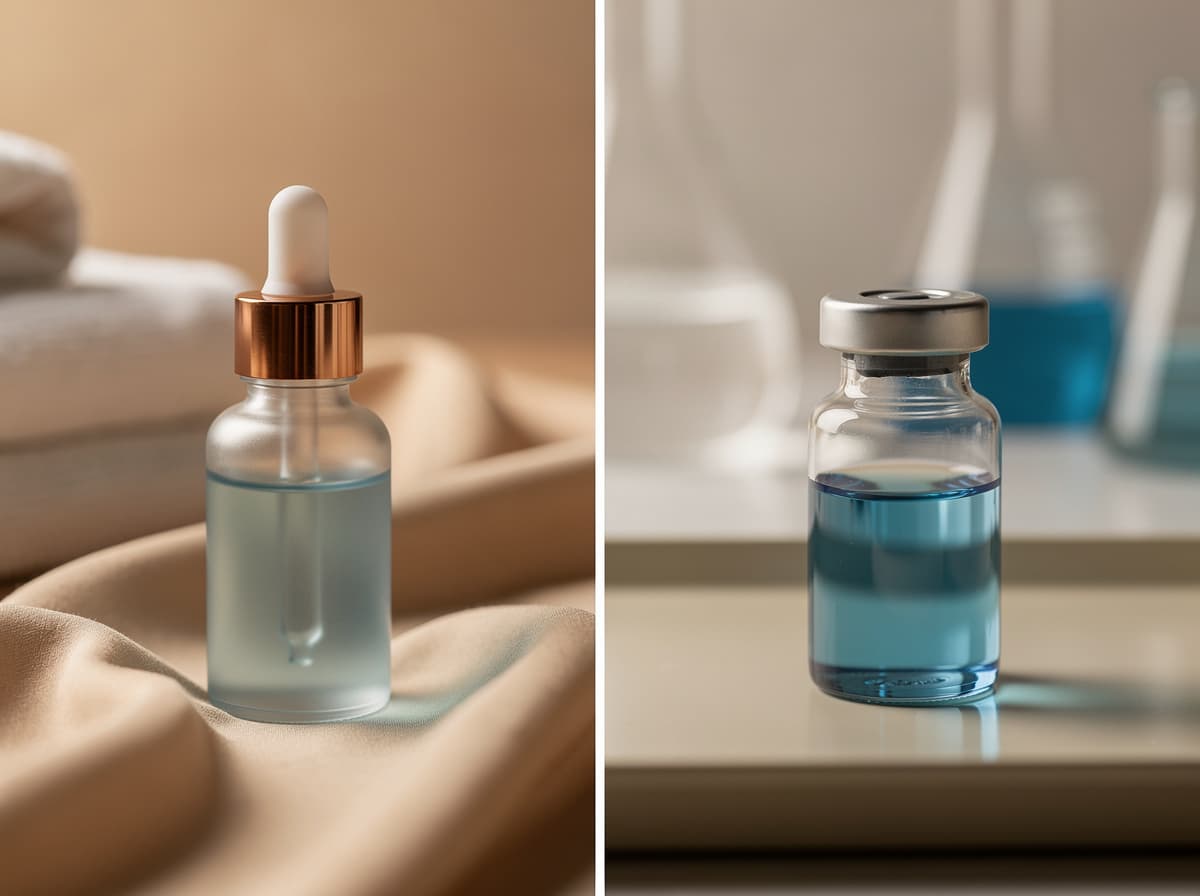
A jar of facial serum containing copper tripeptide-1 at 0.1 percent is governed by cosmetics rules. A vial of lyophilised GHK-Cu sold as a research chemical and intended for subcutaneous injection is governed by medicines law. Same peptide, two different regulatory universes. Certain substances can be a medicinal product in one case and not in another, even if the product contains the substance in the same dosage, when the use in one case is to alleviate disease while the other is not intended for medicinal use; the assessment turns on whether the known use is medicinal or whether the substance has a pronounced pharmacological effect at the given dosage.
Cosmetic GHK-Cu is permitted across the EU and Norway#
Through the EEA agreement, Norway implements EU cosmetics rules. In the European Union, cosmetics are governed by Cosmetics Regulation (EC) No 1223/2009, which establishes rigorous criteria for safety, effectiveness, and labelling of ingredients. GHK-Cu, listed in INCI nomenclature as Copper Tripeptide-1, is an accepted cosmetic active. Copper peptides are permitted in cosmetic formulations without concentration limits under both U.S. and EU regulations, provided they are non-therapeutic, although brands must avoid claims implying wound healing, collagen regeneration, or medical efficacy.
This is the central compliance hinge. The ingredient is legal; the claim profile is what tips a product over into medicines territory. A serum that says "improves the appearance of fine lines" stays cosmetic. A serum that says it heals wounds or reverses photo-damage crosses into the medicinal definition and would require a marketing authorisation. Other European regulators apply the same logic; in the UK, for example, GHK-Cu products are classified as cosmetics under the GB Cosmetic Products Regulation and cannot legally make medicinal claims about treating hair loss.
Injectable GHK-Cu falls under Norwegian medicines law#
Once GHK-Cu is presented in a vial for reconstitution and subcutaneous injection, the product almost always becomes a medicinal product by function, by presentation, or both. The Direktoratet for medisinske produkter, which replaced Statens Legemiddelverk as the regulator on 1 January 2024, has been explicit on this point.
In a 2026 public warning, DMP stated that private individuals are increasingly ordering injectable peptides from foreign websites, that import to Norway is illegal, and that the products are not approved medicinal products. Since peptides are broken down in the gastrointestinal tract they have less effect when taken as tablets or capsules, so they typically need to be injected to have effect, which means they fall under medicines regulation.
VG reporting from 2026 named BPC-157, TB-500, and GHK-Cu among the peptides circulating in social media videos where young users inject themselves.
The mechanics of enforcement are equally clear. Tolletaten states that private individuals are not allowed to import medicinal products in shipments, that this applies to both prescription and non-prescription medicines, and that such shipments can be stopped at customs control. DMP's own guidance reinforces that postal shipments of medicinal products, both prescription and non-prescription, from abroad are not permitted and can be stopped at customs.
The "research use only" label does not create a legal channel#
A common misconception is that the "For Research Use Only" disclaimer on the vial unlocks a different legal pathway. It does not. It is prohibited for private individuals to order medicinal products from abroad via postal shipments to Norway, it is also prohibited to sell and market such products, and this applies to influencers even if they are not earning money from it.
The legal definition is functional, not nominal. A product can be considered a medicinal product either by exerting a medicinal effect (medicine by function) or by being presented with medicinal claims (medicine by presentation), provided it is intended for use in humans or animals; if a substance is found in a preparation marketed as a medicine in Norway or another country, it will as a rule be considered a medicine and stopped in customs control. A vendor's research disclaimer does not override Norwegian classification.
Sports compliance: GHK-Cu and the WADA list#
For competing athletes, the sports-specific question is separate from the import question. As of the 2026 WADA Prohibited List, GHK-Cu is not named explicitly. That is not the same as being permitted.
The WADA framework uses broad categories. Section S0 prohibits at all times any pharmacological substance that no health authority has approved for human therapeutic use and that no other section covers, and injectable GHK-Cu has no such approval anywhere. The 2026 list also prohibits growth factors and growth factor modulators "affecting muscle, tendon or ligament protein synthesis/degradation, vascularisation, energy utilization, regenerative capacity or fibre type switching". GHK-Cu's documented effects on collagen synthesis and tissue remodeling sit close enough to that language that elite athletes should consult their national anti-doping body before any non-cosmetic use. Antidoping Norge is the relevant point of contact in Norway.
What this means practically for Norwegian residents in 2026#
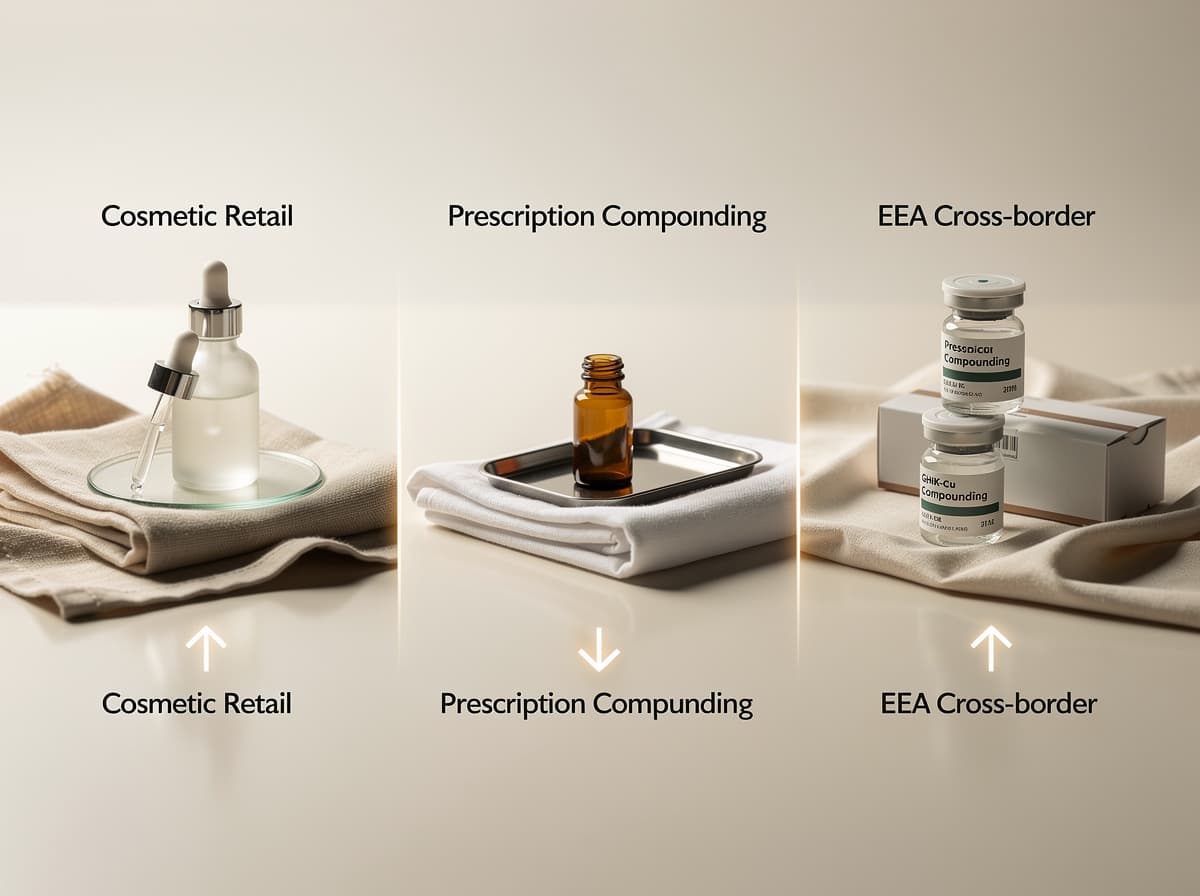
Three lanes are open in principle, and one is not. The cosmetic lane is straightforward: copper peptide serums purchased from an EU-compliant retailer or a Norwegian pharmacy are legal, regulated under cosmetics rules, and broadly available. Copper Tripeptide-1 corresponds to the GHK-Cu complex and these peptides are cosmetically approved and not restricted.
The clinical lane, in principle, runs through a Norwegian-licensed prescriber. For a medicine without Norwegian marketing authorisation, the doctor must apply to DMP for a godkjenningsfritak (exemption), give a medical justification, and hold the necessary information on the product's safety and efficacy; the pharmacy then orders the product. No GHK-Cu product holds a marketing authorisation as a medicine in Norway or the EU, so this route is narrow and untested in practice. Preliminary evidence and decades of preclinical data point toward skin and wound-healing applications.
The EEA cross-border lane is narrow. For travel within the EEA area you can bring an amount of medicines for personal medical use corresponding to a maximum of one year's consumption for each medicine. That covers a product lawfully prescribed and dispensed in another EEA country and carried in personal luggage with documentation. Because no EEA country has authorised a GHK-Cu medicine, it rarely applies to GHK-Cu.
The closed lane is the postal one. Ordering vials from a foreign "research" vendor and having them shipped to a Norwegian address fails on multiple grounds: classification as a medicinal product, lack of marketing authorisation, and the explicit ban on private postal import.
Klarovel's position on GHK-Cu sourcing#
Klarovel is a protocol and education layer, not a peptide retailer. Klarovel does not sell, source, or fulfil GHK-Cu in any form. For researchers and clinicians, the legal classification of imported GHK-Cu in Norway is set out by the DMP, and Klarovel's tools focus on the downstream layer: reconstitution math, dosing windows derived from published research, and stacking logic. Use the peptide reconstitution calculator to translate vial concentrations into accurate dosing volumes once a legal product is in hand, and review how Klarovel works for the broader protocol framework.
The supporting science is robust. In vivo and in vitro studies since 1973 have shown that GHK-Cu possesses health-positive actions including improving wound contraction and epithelization, increasing growth factor production and antioxidant enzyme activity, with gene expression profiling recently shedding new light on its diverse biological actions. Research suggests these effects are mediated through modulation of fibroblast activity, copper transport, and gene-level regulation of repair pathways. What the science does not yet provide is a Norwegian marketing authorisation for any injectable form, which is the gating regulatory fact.
The bottom line on GHK-Cu in Norway#
GHK-Cu is one of the most studied small peptides in skin and tissue science, with decades of preclinical and cosmetic-clinical data behind it. In Norway, that scientific maturity does not automatically translate into legal access for every format. Topical cosmetic use is open. A prescriber exemption route exists in principle but is narrow. Direct private import of injectable research vials is not legal and is actively flagged by DMP and Tolletaten. Anyone building a protocol on GHK-Cu should start with the format that is actually permitted, document the source, treat regulatory clarity as the first input rather than the last, and weigh it against the broader question of whether peptides are safe. Create a free Klarovel account to access the protocol templates, reconstitution calculator, and compliance-aware education layer built for exactly this kind of decision.
Frequently asked questions
Keep reading
Buying Peptides in Norway: Customs and Legal Reality
Norwegian law bans mail-order medicinal products. Here is what Tollvesenet actually seizes, which peptides are on the doping list, and how to stay compliant.

Wegovy Side Effects: How Common, How Long, How Serious
What the Wegovy label and pooled STEP data actually report: incidence per side effect, median duration in days, and the one that does not fade.

Peptide Drug Interactions: What Research Actually Shows
Peptide drug interactions remain understudied. Here is what current research suggests about GLP-1 agonists, GH secretagogues, and repair peptides.