
Peptide Calculator
Three inputs. One answer. Enter your vial size, water volume, and target dose, and get the exact syringe units to draw. No mental math, no guessing.
A free peptide dosing calculator that handles every common research peptide: tirzepatide, semaglutide, retatrutide, BPC-157, ipamorelin, GHK-Cu, and the rest. Below the calculator: a complete peptide reconstitution chart to download or save as an image, answers for specific vial sizes, units conversions, and storage guidance.
If you know which compound you are mixing, there is a calculator for it. Each per-peptide and per-blend page pre-loads that compound's own dose envelope, ceiling, frequency and cycle length from the Klarovel engine, so you do not need to know the dose before the tool is useful.
Reviewed by the Klarovel Medical Advisory Board. Last updated . Primary sources are cited below.
What is the total volume of your syringe?
How many milligrams are in your peptide vial?
How much bacteriostatic water are you adding?
How much peptide do you want per dose?
Select your vial size, water amount, and dose above to see your result.
Save your reconstitution. Get the protocol it belongs in.
We'll send your reconstitution and a link to get your protocol: $99 one time. Previously $179 a year.
How to reconstitute peptides in four steps
Peptides arrive as freeze-dried powder. To reconstitute peptides for injection, you mix them with bacteriostatic water and let the powder fully dissolve. Proper technique keeps the peptide intact and your doses accurate. The peptide mixing calculator above handles the math; the four steps below handle the procedure.
Clean setup
Sterile gloves, clean surface. Have your peptide vial, BAC water, insulin syringe, and alcohol swabs ready before you start.
Warm to room temperature
If either vial was refrigerated or frozen, let it sit at room temperature (20-25 degrees C) first. Cold liquid causes foaming and poor dissolution.
Add water slowly
Swab both vial tops with alcohol. Draw your BAC water and inject it against the inner glass wall at a 45-degree angle. Do not spray it onto the powder directly.
Swirl, never shake
Gently roll or swirl the vial until the solution is completely clear. Aggressive shaking damages peptide bonds. If it stays cloudy, give it more time.
Unsure how much water to use?
Water volume controls concentration. Less water = fewer units per dose (harder to measure small amounts). More water = more units per dose (easier precision). Try different amounts in the calculator above to see how it changes your syringe draw.
Storage after mixing
Once reconstituted, temperature is everything. The peptide is now in solution and degrades faster than powder. Two options depending on your timeline.
Refrigerated (3-4 weeks)
Keep at 2-8 degrees C in the main compartment of your fridge. Avoid the door shelf where temperature swings on every open. Store upright, stopper facing up.
Frozen (3-4 months)
Split into single-use aliquots and freeze at -20 degrees C. Each freeze-thaw cycle degrades the peptide, so only thaw what you intend to use. Do not refreeze.
Powder is more forgiving. Unreconstituted peptide can sit at room temperature for weeks or stay frozen for years. Only mix what you will actually use in the next few weeks.
The math behind every result
The calculator above does this automatically, but here is the four-step formula so you can verify any result by hand. Worked example throughout: a 5 mg vial, 2 ml of bacteriostatic water, and a 250 mcg dose.
Concentration
Vial size divided by water volume. This tells you how much peptide is in each ml of solution.
Injection volume
Your dose (converted to mg) divided by the concentration. This is the actual liquid volume you inject.
Syringe units
Injection volume times 100. A U-100 insulin syringe, the standard type in the US, marks 100 units per ml, so this gives you the exact tick mark.
Doses per vial
Vial size in mcg divided by your dose, rounded down. Always round down: a partial dose left in the vial is not a dose.
Common setups by peptide
Typical reconstitution configurations for popular peptides. Expand any entry to see the math, then load those values into the calculator.
5 mg vial · 2 ml BAC water · 250 mcg dose · 1-2x daily
One of the most widely used repair peptides. A 5 mg vial with 2 ml water gives you a 2.5 mg/ml solution. At 250 mcg per injection, that is 10 units on the syringe and 20 total doses from a single vial.
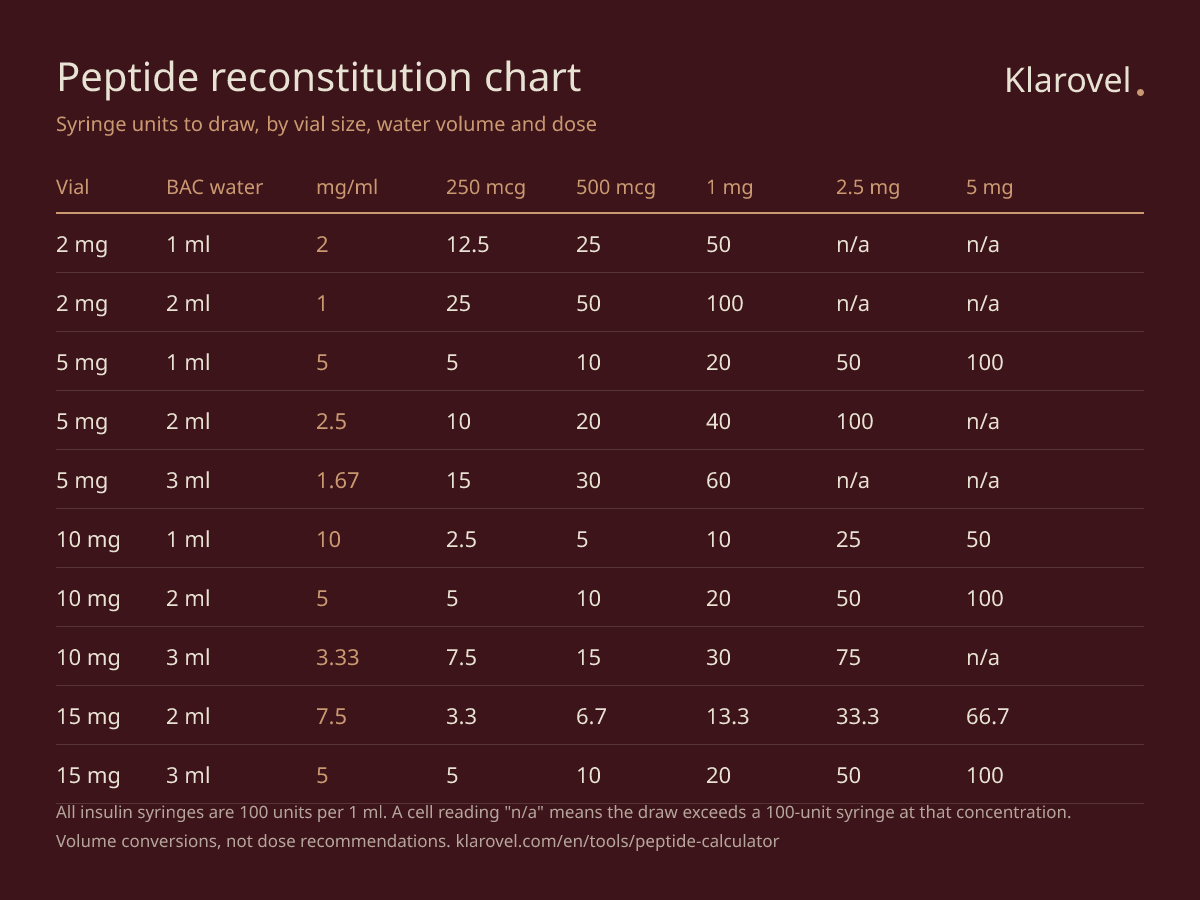
Peptide reconstitution chart
Pre-calculated syringe units for the most common vial and water combinations. Functions as a peptide dosing chart for any peptide where the vial size, water volume, and target dose match a row below. All values assume a 100-unit (1 ml) insulin syringe. A cell reading "n/a" means the dose exceeds syringe capacity at that concentration.
How to use: Find your vial size and water volume on the left, then read across to your dose column. The number is the unit mark on your syringe.
Example: 5 mg vial + 2 ml water + 250 mcg dose = 10 units.
| Vial | BAC Water | Conc. | 250 mcg | 500 mcg | 1 mg | 2.5 mg | 5 mg |
|---|---|---|---|---|---|---|---|
| 2 mg | 1 ml | 2 mg/ml | 12.5 | 25 | 50 | n/a | n/a |
| 2 mg | 2 ml | 1 mg/ml | 25 | 50 | 100 | n/a | n/a |
| 5 mg | 1 ml | 5 mg/ml | 5 | 10 | 20 | 50 | 100 |
| 5 mg | 2 ml | 2.5 mg/ml | 10 | 20 | 40 | 100 | n/a |
| 5 mg | 3 ml | 1.67 mg/ml | 15 | 30 | 60 | n/a | n/a |
| 10 mg | 1 ml | 10 mg/ml | 2.5 | 5 | 10 | 25 | 50 |
| 10 mg | 2 ml | 5 mg/ml | 5 | 10 | 20 | 50 | 100 |
| 10 mg | 3 ml | 3.33 mg/ml | 7.5 | 15 | 30 | 75 | n/a |
| 15 mg | 2 ml | 7.5 mg/ml | 3.3 | 6.7 | 13.3 | 33.3 | 66.7 |
| 15 mg | 3 ml | 5 mg/ml | 5 | 10 | 20 | 50 | 100 |
Standard reconstitution by compound
The chart above works from whatever vial and water volume you have. This one starts from the compound. Each row is a reference reconstitution and the two numbers that follow from it.
Read the last column first. Micrograms per syringe unit is the number that does the work: multiply it by the units you draw, or divide your dose by it to get the units. It holds on 0.3, 0.5 and 1 ml U-100 insulin syringes alike, because all three mark 100 units per ml.
| Compound | Vial | BAC water | Concentration | mcg per unit |
|---|---|---|---|---|
| AOD-9604 | 10 mg | 2 ml | 5 mg/ml | 50 mcg |
| DSIP | 5 mg | 2 ml | 2.5 mg/ml | 25 mcg |
| Epitalon | 50 mg | 5 ml | 10 mg/ml | 100 mcg |
| GHK-Cu | 100 mg | 10 ml | 10 mg/ml | 100 mcg |
| Glutathione | 1500 mg | 10 ml | 150 mg/ml | 1500 mcg |
| HGH Fragment 176-191 | 5 mg | 2 ml | 2.5 mg/ml | 25 mcg |
| IGF-1 LR3 | 1 mg | 1 ml | 1 mg/ml | 10 mcg |
| Ipamorelin | 10 mg | 2 ml | 5 mg/ml | 50 mcg |
| Kisspeptin-10 | 10 mg | 2 ml | 5 mg/ml | 50 mcg |
| KPV (Lys-Pro-Val) | 10 mg | 2 ml | 5 mg/ml | 50 mcg |
| Selank | 10 mg | 2 ml | 5 mg/ml | 50 mcg |
| SS-31 (Elamipretide) | 50 mg | 5 ml | 10 mg/ml | 100 mcg |
Compounds that ship in more than one vial size are deliberately absent. BPC-157, TB-500, Semax, MOTS-c, thymosin alpha-1 and retatrutide each come in two or more sizes, and a single published ratio would be wrong for whoever holds the other one. Use the calculator above with your actual vial, or the per-compound calculators, which carry each compound’s own dose figures from the Klarovel engine.
Take the chart with you
The same chart as an image you can save and a file you can open in a spreadsheet. Both are generated from the table above, so they cannot drift out of step with it. Every figure is a volume conversion, not a dose recommendation.
How much bacteriostatic water for a specific vial
There is no single correct water volume for any vial. What can be answered is where the syringe mark lands at each volume, and which volumes keep that mark readable. Each answer below is computed against that compound's own dose figure from the Klarovel engine, not a generic dose.
How much BAC water for a 10 mg BPC-157 vial?
3 ml is the lowest volume that keeps the draw readable: it puts a 300 mcg dose at 9 units. Larger volumes spread the same dose across more marks, which is easier to draw accurately and empties the vial no faster.
Computed against the Beginner standard dose, from the engine dose table. Frequency for that row: once to twice daily.
| BAC water | Concentration | Draw | Readable |
|---|---|---|---|
| 1 ml | 10 mg/ml | 3 units | No |
| 1.5 ml | 6.67 mg/ml | 4.5 units | No |
| 2 ml | 5 mg/ml | 6 units | No |
| 2.5 ml | 4 mg/ml | 7.5 units | No |
| 3 ml | 3.33 mg/ml | 9 units | Yes |
| 4 ml | 2.5 mg/ml | 12 units | Yes |
| 5 ml | 2 mg/ml | 15 units | Yes |
BPC-157 is dosed in micrograms out of a milligram vial, so a concentrated mix puts a dose at a very small mark. The volumes that keep the draw readable are marked below. BPC-157 may be dosed once or twice daily depending on experience level, and the second dose does not change the water volume, only how fast the vial empties.
How much BAC water for a 1500 mg glutathione vial?
1 ml is the lowest volume that keeps the draw readable: it puts a 200 mg dose at 13.3 units. Larger volumes spread the same dose across more marks, which is easier to draw accurately and empties the vial no faster.
Computed against the Beginner standard dose, from the engine dose table. Frequency for that row: 3 times weekly.
| BAC water | Concentration | Draw | Readable |
|---|---|---|---|
| 1 ml | 1500 mg/ml | 13.3 units | Yes |
| 1.5 ml | 1000 mg/ml | 20 units | Yes |
| 2 ml | 750 mg/ml | 26.7 units | Yes |
| 2.5 ml | 600 mg/ml | 33.3 units | Yes |
| 3 ml | 500 mg/ml | 40 units | Yes |
| 4 ml | 375 mg/ml | 53.3 units | Yes |
| 5 ml | 300 mg/ml | 66.7 units | Yes |
A 1500 mg vial is two orders of magnitude larger than a typical peptide vial, so concentration is the binding problem rather than precision. At low water volumes a single dose is a fraction of a unit of solution, which no syringe resolves. Note also that a glutathione dose is in milligrams, not micrograms: mistranscribing that is a thousandfold error.
How much BAC water for a 5 mg sermorelin vial?
2 ml is the lowest volume that keeps the draw readable: it puts a 250 mcg dose at 10 units. Larger volumes spread the same dose across more marks, which is easier to draw accurately and empties the vial no faster.
Computed against the Beginner standard dose, from the engine dose table. Frequency for that row: once daily at bedtime.
| BAC water | Concentration | Draw | Readable |
|---|---|---|---|
| 1 ml | 5 mg/ml | 5 units | No |
| 1.5 ml | 3.33 mg/ml | 7.5 units | No |
| 2 ml | 2.5 mg/ml | 10 units | Yes |
| 2.5 ml | 2 mg/ml | 12.5 units | Yes |
| 3 ml | 1.67 mg/ml | 15 units | Yes |
| 4 ml | 1.25 mg/ml | 20 units | Yes |
| 5 ml | 1 mg/ml | 25 units | Yes |
Sermorelin is dosed at bedtime, and at higher experience levels the engine dose table allows splitting the daily amount across two or three administrations. Splitting does not change the water volume; it changes how many marks you draw per day and how long the vial lasts.
A draw is treated as readable when it is at least 8 units and fits inside a 100-unit syringe. Below 8 units, a one-unit misread costs more than a tenth of the dose. That threshold is a judgment about syringe legibility, not a clinical figure.
Calculators by peptide and by blend
The calculator above is deliberately compound-agnostic: give it a vial size, a water volume and a dose and it returns the syringe units. The pages below go further. Each one pre-loads that compound's own dose envelope, ceiling, frequency and cycle length from the Klarovel engine, so you do not have to know the dose before you can use the tool.
Named blends and stacks
A blend is a fixed ratio in one vial, so one draw volume has to serve every component at once. These pages split the vial per component, then check the draw against each compound’s own ceiling.
- KLOW calculatorGHK-Cu, BPC-157, TB-500 and KPV. Four targets, four ceilings, one draw.
- GLOW calculatorGHK-Cu, BPC-157 and TB-500. The copper peptide dominates the vial by mass.
- BPC-157 and TB-500 blend calculatorThe co-mixed vial, where both compounds share one draw.
- Wolverine stack calculatorThe same two compounds from separate vials, so each holds its own target.
Single peptides
Each page carries that compound’s dose envelope per experience level, its ceiling, its frequency, its cycle length and the conditions that would change the answer.
- MOTS-c calculatorDosed in milligrams, timed before training.
- KPV calculatorMicrograms from a milligram vial, with an oral alternative route.
- Glutathione calculatorLarge vials, milligram doses, and a unit trap worth knowing about.
- Tesamorelin calculatorA licensed daily dose, taken fasted at bedtime.
- Semax calculatorMicrograms, morning timing, and the widest envelope of the set.
GLP-1 receptor agonists
Label-driven titration rather than a community-titrated range, and continuous use rather than a cycle. Different enough to warrant their own tools.
The rest of the mixing math
The pieces of the calculation that come up on their own often enough to deserve a page.
- Bacteriostatic water calculatorHow much water to add, working backwards from the dose you want.
- Units convertermcg, mg, IU and syringe units, in either direction.
- Titration calculatorBuilds the ramp from an opening dose to a target dose.
- Peptide dosage chartThe full reference table: dose, frequency, timing and cycle for every compound in the catalog.
Units and conversions
Peptide dosing involves five different units. Most confusion comes from mixing up weight (mg, mcg) with volume (ml, units). Here is what each one measures and when you encounter it.
| Unit | Full Name | Measures | Used For |
|---|---|---|---|
| mg | Milligram | Weight | How much peptide is in a vial |
| mcg | Microgram | Weight | How much peptide per injection |
| ml | Milliliter | Volume | BAC water volume and injection volume |
| IU | International Unit | Biological activity | Dosing for HGH and certain hormones |
| Units | Syringe Units | Volume (markings) | The markings on insulin syringes |
Key Conversion
1 mg = 1,000 mcg
A 5 mg vial contains 5,000 mcg total
Syringe Unit to Volume
1 unit = 0.01 ml
30-unit = 0.3 ml, 50-unit = 0.5 ml, 100-unit = 1.0 ml
Peptide dosing at a glance
Typical vial sizes, water volumes, and dose ranges for popular peptides. These are general starting points. Your protocol may differ based on your health profile and goals.
| Peptide | Category | Vial Size | Typical Water | Common Dose |
|---|---|---|---|---|
| BPC-157 | Tissue Repair | 5 mg | 1-2 ml | 250-500 mcg |
| Semaglutide | Weight Loss | 5 mg, 10 mg | 2-2.5 ml | 0.25-2.4 mg |
| Tirzepatide | Weight Loss | 5 mg, 10 mg, 15 mg | 2-3 ml | 2.5-15 mg |
| TB-500 | Tissue Repair | 5 mg, 10 mg | 1-2 ml | 2-5 mg |
| CJC-1295 / Ipamorelin | Growth Hormone | 5 mg blend | 2.5 ml | 300 mcg |
| Sermorelin | Growth Hormone | 5 mg, 9 mg, 15 mg | 2-3 ml | 200-500 mcg |
| AOD-9604 | Weight Loss | 5 mg | 2 ml | 300 mcg |
| PT-141 | Sexual Wellness | 10 mg | 2 ml | 1-2 mg |
Embed this calculator
Free to embed on any site, no attribution fee and no sign-up. Paste the snippet where you want the calculator to appear. It loads a chrome-free version of the tool, sized to fit an article column, and keeps working without any script on your page.
Embed code (HTML)
<iframe
  src="https://www.klarovel.com/en/tools/peptide-calculator/embed"
  title="Peptide Calculator by Klarovel"
  width="100%"
  height="960"
  style="border:0;max-width:720px;"
  loading="lazy"
></iframe>
<p><a href="https://www.klarovel.com/en/tools/peptide-calculator">Peptide Calculator</a> by Klarovel</p>- Adjust height if your layout is narrower than 720px. The embed reflows to a single column on small screens.
- The embedded page is set to noindex, so it will not compete with your own page in search results.
- Please keep the attribution line under the iframe. It is the only thing asked in return.
Cite this tool
Referencing the calculator in an article, a course handout, or a clinic handbook? Use the citation below, or drop in the plain link if you only need an inline reference.
Citation
Klarovel. "Peptide Calculator: Free Reconstitution and Dosing Calculator." Klarovel, https://www.klarovel.com/en/tools/peptide-calculator
Plain link (HTML)
<a href="https://www.klarovel.com/en/tools/peptide-calculator">Peptide Calculator by Klarovel</a>Canonical URL: https://www.klarovel.com/en/tools/peptide-calculator
Common questions
Everything else about reconstitution, dosing math, and syringe selection.
Sources
The arithmetic is ours. The constants and dose schedules it relies on are not ours to assert, so these are the primary documents behind them, retrieved 2026-09-25.
- Bacteriostatic Water for Injection, USP (Hospira), prescribing label. DailyMed, U.S. National Library of Medicine.
Bacteriostatic water is sterile water with 0.9% benzyl alcohol, supplied in a multiple-dose container for repeated withdrawals to dissolve drugs for injection.
- Humulin R U-100, prescribing information. DailyMed, U.S. National Library of Medicine.
U-100 means 100 units per ml, and a U-100 dose must be measured with a syringe marked for U-100. This is the conversion behind step 3 of the formula.
- BD Insulin Syringe, 510(k) K190054 summary. U.S. Food and Drug Administration.
The syringes are intended for U-100 insulin and come in 1 ml, 0.5 ml and 0.3 ml capacities, the three barrel sizes the unit counts on this page apply to.
Go beyond the calculator
Your health profile, your protocol.
The Klarovel engine maps your questionnaire and goals against a 41-peptide catalog, resolves contraindications, calibrates dosing, and sets the cycling schedule. Safety-checked by the Klarovel engine before delivery.
$99 one time. Previously $179 a year. No subscription.