

Norwegian competitive athletes operate under one of the world's strictest anti-doping frameworks. Antidoping Norge enforces the WADA Prohibited List without modification, which means most peptides discussed in wellness circles are banned at all times, in and out of competition. This guide maps which peptides are on the doping list, where they sit in WADA's classification system, and what that means for athletes who care about a clean career.
Key takeaways#
- The 2026 WADA Prohibited List, in force since 1 January 2026, places most peptides in categories S0, S2, or S4, all banned in and out of competition.
- BPC-157 has been on the list since January 2022 under S0 (Non-Approved Substances) and is not eligible for a Therapeutic Use Exemption.
- TB-500 (thymosin beta-4) is explicitly prohibited under S2 growth factors, alongside IGF-1, mechano growth factor, and myostatin inhibitors.
- All growth hormone secretagogues (GHRP-2, GHRP-6, hexarelin, ipamorelin, CJC-1295, sermorelin, tesamorelin) fall under S2.2 and trigger 2 to 4 year sanctions.
- Semaglutide and tirzepatide remain on WADA's 2026 Monitoring Program, not the Prohibited List, but use is being tracked in and out of competition.
The WADA framework places peptides across three categories#
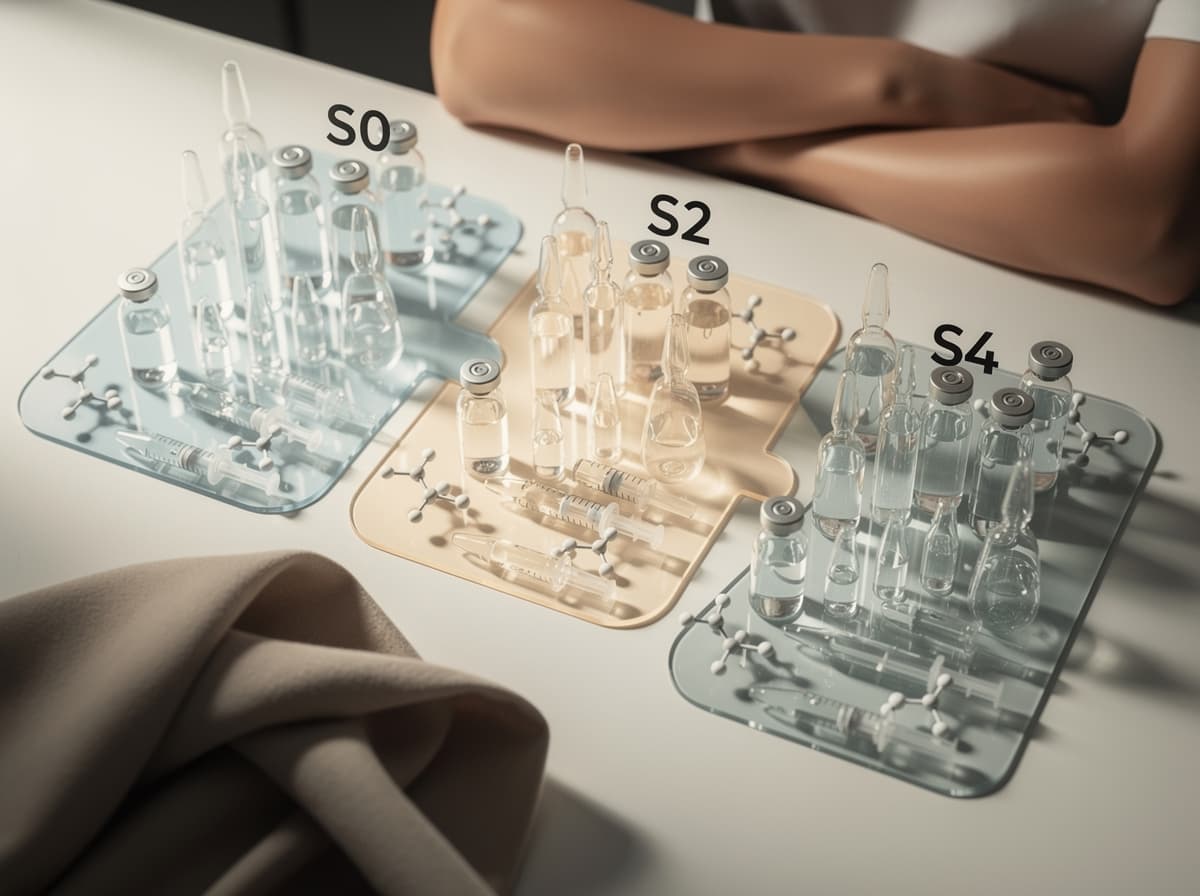
Understanding which "S" code applies to a given peptide matters because the category determines whether a Therapeutic Use Exemption is even possible. WADA's prohibited substances fall into categories including S0 non-approved substances, S1 anabolic agents, S2 peptide hormones, growth factors, related substances, and mimetics, S3 beta-2 agonists, S4 hormone and metabolic modulators, and S5 diuretics and masking agents . Peptides cluster in three of these.
WADA organises prohibited substances into lettered categories with peptides distributed across three sections based on mechanism and regulatory status. S0 covers non-approved substances, meaning compounds without regulatory authorisation for human therapeutic use in any jurisdiction. S2 includes peptide hormones, growth factors, and related substances, which is where most growth hormone secretagogues and myostatin inhibitors land. S4 captures hormone and metabolic modulators, including newer GLP-1 receptor agonists.
Antidoping Norge adopts this list verbatim, as confirmed on their Prohibited List page. Norwegian athletes do not get a separate national interpretation. If WADA prohibits a substance, it is prohibited under Antidoping Norge enforcement.
BPC-157 sits in S0 with no TUE pathway#
BPC-157 is the peptide most frequently misunderstood by recreational athletes who later face sanctions. The World Anti-Doping Agency added BPC-157 to its Prohibited List effective January 1, 2022, classified under Section S0: Non-Approved Substances. Section S0 covers substances used for doping that are not approved by any governmental regulatory authority.
The implications are unforgiving. BPC-157 is classified under WADA's 2026 Prohibited List in two categories: S0 and S2. Detection in any athlete sample, in-competition or out-of-competition, triggers automatic Anti-Doping Rule Violations with sanctions ranging from two to four years depending on intent findings. The peptide is prohibited at all times, meaning recreational use during off-season training carries identical penalties to competition-day detection.
There is no exemption route. The classification exists because BPC-157 is a synthetic peptide with no approved therapeutic use in human medicine, making it ineligible for Therapeutic Use Exemptions. Even the USADA position is explicit about the S0 banner and the absence of clinical approval. Detection is well documented: research demonstrated that BPC-157 was detectable in urine for at least 72 hours with weak cation exchange solid phase extraction protocols , and biomarker tracking extends that window further.
A note on recent regulatory churn: on February 27, 2026, HHS Secretary Robert F. Kennedy Jr. announced that BPC-157 would be among 14 peptides moving back to Category 1, restoring compounding pharmacy access with a physician's prescription. Each of these changes carries specific implications for clinicians, patients, athletes, and researchers. The U.S. compounding shift has no effect on WADA status. Norwegian athletes who see U.S. headlines about BPC-157 "coming back" should read carefully: the S0 ban is intact.
TB-500 and the S2 growth factor subsection capture recovery peptides#
The S2 category is where injury-recovery peptides live. This subcategory bans peptide growth factors. Thymosin beta-4 and derivatives such as TB-500 are explicitly prohibited . WADA's wording is structured to capture analogues even where they are not named individually: Thymosin-β4 and its derivatives such as TB-500 are listed, alongside other growth factors or growth factor modulators affecting muscle, tendon or ligament protein synthesis/degradation, vascularisation, energy utilization, regenerative capacity or fibre type switching .
This catch-all language matters. Mechano growth factor (MGF), IGF-1 and its analogues, fibroblast growth factors, and vascular endothelial growth factor all fall inside the same regulatory net. The BSCG summary of S2 puts it bluntly: many peptides, including synthetic analogues related to growth hormone and erythropoiesis stimulation, are prohibited by WADA regardless of dosage or source. Peptides advertised as research chemicals generally fall under the S0 category of Non-Approved Substances. Any unapproved drug or substance may be considered prohibited by WADA at any time.
Preliminary evidence on TB-500's tissue repair mechanisms has been reviewed in the open literature (see the thymosin beta-4 PubMed indexed work), but research suggests the ergogenic concern, not safety, is what keeps it on the list. Studies have shown the soft-tissue recovery profile is associated with the kind of accelerated return-to-play that meets WADA's "potential to enhance performance" criterion.
Growth hormone secretagogues form the largest banned cluster#
The S2.2 subsection is densely populated with the peptides most commonly marketed to bodybuilders and longevity enthusiasts. S2.2.3 covers growth hormone, its analogues and fragments, including lonapegsomatropin, somapacitan and somatrogon, and growth hormone fragments such as AOD-9604 and hGH 176-191. S2.2.4 captures growth hormone releasing factors including GHRH analogues such as CJC-1293, CJC-1295, sermorelin and tesamorelin, and growth hormone secretagogues and their mimetics .
The S2 list specifically includes CJC-1293, CJC-1295, sermorelin and tesamorelin, anamorelin, capromorelin, ibutamoren (MK-677), ipamorelin, lenomorelin (ghrelin), macimorelin, tabimorelin, and the GHRPs . Hexarelin and the GHRP-1 through GHRP-6 series sit alongside them in S2.2 under the GH-releasing peptide cluster.
Detection has tightened. Growth hormone secretagogues including GHRP-2, hexarelin, ipamorelin, and CJC-1295 remain the most frequently detected peptide class in competitive sport, with plasma detection thresholds lowered to 0.1 ng/mL in 2026 . Detection windows are longer than most users assume: short-acting peptides like GHRP-2 clear plasma in 24 to 48 hours but leave biomarker signatures detectable for 7 to 14 days, and depot formulations like modified CJC-1295 remain detectable for 28 to 35 days .
There is no off-season for these compounds. An athlete who uses ipamorelin in November to "support recovery" can still be sanctioned based on a January out-of-competition test, and the resulting ban applies to every Antidoping Norge testing pool.
GnRH agonists, ACTH, IGF-1, and insulin each have specific rules#
Several peptide categories have nuanced rules worth knowing.
GnRH agonists in males. S2.2.1 prohibits testosterone-stimulating peptides in males including gonadotrophin-releasing hormone (GnRH, gonadorelin) and its agonist analogues such as buserelin, deslorelin, goserelin, histrelin, leuprorelin, nafarelin and triptorelin . The "in males" qualifier is critical: the ban is sex-specific because the ergogenic mechanism (endogenous testosterone stimulation) is sex-specific.
Corticotrophins. S2.2.2 prohibits corticotrophins and their releasing factors, including corticorelin and tetracosactide . While cortisol is catabolic and not anabolic, ACTH's effects on other adrenal hormones and its use in masking other substances led to its inclusion .
Insulin. All insulins, human, animal, and synthetic analogs, are banned for athletes without a documented diabetes diagnosis. Athletes with type 1 diabetes can obtain a Therapeutic Use Exemption. This is one of the few peptide hormones with a clear, working TUE pathway.
IGF-1. Insulin-like growth factor 1 and its analogues sit in S2 alongside growth hormone fragments. Detection has shifted in part toward biomarker panels rather than direct peptide quantification.
GLP-1 agonists sit on the Monitoring Program, not the Prohibited List#
This is the area with the most active 2026 movement, and the one most likely to be misreported. As of 1 January 2026, semaglutide and tirzepatide are not prohibited. They are being watched.
Tirzepatide (Mounjaro, Zepbound), a glucagon-like-peptide-1 receptor agonist, has been added to WADA's 2026 monitoring programme. The programme, effective since 1 January 2026, states that markers of both semaglutide and tirzepatide will be tracked in and out of competition to detect patterns of misuse. GLP-1RAs are used to treat type 2 diabetes but some athletes might seek them out to induce rapid weight loss and alter body composition.
The German anti-doping agency's bulletin on the 2026 list confirms the same: in the 2026 Monitoring Program, the monitoring of semaglutide has been adjusted. From 1 January 2026, markers of semaglutide and additionally of tirzepatide will be monitored to observe possible misuse in-competition and out-of-competition.
What this means practically. The Monitoring Program does not impose sanctions, but data collected may inform future List decisions. A Norwegian triathlete prescribed semaglutide for clinical obesity is not currently committing an anti-doping rule violation, but research suggests the regulatory trajectory points toward full prohibition. Athletes should expect a TUE process to become harder if and when the move happens. The 2026 monitoring data are precisely what will inform that decision.
Some commentary sources project tighter rules ahead. One industry analysis suggests GLP-1 receptor agonists could move toward full prohibition with therapeutic use exemptions requiring documented failure of two first-line therapies before consideration , though this remains forecasting rather than current WADA policy.
Detection has gotten harder to escape#
The detection landscape changed faster than most athletes realise. Direct peptide quantification, once the only tool, has been supplemented by biomarker panels that track downstream effects long after the parent compound has cleared.
Myostatin inhibitors now face indirect detection via biomarker panels (elevated follistatin combined with suppressed myostatin expression) rather than direct peptide quantification . The same logic is being applied across the growth hormone axis. IGF-1, IGFBP-3, and P-III-NP ratios have been shown to reveal exogenous GH or secretagogue use weeks after the injection cycle ended.
The compliance literature, including the BSCG analysis of supplement risks, points out that the supplement market is a vector. Studies have shown that products marketed as legal "recovery aids" frequently contain undeclared peptides. The athlete bears strict liability, and detection in a routine test ends the conversation regardless of intent.
What this means for Norwegian competitive athletes#
Antidoping Norge's testing pool covers more disciplines than many athletes assume. Anyone competing at the elite level under a Norwegian federation that is a WADA signatory is in scope. The 2026 prohibited list applies in full.
A few principles hold up under every audit:
- If a peptide is sold as a "research chemical" or labelled "not for human use," assume it is in S0.
- If a peptide affects the growth hormone axis, assume it is in S2.2.
- If a peptide is a fragment or analogue of an S2 substance, assume the same rules apply by extension.
- TUE pathways exist for a narrow set of approved peptide medicines (insulin for type 1 diabetes is the cleanest example), not for compounds without regulatory approval.
- The supplement industry is not your friend here. Third-party certification programs exist for a reason.
For athletes building a protocol around recovery, sleep, or body composition who are also under WADA jurisdiction, the conclusion is straightforward: most of the peptides discussed in wellness communities are off the table. The risk-reward calculation looks very different for a competitive athlete than for an adult outside the testing pool, and that distinction is precisely what makes the doping list worth reading in full.
Klarovel's curated protocol framework includes WADA-status flags for every peptide we cover, so users in the testing pool can filter prohibited compounds out before they ever appear in a recommendation. See how it works for the methodology, the peptide calculator for dosing reference (research-only), and the disclosures page for our editorial and partner standards.
A clean career is worth more than any peptide#
The peptides on the WADA doping list are there because regulators concluded they meet the criteria for performance enhancement, health risk, or violation of the spirit of sport. For a competitive athlete under Antidoping Norge jurisdiction, the math is simple. A two to four year ban ends most careers. The compounds that get the most attention in wellness marketing, BPC-157, TB-500, the growth hormone secretagogue family, are precisely the ones most likely to trigger that ban. Klarovel's protocol layer is built so athletes in the testing pool can find compliant recovery and longevity strategies without ever brushing up against the list. Register for an account to access WADA-flagged protocols, or read how the system works before deciding whether it fits your competitive situation.
Frequently asked questions
Keep reading

Are Peptides Legal in the US? FDA & DEA Status in 2026
The legal status of peptides in the US is layered, fast-moving, and easy to misread. Here is what FDA, DEA, and the 503A/503B framework actually say in 2026.

Are Peptides Safe? The Honest 2026 Side-Effect Guide
Are peptides safe? An honest 2026 look at side effects, who should avoid them, the sourcing risk picture, and how the law treats them in Norway.
Peptide Side Effects: A Comprehensive Safety Guide 2026
Side effects across BPC-157, semaglutide, tirzepatide, melanotan II, ipamorelin and more. Trial-level adverse event data, monitoring rules, when to stop.