

Wegovy tablets start at 1.5 mg a day and step up every 30 days, through 4 mg and 9 mg, to a 25 mg daily maintenance dose. Wegovy injections start at 0.25 mg a week and step up every 4 weeks, through 0.5, 1.0 and 1.7 mg, to 2.4 mg a week. Both are semaglutide. Anyone who has read one number and then meets the other has good reason to assume a decimal point went missing, and almost every dosing chart online presents the two without ever putting them side by side.
For what the Wegovy pill is, how to take it and how well it works, see the Wegovy pill guide. This page is the dosing reference.
Key takeaways#
- The oral ladder is 1.5, 4, 9 and 25 mg, taken daily, escalating every 30 days.
- The injectable ladder is 0.25, 0.5, 1.0, 1.7 and 2.4 mg, taken weekly, escalating every 4 weeks.
- A higher 7.2 mg weekly injection (Wegovy HD) was FDA-approved in March 2026 for weight reduction. It sits above the standard ladder and has no tablet equivalent.
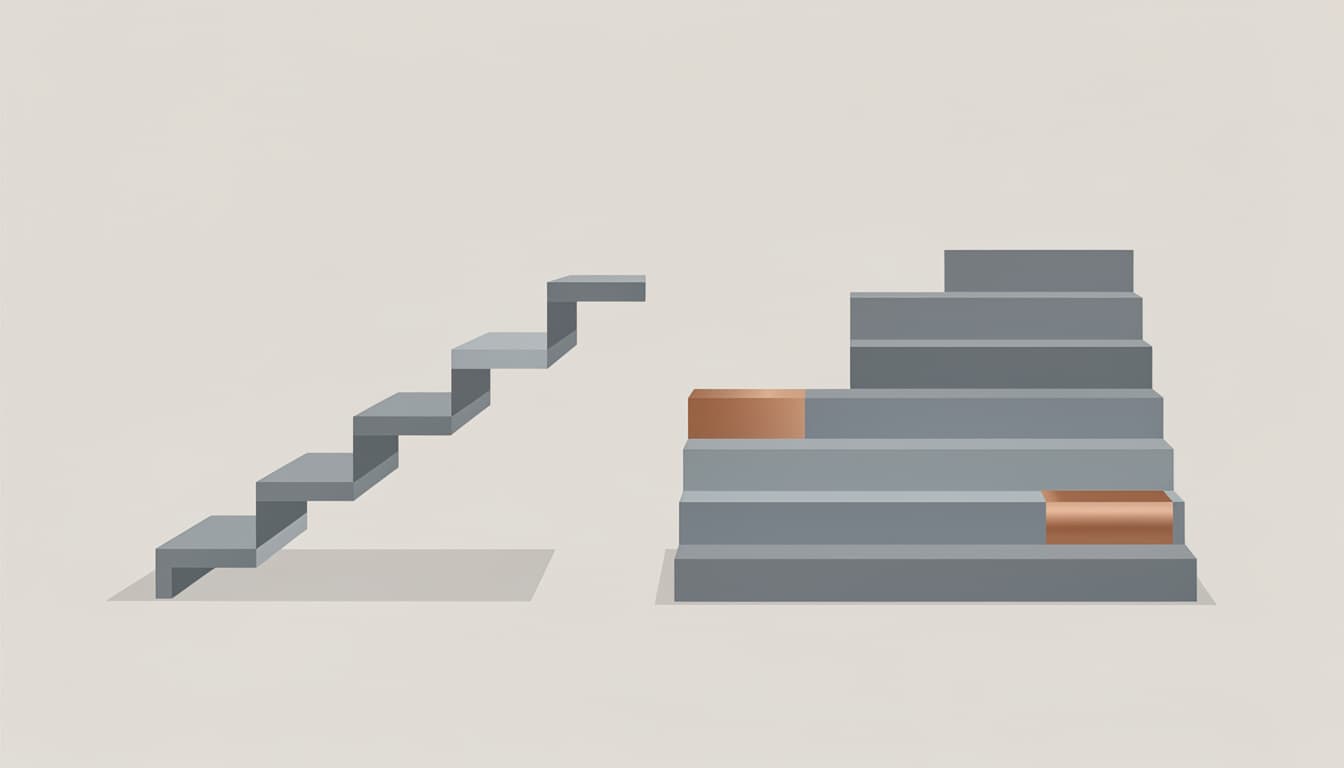
- The standard ladders do not overlap. The lowest oral dose is already more than half the 2.4 mg maintenance injection, and the highest oral dose is roughly ten times it.
- The oral ladder counts in days, not weeks. Thirty days is not four weeks, and the difference compounds to six days across a full titration.
- Research suggests the higher milligram figure reflects absorption, not potency. Very little of an oral peptide dose survives the gut.
The two ladders, side by side#
This is the comparison the search results are missing. Both ladders are published in the same document, the WEGOVY prescribing information, which lists the injection and the tablet as two forms of one product.
| Step | Oral tablet | Injection |
|---|---|---|
| 1 | 1.5 mg daily, days 1 to 30 | 0.25 mg weekly, weeks 1 to 4 |
| 2 | 4 mg daily, days 31 to 60 | 0.5 mg weekly, weeks 5 to 8 |
| 3 | 9 mg daily, days 61 to 90 | 1.0 mg weekly, weeks 9 to 12 |
| 4 | 25 mg daily, day 91 onward | 1.7 mg weekly, weeks 13 to 16 |
| 5 | not applicable | 2.4 mg weekly, week 17 onward |
Two things fall out of reading them together.
The oral ladder is shorter. Four steps to maintenance against five, and 90 days against roughly 112. That is not a claim that oral is gentler. It is a different escalation designed around a different absorption problem.
The numbers never come close. There is no dose where a reader could reasonably substitute one for the other. That is worth stating plainly, because the most dangerous version of this confusion is someone reading a 25 mg figure and applying it to a pen.
The label answers the exchange rate directly#
This is the part almost nothing on the first page of results mentions, and it is the closest thing to a conversion between the two scales:
- Someone on the 2.4 mg weekly injection may switch to the 25 mg daily tablet. The label instructs starting the tablet one week after the last injection.
- Someone who cannot tolerate the 25 mg tablet may switch to the 1.7 mg weekly injection, a step down rather than across.
So the manufacturer treats 2.4 mg weekly and 25 mg daily as broadly interchangeable positions on the same treatment, and treats 1.7 mg weekly as the fallback below the top tablet dose. That is a far more useful anchor than either ladder read on its own.
Why the oral dose is ten times larger#
The gap is an absorption story, not a potency story.

Peptides are chains of amino acids, and the digestive tract is very good at breaking those chains down before they reach the bloodstream. An injected dose bypasses that entirely. A swallowed one has to survive it. Studies have shown oral semaglutide is formulated with an absorption enhancer to get a usable fraction across the stomach lining, and even then the fraction that arrives is small.
So the 25 mg tablet and the 2.4 mg injection are aiming at a broadly comparable amount of drug in circulation. The tablet simply has to start with far more of it.
That also explains the administration rules that come with the tablet and have no injectable equivalent. The label is unusually specific: take it on an empty stomach in the morning with no more than 4 ounces of water, no other liquid, swallow it whole without splitting or crushing, and wait at least 30 minutes before eating, drinking anything else, or taking other oral medicines.
Those are not fussiness. They are the conditions the absorption data was generated under, and the 25 mg figure assumes them.
What the 30-day step actually means#
Every published oral chart says the dose increases "every 30 days". Most injectable charts say "every 4 weeks". These get treated as the same interval and they are not.
Thirty days is 4 weeks and 2 days. Across three escalations that is six days of drift. On its own that is minor, but it matters for anyone mapping the schedule onto a calendar, a refill date, or a bloodwork appointment, and it is the sort of small error that compounds quietly.
The practical version: the oral schedule is counted in days from the first tablet, not in weeks from a fixed weekday. Day 31 is day 31, whatever weekday it lands on.
The trial ladder is not the label ladder#
Worth knowing before comparing charts, because two different escalations are in circulation and both are correct in their own context.
OASIS 4, the phase 3 trial that supported the 25 mg dose, escalated 3 mg, 7 mg, 14 mg, then 25 mg, moving every four weeks. The approved label escalates 1.5 mg, 4 mg, 9 mg, then 25 mg, moving every thirty days. Same destination, different route.
So a chart quoting 3, 7 and 14 mg is not wrong; it is quoting the trial. A chart quoting 1.5, 4 and 9 mg is quoting the label. Only the second describes what a prescription follows.
What the 25 mg dose produced#
OASIS 4 randomized 307 adults with overweight or obesity, two to one, against placebo. At week 64 the mean weight change was 13.6% on oral semaglutide against 2.2% on placebo, a difference of 11.4 percentage points, on the treatment-policy estimand that counts everyone randomized. Among participants who stayed on treatment (the trial-product estimand), Novo Nordisk reports 16.6% against 2.7%. Gastrointestinal adverse events occurred in 74.0% of the oral group against 42.2% on placebo.
Set that beside the injection. STEP 1 reported 14.9% at 68 weeks for semaglutide 2.4 mg weekly, on the same treatment-policy basis. The two sit close enough that the label's willingness to swap 25 mg daily for 2.4 mg weekly looks like the arithmetic it is, rather than a rounding of convenience.
Side effects follow the same pattern as the injection#
Research has shown the side-effect profile of oral semaglutide is class-typical rather than distinct: nausea, vomiting, diarrhea and constipation, concentrated during escalation rather than at the maintenance dose.
That last part is the useful bit and it holds across the whole GLP-1 class. Klarovel's Wegovy side effects guide covers how common each one is and how long it typically lasts, and the pattern is the same whichever form is prescribed. The tablet does not trade GI effects for convenience.
One difference is worth flagging. Because the tablet is taken daily rather than weekly, a missed dose is a smaller event and the recovery is different: the label says to skip a missed tablet and take the next one the following day, while a missed injection can still be taken if the next dose is more than 2 days away.
There is also an Ozempic tablet, and it is a different product. Ozempic tablets are 1.5, 4 and 9 mg for type 2 diabetes, sharing three strengths with the Wegovy tablet. The Ozempic pill explained sets out all five semaglutide products and which number belongs to which.
The short version#
One molecule, two ladders, and no overlap between them. Oral runs 1.5 to 25 mg daily across 90 days. The standard injectable ladder runs 0.25 to 2.4 mg weekly across roughly sixteen weeks. The tenfold gap in the headline number is absorption, not strength, and the 25 mg figure is correct rather than a misprint.
For the injectable ladder in full, see the Wegovy dosage guide. For how the same escalation logic works on the dual agonist, see the tirzepatide dosage chart. Complete the Klarovel questionnaire to see what the engine recommends from a full health profile.
Frequently asked questions
Keep reading

MOTS-C peptide dosage chart: doses, cycles and goals
A MOTS-C peptide dosage chart by experience level: starting dose, target, ceiling and frequency from Klarovel's curated dose table, plus timing and cycle.

Wolverine peptide stack: definition, doses and duration
The Wolverine peptide stack means BPC-157 plus TB-500. Some clinics extend it to four compounds. Dosing tables for both readings, and the cycle length.
Peptide Storage Guide: Cold Chain, Aliquots, Shelf Life
How to store lyophilized and reconstituted research peptides: freezer temperatures, aliquoting workflow, bacteriostatic water windows, and cold-chain rules.