
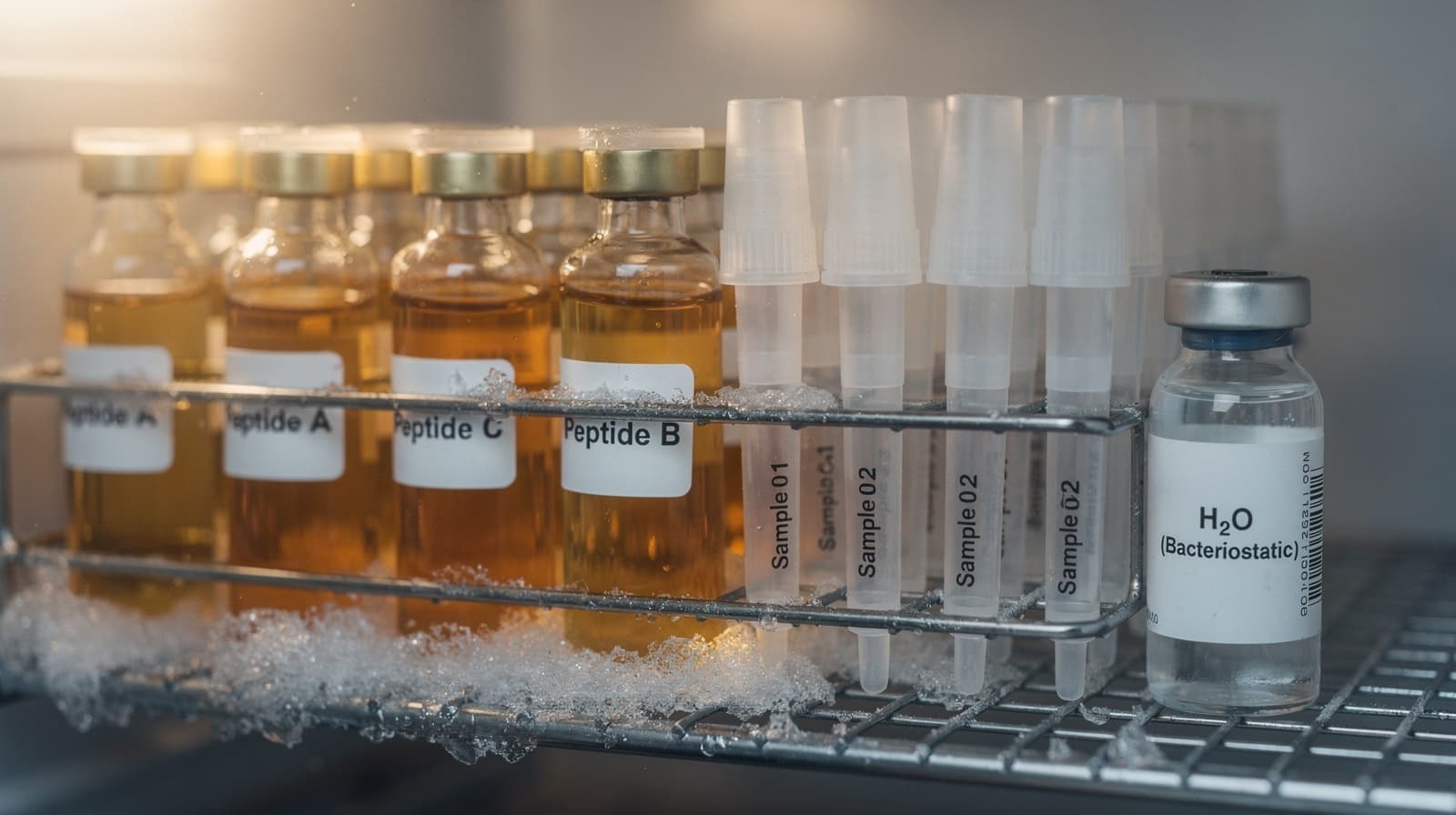
A vial that arrived at 99% purity can drop to unusable levels in days if it sits on the wrong shelf, and the same vial can hold its structure for years in the right freezer. Peptide storage is the least glamorous part of any research protocol and the one most likely to invalidate everything downstream. This guide walks through the temperature ranges, aliquoting workflow, reconstitution windows, and cold-chain rules that separate a reliable stock from a slow-degrading one.
Key takeaways#
- Lyophilized peptides belong at -20°C (-4°F) for long-term storage; manufacturer guidance commonly quotes one to several years at that temperature, and a peer-reviewed study of lyophilized peptide vaccines found five-year stability at -80°C.
- Reconstituted vials must live in the refrigerator at 2-8°C (36-46°F) and are used within 28 days when bacteriostatic water is the solvent, the standard limit for a punctured multiple-dose vial.
- As a rule of thumb, a 10°C rise roughly doubles to triples the rate of many chemical reactions, so brief heat spikes matter more than most people realize.
- Aliquoting into single-use portions avoids repeated freeze-thaw cycles and repeated punctures of the parent vial.
- Humidity, light, and repeated puncture events are the three silent variables that quietly wreck otherwise well-stored peptides.
Lyophilized powder is the stable form, but only under the right conditions#
Freeze-dried peptides look inert. They are not. The formulation literature identifies aggregation, deamidation (of asparagine and glutamine residues) and oxidation (notably of methionine) as the most common degradation routes for proteins and peptides, and these reactions can still proceed in a dry powder, more slowly, especially if residual moisture climbs; research has shown that aggregation has its own set of drivers, from concentration and pH to agitation and lyophilization itself.
The reason lyophilization works is kinetic, not magical. Removing water arrests hydrolysis and microbial growth, but oxidation and residue-specific reactions continue at temperature-dependent rates. That is why the storage temperature you pick is not a suggestion. Formulation scientists use the Arrhenius relationship to model how degradation rates rise with temperature (with caveats for complex proteins), and lowering temperature is the most reliable way to extend shelf life.
Practical temperature tiers (typical guidance; exact figures vary by sequence and manufacturer):
- Room temperature (15-25°C): acceptable for shipping windows of days to a few weeks. Not appropriate for storage.
- Refrigerated (2-8°C): commonly quoted as months to a couple of years for lyophilized product, depending on sequence.
- Freezer (-20°C): the standard long-term option, commonly quoted as one to several years.
- Ultra-low (-80°C): archival tier. A 2024 stability report notes that lyophilized melanoma peptide vaccine mixtures kept stability, purity and sequence identity for up to five years at -80°C.
Humidity is the variable most people underweight. Even a sealed vial can accumulate moisture through repeated warm-cold cycles that produce condensation on the inner surface. Once residual water climbs, deamidation and hydrolysis reappear.
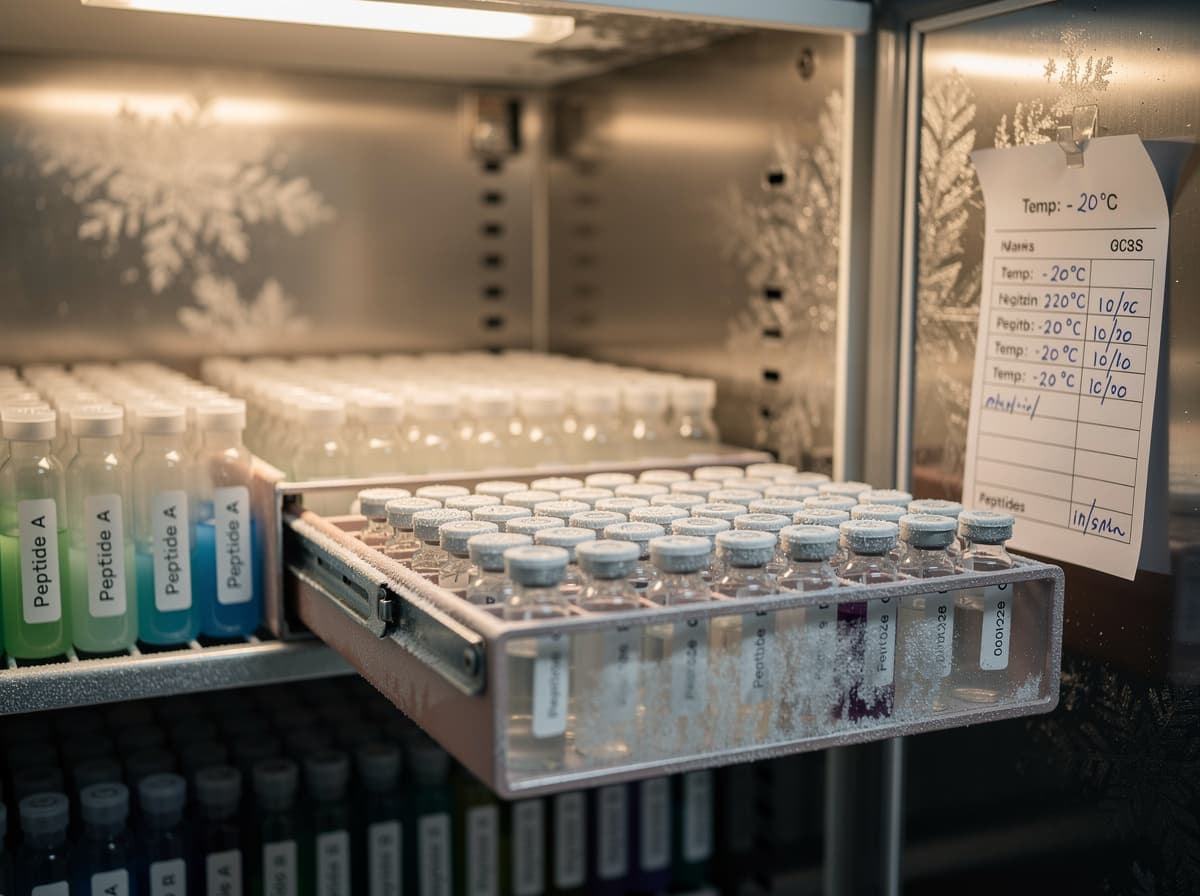
Reconstitution collapses the stability window from years to weeks#
The moment water enters the vial, the clock speeds up. Reconstituted peptides are, by every measurable metric, less stable than their lyophilized parent. Hydrolysis reactivates, deamidation accelerates, and any microbial contaminant introduced during puncture begins to grow.
The solvent choice matters. Bacteriostatic water for injection contains 0.9% benzyl alcohol, which inhibits bacterial proliferation and is what allows a multiple-dose vial: CDC guidance is to date an opened multiple-dose vial and discard it within 28 days unless the manufacturer states otherwise. Sterile water without a preservative is a single-session diluent. Plain saline adds sodium chloride, which can change how some sequences dissolve or aggregate.
Typical working windows after reconstitution:
- Sterile water for injection: use within 24 hours, then discard.
- Bacteriostatic water at 2-8°C: up to 28 days (the multiple-dose vial rule); some peptides degrade sooner.
- Bacteriostatic water at -20°C (aliquoted, single-use): longer, but freeze-thaw sensitivity varies by sequence.
A 2015 study of native GLP-1 and glucagon spiked into human plasma illustrates the point: GLP-1 was unaffected by three freeze-thaw cycles and stable for a year frozen, while measured glucagon fell by almost half once frozen. That was a blood-sample assay study, not a drug formulation, but the takeaway carries over: freeze-thaw tolerance is sequence-specific, not a universal rule.
Aliquoting is the highest-value habit in peptide handling#
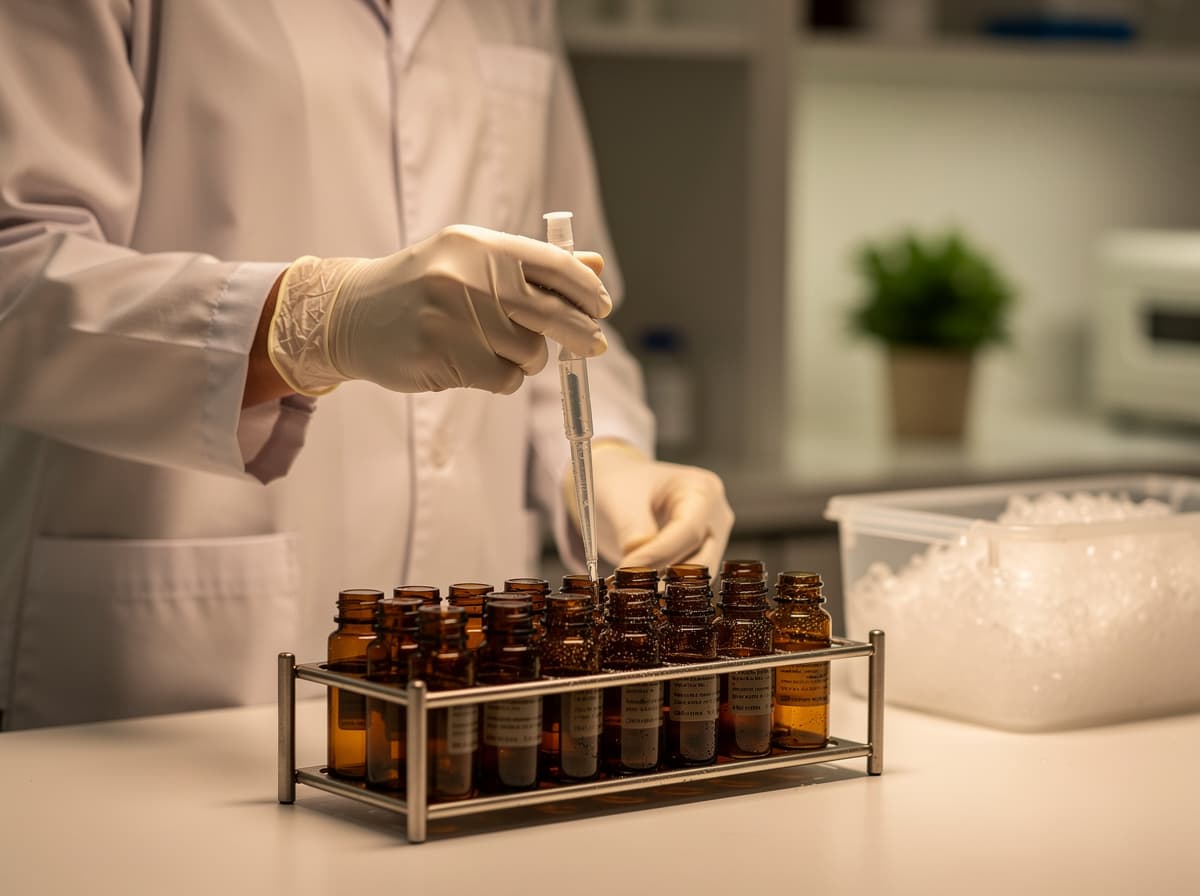
Splitting a lyophilized master vial into single-use portions, or dividing a freshly reconstituted solution into single-use aliquots at -20°C, protects the parent stock from the two most common sources of decay: repeated warming and repeated puncture.
The mechanism is well documented. During freezing, ice crystal nucleation creates a heterogeneous environment where solutes concentrate in shrinking pockets of unfrozen liquid, briefly raising local peptide concentration and shifting pH. This cryoconcentration stress can drive aggregation or unfolding. Repeated freeze-thaw cycles are associated with measurable, sequence-dependent degradation, which is why single-use aliquots are the standard lab practice.
Aliquoting workflow that works in practice:
- Calculate the exact reconstitution volume you need per session using a peptide calculator so aliquot sizes match dose planning. Klarovel's reconstitution calculator handles the math for common concentrations.
- Reconstitute the master vial slowly along the inner wall to avoid foaming; gentle swirl, no vortex.
- Transfer single-use volumes into sterile amber vials or cryo tubes under aseptic technique.
- Label each aliquot with peptide identity, reconstitution date, concentration, and expiry.
- Freeze immediately at -20°C. Avoid frost-free freezers where possible because their defrost cycles create mini freeze-thaw events near the walls.
The alternative to aliquoting is puncturing the same vial dozens of times over weeks. Each puncture introduces a small amount of air, potential contamination, and mechanical disturbance to the meniscus.
The cold chain is only as strong as its final link#
Lyophilized peptides generally tolerate a few days of ambient transit; the 2024 vaccine-peptide report cited below found 17 of 18 peptides stable for up to three months at room temperature, though tolerance is sequence-dependent. What breaks the cold chain is almost always the last hour: a package sitting on a hot porch, a lab bench delay before someone moves it to the freezer, or a summer car ride between facilities.
A few operational rules that catch most failures:
- Inspect packaging on arrival. If temperature indicators are included, check and photograph them.
- Move lyophilized vials to -20°C storage the same day they arrive. Same-day, not same-week.
- Never leave a reconstituted vial at room temperature longer than the working session requires. Return it to 2-8°C between draws.
- For any transport of reconstituted material between locations, use an insulated container with ice packs and minimize duration.
- Avoid direct sunlight and any surface that can exceed 40°C (104°F); degradation rates climb with temperature.
Studies have shown real tolerance for short excursions. A stability study on lyophilized melanoma peptide vaccines reported that 17 of 18 peptides remained stable at +4°C or room temperature for up to three months, with only one showing methionine oxidation. That tolerance is real, but the ceiling is short and sequence-dependent.
Different peptide classes have different tolerance profiles#
Storage recommendations are not one-size-fits-all. Sequence composition drives risk:
- Methionine, cysteine, tryptophan residues: these are the primary targets of oxidative degradation. Peptides rich in them benefit from oxygen-limited storage and shorter working windows once reconstituted.
- Asparagine-glycine motifs: asparagine is more deamidation-prone than glutamine, and small flexible neighbors like glycine accelerate the reaction. Freezer storage is preferred even in lyophilized form.
- Full-length growth-related peptides: these depend on maintaining specific tertiary structure and tend to be the most cold-chain sensitive compounds in research use. Lyophilized product should stay at -20°C to -80°C, and reconstituted working solutions have shorter usable windows than most peptides.
- Small stable sequences (BPC-157, TB-500 fragments): more forgiving, but still governed by the same Arrhenius rules.
The practical rule: default to the strictest storage tier that applies to any residue in your peptide, not the most lenient. For how Klarovel builds a protocol, see how it works.
Storage failure modes to check before every session#
Visual and procedural checks catch most degraded stocks before they are used:
- Cloudiness in a reconstituted vial after gentle swirling suggests peptide degradation, precipitation from pH incompatibility, or incomplete dissolution. Bacteriostatic water itself is clear and does not contribute cloudiness under normal conditions.
- Color change in the powder or solution can indicate oxidation. Fresh lyophilized peptide is typically a white to off-white cake.
- Vial pressure loss when reconstituting can mean seal failure and possible moisture ingress during storage.
- Undated aliquots should be discarded. A vial that has outlived its labeled window has, statistically, degraded.
- Frost accumulation on the vial after freezer storage suggests temperature cycling and possible moisture condensation inside.
None of these checks replace analytical verification, but they filter out the most common failures at almost zero cost.
Storage discipline is the protocol layer nobody sees#
Every downstream result depends on the assumption that the peptide in the vial matches what the certificate of analysis said when it shipped. That assumption only holds if the freezer holds, the aliquoting is clean, and the reconstituted vial gets used inside its window. Klarovel builds the protocol layer: peptide selection, dosing bounds and cycling from your health profile. Create a Klarovel account to build yours.
Frequently asked questions
Keep reading

Wegovy Pill Dosage Chart: Why 25 mg Is Not a Misprint
The oral Wegovy ladder runs 1.5 to 25 mg daily; the standard injection ladder runs 0.25 to 2.4 mg weekly. Same molecule, different scale, often conflated.
MOTS-C peptide dosage chart: doses, cycles and goals
A MOTS-C peptide dosage chart by experience level: starting dose, target, ceiling and frequency from Klarovel's curated dose table, plus timing and cycle.
Wolverine peptide stack: definition, doses and duration
The Wolverine peptide stack means BPC-157 plus TB-500. Some clinics extend it to four compounds. Dosing tables for both readings, and the cycle length.