
Reference figures

Sourced, schematic figures for writers, educators and clinicians. Each one is free to use under CC BY 4.0 with credit to Klarovel, carries its sources on its page, and comes with embed code. None of them is a dose recommendation.
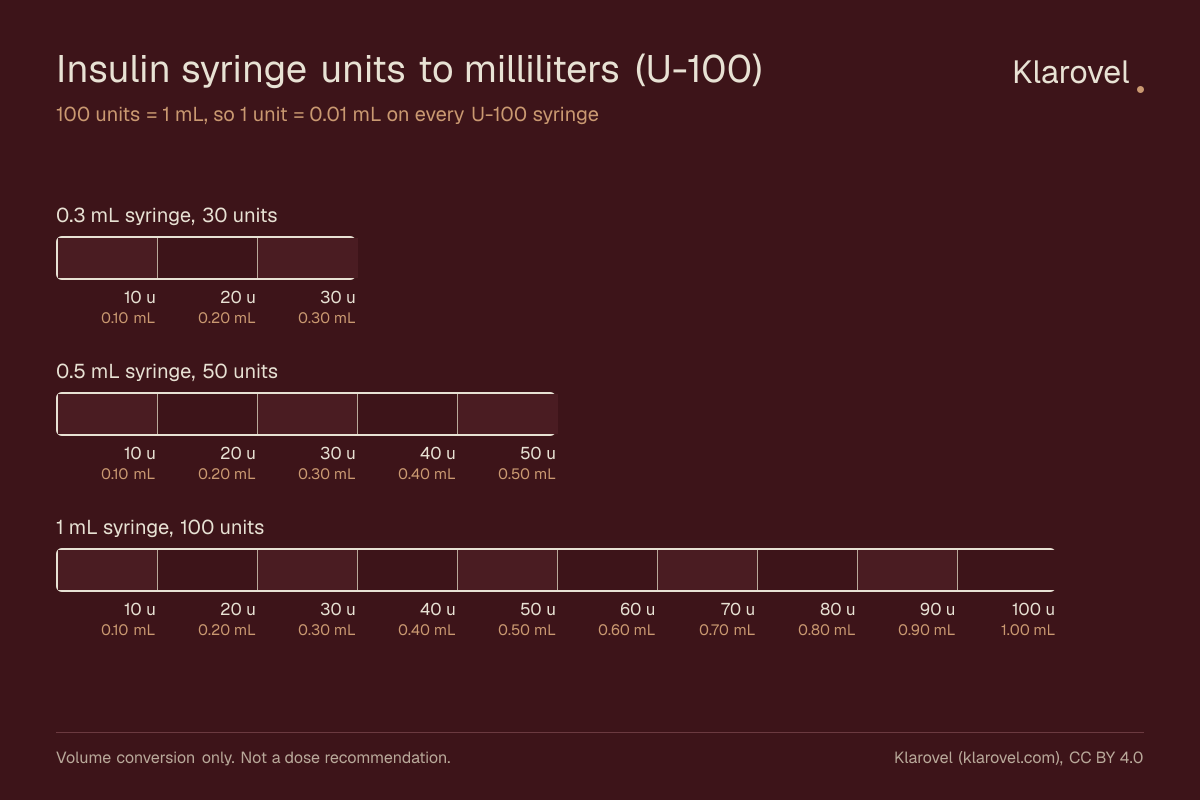
  • Three U-100 insulin syringe scales side by side, 0.3 mL, 0.5 mL and 1 mL, with unit markings converted to milliliters: 10 units equals 0.10 mL and 100 units equals 1 mL.

    Insulin syringe units to milliliters (U-100)

    On a U-100 insulin syringe, 100 units equal 1 milliliter, so every unit is 0.01 mL. The three common barrel sizes hold 30, 50 and 100 units.
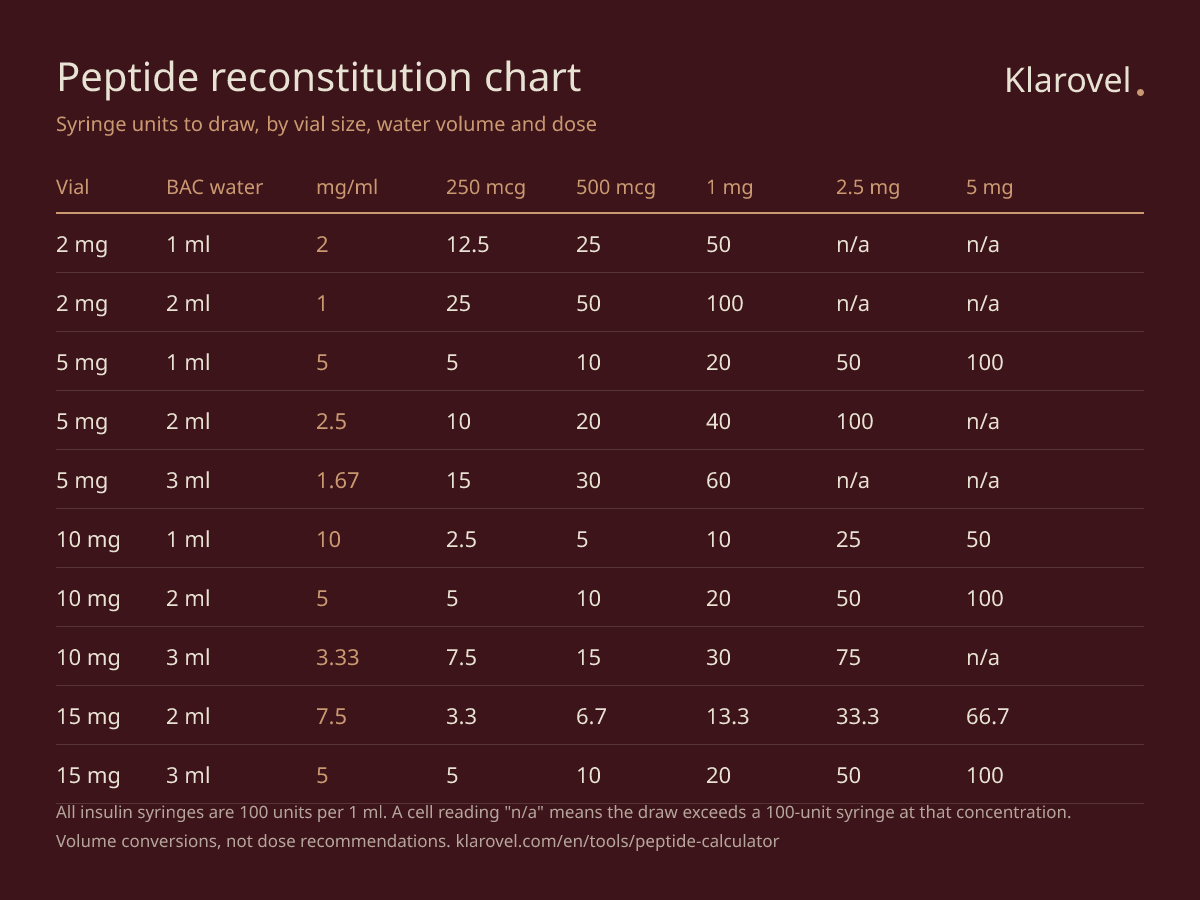
  • Table of peptide vial sizes and bacteriostatic water volumes, with the resulting concentration in mg/mL and the syringe units to draw for doses of 250 mcg, 500 mcg, 1 mg, 2.5 mg and 5 mg.

    Peptide reconstitution matrix

    Syringe units to draw for common doses, by vial size and water volume. Every value is arithmetic over the vial and the water; none is a dose recommendation.
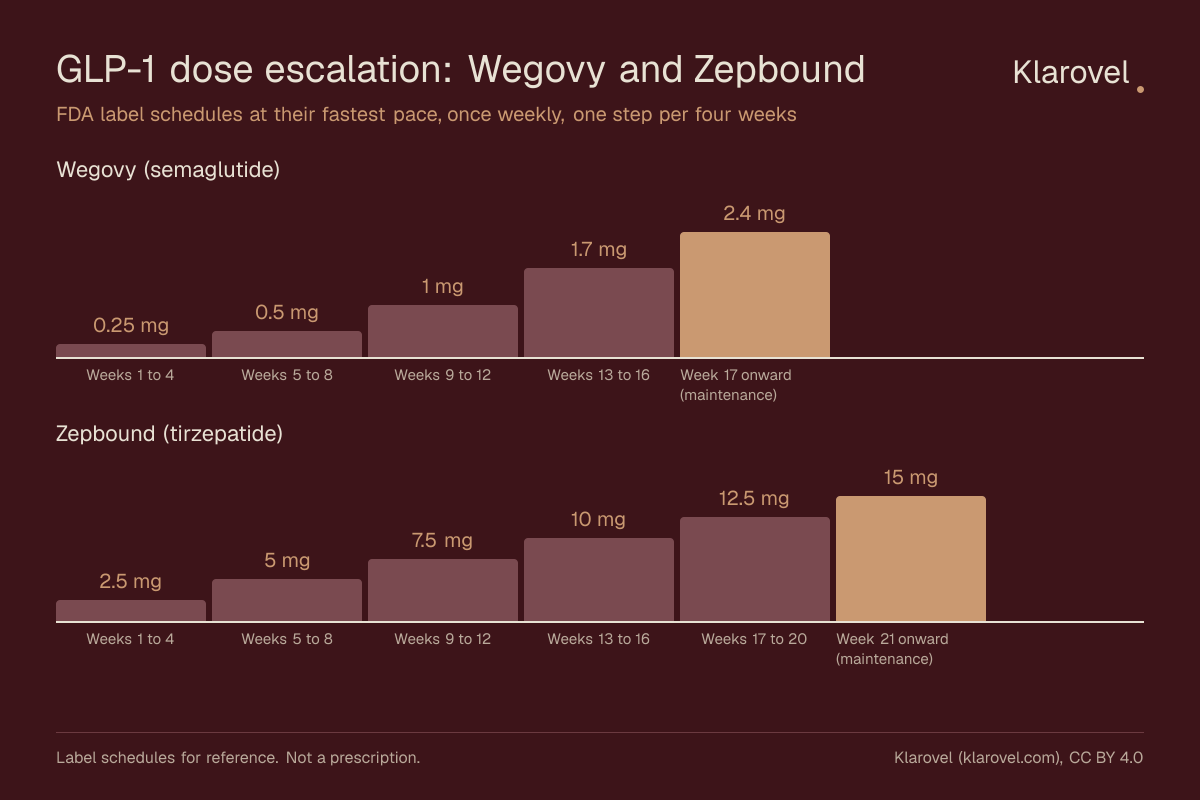
  • Two step charts of weekly dose escalation. Wegovy (semaglutide): 0.25, 0.5, 1, 1.7 mg for four weeks each, then 2.4 mg from week 17. Zepbound (tirzepatide): 2.5, 5, 7.5, 10, 12.5 mg for four weeks each, then 15 mg from week 21.

    GLP-1 dose escalation schedules: Wegovy and Zepbound

    The escalation schedules on the FDA labels for Wegovy (semaglutide) and Zepbound (tirzepatide), at their fastest pace: one step every four weeks to a maintenance dose. Both labels allow more than one maintenance dose.
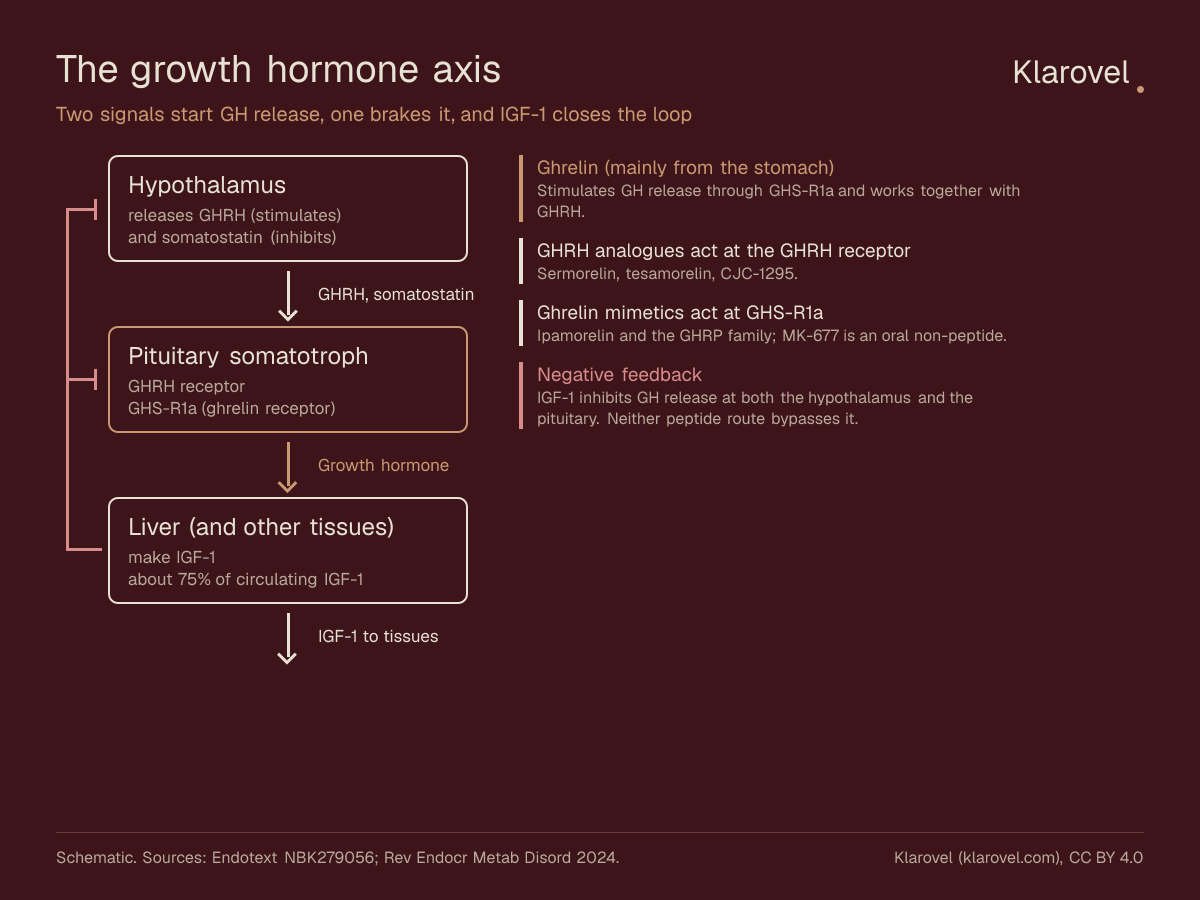
  • Diagram of the growth hormone axis: the hypothalamus releases GHRH, which stimulates, and somatostatin, which inhibits, growth hormone release from the pituitary. Ghrelin acts through the GHS-R1a receptor. Growth hormone drives IGF-1 production, mostly in the liver, and IGF-1 feeds back to inhibit both the hypothalamus and the pituitary. GHRH analogues act at the GHRH receptor and ghrelin mimetics at GHS-R1a.

    The growth hormone axis

    GHRH drives growth hormone release, somatostatin brakes it, and ghrelin adds to it through its own receptor. IGF-1, made mostly in the liver, closes the loop. The two peptide families act at the two stimulating receptors.
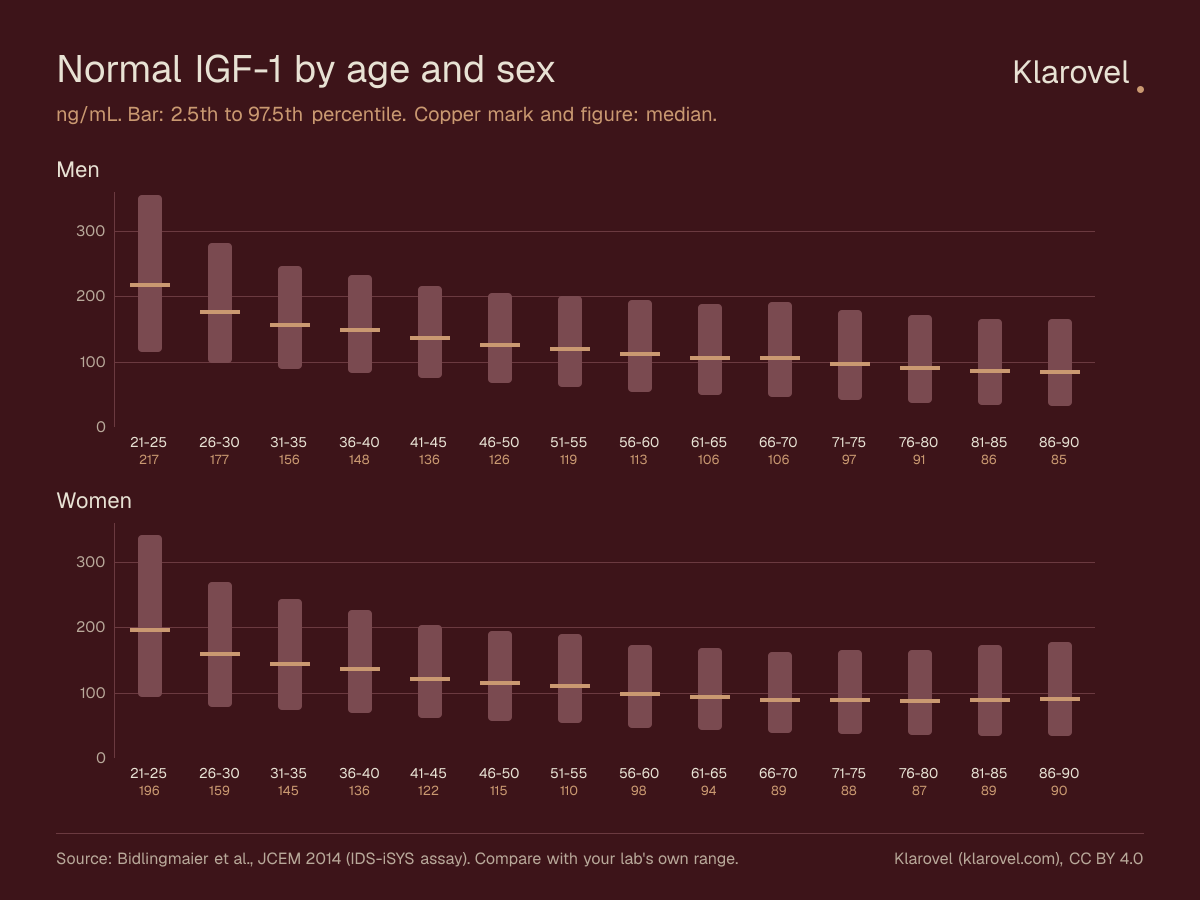
  • Two range charts of normal IGF-1 in ng/mL by age band, men and women aged 21 to 90. Each band shows the 2.5th to 97.5th percentile range and the median. The median falls from about 217 ng/mL in men aged 21 to 25 to about 85 ng/mL at 86 to 90, and from about 196 to 90 ng/mL in women.

    Normal IGF-1 by age and sex

    The normal range of IGF-1 falls steadily with age in both sexes. Each bar spans the 2.5th to 97.5th percentile of a healthy reference population, with the median marked, from a 15,014-person study.

Newsletter

Field notes.

Notes from the engine team. What we learned, what we changed, what the literature actually says. Wednesdays.

One email per week. No tracking pixels. One-click unsubscribe in every issue.