
Peptide reconstitution matrix
Syringe units to draw for common doses, by vial size and water volume. Every value is arithmetic over the vial and the water; none is a dose recommendation.
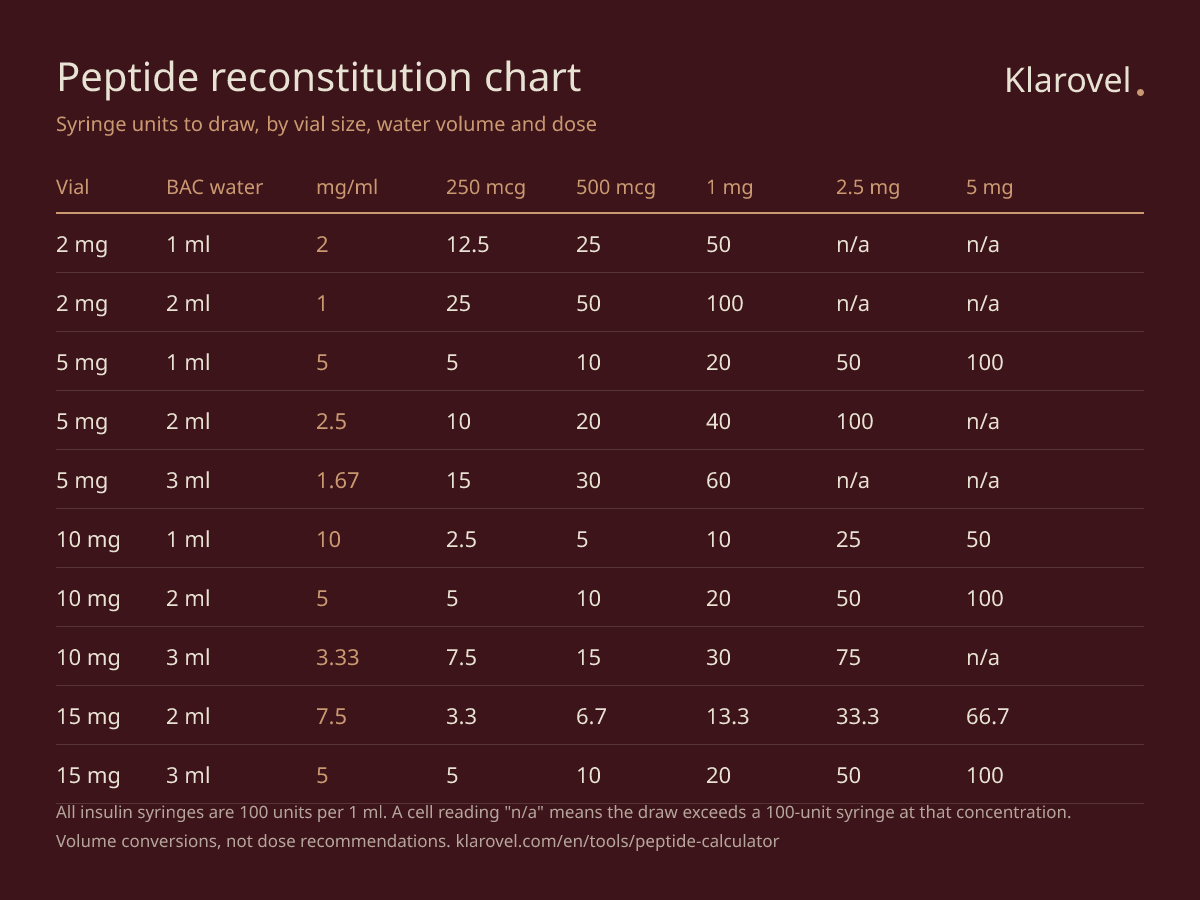
Reconstitution turns a vial of dry powder into a solution of known strength. The concentration is the vial content divided by the water added: a 5 mg vial with 2 mL of water holds 2.5 mg per mL.
On a U-100 syringe each unit is 0.01 mL, so the units to draw for a dose are the dose divided by the concentration, times 100. The matrix does that for the vial sizes and water volumes people most often use.
A cell marked n/a is a draw above 100 units, which a 1 mL syringe cannot hold in one injection.
| Vial | Water | mg/mL | 250 mcg | 500 mcg | 1 mg | 2.5 mg | 5 mg |
|---|---|---|---|---|---|---|---|
| 2 mg | 1 mL | 2 | 12.5 | 25 | 50 | n/a | n/a |
| 2 mg | 2 mL | 1 | 25 | 50 | 100 | n/a | n/a |
| 5 mg | 1 mL | 5 | 5 | 10 | 20 | 50 | 100 |
| 5 mg | 2 mL | 2.5 | 10 | 20 | 40 | 100 | n/a |
| 5 mg | 3 mL | 1.67 | 15 | 30 | 60 | n/a | n/a |
| 10 mg | 1 mL | 10 | 2.5 | 5 | 10 | 25 | 50 |
| 10 mg | 2 mL | 5 | 5 | 10 | 20 | 50 | 100 |
| 10 mg | 3 mL | 3.33 | 7.5 | 15 | 30 | 75 | n/a |
| 15 mg | 2 mL | 7.5 | 3.3 | 6.7 | 13.3 | 33.3 | 66.7 |
| 15 mg | 3 mL | 5 | 5 | 10 | 20 | 50 | 100 |
Use this figure
Free to use in articles, course material and reports under CC BY 4.0. Credit “Klarovel” with a link to this page. The credit line is already printed on the image.
Related: Peptide reconstitution calculator
Klarovel does not sell, supply or ship peptides. Nothing on this page is medical advice or a dose recommendation.