
The growth hormone axis
GHRH drives growth hormone release, somatostatin brakes it, and ghrelin adds to it through its own receptor. IGF-1, made mostly in the liver, closes the loop. The two peptide families act at the two stimulating receptors.
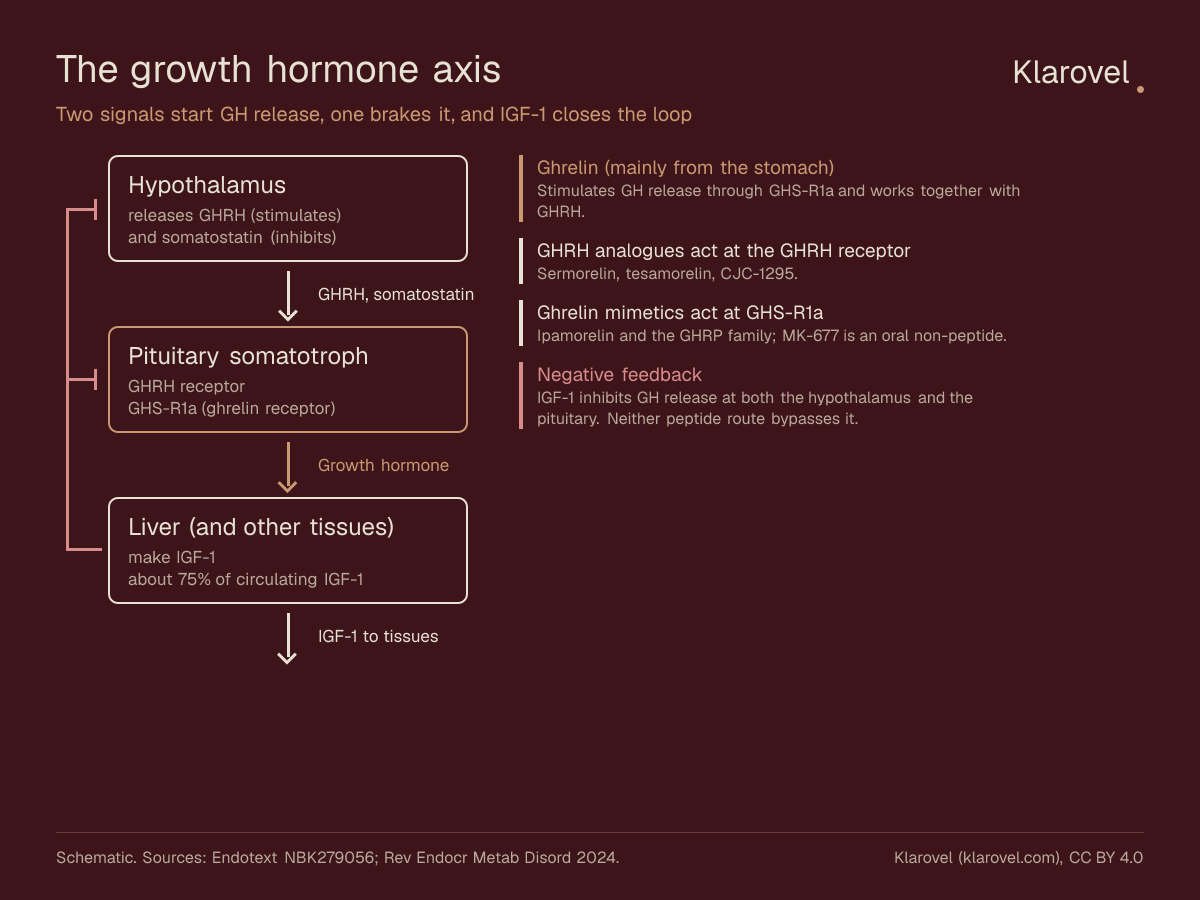
Growth hormone is released from the pituitary in pulses. Two hypothalamic hormones set the rhythm: growth hormone-releasing hormone (GHRH) stimulates release and somatostatin inhibits it. Ghrelin, made mainly in the stomach, stimulates release through a separate receptor, GHS-R1a, and works together with GHRH.
Growth hormone acts on tissues directly and through IGF-1, about three quarters of which in the circulation is made by the liver. IGF-1 then inhibits growth hormone release at both the hypothalamus and the pituitary. That negative feedback is why IGF-1 is the usual blood marker for how active the axis is.
The peptides discussed on this site act at the two stimulating receptors. GHRH analogues such as sermorelin, tesamorelin and CJC-1295 act at the GHRH receptor. Ghrelin mimetics such as ipamorelin and the GHRP family act at GHS-R1a, as does the oral non-peptide MK-677. Neither route bypasses the feedback loop.
| Signal | Made in | Effect on GH release | Receptor |
|---|---|---|---|
| GHRH | Hypothalamus | Stimulates | GHRH receptor (pituitary) |
| Somatostatin | Hypothalamus | Inhibits | Somatostatin receptors |
| Ghrelin | Mainly stomach | Stimulates, with GHRH | GHS-R1a |
| IGF-1 | Mainly liver | Inhibits (negative feedback) | IGF-1 receptor |
Sources
Use this figure
Free to use in articles, course material and reports under CC BY 4.0. Credit “Klarovel” with a link to this page. The credit line is already printed on the image.
Related: The GH peptide axis, explained
Klarovel does not sell, supply or ship peptides. Nothing on this page is medical advice or a dose recommendation.