

On a GLP-1 drug, roughly a quarter of the weight you lose is lean mass rather than fat, according to a 2025 meta-analysis of 22 randomized trials, and a 2026 meta-analysis found lifestyle intervention alone costs a similar share. In SURMOUNT-1 about 75% of the weight lost on tirzepatide was fat and 25% lean. Resistance training two to three times a week and 1.2 to 1.6 g of protein per kg of body weight a day are the strategies with evidence for shrinking the lean-mass share. This guide pulls together the trial data, names the groups at real risk, and lays out the protein and training protocol the literature supports.
Key takeaways#
- In the STEP 1 substudy, semaglutide produced roughly 15% total weight loss, with lean body mass falling about 9.7% in absolute terms, while the lean-to-fat ratio actually improved.
- Across registration trials, the fraction of weight lost from lean mass ranges from about 15% to 40%, with semaglutide and tirzepatide at the higher end and liraglutide somewhere between.
- A 2024 network meta-analysis of 22 randomized trials found lean mass comprised about 25% of total weight loss on GLP-1 receptor agonists.
- Older adults, people with type 2 diabetes, and anyone with existing sarcopenic obesity face the highest functional risk.
- Pairing 1.2 to 1.6 g/kg/day of protein with resistance training two to three times per week is the evidence-aligned mitigation strategy.
The headline numbers are wider than most patients realise#
When clinicians say GLP-1 receptor agonists cause muscle loss, they are drawing on a range, not a single figure. Studies have shown that a reduction in muscle mass accompanies total weight loss, and lean body mass can account for up to 15-40% of total weight loss from GLP-1 therapies. That spread reflects differences in agent, dose, duration, baseline body composition, and how lean mass was measured (DXA vs. MRI).
In the STEP 1 body composition substudy, 140 participants underwent DXA scans at baseline and week 68. Percentage change in body weight from baseline to week 68 was -15.0% with semaglutide vs -3.6% with placebo, resulting in reductions in total fat mass (-19.3%) and regional visceral fat mass (-27.4%). Total lean body mass decreased from baseline (-9.7%); however, the proportion relative to total body mass increased by 3.0 percentage points.
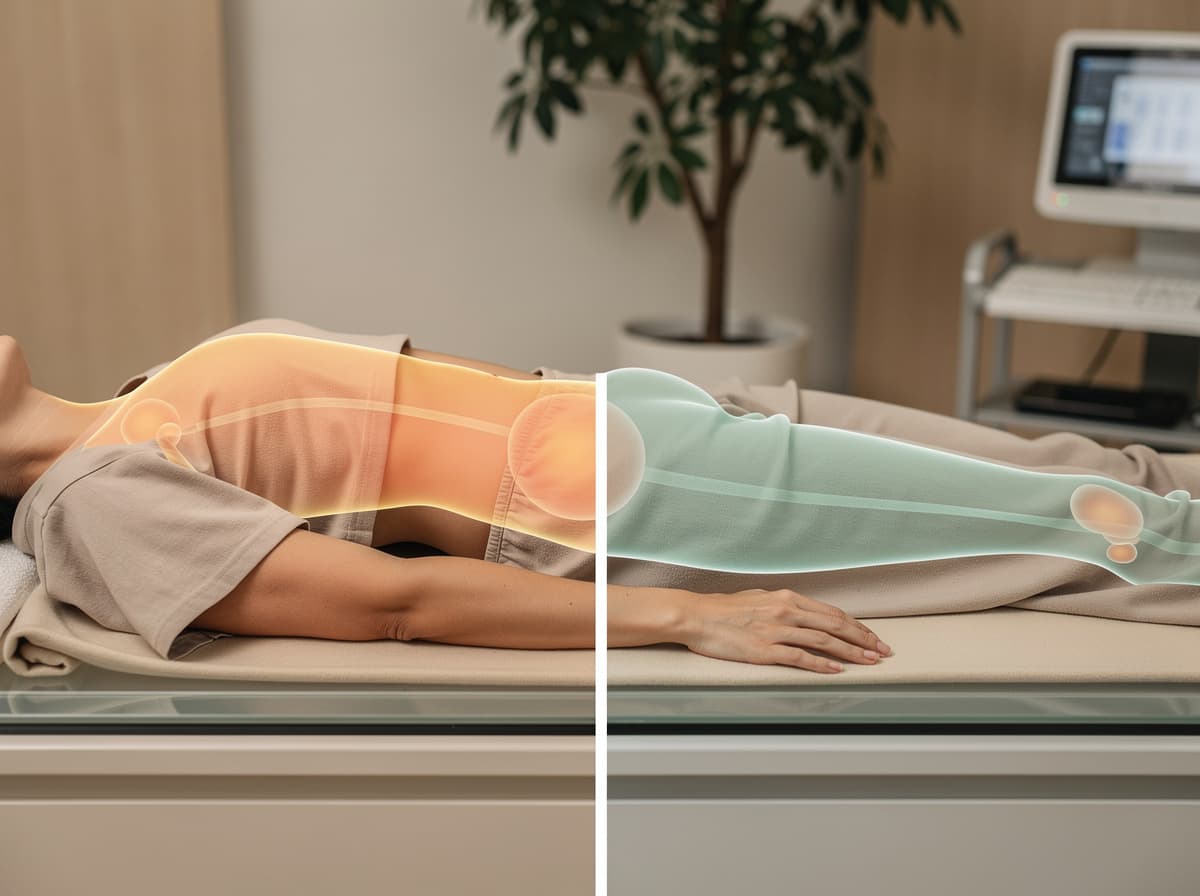
That last sentence matters. Lean mass fell in absolute kilograms, but participants became proportionally leaner. In STEP 1, evaluating semaglutide, lean mass was reduced by −6.92 kg (placebo-corrected −5.44 kg) with a weight reduction of −15.2 kg (placebo-corrected −12.7 kg), yielding a fraction of weight lost from lean mass of 45.5%. In the same Circulation analysis, tirzepatide in SURMOUNT-1 produced a placebo-corrected lean-mass fraction of about 34.3%.
The trial record, one row per study#
Every figure below is read from the published trial or meta-analysis linked in its row.
| Study | Design | n | Duration | Lean mass finding |
|---|---|---|---|---|
| Eisa & Barood 2026 | Systematic review and meta-analysis, 20 RCTs | 15,782 | to Jan 2026 | Lean mass was 35.2% (95% CI 31.5-38.9) of weight lost on semaglutide, 25.4% (22.8-28.0) on tirzepatide, 26.8% (23.1-30.5) on liraglutide |
| SURMOUNT-1 DXA substudy 2025 | RCT substudy, DXA | 160 of 2,539 | 72 weeks | Tirzepatide: weight −21.3%, fat −33.9%, lean −10.9%. About 75% of weight lost was fat and 25% lean, the same split as placebo |
| Karakasis et al. 2025 | Systematic review and meta-analysis, 22 RCTs | 2,258 | varies | Lean mass fell 0.86 kg (95% CI −1.30 to −0.42), about 25% of total weight lost, but relative lean mass was unaffected. Liraglutide was the only agent to cut weight without significantly cutting lean mass |
| Rochira et al. 2024 | Systematic review, tirzepatide | multiple | varies | Concludes the effect on body fat is established but the impact on lean mass is not yet settled and needs further study |
| Murphy & Koehler 2022 | Meta-analysis and meta-regression, RCTs of resistance training in an energy deficit | multiple | 3 weeks or more | Energy deficit impaired lean mass gains (effect size −0.57, p = 0.02) but did not impair strength gains |
| Longland et al. 2016 | RCT, ~40% energy deficit plus intense training | 40 | 4 weeks | At 2.4 g/kg/day protein lean mass rose 1.2 ± 1.0 kg, against 0.1 ± 1.0 kg at 1.2 g/kg/day (p < 0.05) |
| Heymsfield et al. 2021 | Phase 2 RCT, bimagrumab vs placebo | 75 | 48 weeks | Lean mass +3.6% (+1.70 kg) vs −0.8% on placebo, with fat mass −20.5% (−7.5 kg) |
| Sardeli et al. 2018 | Systematic review and meta-analysis, obese older adults | multiple | varies | Resistance training prevented the muscle loss otherwise induced by caloric restriction |
Two things in that table are not in the popular framing.
The lean-mass fraction on a GLP-1 is not worse than dieting. In the same meta-analysis, lifestyle intervention alone gave up 26.2% (24.1-28.3) of weight lost as lean mass, statistically indistinguishable from the incretin arms (p = 0.42). Losing weight costs lean mass. The drug is not what makes it cost lean mass.
Resistance training changes the number more than the drug choice does. Lifestyle plus resistance training gave up 17.5% (14.2-20.8), the most favourable profile in the analysis. Heterogeneity was moderate (I² = 68%) and no publication bias was detected (Egger's p = 0.23).
Can you gain muscle while on a GLP-1?#
The honest answer has two halves, and both are measured.
Gaining lean mass in an energy deficit is harder, but not impossible. Longland et al. ran a 4-week trial at roughly a 40% energy deficit with a high volume of training and found lean mass increased by 1.2 ± 1.0 kg at 2.4 g/kg/day of protein, against 0.1 ± 1.0 kg at 1.2 g/kg/day. That was young men over four weeks at a protein intake well above the usual recommendation, so it is a proof of principle rather than a template.
Strength is the more reliable win. Murphy and Koehler's meta-analysis of resistance training in an energy deficit found lean mass gains were impaired against training without a deficit (effect size −0.57, p = 0.02), while strength gains were not. Research suggests you may not add much muscle while losing weight, and may still get measurably stronger. For most people on a GLP-1 that is the outcome worth training for.
Lean mass is not the same as muscle, and that matters#
The "40% of weight loss is muscle" headline has become a shorthand that overstates the picture. Lean body mass on a DXA scan includes water, organs, connective tissue, and skeletal muscle. As a person loses fat, glycogen and intramuscular water shift too, which inflates the apparent lean-mass drop.
Recent reviews emphasize that lean body mass is not synonymous with skeletal muscle mass, that relative lean proportion often increases during incretin-based weight loss, and that functional outcomes may be more informative than absolute lean-mass change alone. A Circulation primer reframed the question entirely: based on contemporary evidence with the addition of studies using magnetic resonance imaging, skeletal muscle changes with GLP-1 RA treatments appear to be adaptive, with changes in muscle volume commensurate with what would be expected for the degree of weight loss.
A 2025 meta-analysis published in Metabolism tightened the estimate further. GLP-1RAs significantly reduced total body weight (MD -3.55 kg), fat mass (MD -2.95 kg), and lean mass (MD -0.86 kg), with lean mass loss comprising approximately 25% of the total weight loss. However, the relative lean mass, defined as percentage change from baseline, was unaffected.
Translation: the average GLP-1 user loses muscle in absolute terms but ends up with the same or higher proportion of muscle in their body. That is not nothing, but it is not the catastrophic muscle wasting that some media coverage implies.
Who actually faces clinical risk#
The aggregate data is reassuring. The subgroup data is not, and this is where editorial nuance matters.
Older adults. Natural aging reduces skeletal muscle mass by 12% to 16%, leaving little margin before critical thresholds are crossed, and muscle loss from GLP-1 drugs could push some patients over the edge into frailty. Up to half of adults over age 80 experience sarcopenia, which increases the risk of falls, fractures, and disability.
People with type 2 diabetes. Diabetic patients have lower baseline muscle quality. In the SEMALEAN study, subgroup analyses revealed greater weight and fat mass loss in women, while patients with type 2 diabetes or prior GLP-1 analogue use showed attenuated responses.
Anyone with sarcopenic obesity at baseline. The SEMALEAN cohort is instructive here: handgrip strength improved significantly (+4.5 kg at M12), and the prevalence of sarcopenic obesity decreased from 49% at baseline to 33% at M12. Function improved even though absolute lean mass fell, because the patients were carrying so much excess adipose that the relative gain in muscle quality outpaced the absolute loss.
Patients who cycle on and off the medication. This is the hidden risk. A recent meta-analysis of eight randomised controlled trials reported that participants taking semaglutide/tirzepatide regained 9.69 kg over 48-52 weeks after stopping, and weight cycling may result in gains in fat mass that are accompanied by losses (and no subsequent regain) in muscle mass. The fat comes back faster than the muscle does.
Why GLP-1s cause lean mass loss in the first place#
Three mechanisms stack. None are unique to GLP-1 receptor agonists, but the drugs amplify all three.
1. The calorie deficit itself. Any rapid weight loss reduces lean mass. Every weight loss approach causes some loss of lean body mass, not just GLP-1. When the body senses a large energy gap, gluconeogenesis pulls amino acids from skeletal muscle. The deeper and faster the deficit, the more muscle pays.
2. Suppressed protein intake. GLP-1 receptor agonists work by slowing gastric emptying and dampening appetite. Patients eat less, and protein, being the most satiating macronutrient by gram, is often what drops first. GLP-1 users often experience profound appetite suppression, which may hinder their ability to consume enough protein to support muscle maintenance.
3. Reduced mechanical loading. Weight loss tends to drag down spontaneous activity. Without an active resistance signal, the body interprets muscle as metabolically expensive tissue it no longer needs.
The good news: each mechanism has a known countermeasure.
The protein and training protocol the literature supports#
Research has shown that the combination of adequate dietary protein and progressive resistance training preserves the large majority of lean mass during caloric deficits, including those induced pharmacologically. Research suggests that a high protein diet and resistance training may help prevent loss of muscle mass during GLP-1 RA usage, and a targeted and individualized nutrition and physical activity regimen should be instituted for each patient with a focus on optimizing protein intake and performing frequent resistance training.
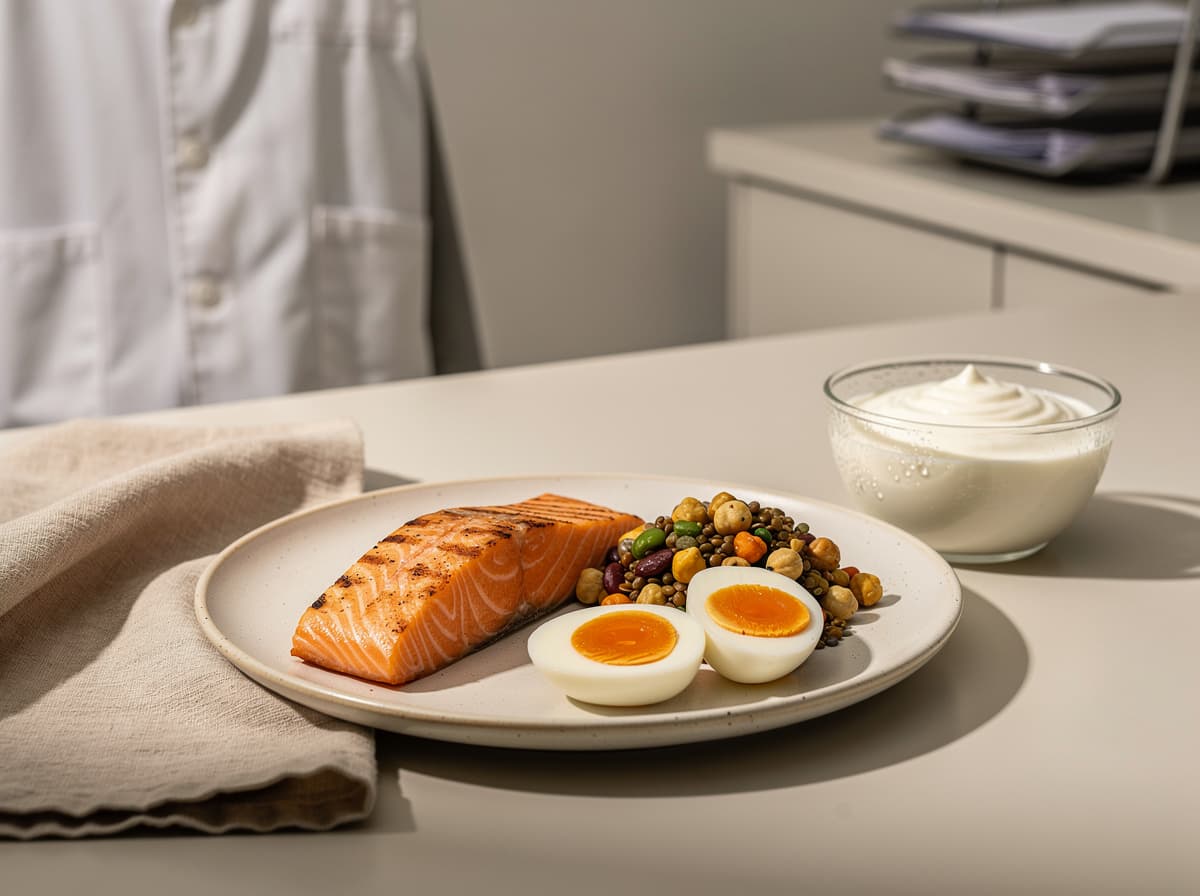
Protein target. The consensus range across recent reviews lands at 1.2 to 1.6 g/kg/day of protein (about 90 to 120 g for many adults), strength training 2 to 4 times per week, avoiding extreme calorie restriction to keep weight loss steady, and prioritizing sleep, hydration, and tracking strength and body composition. For a 75 kg adult, that is 90 to 120 g of protein daily, distributed across the day.
Distribution matters more than total. Muscle protein synthesis is stimulated by leucine boluses, so 25 to 40 g of protein per meal beats 60 g once a day. Distribute protein evenly across meals, aim for 20-40 g per meal to maximize muscle protein synthesis.
Practical eating strategy. Appetite drops fast on a GLP-1, so protein has to come first in each meal. Liquid options (Greek yogurt, whey shakes, skyr, cottage cheese, bone broth with collagen) are easier to tolerate during nausea windows.
Resistance training, not cardio. Walking is good for cardiovascular health and adherence, but it does not preserve muscle under a deficit. In addition to resistance training two to three times a week, it is recommended that individuals taking GLP-1 or GLP-1/GIP receptor agonists accumulate 150 minutes of moderate to vigorous physical activity per week. Sessions should hit major compound patterns: squat, hinge, push, pull, carry.
Intensity matters more than volume. Training at or above 70% of 1RM has been shown to be particularly effective in preserving lean mass during caloric deficits. Two heavy full-body sessions weekly outperform five high-rep junk-volume sessions when calories are limited and recovery is compromised.
What the next generation of trials is showing#
The pharma industry has read the same data and is responding with combination protocols. The BELIEVE phase 2b trial paired semaglutide with bimagrumab, an activin type II receptor antibody. The combination therapy yielded 92.8% of total weight loss from fat mass compared to semaglutide alone (71.8%) and a 22.1% decrease in bodyweight.
The COURAGE trial tested semaglutide with trevogrumab, an anti-myostatin antibody. At interim analysis, 34.5% of semaglutide-induced weight loss was due to lean mass loss, while patients in all combination groups preserved more lean mass with greater fat loss from baseline compared to semaglutide alone.
These are not yet approved. They signal where the field is moving: away from "how much weight" and toward "what kind of weight." Preliminary evidence suggests that the next class of obesity protocols will pair appetite suppression with explicit muscle-preservation pharmacology. Until then, protein and barbells remain the operative protocol.
Tracking what actually matters#
The bathroom scale is a low-resolution tool for this. A patient losing 1 kg per week looks great on the scale and may be losing 0.7 kg of fat and 0.3 kg of lean mass. A patient losing 0.4 kg per week with rising grip strength is winning, even though the scale moves less.
Useful markers, in priority order:
- Grip strength (handheld dynamometer, monthly). SEMALEAN found a clinically meaningful +4.5 kg improvement at 12 months, associated with reduced sarcopenic obesity prevalence.
- Lifting performance. If working sets are climbing or holding, muscle is staying.
- Waist circumference (monthly). Tracks visceral fat better than weight.
- DXA or BIA body composition (every 3 to 6 months for those who can access it).
- Photos, taken under consistent lighting every 4 weeks.
Skip daily weigh-ins. The signal is buried in water-weight noise.
The protocol question, not the pharmacology question#
GLP-1 muscle loss is real, measurable, and predictable. It is also one of the most addressable side effects in modern obesity care. The drug delivers the appetite signal. The patient still has to deliver the protein and the training stimulus. When both pieces are present, the data is reassuring; when either is missing, the data is not.
Klarovel curates the protocol layer only; it does not sell, source, or fulfil peptides. For users planning a GLP-1 program, the peptide calculator handles dose pacing and titration math, how it works explains the model, and the broader guide to peptides for weight loss frames where muscle preservation sits in the wider class. Anyone serious about preserving muscle through a weight-loss cycle should register for the full protocol library before starting the first injection.
Frequently asked questions
Keep reading
The Ozempic Pill: Five Semaglutides, Three Shared Doses
Ozempic tablets, Rybelsus and Wegovy tablets are all semaglutide, and three strengths appear on two different products. Here is which is which.

How Does Zepbound Work, and How Long Until It Does?
Zepbound acts on two receptors, not one. The label gives four different answers to how long it takes to work, depending on which effect you mean.
Ozempic Face: What It Is, and Why It Is Not Ozempic
Facial hollowing after rapid weight loss is real, but it tracks how fast the weight comes off, not semaglutide itself. What the body composition data shows.