
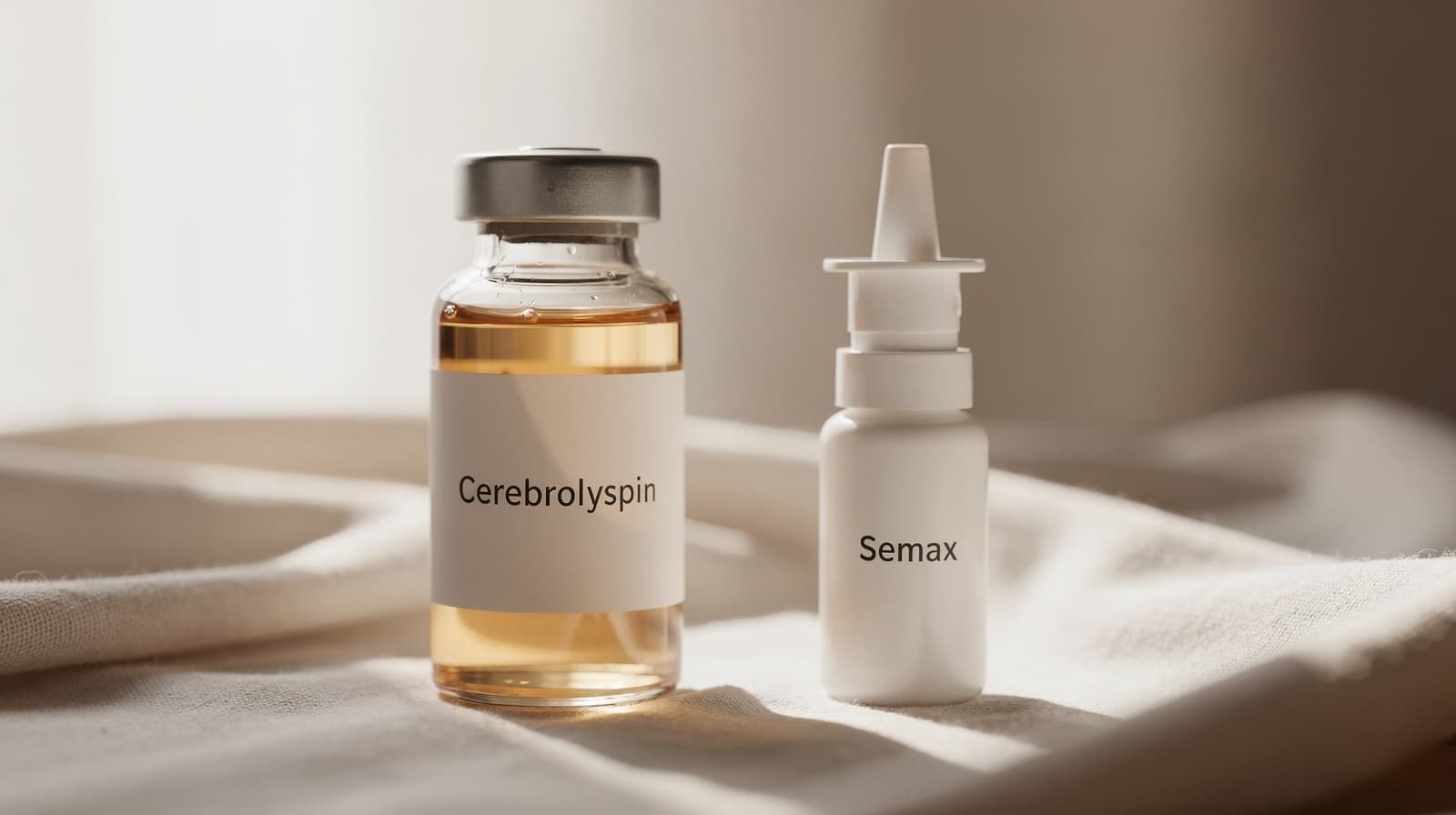
Cerebrolysin and Semax sit at opposite ends of the same Russian neuropeptide canon. One is an IV-only porcine brain hydrolysate with two decades of stroke meta-analyses behind it; the other is a synthetic heptapeptide squirted up the nose for off-label cognitive enhancement. Readers comparing them usually want one answer: which compound earns its reputation, and for what.
Key takeaways#
- Cerebrolysin is a multi-peptide hydrolysate; Semax is a single seven-amino-acid synthetic analog of ACTH(4-10). They share BDNF upregulation as a mechanism but reach it differently.
- Cerebrolysin has the heavier clinical file: the nine-trial post-stroke meta-analysis pooled 1,879 patients and produced a number-needed-to-treat of 7.7 for early NIHSS improvement.
- Semax evidence is narrower, mostly Russian-language, and dominated by non-randomized stroke and ADHD cohorts. Preclinical mechanism work is solid; controlled human data is thin.
- Routes differ sharply: Cerebrolysin requires IV or IM administration in a clinic; Semax is intranasal and self-administered in research contexts.
- Neither compound is FDA-approved. Cerebrolysin is registered in roughly 50 countries (Austria, China, Russia, parts of Eastern Europe); Semax is on the Russian Vital Drugs list but unregistered elsewhere.
How Cerebrolysin works: a porcine hydrolysate that mimics endogenous neurotrophins#
Cerebrolysin is not a single peptide. It is a standardized enzymatic hydrolysate of purified porcine brain proteins, and its composition is roughly 25% low-molecular-weight peptides under 10 kDa and 75% free amino acids. Independent characterization work in PMC has shown that Cerebrolysin's peptide fingerprint differs meaningfully from competitor brain hydrolysates, and only Cerebrolysin induced neurofilament-L expression in PC12 cell assays, suggesting the activity is composition-specific rather than generic.
The proposed mechanism is multi-target. Research suggests Cerebrolysin's peptide fragments mimic endogenous brain-derived neurotrophic factor (BDNF), nerve growth factor (NGF), glial cell line-derived neurotrophic factor (GDNF), and ciliary neurotrophic factor (CNTF). Preclinical data points to additional effects on amyloid precursor protein processing, reduced neuroinflammation, and supported neurogenesis. The route is parenteral, typically intravenous infusion over 15-60 minutes; the half-life is short but the pleiotropic, multi-target profile is what researchers cite when arguing it modulates post-lesional endogenous brain recovery rather than acting as a pure neuroprotectant.
How Semax works: a seven-amino-acid ACTH fragment that drives BDNF transcription#
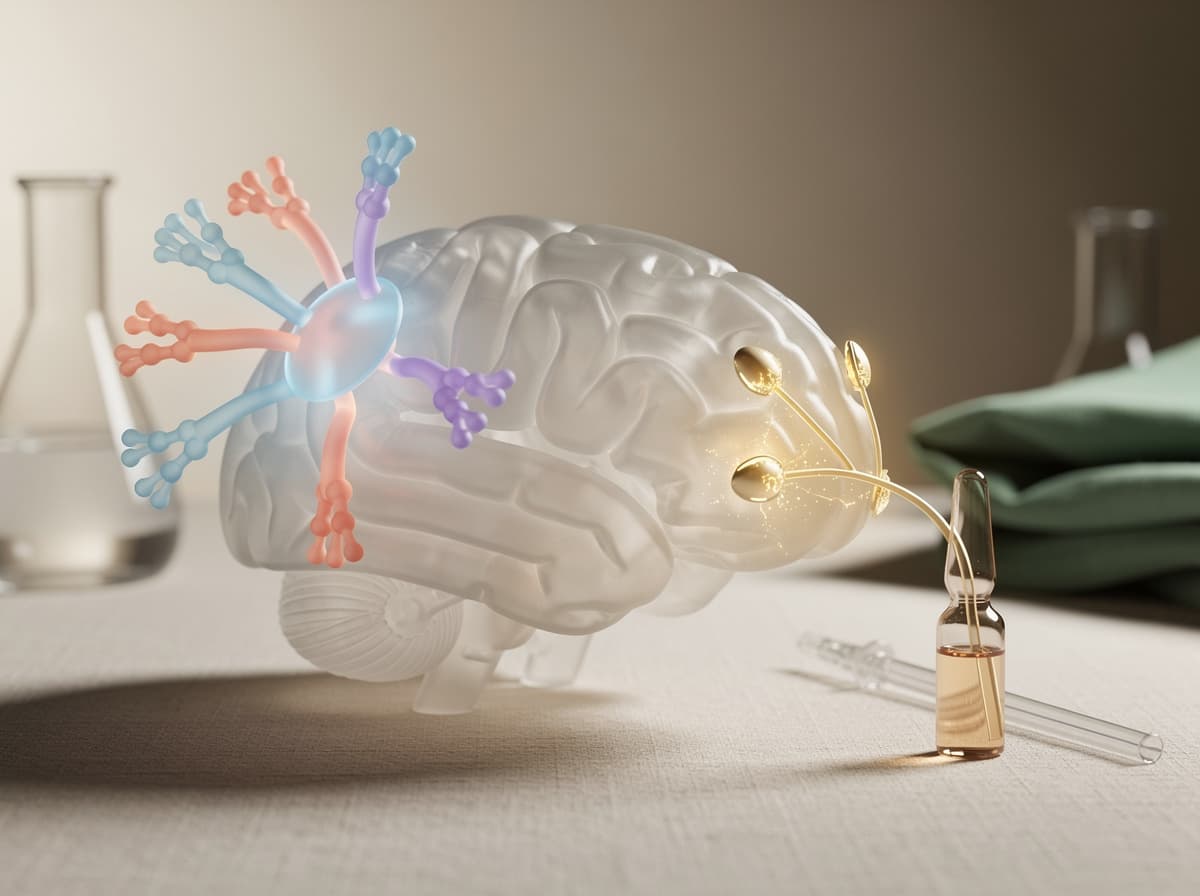
Semax is the heptapeptide Met-Glu-His-Phe-Pro-Gly-Pro, a synthetic analog of the adrenocorticotropin fragment (4-10) that has profound effects on learning and exerts marked neuroprotective activities after intranasal application. Unlike its parent hormone, Semax has no corticotropic activity; it does not raise cortisol.
Mechanistically, the central finding has been replicated repeatedly. A single intranasal dose of Semax produced a 1.4-fold increase in BDNF protein, a 1.6-fold rise in trkB tyrosine phosphorylation, and 3-fold and 2-fold increases in BDNF and trkB mRNA respectively in the rat hippocampus. A separate basal-forebrain study confirmed that Semax binds specifically and increases BDNF protein levels in rat basal forebrain. Studies have shown additional modulation of VEGF expression, dopaminergic tone, and a Pro-Gly-Pro C-terminal fragment that retains independent activity. A 2025 paper in the Bulletin of Experimental Biology and Medicine documented that Semax significantly increased the frequency of spontaneous calcium fluctuations in CA1 pyramidal neurons at 1 μM, localizing some of its action to hippocampal network excitability.
The route is intranasal, which has been shown to bypass the blood-brain barrier via olfactory transport. Half-life in plasma is minutes; CNS effects persist for hours because the downstream cascade is transcriptional.
Dosing: Cerebrolysin vs Semax in published research protocols#
The two compounds live in different dosing universes.
Cerebrolysin research protocols are clinic-scale. The pivotal CARS stroke trials administered 30 mL Cerebrolysin once daily for three weeks, started 24-72 hours after stroke onset. The 2018 nine-trial meta-analysis pooled studies using 30 mL/day for at least one week, initiated within 72 h post-stroke. Vascular dementia protocols have used intravenous Cerebrolysin 20 mL once daily over two treatment cycles as add-on therapy. Alzheimer's trials have used 30 mL IV in 100 mL saline, five days per week for four weeks.
Semax research protocols are outpatient-scale. A rodent mechanism study used a single application of Semax at 50 μg/kg body weight to produce the BDNF and trkB changes cited above. Human stroke protocols documented in Russian literature have used 1% intranasal Semax in the acute period; nootropic community protocols cluster an order of magnitude lower, around 200-600 mcg/day, and are not validated by controlled trials. Research-published doses for Semax outside the stroke setting remain limited and non-standardised.
The cadence diverges too. Cerebrolysin is delivered in fixed 2-4 week cycles. Semax is typically pulsed daily across shorter courses, with the BDNF/trkB upregulation persisting beyond the dosing window.
Evidence: what the studies actually show#
This is where the gap widens.
Cerebrolysin has the heavier evidence base. The CARS-1 and CARS-2 meta-analysis (N=442) reported a Mann-Whitney effect size of 0.62 on the ARAT motor score at day 90 (P < 0.0001) and a number-needed-to-treat of 7.1 for early NIHSS improvement. The larger 2018 meta-analysis pooled nine randomized controlled trials with a Mann-Whitney effect size of 0.60 on NIHSS at day 30 across 1,879 patients (P < 0.0001), with a combined NNT of 7.7. In vascular dementia, a 24-week randomized trial reported ADAS-cog+ improvement of 10.6 points in the Cerebrolysin group versus 4.4 in placebo (least squares mean difference -6.17; P < .0001). A six-trial Cochrane-style meta-analysis confirmed a weighted mean ADAS-cog+ difference of -4.01 (95% CI -5.36 to -2.66) in vascular dementia. In mild-to-moderate Alzheimer's, a six-RCT meta-analysis reported a standardized mean difference of -0.40 in cognitive function at four weeks (95% CI -0.66 to -0.13, P = 0.0031).
Semax has a narrower, methodologically softer file. The mechanism studies are clean and reproducible. The human clinical evidence is dominated by non-randomized Russian stroke and pediatric ADHD cohorts. Preliminary evidence has been associated with neurological improvement in acute ischemic stroke, but the largest non-blinded series do not approach the rigor of the Cerebrolysin RCT package. The Strand group review characterized non-corticotropic ACTH peptides as modulators of nerve development and regeneration, which is consistent with the preclinical signal but not a substitute for placebo-controlled human data.
A practical read: Cerebrolysin has been shown to produce small-to-moderate effect sizes in multi-thousand-patient pooled analyses. Semax has been associated with promising effects in smaller, less rigorously controlled studies, and the strongest evidence is preclinical.

Side effects and contraindication profile#
Cerebrolysin is parenteral and tolerability data comes from large trials. Across the nine-RCT meta-analysis, safety aspects were comparable to placebo. The systematic review of the Alzheimer's program noted vertigo, headache, increased sweating, and nausea as the most common adverse effects, with rare anaphylactoid reactions reported. The porcine source is a relative contraindication for patients with severe protein allergy.
Semax has a different risk shape. Because intranasal absorption is variable and the doses are small, systemic exposure stays low. Reported community side effects cluster around mild headache, irritability, and brief sleep disruption when dosed late in the day. The mechanism does not implicate adrenal stimulation, since the ACTH(4-10) fragment lacks corticotropic activity, which is the property that distinguishes it from earlier ACTH-derived peptides. The harder unknown is long-term safety: no large multi-year Semax cohorts have been published.
Overlap zone: both compounds are contraindicated in active seizure disorders without specialist input, because BDNF upregulation in animal models can alter seizure thresholds bidirectionally.
When to choose Cerebrolysin#
Cerebrolysin is the better starting point when the research context is:
- Post-acute ischemic stroke rehabilitation within 72 hours of onset, where the CARS NNT of roughly 7 aligns with reproducible motor and NIHSS endpoints.
- Vascular dementia of mild to moderate severity, where the published ADAS-cog+ effect size is the largest in the field.
- Traumatic brain injury recovery in protocols already using IV neuroprotective adjuncts.
- Settings where IV administration is logistically feasible and a 21-day in-clinic course is acceptable.
The compound rewards a defined recovery window. It is not a daily maintenance tool.
When to choose Semax#
Semax is the more reasonable choice when the research context is:
- Cognitive performance and attention-related endpoints in healthy adults, where the BDNF/trkB transcriptional response is the target.
- Settings where intranasal self-administration is required because IV access is not available.
- Stacking with other transcription-modulating compounds where a short half-life and on-demand dosing matter.
- Short-cycle protocols of 10-14 days where rapid neurotrophin induction is the mechanism of interest, not multi-week tissue remodeling.
For most subclinical cognitive endpoints, Semax is the more practical compound; the trade-off is weaker controlled-trial backing.
Can you stack them?#
Stacking is not standard practice. The conflict is not pharmacodynamic; both upregulate BDNF/trkB signaling. The conflict is methodological. Cerebrolysin already delivers a multi-target neurotrophic load, including BDNF mimetics. Adding Semax adds another upstream BDNF stimulus without a clean dose-response model and makes attribution of effect or adverse event impossible. The published research file contains no controlled co-administration trials. Researchers running both in sequence rather than in parallel reduce this attribution problem and stay closer to the published protocols.
Verdict: Cerebrolysin for recoverable injury, Semax for cognitive maintenance#
Cerebrolysin is the better starting point for post-stroke, vascular dementia, and Alzheimer's research contexts because the controlled-trial denominator is roughly an order of magnitude larger and the effect sizes are reproducible across independent meta-analyses. Semax is the better starting point for healthy-adult cognitive research and short transcription-modulation cycles because intranasal dosing is practical, the BDNF/trkB mechanism is clean, and adrenal activation is not on the table. The two compounds are not interchangeable, and the Russian-stack convention of combining them in undefined ratios is not supported by published evidence. Pick the one that matches the endpoint; do not assume more is better.
Quantify which one your protocol actually points to#
Cerebrolysin and Semax are not substitutes. They are two distinct tools with different routes, different evidence weights, and different research windows. Run your endpoint against the published protocol cadence before committing to either. Use the Klarovel peptide calculator to translate research-published doses into your own context, complete the intake questionnaire so the protocol layer is matched to your bloodwork and goals, and review the methodology and disclosures Klarovel applies before any peptide is recommended. Readers comparing other Russian-stack compounds can continue with the how-it-works overview to see where curation ends and supplier fulfillment begins.
Frequently asked questions
Keep reading
Peptides for Testosterone: Which Axis Actually Works
Most peptides for testosterone act on the growth hormone axis and never touch LH. Here is which compounds have measured serum testosterone in men.
Tirzepatide vs Retatrutide: What the 2026 Data Show
Retatrutide reached 28.3% weight loss at 80 weeks; tirzepatide 20.9% at 72. A side-by-side of receptor targets, trial data, tolerability and status.
Semax vs Selank: Mechanism, Evidence, and Stacking
Semax and Selank share a Moscow lab and an intranasal route, but hit different targets. Mechanism, Russian trial data, dosing logic, and 2026 FDA status.