
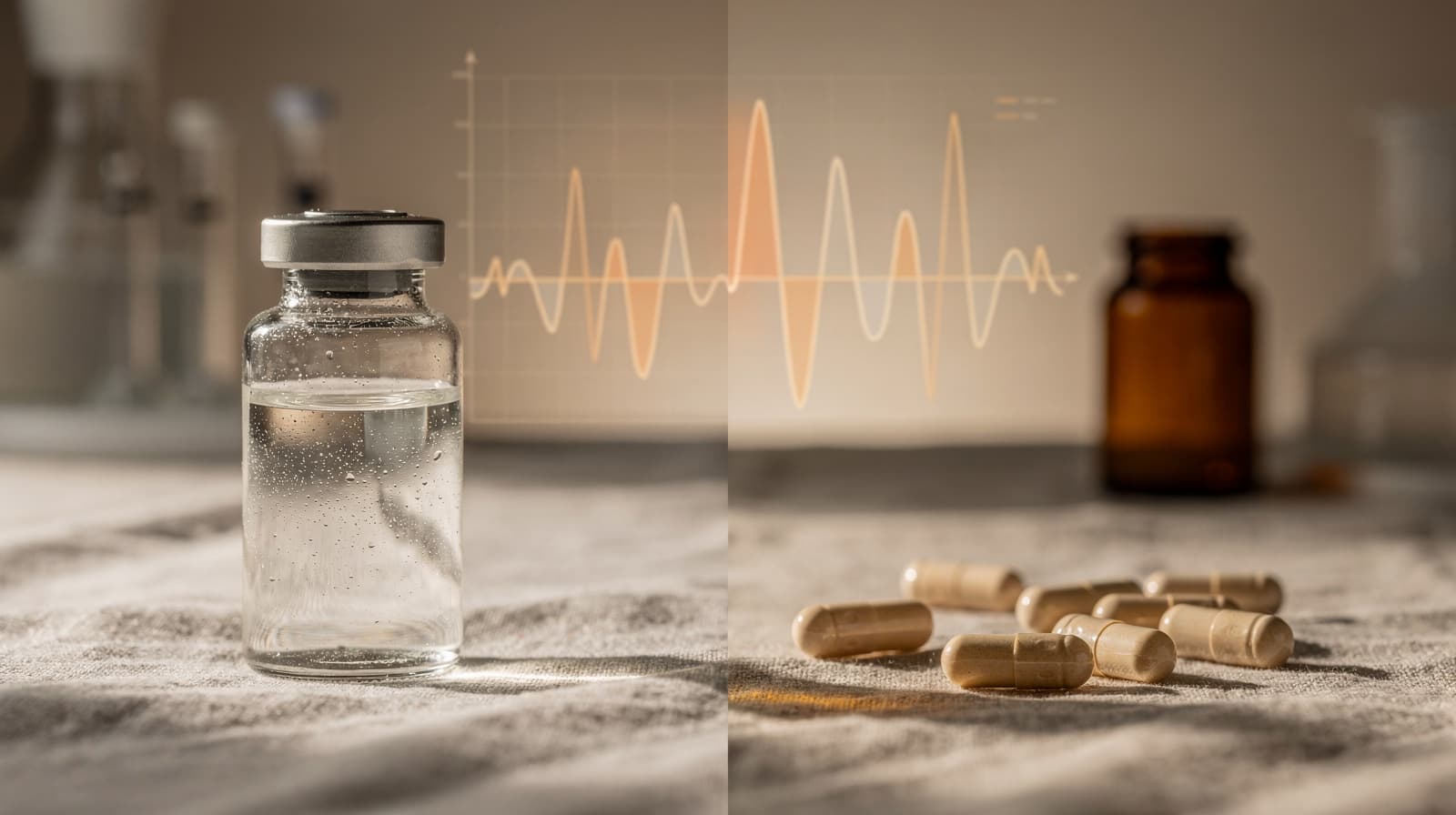
Hexarelin and MK-677 both activate the same receptor, the GHS-R1a ghrelin receptor, but they behave nothing alike in the body. One is a peptide injection that produces one of the largest acute GH spikes of any tested secretagogue and then loses roughly half its effect within four months. The other is a small molecule swallowed once a day that sustains elevated IGF-1 for two years, at the cost of measurable insulin resistance. This comparison unpacks which one fits which research context, and where the trade-offs actually sit.
Key takeaways#
- Hexarelin produces peak GH of roughly 50-80 ng/mL after a single 1 to 2 mcg/kg intravenous dose but shows partial receptor desensitization by week 4 of continuous twice-daily use.
- MK-677 is an orally active ghrelin-receptor agonist (it is not the only one: macimorelin is FDA-approved as an oral diagnostic test); a single 25 mg dose sustains elevated GH and IGF-1 for roughly 24 hours.
- The Nass 2-year randomized controlled trial confirmed sustained IGF-1 elevation with 25 mg daily MK-677 across 24 months, alongside a persistent rise in fasting glucose.
- Hexarelin's ceiling is neuroendocrine spillover (cortisol, prolactin, ACTH); MK-677's ceiling is metabolic (insulin sensitivity, fluid retention, a cardiac safety signal in the CLASS hip-fracture trial).
- Neither compound is approved by the FDA or EMA, and both are prohibited in sport under WADA class S2. Since 15 September 2026, ibutamoren (MK-677) is also on Norway's national doping list.
How hexarelin works#
Hexarelin is a synthetic hexapeptide (His-D-2-methyl-Trp-Ala-Trp-D-Phe-Lys-NH2) that binds GHS-R1a with potency comparable to endogenous ghrelin. Subcutaneous bioavailability sits around 77% (Ghigo et al. 1994), half-life is roughly 55 minutes, and peak plasma GH arrives about 30 minutes after injection. It is one of the strongest acute GH secretagogues ever characterised: testing IV doses up to 1 mcg/kg in healthy adult men, Massoud and colleagues (1996) documented a GH dose-response plateau of roughly 140 mU/L at 1 mcg/kg, with an ED50 of 0.48 mcg/kg.
Beyond the pituitary, hexarelin has a second binding site that MK-677 does not share. It engages the cardiac CD36 scavenger receptor, and animal work suggests this is the basis for its GH-independent cardioprotective signalling. That signal has not translated into approved cardiac indication, but it is the mechanistic reason hexarelin keeps appearing in cardiovascular research when other GHRPs do not.
How MK-677 works#
MK-677 (ibutamoren) is not a peptide. It is a small-molecule spiroindanylpiperidine, roughly 529 Da, that mimics ghrelin at GHS-R1a. Because it is non-peptidic, it survives gastric passage: oral bioavailability sits at 60-70%, and the roughly 5-hour half-life is long enough to sustain elevated GH pulsatility and IGF-1 across a full 24-hour dosing interval. GH peaks 1-2 hours after ingestion.
Mechanistically, MK-677 stimulates GHRH release, suppresses somatostatin, and amplifies pituitary GH signalling. In practical terms, that means IGF-1 rises are measurable within two weeks and, per the Nass 2-year randomized controlled trial, maintained for at least 24 months of continuous daily dosing without tachyphylaxis at the hormonal level. Preliminary evidence from the same trial also documented a fat-free mass gain of roughly 1.1 kg versus a 0.5 kg loss on placebo, with no measurable change in isokinetic strength.

Dosing: hexarelin vs MK-677#
Research-published protocols for the two compounds do not overlap.
For hexarelin, the dose-response work by Massoud et al. 1996 put the GH plateau at 1.0 mcg per kg body weight, with cortisol already rising about 40% from 0.5 mcg/kg and prolactin plateauing near a 180% rise at 1.0 mcg/kg. Ghigo et al. 1994 found that 2.0 mcg/kg IV still added GH over 1.0 mcg/kg, so the plateau is not a hard ceiling. Community research protocols typically translate this to 100 to 200 mcg subcutaneous once or twice daily on an empty stomach. Cycling is mandatory: most protocols cap at 4 to 6 weeks on followed by 4 to 8 weeks off to allow GHS-R1a receptor density to recover.
For MK-677, published human trials have used 10 mg to 25 mg administered orally once daily, with 25 mg being the standard used in the Nass, Chapman, Svensson, and Sevigny trials. Timing is flexible because the half-life is long, though many researchers dose in the evening because ghrelin-mimetic-induced hunger is more manageable at night and the GH surge synergises with the natural sleep-onset pulse. Cycles in the published literature range from 8 weeks to 24 months of continuous use.
The Klarovel peptide calculator reconstructs these research-published ranges for a given body weight so the arithmetic is not something to redo by hand.
Evidence: what the studies actually show#
No head-to-head randomized trial has been published. The comparison is built from the strongest primary study on each side.
For hexarelin, the pivotal chronic-dosing study is Rahim et al. 1998, a 16-week trial of twice-daily subcutaneous hexarelin (1.5 mcg/kg) in 12 healthy elderly individuals. The mean areas under the GH curve at weeks 0, 1, 4, and 16 were 19.1, 13.1, 12.3, and 10.5 μg/l/hour respectively, with a significant change across the study period (P = 0.0003) and significant decreases at weeks 4 and 16 versus baseline. Critically, four weeks after study completion, hexarelin was re-administered and the AUC-GH rose significantly compared with week 16 (from 10.5 to 19.4 μg/l/hour, P < 0.05) and was not significantly different from week 0, showing the attenuation is partial and reversible. Serum IGF-1 did not change significantly over the 16 weeks.
For MK-677, the Nass 2008 randomized trial in 65 healthy adults aged 60 to 81 remains the reference study. Two-year daily oral 25 mg MK-677 raised GH and IGF-1 to youthful-range values, increased fat-free mass by 1.1 kg (versus a 0.5 kg loss on placebo), and, importantly for a comparison against hexarelin, showed no significant hormonal desensitization at the two-year mark. The trial also produced a sustained rise in fasting glucose and a decrease in insulin sensitivity that persisted for the entire two-year window. A subsequent 12-month trial in Alzheimer's disease patients (Sevigny et al. 2008) confirmed a 72.9% IGF-1 elevation at 12 months but produced zero cognitive benefit on any of four outcome measures.
The evidence asymmetry matters: MK-677 has been shown to hold its hormonal effect for 24 months of continuous dosing; hexarelin has been shown to lose roughly half its GH-releasing effect within 16 weeks of continuous dosing. That single fact reshapes which compound fits which protocol.
Side effects and contraindication profile#
Hexarelin's liability is neuroendocrine spillover. Because it activates GHS-R1a with high potency, it drives measurable cortisol and prolactin release. The Massoud dose-response work documented cortisol and prolactin release climbing alongside GH across the 0.5 to 1.0 mcg/kg range. Hexarelin also stimulates ACTH and cortisol release, a response that is suppressed by glucocorticoid feedback, and the effect is real enough that chronic-dosing studies specifically monitor 24-hour urinary free cortisol. Water retention, transient carpal tunnel symptoms, and appetite increase are secondary features. And the desensitization ceiling is not a rumour: it is the single reason hexarelin never reached approval as a GH-axis therapeutic.
MK-677's liability is metabolic and cardiac. The Nass trial's fasting-glucose rise of roughly 0.3 mmol/L persisted for the full 24-month observation window. A separate hip-fracture programme (the CLASS trial) recorded an increased incidence of congestive heart failure in elderly participants who were already predisposed, and that safety signal is associated with the compound's approval failure. Fluid retention, nocturnal hunger surges, transient lower-limb oedema, and sustained appetite increase are routine. Active or suspected malignancy is a hard contraindication because sustained IGF-1 elevation is associated with cell-proliferation signalling and long-term cancer-incidence data are absent.
Overlap: both compounds increase appetite, both can produce fluid retention, both can transiently raise fasting glucose. Divergence: hexarelin's cortisol/prolactin signal is the ceiling; MK-677's insulin-resistance and cardiac signal is the ceiling.
When to choose hexarelin#
Research contexts where hexarelin fits better than MK-677:
- Short-duration protocols (4-6 weeks) where a maximal acute GH pulse is the primary endpoint, not chronic IGF-1 exposure.
- Studies specifically probing cardiac GHS-R / CD36 signalling, where MK-677 is mechanistically irrelevant.
- Rotation protocols where the researcher wants a high-amplitude pulse peptide to alternate with a lower-potency GHRP such as ipamorelin.
- Any context where the researcher wants to preserve endogenous insulin sensitivity and cannot accept the sustained glycemic drift documented with 25 mg MK-677.
When to choose MK-677#
Research contexts where MK-677 fits better than hexarelin:
- Long-arc IGF-1 optimisation research where the endpoint is cumulative exposure over months rather than a per-injection GH peak.
- Any protocol where injection compliance is a limiting variable. Oral dosing removes the biggest source of protocol dropout in GH-axis studies.
- Bone-turnover research: the Murphy 1999 work showed sustained bone-remodelling marker elevation on 25 mg daily oral MK-677, and there is no comparable long-duration hexarelin dataset.
- Sarcopenia and fat-free mass endpoints in older subjects, where the two-year Nass data provides the reference frame.
Can you stack them?#
Stacking hexarelin and MK-677 is not standard research practice, and the reason is receptor-level, not regulatory. Both compounds bind the same GHS-R1a site. Layering them produces no supra-additive GH response because the receptor is already saturated at the standard MK-677 24-hour trough plasma level. Worse, chronic MK-677 exposure accelerates the receptor-desensitization curve that already limits hexarelin's chronic use, meaning a stack shortens hexarelin's useful cycle window rather than extending it. The productive stacking pattern in GH-axis research pairs a GHRH analogue (CJC-1295, tesamorelin, sermorelin) with one ghrelin-receptor agonist, not two.
Verdict#
For most research contexts targeting sustained GH-axis elevation over months, MK-677 is the better starting point. The 2-year Nass RCT provides a reference dataset that hexarelin simply does not have, oral dosing removes the compliance failure mode, and the hormonal signal does not desensitize. Hexarelin remains the better choice in exactly two contexts: acute-pulse pharmacology studies where a maximal single-dose GH peak is the endpoint, and cardiac CD36 research where its second binding site is the entire mechanism of interest. If the research goal is body-composition-adjacent and the timeline is measured in months, MK-677. If the goal is a discrete acute pulse or CD36-mediated cardiac signalling, hexarelin. Neither compound is a general-purpose "GH optimiser," and both carry ceilings that show up in the peer-reviewed record, not in forum anecdote.
Where this leaves the decision#
The choice between hexarelin and MK-677 is not a strength contest. It is a question about what the researcher wants the GH-axis intervention to look like: a discrete injectable pulse with a hard chronic-use ceiling, or a rolling oral elevation with a metabolic tax. Both are legitimate research tools; neither is a shortcut. If you want the quantified version of this decision built around your own health profile and goal, the Klarovel peptide calculator reconstructs research-published dose ranges for both compounds, and the /register intake captures your health history and, if you have them, optional lab values such as fasting glucose, HbA1c and IGF-1.
Frequently asked questions
Keep reading
Peptides for Inflammation: Mapping BPC-157, KPV, and Thymosins
Peptides for inflammation compared by mechanism and evidence stage: BPC-157, KPV, thymosin alpha-1, and thymosin beta-4, with FDA status and safety notes.
Mounjaro vs Zepbound: Same Drug, Two Different FDA Labels
Mounjaro and Zepbound are the same drug, tirzepatide, at the same doses. The difference is the FDA label: diabetes for Mounjaro, weight loss for Zepbound.
Rybelsus for Weight Loss: Not Approved, and the Pill That Is
Rybelsus is not FDA-approved for weight loss and moves the scale only a little. The oral semaglutide approved for weight loss is the Wegovy pill at 25 mg.