

Two peptides frequently end up in the same conversation, and they should not. BPC-157 is a tissue-repair molecule with a gut-and-musculoskeletal specialisation. Thymosin alpha-1 is a T-cell primer used for viral clearance and immune reconstitution. This comparison sorts which one your goal actually points to, where the evidence is strongest, and whether stacking makes any biological sense.
Key takeaways#
- BPC-157 acts locally on tissue: it supports angiogenesis, collagen synthesis, fibroblast activity, and modulation of nitric oxide pathways across muscle, tendon, ligament, bone, and gastrointestinal tissue . Choose it for gut lining and musculoskeletal injury.
- Thymosin alpha-1 acts systemically on immunity: it acts through Toll-like receptors in myeloid and plasmacytoid dendritic cells, initiating production of immune-related cytokines . Choose it for viral load, sick-day protocols, and post-illness immune reconstitution.
- Human evidence base is asymmetric: BPC-157 is preclinical-heavy with a handful of pilot studies; thymosin alpha-1 has been studied in over 4,400 clinical-trial subjects and is approved as Zadaxin in Italy. The widely repeated "approved in 30+ countries" figure comes from a company annual report that the FDA says it cannot verify.
- Stacking is defensible only when goals genuinely diverge (e.g. gut healing plus immune reconstitution post-antibiotics). It is not "supra-additive" because the receptors and target cell populations do not overlap.
- Both carry meaningful caveats: neither is FDA-approved or currently compoundable in the US, and BPC-157 is prohibited by WADA; thymosin alpha-1 also requires caution in active autoimmunity.
How BPC-157 works#
BPC-157 is a synthetic 15-amino-acid fragment derived from a protective protein isolated from human gastric juice. It is a pentadecapeptide with reparative and anti-inflammatory properties demonstrated across preclinical models . Its mechanism is best described as convergent: it pushes several parallel pathways that all feed wound resolution.
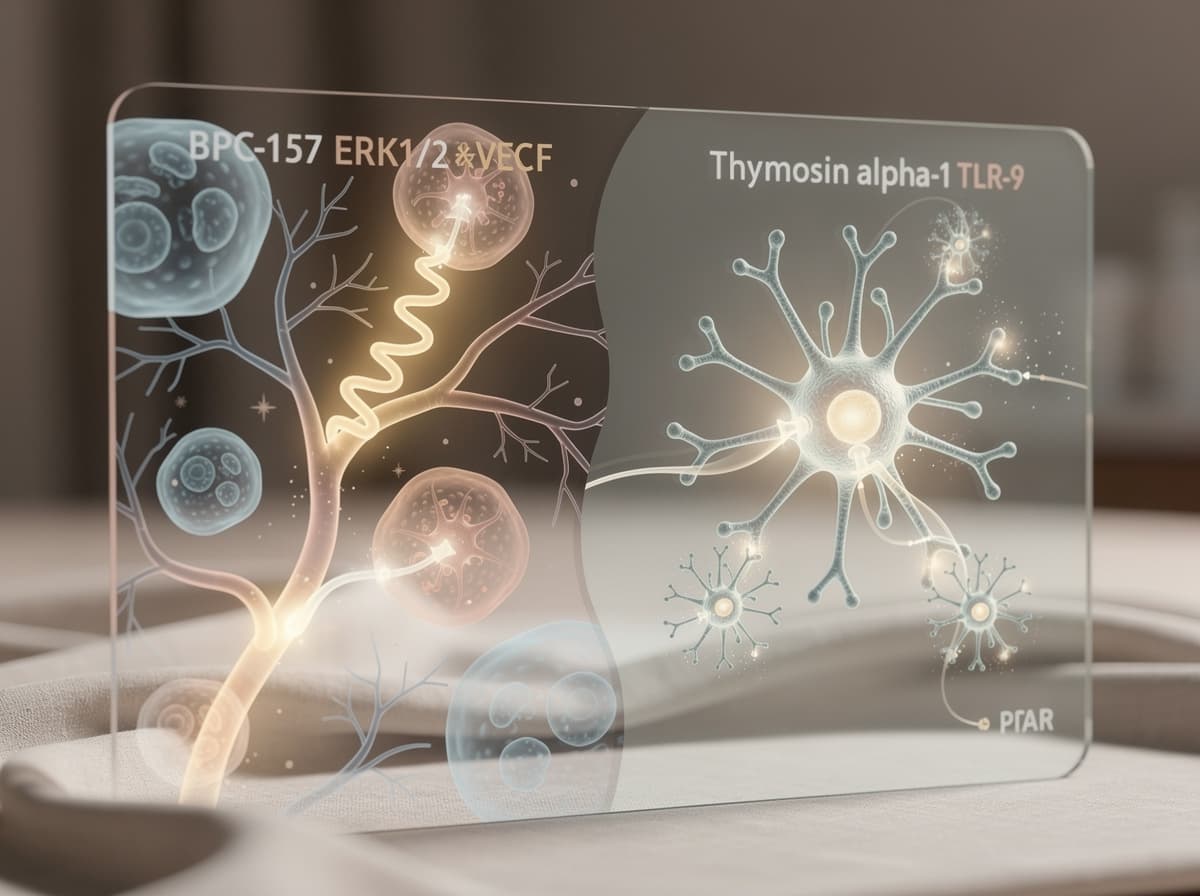
Mechanistically, BPC-157 significantly enhances ERK1/2 phosphorylation in a dose-dependent manner, leading to increased cellular proliferation, migration, and vascular tube formation, with downstream activation of c-Fos, c-Jun, and EGR-1 regulating cell cycle progression, extracellular matrix remodeling, and angiogenic signaling . In parallel, it engages the nitric oxide system and upregulates VEGF, which is why perfusion-limited tissues like tendon and ligament respond to it.
Route matters. Preclinical data has shown effects across tendon, ligament, bone, cornea, muscle, and GI mucosa, and the oral (arginate) form is used specifically for gut targets because injectable BPC-157 has a short half-life and does not need to survive gastric acid when delivered subcutaneously. The peptide is not FDA-approved and human evidence remains limited to small pilot studies.
How thymosin alpha-1 works#
Thymosin alpha-1 is a 28-amino-acid peptide originally isolated from thymic tissue. It was identified as the compound responsible for restoring immune function to thymectomized mice, and has a pleiotropic mechanism affecting multiple immune cell subsets involved in immune suppression . Where BPC-157 is a tissue molecule, thymosin alpha-1 is an immune-system molecule.
The mechanism is receptor-mediated on dendritic cells rather than direct pathogen killing. Thymosin alpha-1 binds TLR3/4/9 and activates downstream IRF3 and NF-κB signal pathways, and TLR2 and TLR7 are also associated with it, promoting cytokine production and enhancing innate and adaptive immune responses . Functionally this translates into more mature Th1 cells, expanded CD8+ cytotoxic populations, and a re-balanced CD4/CD8 ratio.
Clinical footprint is substantial. Over 4,400 subjects have been enrolled in US, European and Chinese clinical trials investigating Ta1, including primary treatment for acute infections such as severe sepsis and for chronic infections including chronic hepatitis B . It has been studied in viral hepatitis, sepsis, and as a chemotherapy adjunct, with mixed results: the largest sepsis trial (TESTS, 1,106 patients, 2025) found no 28-day mortality benefit (PubMed). It is sold as Zadaxin, and the FDA confirms approval in Italy; the often-quoted "more than 30 countries" figure traces to the manufacturer's 2014 annual report, which the FDA states it cannot independently verify (FDA briefing document). It is not approved in the US.
Dosing: BPC-157 vs thymosin alpha-1#
The two dosing pictures could not be more different. Thymosin alpha-1 has a pharmaceutical-grade, trial-derived dose. BPC-157 does not.
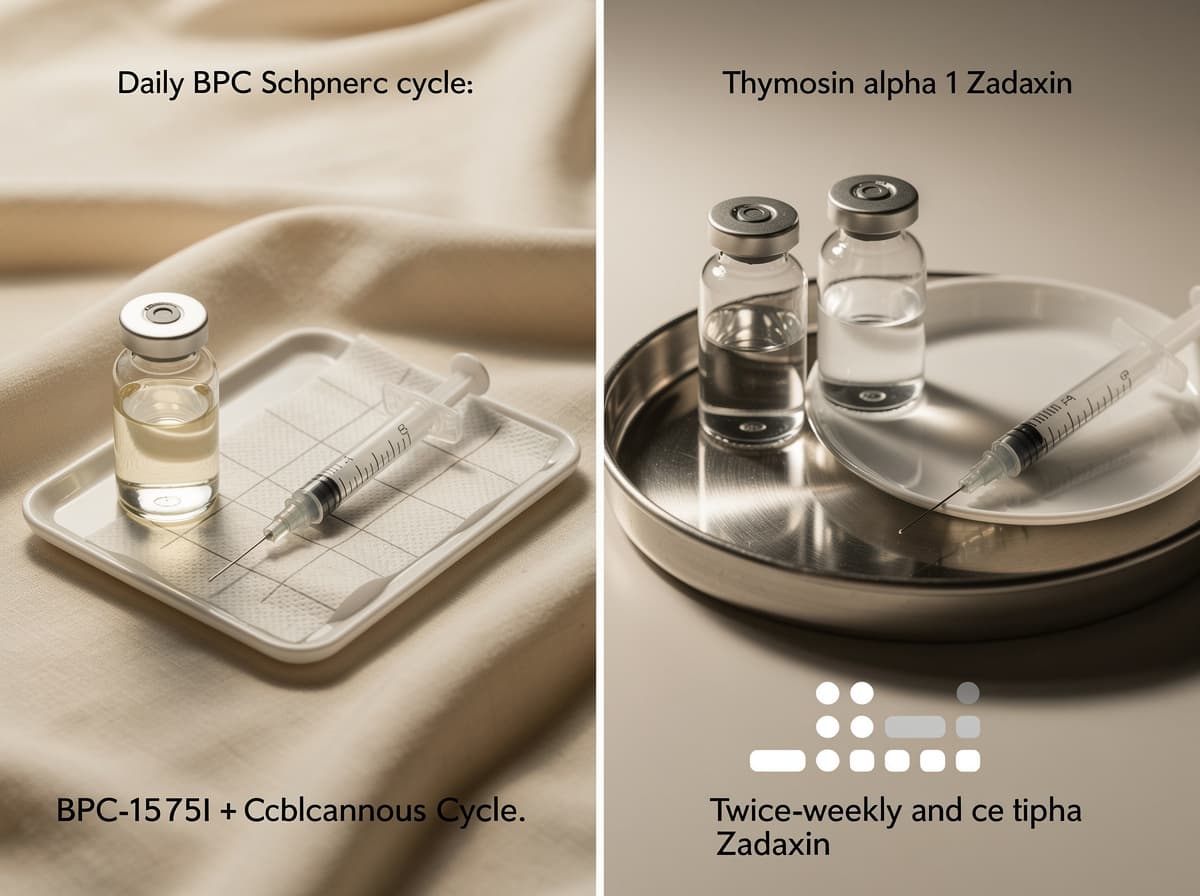
For BPC-157, research protocols are extrapolated from preclinical work and small pilots rather than Phase III trials. The research literature uses 2.5-3.75 mcg/kg twice daily, which for most adults lands in the 300-400 mcg/day range . A common musculoskeletal cycle is 300-500 mcg once or twice daily, subcutaneous near the injured area or systemically, for 4-8 weeks . For gut targets, oral dosing at 250-500 mcg/day is more common because direct luminal exposure is the mechanism of interest. These are research-context ranges, not personal-use recommendations.
For thymosin alpha-1, the dose is essentially settled. The most extensively studied and regulatory-approved regimen is the standard Zadaxin protocol: 1.6 mg thymalfasin by subcutaneous injection twice weekly, with injections separated by approximately 3 to 4 days . In sepsis research the same 1.6 mg unit dose was given more often: every 12 hours for seven days in the TESTS trial. Practitioner cycles for general immune support typically run 8-12 weeks, which is convention rather than trial data.
Fasting and timing: BPC-157 does not require a fasting window. Thymosin alpha-1 also does not: the Zadaxin regimen carries no fasting instruction.
Evidence: what the studies actually show#
There is no head-to-head randomized trial comparing BPC-157 against thymosin alpha-1, and there almost certainly never will be, because they are not indicated for the same problem.
The most-cited evidence for thymosin alpha-1 comes from its chronic hepatitis B development programme (although the FDA concluded in 2024 that the evidence was insufficient to determine effectiveness in hepatitis B) and a 2025 meta-analysis in severe acute pancreatitis (SAP). The SAP meta-analysis pooled five randomized controlled trials comprising 706 patients and reported thymosin alpha-1 was associated with improved cellular immunity and reduced infection rates. Studies have shown that CD4+ T lymphocyte levels rise and the CD4+/CD8+ ratio improves, enhancing immune function . Safety across the clinical database is favorable: the FDA's 2024 review found Tα1 was generally not associated with significant adverse events attributable to it at 1 to 16 mg for up to twelve months, with local irritation and injection-site discomfort the most common reactions (FDA briefing document).
For BPC-157, the evidence base is preclinical. A 2025 systematic review of 36 studies in HSS Journal found consistent musculoskeletal benefits across preclinical models, but only one clinical study was included. Human data has been limited to a pilot study of IV BPC-157 at 10 mg and then 20 mg in two healthy adults with no adverse events, and a retrospective study in which 7 of 12 patients with chronic knee pain reported 6+ months of relief after an intra-articular injection . A randomized placebo-controlled trial in acute hamstring strain (NCT07437547) is now enrolling, which will be the first properly controlled musculoskeletal readout.
The asymmetry matters. Thymosin alpha-1 has clinical outcome data across thousands of patients. BPC-157 has mechanistic plausibility across dozens of animal models and a handful of human pilots.
Side effects and contraindication profile#
The safety profiles diverge as sharply as the mechanisms.
BPC-157: injection-site reactions dominate, with occasional GI upset, lightheadedness, and headache in early weeks. Mild injection-site reactions are the most common, followed by mild GI upset in the first week, occasional lightheadedness, and headaches, with most effects resolving within 24-72 hours and responding to a dose reduction . The real concern is not observed toxicity but mechanistic: BPC-157 activates FAK-paxillin signaling and VEGFR2-driven angiogenesis, mechanisms that play documented roles in metastasis and malignant progression . This is why active or recent cancer is a hard contraindication. On regulation: the FDA placed BPC-157 in Category 2 for compounding in 2023 and removed it on April 22, 2026; in July 2026 its compounding advisory committee voted 8 to 6 to recommend it for the 503A bulks list, but no rule has followed, so it still cannot be compounded (FDA). WADA lists BPC-157 under S0 (non-approved substances), prohibited in and out of competition .
Thymosin alpha-1: the profile is unusually clean given the size of the exposure database, and the FDA's 2024 review found no significant adverse events attributable to it in most clinical studies. Injection-site pain, mild fever, and flu-like symptoms are the reported adverse events. The theoretical caution is active autoimmune disease: because thymosin alpha-1 primes T-cell activity, using it during an active autoimmune flare is where preliminary evidence supports pause and reassessment.
Overlap: both cause local injection reactions. Both are contraindicated in pregnancy and paediatrics for lack of data. Divergence: BPC-157 carries an angiogenic-mechanism cancer flag; thymosin alpha-1 carries an autoimmune-priming flag. Neither flag applies to the other peptide.
When to choose BPC-157#
Pick BPC-157 when the target is structural tissue or gut lining. The concrete scenarios where it earns its place:
- Acute soft-tissue injury: a graded hamstring strain, tendinopathy, or ligament sprain where perfusion and fibroblast activity are rate-limiting. Preclinical data points to tendon, ligament, and muscle as the strongest tissue targets.
- NSAID- or stress-related gut damage: research suggests oral BPC-157 supports mucosal repair, and this is arguably the most mechanistically defensible use case.
- Post-surgical soft-tissue recovery (non-oncology): perilesional or systemic dosing during weeks 2-8 of rehabilitation, alongside physiotherapy rather than instead of it.
- Chronic joint pain with a clear mechanical driver: intra-articular or proximal-injection protocols in a physician-supervised setting.
Do not pick BPC-157 for immune complaints, fatigue of unclear origin, or sick-day support. That is not what it does.
When to choose thymosin alpha-1#
Pick thymosin alpha-1 when the target is immune function, particularly T-cell reconstitution or viral load. Concrete scenarios:
- Post-viral fatigue and immune reconstitution: long-COVID-adjacent presentations with documented low lymphocyte counts or inverted CD4/CD8 ratios. The data here is mixed: the severe acute pancreatitis meta-analysis found higher CD4+ percentages, while a 275-patient COVID-19 study found no benefit on restoring CD4+ and CD8+ counts.
- Chronic viral infection support (hepatitis B/C context): the Zadaxin evidence base is directly relevant, though this is a prescription-only use.
- Sick-day or acute-illness spike-dose protocol: practitioner protocols use short daily courses (typically 1.6 mg daily for 5-7 days) at the earliest sign of a respiratory infection, extrapolated from the sepsis dosing literature rather than tested in that setting.
- Immunosenescence in adults over 60: age-associated immune decline is one of the classical thymosin alpha-1 targets, and the peptide has been used across a wide adult age range.
Do not pick thymosin alpha-1 for tendinopathy, gut ulcers, or musculoskeletal recovery. It has no meaningful signal there.
Can you stack them?#
Yes, but only if your goals genuinely span both mechanisms. The stack is not amplification, it is parallel action.
The receptors do not overlap. BPC-157 engages ERK1/2 and VEGFR2 on tissue cells; thymosin alpha-1 engages TLRs on dendritic cells. There is no shared signalling node where one peptide potentiates the other, so calling this "supra-additive" is inaccurate. What the stack does offer is two separate problems addressed in one protocol window, for example gut lining repair after a course of antibiotics combined with T-cell reconstitution after the infection that necessitated them.
Practical stacking considerations: separate injection sites, keep the thymosin alpha-1 schedule at its trial-standard cadence (Monday/Thursday), and run BPC-157 on its own daily rhythm. Do not double-dose either based on the presence of the other. If the goal is really only one problem (either healing OR immune), a single-peptide protocol is more defensible and easier to titrate.
Verdict#
For most readers, thymosin alpha-1 is the better starting point if the problem is immune, and BPC-157 is the better starting point if the problem is structural. These are non-competing tools for non-competing problems, and the market's tendency to frame them as alternatives is a category error.
If you are choosing between them without a clear goal, thymosin alpha-1 has the larger human record: decades of randomized trials, approval in Italy, and a favorable safety profile in the FDA's review, although its largest sepsis trial was null and the FDA found its hepatitis B evidence insufficient. BPC-157 remains investigational, with strong mechanism and thin human evidence. In the US neither can currently be compounded: an FDA advisory committee voted 4 to 17 against thymosin alpha-1 in December 2024, and voted 8 to 6 for BPC-157 in July 2026 with no rule yet. That does not make BPC-157 wrong for the right indication; it makes it a tool that requires a specific injury or GI complaint to justify.
The framing that matters: match the peptide to the mechanism your health profile or symptom pattern actually implicates. Use the peptide calculator to translate the research doses into your own vial concentration, and use the protocol questionnaire to determine which mechanism your presentation actually points to.
Match the peptide to the mechanism#
The BPC-157 vs thymosin alpha-1 debate collapses once the goal is defined. Healing tendon or gut lining is not the same problem as reconstituting T-cell immunity, and the peptide that fits your problem is not the peptide that fits someone else's. Klarovel does not sell, source or fulfil peptides; its role is the protocol layer built from your health profile. Run the peptide calculator to convert research doses into your vial, complete the questionnaire to pressure-test which mechanism your presentation actually implicates, and read how the protocol layer works before you commit to either molecule.
Frequently asked questions
Keep reading
Peptides for Inflammation: Mapping BPC-157, KPV, and Thymosins
Peptides for inflammation compared by mechanism and evidence stage: BPC-157, KPV, thymosin alpha-1, and thymosin beta-4, with FDA status and safety notes.
Mounjaro vs Zepbound: Same Drug, Two Different FDA Labels
Mounjaro and Zepbound are the same drug, tirzepatide, at the same doses. The difference is the FDA label: diabetes for Mounjaro, weight loss for Zepbound.
Rybelsus for Weight Loss: Not Approved, and the Pill That Is
Rybelsus is not FDA-approved for weight loss and moves the scale only a little. The oral semaglutide approved for weight loss is the Wegovy pill at 25 mg.