
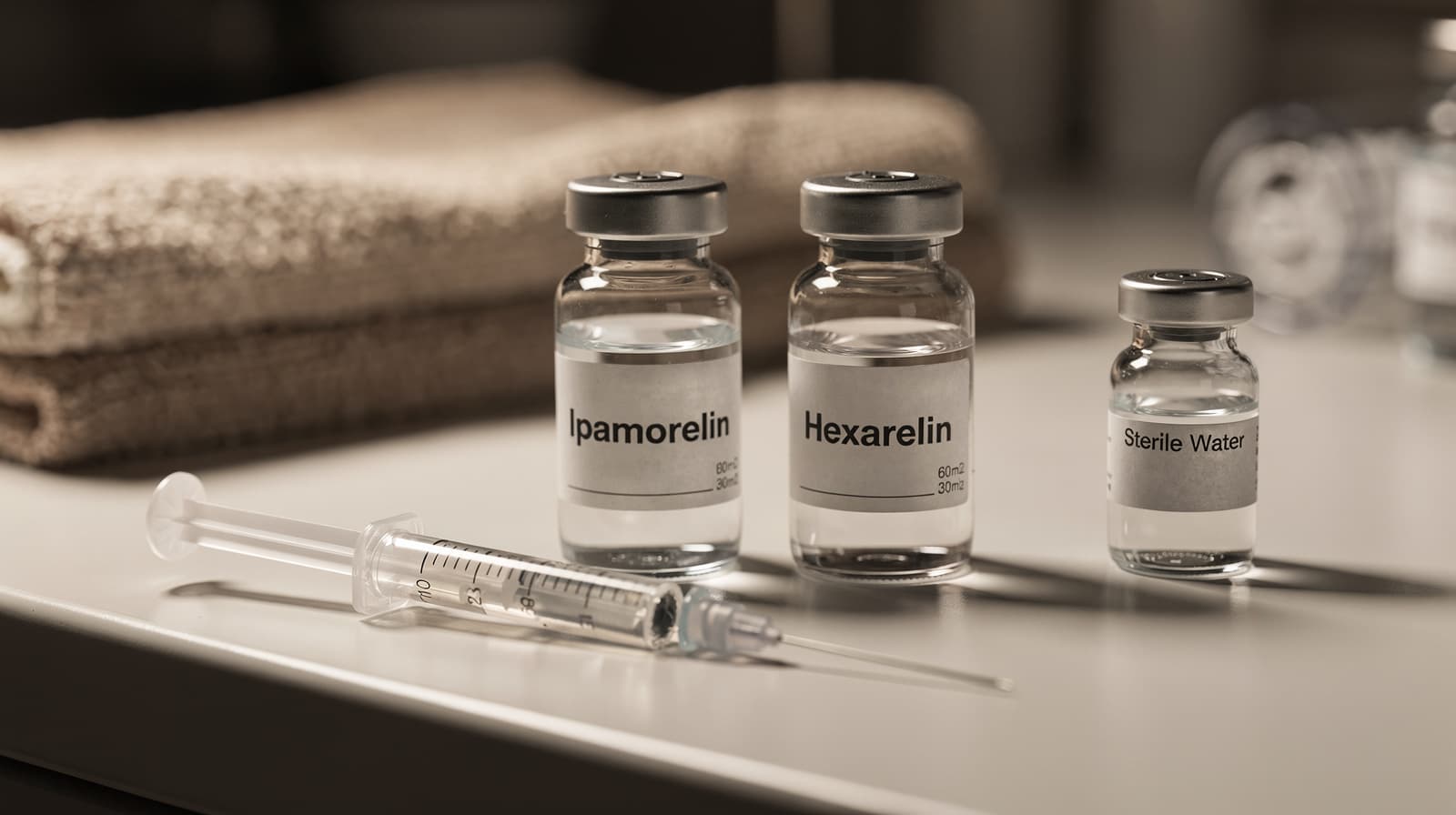
Two GHRPs, two very different personalities. Ipamorelin is the clean signal: a selective ghrelin-receptor agonist engineered to release growth hormone and nothing else. Hexarelin is the raw amplifier: the strongest GH pulse in the class, packaged with a cortisol and prolactin tax that ipamorelin refuses to pay. This comparison walks through mechanism, dosing, evidence, and side-effect trade-offs so the choice reduces to a decision rule rather than a preference.
Key takeaways#
- Ipamorelin is the first GHRP designed to release GH without measurably raising cortisol, prolactin, or ACTH at research doses, making it the "cleanest" option in the class.
- Hexarelin produces a larger GH pulse than ipamorelin at equivalent doses but reliably elevates prolactin and cortisol: in human dose-response work, cortisol rose about 40% from 0.5 µg/kg IV and prolactin rose up to about 180% at 1.0 µg/kg IV.
- Hexarelin uniquely binds cardiac CD36 receptors, giving it GH-independent cardioprotective effects that ipamorelin does not share.
- Hexarelin desensitizes the ghrelin receptor faster than ipamorelin, forcing shorter cycles (typically 4-8 weeks on, 4-8 weeks off) versus longer continuous ipamorelin windows.
- For chronic GH-axis support, ipamorelin is the better starting point; for acute GH provocation or cardiac research, hexarelin is the more specific tool.
How ipamorelin works#
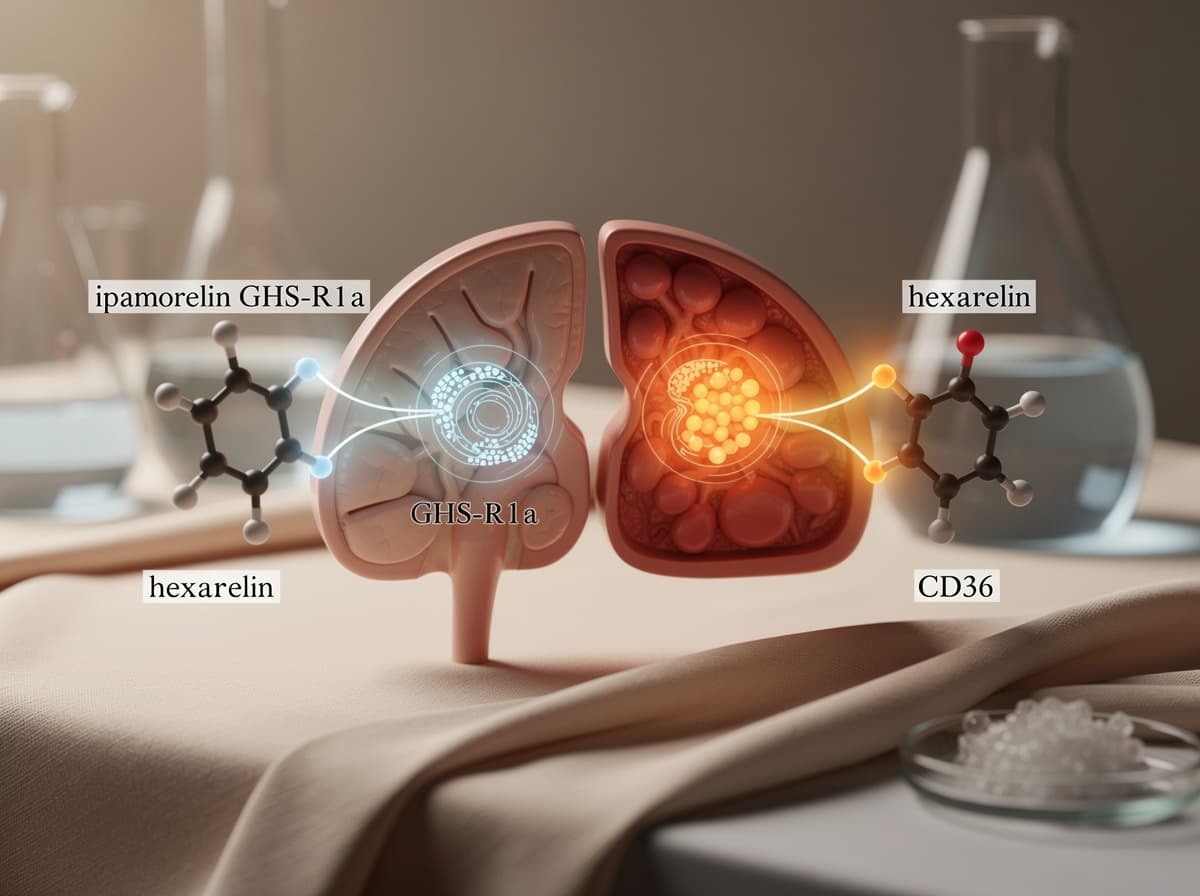
Ipamorelin is a pentapeptide (Aib-His-D-2-Nal-D-Phe-Lys-NH2) that acts as a selective agonist at the growth hormone secretagogue receptor GHS-R1a, the same receptor that binds endogenous ghrelin. It was identified through a Novo Nordisk medicinal-chemistry program by removing the central Ala-Trp dipeptide from GHRP-1, and the resulting molecule keeps the GH-releasing potency of GHRP-6 while shedding the off-target hormonal noise. In the original 1998 characterization, Raun and colleagues reported that in vitro potency and efficacy tracked closely with GHRP-6 (EC50 ≈ 1.3 nmol/L, Emax ≈ 85%), and that in vivo GH release in anaesthetised rats was comparable at an ED50 of roughly 80 nmol/kg.
The selling point is selectivity. Research has shown that ipamorelin releases GH without meaningfully elevating cortisol, ACTH, or prolactin, even at doses exceeding the effective GH-stimulating concentration by more than 200-fold. Because the receptor engagement is narrow, endogenous somatostatin feedback still throttles the pulse, so the peptide amplifies natural pulsatility rather than flattening it into a plateau. Terminal half-life is approximately two hours in healthy men (measured after a 15-minute intravenous infusion, with the GH peak at about 40 minutes; Gobburu et al. 1999), so each dose creates one clean GH pulse that returns to baseline within a few hours.
How hexarelin works#
Hexarelin is a hexapeptide (His-D-2-methyl-Trp-Ala-Trp-D-Phe-Lys-NH2), a super-analog of GHRP-6 with higher receptor affinity and higher GH-releasing potency. Like ipamorelin, it activates GHS-R1a in the pituitary and hypothalamus, but the binding is stronger and the downstream GH pulse is taller. In healthy volunteers, Ghigo and colleagues found that 1.0 µg/kg IV released about twice as much GH as the same dose of GHRH, and 2.0 µg/kg released more still. A separate IV dose-response study by Massoud and colleagues put the GH plateau near 1.0 µg/kg, with prolactin and cortisol rising alongside GH.
Hexarelin's second identity is what makes it interesting outside the GH axis. It binds the CD36 scavenger receptor on cardiomyocytes, an interaction identified when a photoactivatable hexarelin derivative cross-linked to an 84 kDa cardiac binding protein later sequenced as CD36. CD36 activation by hexarelin triggers PI3K/Akt and ERK1/2 signaling, and preclinical data points to reduced cardiomyocyte apoptosis and smaller infarct size in ischemia-reperfusion models, effects that persist even in GH-deficient animals. In the CD36 identification study itself, hexarelin's coronary effect was absent in hearts from CD36-null mice. That mechanistic wrinkle is the reason hexarelin appears in cardiovascular literature while ipamorelin does not.
Dosing: ipamorelin vs hexarelin#
Research-published dosing looks superficially similar but diverges on frequency and cycle length.
For ipamorelin, most research protocols use 100 to 300 mcg per subcutaneous injection, one to three times per day, with a two-hour half-life driving the split-dose approach. Community bodybuilding and anti-aging frameworks commonly settle on 200-300 mcg per day, often split into a morning and pre-bed shot to overlap with the natural nocturnal GH surge. Dose-response flattens above roughly 300 mcg per injection: research suggests more peptide does not add more GH pulse, only more cost and side-effect risk.
For hexarelin, research protocols typically range from 100 to 200 mcg per subcutaneous injection, one to three times daily, with doses above 200 mcg producing minimal additional GH but a disproportionate rise in cortisol and prolactin. The Massoud IV dose-response study put the GH plateau near 1.0 µg/kg, and going higher mainly adds side-effect load. Because hexarelin desensitizes GHS-R1a faster, recommended cycles are 6 to 8 weeks on followed by 4 to 8 weeks off, shorter than the 8 to 12 week cycles typical for GHRP-2 or GHRP-6, and considerably shorter than the continuous windows tolerated with ipamorelin.
Both peptides are administered subcutaneously on an empty stomach because elevated glucose and insulin blunt the GH response. Klarovel's peptide calculator handles the reconstitution math for either compound.
Evidence: what the studies actually show#
No head-to-head randomized trial has compared ipamorelin and hexarelin directly in humans, so the comparison is built from parallel primary data.
On the ipamorelin side, human evidence is limited. Preliminary evidence comes from human pharmacokinetic/pharmacodynamic work and a Phase II trial for postoperative ileus that found no significant difference from placebo (Beck et al. 2014), with most efficacy data drawn from animal models. The pivotal selectivity finding comes from rats and swine: ipamorelin stimulated GH release without raising ACTH or cortisol beyond what GHRH does, even at doses more than 200-fold above the GH ED50 (Raun et al. 1998).
On the hexarelin side, human data is denser but older. Ghigo and colleagues (1994) showed hexarelin releases about twice as much GH as an equal dose of GHRH, and Arvat and colleagues (1997) documented its prolactin, ACTH, and cortisol release from childhood to old age, with the GH response falling in the elderly while the ACTH response did not. The cardiovascular literature is where hexarelin pulls ahead: Bodart et al. (2002) identified CD36 as hexarelin's cardiac binding site, where its activation raised coronary perfusion pressure, an effect absent in CD36-null hearts. Separate ischemia-reperfusion studies in animals report GH-independent cardioprotection, an effect associated with Akt-pathway activation.
Side effects and contraindication profile#
The side-effect ledger is where the two peptides diverge most sharply.
Ipamorelin's profile is dominated by GH-class effects rather than off-target hormones. Reported effects in research and community use include mild headache, transient water retention, tingling in the extremities (paresthesia), and occasionally mild appetite increase. Cortisol, prolactin, and ACTH are not meaningfully elevated at research doses.
Hexarelin carries the same GH-class effects plus a documented cortisol and prolactin bump. In an IV dose-response study in healthy men, cortisol rose about 40% from 0.5 µg/kg and prolactin rose up to about 180% at 1.0 µg/kg (Massoud et al. 1996). Sustained prolactin elevation is associated with sexual side effects, and repeated cortisol spikes are a concern in any protocol targeting recovery or sleep, both of which are cortisol-sensitive. Hexarelin also desensitizes GHS-R1a faster because of higher receptor affinity, and elevated GH and IGF-1 are mitogenic, so individuals with active malignancy or high cancer risk should not use hexarelin. The CD36 pathway adds cardiac-active behavior that is a feature for cardiovascular research and a caution for anyone with unstable cardiac status.
When to choose ipamorelin#
Ipamorelin is the better default when the protocol runs long or the endpoint is cortisol-sensitive.
- Chronic GH-axis support (12+ weeks): the selective profile avoids compounding cortisol and prolactin exposure over time.
- Sleep and recovery protocols: cortisol elevation actively undermines both endpoints, so the "clean" GHRP wins by default.
- Combination stacks with a GHRH analog (CJC-1295 with or without DAC): the pairing hits complementary receptors, and ipamorelin's narrow selectivity keeps the stack hormonally quiet.
- Individuals sensitive to prolactin-driven sexual side effects or with a personal history of elevated cortisol.
When to choose hexarelin#
Hexarelin earns its place when the goal is acute magnitude or cardiac mechanism.
- Acute GH provocation testing where maximum pulse height matters more than hormonal cleanliness.
- Cardiovascular research protocols targeting CD36-mediated cardioprotection, an effect that has been shown to be GH-independent.
- Short, high-amplitude cycles (4-8 weeks) where the researcher accepts cortisol and prolactin bumps as part of the design.
- Comparative studies where hexarelin's higher receptor affinity is the variable being tested.
Can you stack them?#
Stacking ipamorelin with hexarelin is not standard practice because both peptides compete for the same GHS-R1a receptor, so the pairing is redundant rather than complementary. The stack that actually works with either peptide is a GHRH analog (sermorelin, CJC-1295, tesamorelin), which hits the GHRH receptor on the opposite side of the pituitary and produces a supra-additive GH pulse relative to either peptide alone. Running hexarelin and ipamorelin together adds side-effect load from hexarelin without gaining pulse amplitude that hexarelin alone would not already provide.
Verdict#
For most GH-axis protocols, ipamorelin is the better starting point. The selectivity profile means a longer usable cycle, fewer downstream endocrine variables, and a cleaner match with recovery and sleep endpoints where cortisol is antagonistic. Hexarelin is the correct choice in two narrow contexts: acute GH provocation where pulse magnitude is the primary variable, and cardiovascular research where CD36 engagement is the mechanism under investigation. Framed as a decision rule: pick ipamorelin unless the protocol specifically requires either hexarelin's higher GH ceiling or its cardiac receptor activity.
Turn the comparison into a protocol#
The right GHRP is the one that matches the endpoint you can actually measure. Klarovel builds the protocol layer from your health profile, so the choice between ipamorelin and hexarelin becomes a quantified decision rather than a forum-driven guess. Start with the peptide calculator to model dosing for either compound, review how the platform works, and register to build a protocol that reflects your baseline rather than someone else's stack.
Frequently asked questions
Keep reading
Peptides for Inflammation: Mapping BPC-157, KPV, and Thymosins
Peptides for inflammation compared by mechanism and evidence stage: BPC-157, KPV, thymosin alpha-1, and thymosin beta-4, with FDA status and safety notes.
Mounjaro vs Zepbound: Same Drug, Two Different FDA Labels
Mounjaro and Zepbound are the same drug, tirzepatide, at the same doses. The difference is the FDA label: diabetes for Mounjaro, weight loss for Zepbound.
Rybelsus for Weight Loss: Not Approved, and the Pill That Is
Rybelsus is not FDA-approved for weight loss and moves the scale only a little. The oral semaglutide approved for weight loss is the Wegovy pill at 25 mg.