

Two peptides keep showing up in nootropic forums under the same banner of cognitive enhancement, yet they sit on opposite ends of the evidence spectrum. Dihexa is a preclinical curiosity with extraordinary potency claims in rodents and zero completed human pharmacokinetic data. Semax is a Russian-registered intranasal peptide with decades of clinical use behind it. This piece works through the mechanism, dosing, evidence, safety and use-case logic for each, then takes a position.
Key takeaways#
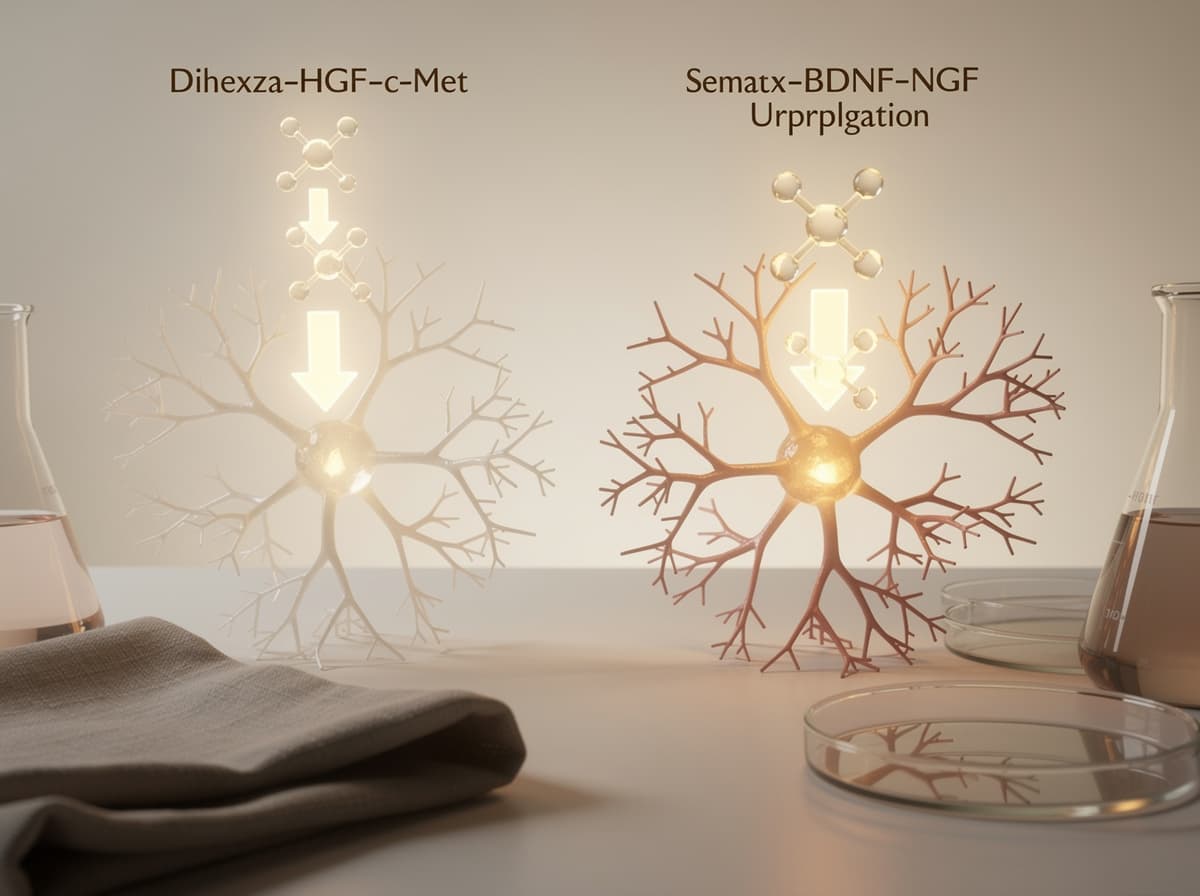
- Dihexa is an orally active angiotensin IV analogue that potentiates the HGF / c-Met system and induces hippocampal synaptogenesis; Semax is an intranasal ACTH(4-7) analogue that drives rapid BDNF and NGF upregulation.
- Research-published Dihexa doses derive almost entirely from rodent work (oral 2 mg/kg/day, intraperitoneal 0.5 mg/kg/day); community oral protocols of 8 to 45 mg daily are not clinically validated.
- Semax research protocols range from 250 to 1000 mcg per intranasal administration, with total daily amounts of 500 to 3000 mcg; Russian acute-stroke protocols reach 6000 mcg per day.
- Semax carries more than 30 years of human clinical use, including stroke-recovery trials; Dihexa has zero published human trials and one retracted paper in its core literature.
- For most cognitive-enhancement use cases, Semax is the better starting point because the human safety record exists and the dosing window is published.
How dihexa works#
Dihexa (developmental code PNB-0408, chemical name N-hexanoic-Tyr-Ile-(6) aminohexanoic amide) is a modified dipeptide (Tyr-Ile with an N-terminal hexanoyl cap and a C-terminal aminohexanoic amide) derived from the six-residue angiotensin IV, engineered at Washington State University to cross the blood-brain barrier while resisting enzymatic clearance. Its proposed mechanism is indirect: rather than agonising c-Met directly, it was reported to bind hepatocyte growth factor with high affinity (Kd around 65 pM) and potentiate HGF activity at the c-Met receptor, augmenting c-Met phosphorylation at subthreshold HGF concentrations without activating c-Met on its own. Those figures come from Benoist et al. 2014, which was retracted in April 2025 for falsified data, so the mechanism is best read as a hypothesis.
Downstream of c-Met, the HGF axis drives hippocampal spinogenesis and synaptogenesis. Preclinical data has shown that dihexa induces dendritic spine formation in cultured hippocampal neurons and reverses scopolamine-dependent spatial learning deficits in rats. Pharmacokinetic work in Sprague-Dawley rats has shown a circulating half-life of roughly 12.7 days after intravenous administration and 8.8 days after intraperitoneal administration, an unusually long persistence for a peptide. The compound is orally active because of the hexanoic and aminohexanoic modifications, which both extend metabolic stability and support transcellular transport.
What dihexa does not have: a completed human pharmacokinetic study, a published clinical trial, or a regulatory approval anywhere in the world. Its evidence base is also weaker than it was two years ago. The most cited paper supporting its synaptogenic claim, Benoist et al. 2014 in the Journal of Pharmacology and Experimental Therapeutics, received a notice of concern in 2021 and was formally retracted in April 2025. The earlier paper from the same laboratory that introduced dihexa, McCoy et al. 2013, carries an expression of concern of its own and has not been retracted. The rodent synaptogenesis finding is therefore better treated as unsettled than as established, and the human question remains entirely open.
How semax works#
Semax is a synthetic heptapeptide with the sequence Met-Glu-His-Phe-Pro-Gly-Pro, derived from the N-terminal fragment 4-7 of adrenocorticotropic hormone with a C-terminal Pro-Gly-Pro tail that resists peptidase degradation. It was developed at the Institute of Molecular Genetics of the Russian Academy of Sciences in the 1980s and has been a registered prescription product in Russia since the 1990s for ischemic stroke recovery and cognitive impairment.
The central mechanism is rapid upregulation of BDNF and NGF mRNA expression in the hippocampus and frontal cortex within hours of a single intranasal dose. Dolotov and colleagues, writing in the Journal of Neurochemistry, demonstrated that intranasal Semax increases BDNF protein in rat basal forebrain and identified specific calcium-dependent binding sites for the peptide with a dissociation constant near 2.4 nM. Downstream of the neurotrophin surge, Semax modulates dopamine turnover in the striatum and produces measurable changes in attention and working memory performance.
Pharmacokinetically, Semax is the opposite of dihexa. Plasma half-life is two to three minutes; oral bioavailability is effectively zero because gastric and small-intestinal peptidases destroy the peptide on contact. Intranasal delivery provides partial direct nose-to-brain transport through olfactory and trigeminal pathways alongside systemic absorption. Neurotrophin effects persist 24 hours or more after the peptide itself has cleared, the classic pattern of a transcriptional modulator.
Dosing: dihexa vs semax#
Dihexa. Research-published doses come almost entirely from rodent work. The McCoy 2013 evaluation in the Journal of Pharmacology and Experimental Therapeutics established procognitive activity at high oral and intraperitoneal doses in scopolamine-impaired rats, with strong performance improvements over the impaired control groups and equivalence to vehicle controls at oral 2.0 mg/kg/day and intraperitoneal 0.5 mg/kg/day (USPTO 9051351). No human pharmacokinetic study has been completed. Community protocols cluster around 8 to 45 mg orally daily, cycled, but these figures have no clinical validation and should be read as anecdotal community practice rather than research-published doses.
Semax. Russian clinical protocols and the international research community converge on a 250 to 1000 mcg per administration window. A dose range of 250 to 1000 mcg per administration, one to three times daily, delivered intranasally, with total daily research doses typically sitting between 500 and 3000 mcg, is the standard reference frame. The stroke-recovery upper bound reaches 6000 mcg per day in published Russian protocols, cycled in 10-day blocks with washout periods. Plasma half-life is two to three minutes; downstream BDNF and NGF effects persist 24 hours or more.
The cadence difference matters. Dihexa is dosed for steady-state accumulation because of its multi-day half-life. Semax is dosed for pulsed transcriptional events: the peptide clears fast, the gene-expression downstream effects persist, and re-dosing in 12 to 24 hour windows compounds the neurotrophin signal without runaway plasma exposure.
Evidence: what the studies actually show#
Dihexa preclinical record. The strongest data sits in rodent cognition models. Spatial learning recovery in aged and scopolamine-impaired rats, hippocampal spine density increases in cultured neurons, and a single APP/PS1 mouse study at 1.44 and 2.88 mg/kg intragastric over three months showing restored cognitive function, reduced neuronal loss, and suppressed glial activation. The often-quoted claim that dihexa is seven orders of magnitude more potent than BDNF in a neurotrophic assay comes from a 2012 Washington State University press release accompanying the McCoy paper; the paper itself does not report a head-to-head comparison with BDNF, and the figure has not been independently replicated. No randomised controlled trial in humans exists. No phase 1 pharmacokinetic data in humans exists.
Semax human evidence. Russian clinical work covers acute ischemic stroke, optic nerve disorders, and cognitive enhancement in healthy adults. The clinical record spans more than 30 years, and Semax has been a registered prescription product in Russia since the 1990s. Independent Western replication is sparse, and most clinical data appears in Russian-language journals. Stroke-recovery protocols at 6000 mcg/day for 10-day cycles have been associated with improved neurologic recovery scores without significant adverse-event signals in the published Russian dataset.
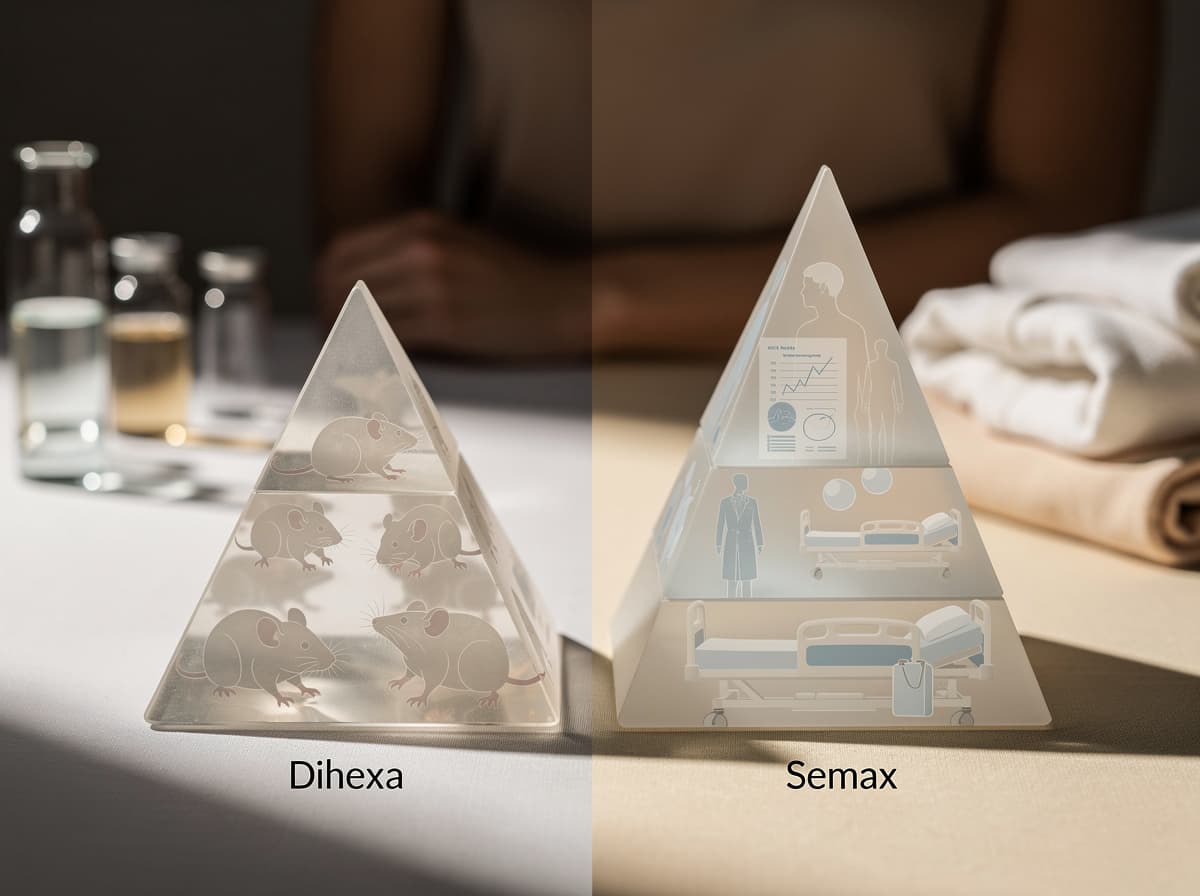
Head-to-head. No direct comparative trial exists. The decision rule comes from translation strength: Semax has been shown in humans to produce the neurotrophin and behavioural effects that dihexa has only been shown to produce in rodents.
Side effects and contraindication profile#
Dihexa. The published safety data is limited to short-duration rodent studies referenced in the Washington State patent filings. No human adverse-event registry exists. Community-reported side effects from oral protocols include headache, irritability, and sleep disturbance at higher doses, but these are preliminary evidence drawn from forums rather than controlled trials. The HGF / c-Met pathway is implicated in cancer biology, and chronic potentiation in humans carries theoretical proliferation risk that has not been characterised in clinical work. Contraindications cannot be enumerated because the human safety profile has not been studied.
Semax. The Russian clinical safety profile across more than three decades is benign. Reported side effects are mild and infrequent: transient nasal irritation, occasional headache, and rare reports of mild irritability or sleep disturbance. The intranasal route limits systemic exposure. Preclinical data points to no significant cardiovascular, hepatic, or renal toxicity at therapeutic doses. Pregnancy and pediatric use lack adequate documentation in the Western literature and should be avoided outside specific Russian clinical indications.
The asymmetry is structural. Semax has a human safety record because humans have been using it for thirty years under regulatory oversight. Dihexa does not.
When to choose dihexa#
Dihexa fits a narrow research-context profile:
- Preclinical investigators studying HGF / c-Met-driven synaptogenesis who need an orally bioavailable, BBB-penetrant tool compound.
- Researchers modelling dendritic spine dynamics in hippocampal slice or cultured neuron preparations where direct HGF delivery is impractical.
- Comparative pharmacology studies positioning angiotensin IV analogues against established neurotrophic factors.
- Cognitive-enhancement self-experimenters who accept that they are operating without human pharmacokinetic data and are willing to absorb the theoretical c-Met-related risk.
Dihexa is not a first-line choice for general cognitive support, age-related cognitive concerns, or post-stroke recovery scenarios where evidence-based options exist.
When to choose semax#
Semax fits a broader and better-evidenced profile:
- Cognitive enhancement in healthy adults seeking BDNF and NGF upregulation with a published dosing window and a multi-decade safety record.
- Attention and working-memory support where dopaminergic modulation is desirable without serotonergic anxiolytic effects.
- Post-stroke cognitive recovery research, where the Russian clinical protocols provide a published framework.
- Stack design where rapid neurotrophin induction is the desired pharmacology and an intranasal delivery route is acceptable.
The trade-off is route: intranasal dosing several times daily is logistically less convenient than oral capsules. Most users adapt quickly.
Can you stack them?#
Mechanistically, dihexa (HGF / c-Met potentiation) and Semax (BDNF / NGF mRNA upregulation) hit different upstream nodes that converge on synaptic plasticity. There is no published research-protocol that combines them in humans or animals. Stacking is not standard practice because two independent neurotrophic stimuli with limited combined safety data multiply the unknown rather than the benefit. The c-Met pathway and the TrkB / TrkA pathway have distinct cancer-relevant signalling profiles, and chronic dual potentiation has not been characterised in any controlled study. For research contexts, run them separately and document each in isolation before considering combination.
Verdict#
For most cognitive-enhancement and neuroprotection contexts, Semax is the better starting point because it has a published dosing window, a 30-year human safety record, and a documented BDNF / NGF mechanism that has been shown to translate from rodents to humans. Dihexa is the more interesting tool compound for HGF / c-Met research, and its synaptogenesis claim is mechanistically novel, but it remains a preclinical molecule without human pharmacokinetic data, without a completed clinical trial, and with a partially retracted core literature. Choose Semax if your goal is a research-validated nootropic peptide. Choose dihexa only if you are running HGF-pathway-specific research and accept the absence of human data as part of the experimental design.
Run your decision through the calculator before you commit#
Both peptides demand precise reconstitution math and disciplined cycling. Run any candidate protocol through the peptide calculator to verify the per-dose volume against the concentration you plan to reconstitute, and complete the intake questionnaire so the protocol layer matches your health profile rather than a forum thread. Klarovel does not sell peptides; the disclosures page explains how it works. For the deeper mechanism breakdown on each compound, see the dihexa complete guide and the semax complete guide, and review how Klarovel works before registering an account. The right answer between these two is the one your data actually supports.
Frequently asked questions
Keep reading

Peptides for Inflammation: Mapping BPC-157, KPV, and Thymosins
Peptides for inflammation compared by mechanism and evidence stage: BPC-157, KPV, thymosin alpha-1, and thymosin beta-4, with FDA status and safety notes.
Mounjaro vs Zepbound: Same Drug, Two Different FDA Labels
Mounjaro and Zepbound are the same drug, tirzepatide, at the same doses. The difference is the FDA label: diabetes for Mounjaro, weight loss for Zepbound.
Rybelsus for Weight Loss: Not Approved, and the Pill That Is
Rybelsus is not FDA-approved for weight loss and moves the scale only a little. The oral semaglutide approved for weight loss is the Wegovy pill at 25 mg.