

Russia approved Semax peptide in the early 1990s for ischemic stroke and cognitive disorders, and Russian neurologists have run controlled clinical trials of the compound in stroke wards ever since (Gusev et al., PubMed 11517472). Three decades later, the FDA, the EMA, and Norway's DMP have authorized none of it. That gap, between a Semax peptide with thirty years of clinical use in one country and zero approvals everywhere else, is where any honest conversation about it has to start.
Semax peptide is a seven-amino-acid fragment of ACTH approved in Russia and unscheduled almost everywhere else#

The active sequence is Met-Glu-His-Phe-Pro-Gly-Pro: four amino acids that match the fourth through seventh residues of adrenocorticotropic hormone, plus a Pro-Gly-Pro tail that resists enzymatic breakdown (PubMed 15344653). Researchers at the Russian Institute of Molecular Genetics built that tail in the 1980s precisely because the native ACTH(4–10) fragment was metabolized within seconds. Adding Pro-Gly-Pro stretches the functional window long enough for a neuroprotective response to take hold, even though the peptide itself still clears from plasma fast (more on that paradox below).
Russia has approved Semax for clinical use across several indications: ischemic stroke and transient ischemic attack, cognitive and memory disorders, optic nerve atrophy, and certain peptic ulcers (Polunin et al., PubMed 10741256). The Russian government later placed Semax on its national essential-medicines list, putting it on the same regulatory tier as the medicines the state guarantees access to.
Outside Russia and Ukraine, the regulatory picture is empty. The US FDA has not approved Semax for any indication. It left the FDA's Category 2 list in April 2026, and on 24 July 2026 an FDA advisory committee voted 8 to 5 to recommend it for the 503A compounding list (FDA, 2026), but no rule has followed, so it cannot yet be compounded (status on the regulatory status tracker). The EMA has not authorized it. Norway's DMP has not registered it as a medicinal product. The clinical-evidence package that satisfied Russian regulators in the 1990s was never submitted to Western agencies, and the original patent expired before any Western firm had reason to invest in the multi-hundred-million-dollar trials that approval would require. Generic competitors would arrive the day approval did.
This regulatory contradiction is not a fringe technicality. It defines how Semax is sourced, classified, and discussed in 2026: as a research peptide in most of the world, with the genuine clinical evidence trapped behind a language barrier and a patent timeline that never lined up with Western drug development.
Semax raises BDNF in the basal forebrain within three hours of intranasal dosing#
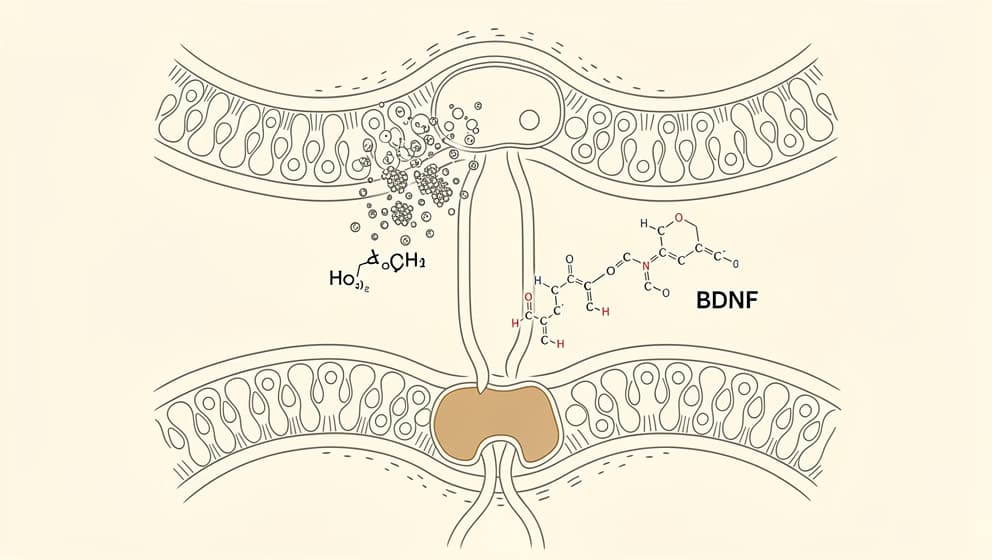
The class-defining mechanism of cognitive peptides is neurotrophic signaling, and Semax is one of the cleanest examples. A 2006 study in Brain Research applied intranasal Semax at 50 and 250 µg/kg bodyweight to rats and measured BDNF protein levels across brain regions (Dolotov et al., PubMed 16635254). At three hours post-dose, BDNF rose specifically in the basal forebrain, with no equivalent change in the cerebellum. The same paper documented specific binding to basal forebrain cell membranes with a dissociation constant (Kd) of 2.4 nM, suggesting a defined receptor interaction rather than a generic stimulating effect.
Research has shown the Semax BDNF response is not isolated. A separate study in the rat hippocampus reported that Semax modulates not only BDNF but also its receptor TrkB, the kinase that translates BDNF binding into structural plasticity (Dolotov et al., PubMed 16996037). The two effects together form a coherent picture: more BDNF, more receptors to read it, and the downstream gene-expression cascade that BDNF/TrkB signaling drives.
A more recent paper in a rat model of focal cerebral ischemia reinforced the time course in damaged tissue. After permanent middle cerebral artery occlusion, Semax at 100 µg/kg raised BDNF transcription at three hours and NGF transcription at 24 and 72 hours, selectively in the ischemic cortex rather than across the whole brain (Dmitrieva et al., PMC 11498467). Selectivity matters. A peptide that nudges neurotrophin production where damage exists is more useful than one that floods the entire brain at once.
Preclinical data points to Semax interacting with the melanocortin receptor family as well, competitively antagonizing α-melanocyte-stimulating hormone at MC4 and MC5. The functional consequence is debated, but it places Semax inside a receptor system that touches stress, inflammation, and reward pathways, in addition to the BDNF-driven plasticity story that defines the Semax BDNF data.
The pharmacokinetic paradox: a five-minute plasma half-life that produces 24-hour effects#
Semax clears from plasma in two to five minutes. By conventional dosing logic that should make it useless, requiring a redose every quarter of an hour. The effects do not behave that way: research suggests neurotrophin-driven changes persist for roughly 20 to 24 hours after a single intranasal dose. The peptide is a trigger rather than a sustained agent. It binds, starts a signal, and is degraded, and the signal then propagates through the slower kinetics of transcription and protein synthesis.
The route matters mechanically too. Beyond bypassing first-pass metabolism, intranasal delivery opens a partial nose-to-brain pathway through the olfactory and trigeminal systems, so some of the dose reaches the central nervous system without entering systemic circulation. That is why the Russian clinical literature uses it throughout.
Intranasal and subcutaneous are different arithmetic, not different flavours#
Klarovel's engine records Semax as intranasal on all five experience tiers. That decides which sum you do.
| Intranasal solution | Subcutaneous | |
|---|---|---|
| Supplied as | 0.1% or 1% solution, dropper bottle | Lyophilised powder in a vial |
| You measure | Drops | Syringe units |
| Strength comes from | The % printed on the bottle | Vial mg divided by water added |
| The conversion | % w/v x 10 = mg/mL, then x 1000 x drop volume = mcg per drop | mcg to mL to units |
The one piece of arithmetic worth memorising: X% w/v means X grams per 100 mL, so the multiplier is ten. A 0.1% solution is 1 mg/mL. At a typical 0.05 mL drop that is 50 mcg per drop, so a 300 mcg dose is six drops, three per nostril. A 1% solution is ten times stronger, 500 mcg per drop, and the same 300 mcg dose is no longer deliverable in whole drops.
Drop volume varies by dropper, which is why it belongs in the sum rather than being assumed. The Semax dosage calculator does this arithmetic against the engine dose table.
The PK paradox does not change that math; it changes what the math is for. The goal is reliable daily exposure to a trigger, not steady-state plasma concentration.
Russian stroke trials underpin the clinical record, but Western RCTs do not yet exist#
Every Semax clinical trial indexed on PubMed is Russian, and there are four of them. This is the whole ledger.
| Trial | Design | n | Indication | Dose and route | Outcome reported | Replicated outside Russia |
|---|---|---|---|---|---|---|
| Gusev 1997 | Controlled, not randomised | 30 vs 80 controls | Acute hemispheric ischemic stroke | 12 mg/day (moderate), 18 mg/day (severe), 5 to 10 days | Faster regression of focal motor and general cerebral disorders | No |
| Polunin 2000 | 3 groups, drops vs electrophoresis vs control | not stated | Optic nerve disease and partial atrophy | Intranasal drops | Improved visual acuity, visual field, colour vision | No |
| Serdiuk 2007 | Open-label, sequential groups | 27 | Motor neuron disease | 12 mg/day, 1% solution, intranasal, two 10-day courses | Inconclusive on efficacy; concluded short-interval EMG is unsuitable for monitoring | No |
| Gusev 2018 | Controlled subgroups, early vs late rehab | 110 | Post-stroke rehabilitation | 6,000 mcg/day, two 10-day courses | Raised plasma BDNF regardless of rehabilitation timing | No |
Three things follow, and the third is the one that matters most to a reader deciding what to take.
Four is the entire indexed clinical record. PubMed holds 231 Semax records. 105 are Russian-language, and only these four carry a clinical-trial publication type. The English-language work is real but mechanistic: stem-cell models, ischaemia transcriptomics, copper-binding chemistry, default-mode-network imaging. None of it replicates a clinical endpoint.
The replication column is empty on purpose. No trial above has been repeated outside Russia. Part of that is economics rather than scepticism: the original patent expired before any Western developer could justify the cost, and a generic landscape removes the exclusivity that funds approvals.
The trial doses are not the doses people take for cognition. These trials ran 6,000 to 18,000 mcg daily, in acute neurology, under supervision. The dose table further down this page runs 200 mcg at the starting tier to 3,000 mcg at the experienced ceiling, which is between two and sixty times lower. The Russian record is evidence that the molecule does something in stroke and optic-nerve injury. It is not evidence for the nootropic dose range, and treating it as though it were is the most common error in writing about this compound.
For readers tracking the broader cognitive-peptide evidence base, Klarovel's pillar on cognitive peptides puts Semax in context with Selank, DSIP, and Cerebrolysin: the four compounds with enough human data to discuss seriously, in descending order of trial weight.
Thirty years of clinical use produced a narrow side-effect profile, with one specific exception#
The longest-running case for Semax safety is its Russian clinical record. Across three decades of stroke-ward and cognitive-disorder use, the reported Semax side effects remain narrow and the most common issues track the route of administration. Intranasal Semax causes nasal irritation, occasional burning, and runny nose in a meaningful minority of users. Russian clinical observations have noted nasal mucosa discoloration in approximately 10% of patients, typically reversible after discontinuation.
Headaches, mild and transient, are the next most common complaint. Insomnia appears when Semax is dosed late in the day, which is consistent with its pro-attention pharmacology rather than a paradoxical effect. Mild nausea and dizziness round out the typical list.
The specific exception is glucose. In clinical observations, approximately 7.4% of diabetic patients showed transient blood glucose elevation associated with Semax administration. The effect is not large but it is consistent enough to warrant attention in anyone using insulin or sulfonylureas. Semax has also produced transient blood pressure increases at the higher end of dosing, particularly in the multi-milligram-per-day stroke protocols rather than the lower Semax nootropic ranges.
What the literature does not show, after thirty years, is severe organ toxicity, dependence, or rebound effects after discontinuation. That is a meaningful piece of evidence in its own right, even if it does not substitute for the controlled trials that would let a Western regulator make a positive ruling.
Semax peptide benefits, weighed against the evidence quality#
The claims cluster around three things: cognitive performance, BDNF-driven neurotrophic support, and post-stroke recovery. The mechanism work is the cleanest of the three, with a defined receptor-binding profile and a documented three-hour rise in basal-forebrain BDNF after intranasal dosing. The stroke claim rests on the trials in the ledger above. The cognitive-performance claim, particularly attention and memory under stress, is the weakest: it is the one indication with no trial of its own at any dose.
A common search variant worth disambiguating is N-acetyl Semax peptide, sometimes labeled with an amidated tail. The N-acetyl Semax peptide variant is a stabilized analogue marketed primarily by research-chemistry vendors; the bulk of the published Russian clinical literature refers to the unmodified Semax peptide rather than the N-acetyl form. When evaluating product listings, knowing which variant is in the vial matters more than the surface-level naming.
Norwegian customs treats Semax peptide like every other unlicensed compound, regardless of its Russian approval#
In Norway, Semax sits inside the same legal architecture as every other peptide without a Norwegian marketing authorization. DMP has not registered Semax as a medicinal product. The EMA has not authorized it. That places Semax under forskrift 2004-11-02-1441 § 3-2, which prohibits postal import of medicines, prescription or over-the-counter, into Norway. Tolletaten enforces this at customs by seizing and destroying packages.

The 2025 addition of BPC-157 to the Norwegian Medicines Agency's named stop-list set the precedent that the agency will explicitly call out specific compounds when it sees enough import volume to warrant action. Semax is not currently named in the same way, but the underlying legal framework is identical. Buying Semax from a research-chemistry vendor and shipping it to a Norwegian address sits inside the same forskrift, with the same enforcement at customs, regardless of how the package is labeled.
There is also a quality-control axis to consider. Independent third-party assays of unlicensed research peptides regularly find purity and content variations of 20% or more from labeled values, with occasional endotoxin issues. A pharmacy product manufactured under Russian Ministry of Health oversight is not the same molecule, in practical terms, as a vial labeled "Semax" purchased through an unlicensed reseller. The risk is not abstract.
For Norwegian readers researching this class, the practical conclusion mirrors the one in Klarovel's guide on the legal status of peptides in Norway: the current 2026 framework leaves no compliant import route for Semax. The path forward is either a Norwegian-licensed peptide product (where one exists for a given indication) or no peptide at all.
Direct comparisons: Cerebrolysin vs semax, Dihexa vs semax, P21 vs semax, Semax vs selank.
Where Semax peptide fits in Klarovel's broader cognitive peptide framework#
Three decades of Russian clinical use, real mechanism evidence in the BDNF/TrkB pathway, and zero approvals in the systems that govern Norwegian residents. None of those facts cancel each other out. The Russian neurology literature is genuine, the Western evidence gap is genuine, and any guide that resolves the tension is simplifying.
Complete the Klarovel questionnaire to see what the engine recommends from a full health profile rather than a single compound's reputation.
Frequently asked questions
Keep reading
Kisspeptin Peptide: What Human Trials Show About HPG Axis
Kisspeptin peptide switches on the brain's reproductive axis. See what human trials actually show about LH timing, testosterone, and dosing limits.
LL-37 Peptide: Evidence, Risks, and Unanswered Questions
LL-37 peptide kills bacteria by rupturing membranes, but human evidence stops at topical ulcer trials and one gene-therapy study, not injections.
Wegovy Pill: How It Works, How to Take It, and Results
The Wegovy pill is semaglutide 25 mg taken daily, FDA-approved for weight loss in December 2025. How to take it, how well it works, and how it compares.