

Tesofensine is an oral, once-daily small molecule, not a peptide and not a GLP-1 drug, that is not approved anywhere: in its 24-week Phase 2 trial, 0.5 mg produced 9.2 percentage points more weight loss than diet plus placebo. It blocks the reuptake of dopamine, norepinephrine and serotonin, and its main safety signal is a raised resting heart rate. Its most advanced application, in Mexico, was resubmitted in February 2025 after a first-round refusal. This guide walks through the mechanism, the trial data, the safety picture, and how it compares to semaglutide and tirzepatide in 2026.
Key takeaways#
- Tesofensine is a small-molecule triple monoamine reuptake inhibitor blocking dopamine, serotonin, and norepinephrine transporters simultaneously, making it a distinct pharmacological class from GLP-1 agonists.
- In the 24-week Phase 2 TIPO-1 trial, tesofensine 0.25 mg, 0.5 mg and 1.0 mg produced mean weight loss 4.5, 9.2 and 10.6 percentage points greater than diet plus placebo (placebo group: 2.0%).
- The compound is oral, once daily, and does not require injection or titration.
- The main safety signal is a resting heart rate increase of 7.4 bpm at the 0.5 mg dose; blood pressure did not rise significantly at 0.25 or 0.5 mg in Phase 2.
- Regulatory status remains regional. Saniona's partner Medix completed a Phase 3 trial in Mexico; COFEPRIS did not approve the first filing, and Medix resubmitted the full dossier in February 2025. No approval has been announced.
Tesofensine is a triple monoamine reuptake inhibitor, not a peptide or GLP-1#
The primary keyword mechanism matters because it defines everything else about the compound's profile. Tesofensine (also known as NS2330) is a triple monoamine reuptake inhibitor originally developed by the Danish company NeuroSearch, which sponsored the Phase 2 obesity trial. It blocks the reuptake transporters for dopamine (DAT), norepinephrine (NET), and serotonin (SERT) at the presynaptic terminal, raising synaptic concentrations of all three neurotransmitters.
The clinical story started as a detour. Tesofensine was originally in development for Parkinson's disease and Alzheimer's disease; efficacy in those indications was underwhelming, but trial participants lost meaningful weight, which redirected the program toward obesity. Research suggests the appetite-suppressing effect is driven primarily by indirect stimulation of α1 adrenoceptor and dopamine D1 receptor pathways. In a diet-induced obese rat model, tesofensine-induced hypophagia was almost completely reversed by prazosin (α1 antagonist) and partially blocked by SCH23390 (D1 antagonist), while α2, D2, D3, and 5-HT2A/C antagonists had no effect.
That receptor mapping matters. It means the anorectic effect does not depend on serotonergic satiety in the way older agents like sibutramine did; it depends on noradrenergic and dopaminergic reward-circuit modulation. This is why tesofensine is often called a "fourth-class" weight-loss compound, distinct from GLP-1 agonists, older sympathomimetics, and lipase inhibitors.
TIPO-1 defined the efficacy signal at 24 weeks#
The reference dataset is still the 2008 Astrup trial published in The Lancet. In a 24-week randomized, double-blind, placebo-controlled Phase 2 study across five Danish obesity centres, 203 obese patients (BMI 30 to 40) were assigned to tesofensine 0.25 mg, 0.5 mg, 1.0 mg, or placebo once daily alongside an energy-restricted diet.
The primary outcome was clean. Diet plus placebo produced 2.0% weight loss, and the three tesofensine doses produced mean weight loss 4.5%, 9.2%, and 10.6% greater than that, respectively. At the middle dose that later became the target for Phase 3, patients lost roughly 11 kg over six months, and heart rate rose by 7.4 beats per minute. A 2009 published evaluation of the trial concluded that tesofensine 0.5 mg may cause almost double the weight loss observed with sibutramine or rimonabant, which was the benchmark comparison at the time.
Body composition data mattered too. Weight loss was predominantly fat mass with relative preservation of lean body mass, a favorable profile compared to interventions where muscle loss can be substantial. Quality-of-life measures (physical functioning, self-esteem, sexual life) also improved in the active arms. Studies have shown that in overweight and moderately obese men, tesofensine has a pronounced effect on appetite sensations and a slight effect on energy expenditure at night, and both effects can contribute to the strong weight-reducing effect.
It is worth flagging that The Lancet published an expression of concern about the 2008 paper in 2013, after a Danish Health and Medicines Authority inspection. The inspection found that headache, migraine, stress and depression were under-recorded as adverse events, and also raised informed-consent and blinding issues at individual sites. The authors stated that the inspection found the primary and secondary efficacy endpoints and serious adverse events were reported in accordance with source data. This is one of several reasons the compound is best framed as an active investigational asset rather than an established option.

How tesofensine compares to semaglutide and tirzepatide#
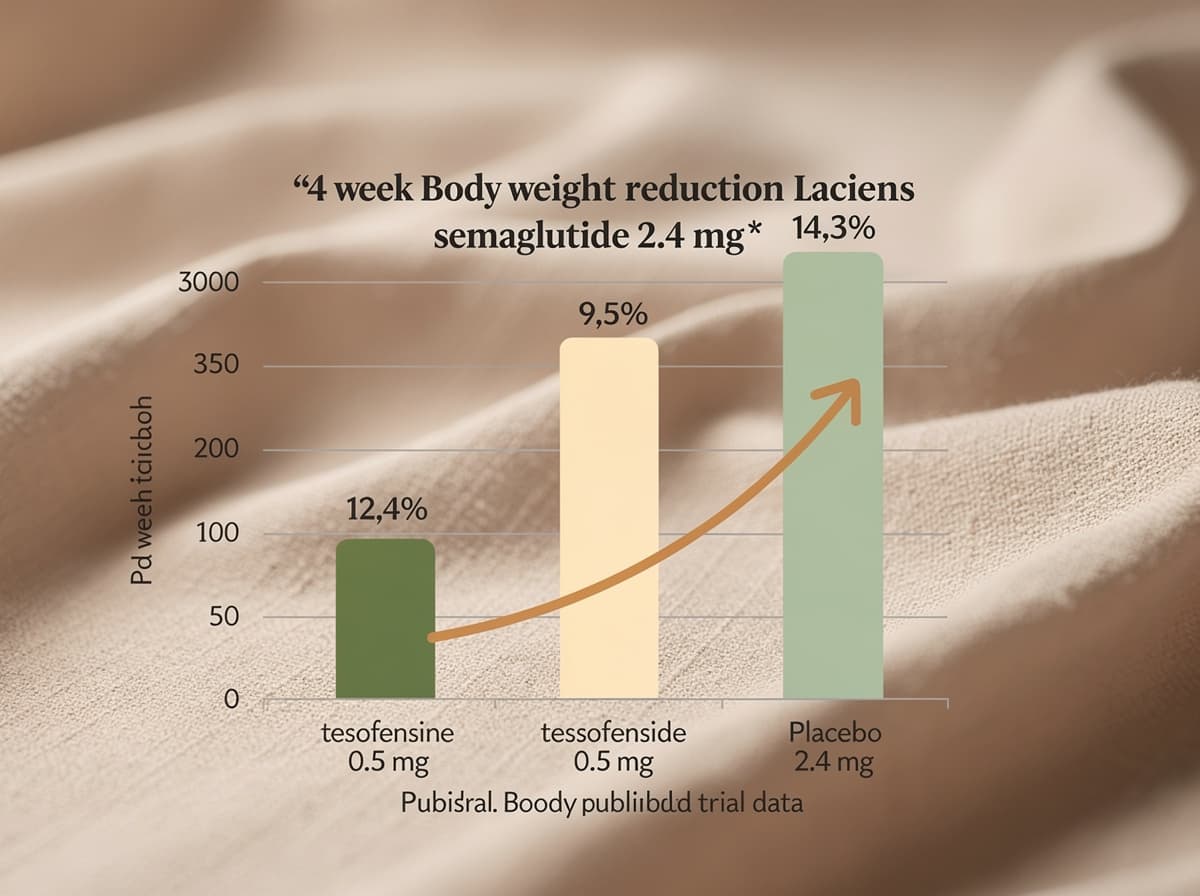
This is the question every reader arrives with. The honest answer: total weight loss over long time horizons favors the incretin agents, but tesofensine reaches similar territory faster and without injections. Wegovy (semaglutide 2.4 mg) produced roughly 15% body-weight reduction over 68 weeks in the STEP program, and a recent meta-analysis found that tirzepatide is significantly superior to semaglutide for weight reduction, with higher odds of achieving at least 10% weight loss.
Tesofensine's placebo-adjusted 9.2 to 10.6 points at 24 weeks is in that neighborhood on a per-month basis. Saniona's pipeline page describes tesofensine 0.5 mg as producing weight loss "in the same ballpark of some of the best GLP-1 analogs" and, unlike GLP-1s, provided as tablets with no titration requirement.
Practical differences that matter for a research or protocol context:
- Route: tesofensine is oral once daily; semaglutide 2.4 mg is a weekly subcutaneous injection.
- Titration: GLP-1 agonists require a multi-month up-titration to manage nausea. Tesofensine was studied at fixed daily doses.
- Side-effect profile: GLP-1 side effects concentrate on GI (nausea, vomiting, constipation). Tesofensine side effects concentrate on sympathetic activation (heart rate increase, dry mouth, insomnia).
- Muscle preservation: both classes preserve lean mass reasonably well; the incretin class is being paired with resistance training and, increasingly, with myostatin-pathway compounds in research settings.
- Regulatory status: semaglutide and tirzepatide are approved for chronic weight management in the US, EU, and most jurisdictions. Tesofensine is not.
Preliminary evidence suggests the two mechanisms could be complementary rather than competitive. GLP-1s slow gastric emptying and act on hindbrain satiety circuits; tesofensine acts on forebrain reward and hypothalamic appetite circuits. No head-to-head trial has been published.
Doses studied were narrow, and the safety signal is cardiovascular#
The Phase 2 and Phase 3 program tested a narrow range. Doses evaluated were 0.25 mg, 0.5 mg, and 1.0 mg once daily, and the 0.5 mg dose became the reference because it captured most of the efficacy of 1.0 mg with a milder cardiovascular signal. Titration was not required; tablets were taken as fixed daily doses.
The 1.0 mg arm was dropped from Phase 3. Saniona's completed Phase 3 program studied only 0.25 mg and 0.5 mg once daily, confirming the efficacy and safety profile observed at those doses in Phase 2. That is the dose window that any future regulatory label, if approval is granted anywhere, is likely to reflect.
The dominant safety concern is cardiovascular. Norepinephrine reuptake inhibition activates peripheral adrenergic signaling, which raises resting heart rate and, to a lesser extent, blood pressure. Preclinical data points from a rat study demonstrated that tesofensine causes elevations in heart rate and blood pressure by increasing sympathetic activity, and that different adrenoceptor subtypes may be responsible for the anti-obesity and cardiovascular effects. That mechanistic split is what motivated the Tesomet program.
Tesomet is a fixed-dose combination of tesofensine and metoprolol, a β1-selective cardio-selective adrenoceptor blocker. Regulatory documentation notes that any increase in HR and/or BP constitutes an unacceptable safety risk for endocrine and metabolic approvals, and Saniona decided not to develop tesofensine as a stand-alone therapy, instead pursuing the combination product to mitigate the increases in BP and HR. Tesomet is now positioned toward rare eating disorders rather than general obesity.
Beyond cardiovascular effects, the side effects most commonly reported in trials are dry mouth, insomnia, nausea, constipation, and headache. Psychiatric events (anxiety, mood shifts) have been observed, particularly at higher doses, which is why active mood-disorder history is generally treated as a contraindication in research settings. Tesofensine has a long elimination half-life of roughly 8 days, meaning any dose adjustment takes weeks to fully wash out.
Regulatory status is regional and unfinished#
Tesofensine has never received a US or EU marketing authorization. The most advanced regulatory route has been through Mexico, where Saniona partnered with Medix. Research has shown that in February 2016, Saniona entered into a collaboration with Medix for the development and commercialization of tesofensine and Tesomet in Mexico and Argentina, with Medix responsible for the Mexican Phase 3 program.
The randomized, double-blind, placebo-controlled Phase 3 trial included 372 ambulatory adult patients with obesity, randomized into three arms of 124 patients each receiving either 0.25 mg tesofensine, 0.5 mg tesofensine, or placebo once daily for 24 weeks. The primary endpoint was absolute and percent change in body weight over the treatment period. Medix submitted a new drug application to COFEPRIS based on that dataset.
The outcome was not clean. Saniona announced that Medix had not received approval from COFEPRIS for tesofensine for the treatment of obesity, and that Medix is entering a dialogue with the agency regarding the path forward as it appears the decision was not based on the full data package as submitted. That was November 2024. After further discussion with the agency, Medix resubmitted the complete dossier, roughly 20,000 pages, to COFEPRIS in February 2025. Saniona has not announced an approval since. There is no equivalent US or EU regulatory program active. Tesofensine remains an investigational compound, and material sold under its name outside a clinical trial is not an approved medicine.
Direct comparisons: MK-677 vs tesofensine, Tesofensine vs semaglutide.
Where tesofensine fits in a 2026 protocol layer#
Tesofensine is the most interesting weight-loss asset outside the incretin class, and it is not close to being a household compound. The efficacy signal is real; the safety signal is manageable but requires monitoring; the regulatory picture is unfinished. For readers building a research-informed view of the weight-loss landscape, tesofensine belongs in the same mental folder as retatrutide and cagrilintide: promising, structurally distinct, and not something to be used casually.
If you are mapping compounds to goals and want to compare tesofensine to semaglutide, tirzepatide, or the emerging triple agonists on efficacy, half-life, and route, start with the peptide calculator and how it works. To join the research protocol layer and receive updates when new tesofensine data emerges, register here.
Frequently asked questions
Keep reading

Wegovy Pill: How It Works, How to Take It, and Results
The Wegovy pill is semaglutide 25 mg taken daily, FDA-approved for weight loss in December 2025. How to take it, how well it works, and how it compares.

5-Amino-1MQ Guide: What the NNMT Evidence Actually Shows
5-Amino-1MQ is sold for fat loss, but every published result is preclinical. Read the NNMT mechanism, the circulating dosing range, and its FDA status.

Peptides for Men: What Works by Goal and Evidence Stage
Men search peptides for seven goals: muscle, fat loss, libido, hormones, recovery, hair, longevity. Here is the FDA status and trial evidence behind each.