
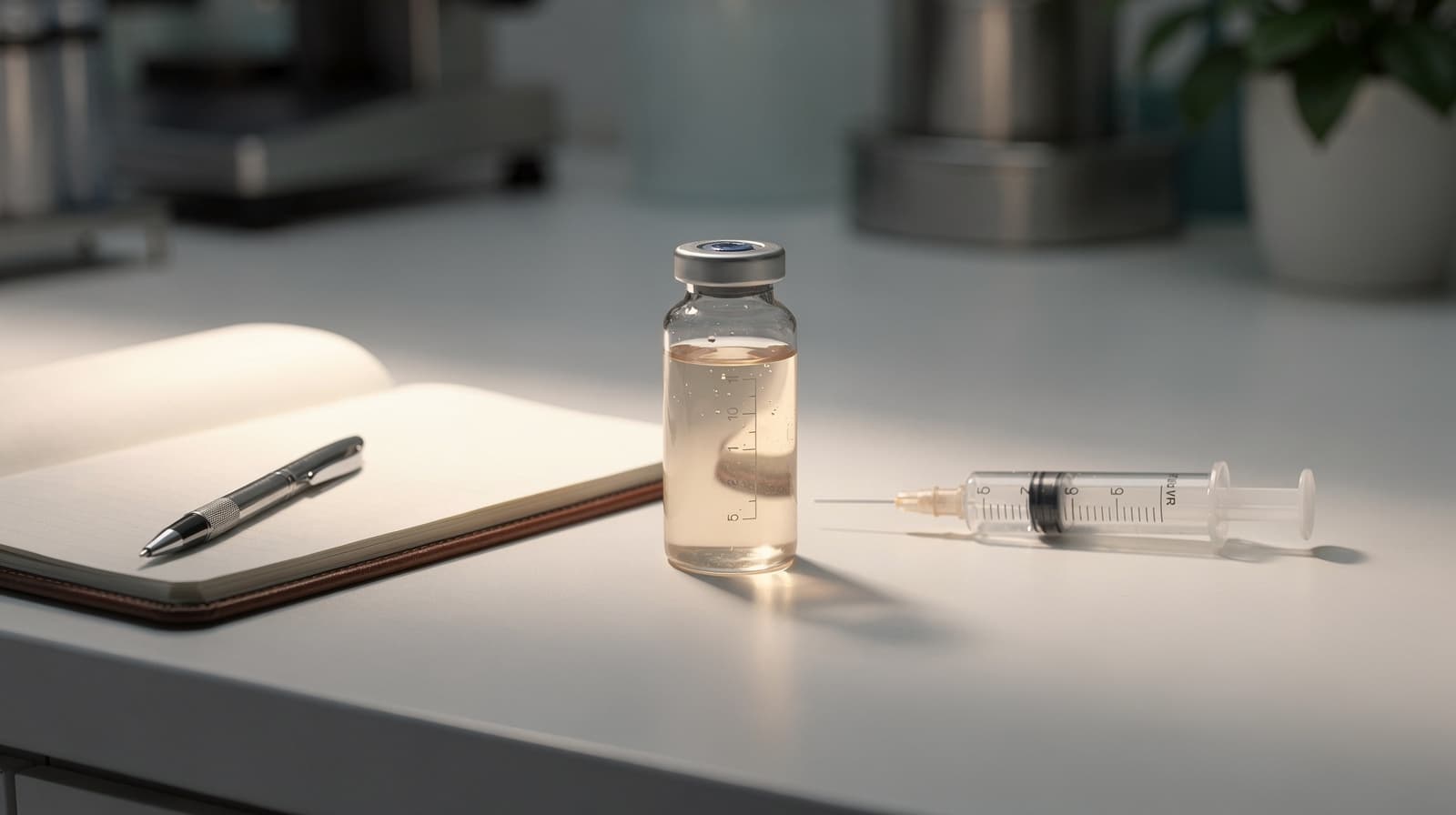
In the 1990s, hexarelin was among the most potent growth hormone releasing peptides in the literature. It produced GH pulses at least as large as GHRP-6 and about twice what the same dose of GHRH achieved. Then the peptide community quietly moved on. This guide explains what the molecule actually does, why the receptor desensitizes within days, and what the CD36 cardiac angle means for anyone still evaluating hexarelin as a research compound.
Key takeaways#
- Hexarelin is a synthetic hexapeptide (His-D-2-methyl-Trp-Ala-Trp-D-Phe-Lys-NH2) that binds two distinct receptors: GHS-R1a in the pituitary and CD36 in cardiac tissue.
- Peak GH responses of roughly 50-80 µg/L occur about 30 minutes after a 1-2 µg/kg intravenous dose, with a plasma half-life near 55 minutes.
- Receptor desensitization is measurable within 2-5 minutes of the first dose at the second-messenger level, and in the 16-week Rahim trial the GH response was significantly lower by week 4 of continuous use, recovering after 4 weeks off.
- Unlike ipamorelin, hexarelin raises ACTH, cortisol, and prolactin at standard GH-releasing doses.
- Research suggests the CD36 pathway mediates cardioprotective effects independent of growth hormone release, which is why the molecule remains interesting for cardiovascular research despite its abandonment as a general GH tool.
Hexarelin was designed to be more stable than GHRP-6#
Hexarelin is not a novel scaffold. It is a modification. Hexarelin represents an evolution from GHRP-6, with structural modifications that enhance potency and selectivity. The change was a single amino acid substitution: standard tryptophan replaced with the chemically more stable 2-methyl-tryptophan.
That substitution mattered. In anesthetized adult male rats, intravenous administration of GHRP-6 or hexarelin elicited prompt GH release with peak levels within 10 minutes, and hexarelin given subcutaneously elicited a long-lasting GH release that was slightly more effective than GHRP-6. The original characterization work was published by Deghenghi and colleagues in Life Sciences in 1994, and it established hexarelin as a highly effective GH releaser, matching GHRP-6 intravenously and slightly outperforming it subcutaneously. In healthy volunteers, Ghigo and colleagues then showed that 1 µg/kg of intravenous hexarelin released about twice as much GH as the same dose of GHRH.
The molecule is a hexapeptide. Six amino acids. Hexarelin is an engineered growth-hormone-releasing peptide (GHRP), specifically a hexapeptide (His-D-2-methyl-Trp-Ala-Trp-D-Phe-Lys-NH2), that functions via particular receptors in the pituitary and hypothalamus regions to induce growth hormone production in both animals and humans. The developer was Mediolanum Farmaceutici, and early clinical work included both GH deficiency diagnosis and pediatric growth studies.

The GH pulse is larger than any other GHRP, but the pharmacology is broader#
At the pituitary level, hexarelin behaves like ghrelin with more force. The binding strength of hexarelin at the ghrelin receptor is comparable to ghrelin itself (half-maximal effective concentrations of 1.7 and 1.0 nanomoles per liter, respectively), but its additional interaction with CD36 gives it effects that go beyond simple growth hormone release.
Studies have shown the amplitude difference clearly. In direct comparison rodent studies at 1 µg/kg intravenous, ipamorelin produced a GH peak of approximately 34-38 ng/mL with no significant elevation of ACTH, cortisol, FSH, LH, or prolactin, whereas hexarelin produced a GH peak of approximately 38-44 ng/mL with ACTH approximately 1.6-1.8 times baseline, mild cortisol elevation, and modest elevation of prolactin.
That off-target activation is the first practical problem. Hexarelin's activity is not limited to growth hormone; it also causes mild increases in prolactin, ACTH, and cortisol. For a wellness protocol focused on clean somatotropic amplification, elevating the stress axis is the wrong trade. It is why the field shifted to ipamorelin and later to newer secretagogues, which have been shown to release GH without the neuroendocrine spillover.
Route and bioavailability also constrain the molecule. Subcutaneous injection is functionally the only viable delivery route (biological bioavailability about 77%); oral bioavailability is below 1%, and intranasal delivery loses roughly 95% of the dose (Ghigo et al. 1994).
Tachyphylaxis is the reason hexarelin fell out of fashion#
The single most important fact about hexarelin is that the receptor stops responding. Fast.
In laboratory studies, measurable desensitization of the ghrelin receptor's signaling occurred within 2 to 5 minutes after the first dose, meaning the receptor essentially dials down its response almost immediately, reducing the growth hormone pulse with repeated or continuous exposure. This is not slow tolerance. It is near-instant homologous desensitization at the second messenger level.
The clinical consequence is documented. In a 16-week study by Rahim and colleagues, GH response to hexarelin declined significantly by week 4 and further by week 16, and receptor sensitivity returned to baseline within approximately 4 weeks of discontinuation. That is why every hexarelin protocol you will ever read specifies cycling. It is also why higher doses do not rescue the effect: preliminary evidence indicates the block is downstream of the receptor surface, not a matter of receptor occupancy.
The saturation curve reinforces this. Preclinical data points to a plateau in the GH response above roughly 2 µg/kg in humans, above which additional dose does not produce a proportionally larger pulse. More is not more.
The CD36 receptor is the reason hexarelin still matters at all#
If tachyphylaxis were the only story, hexarelin would be a historical footnote. It is not, because of a second binding site.
To identify the molecular target mediating the cardiovascular activity of hexarelin, rat cardiac membranes were labeled with a radioactive photoactivatable derivative of hexarelin, a binding protein of Mr 84 000 was identified, and the N-terminal sequence determination of the deglycosylated protein was identical to rat CD36, a multifunctional glycoprotein expressed in cardiomyocytes and microvascular endothelial cells. The finding was published by Bodart and colleagues in Circulation Research in 2002. In that study the measured effect of CD36 activation was coronary vasoconstriction; the cardioprotective findings below come from separate animal work.
CD36 changes the interpretation of hexarelin's cardiac data. The second receptor is CD36, a scavenger receptor expressed in cardiac tissue, macrophages, and adipose tissue; animal studies link CD36 to hexarelin's cardiac effects, which appear to be substantially independent of GH release, and this dual-receptor engagement distinguishes hexarelin from most other GH secretagogues.
Preclinical data points to concrete effects. When hexarelin activates CD36 receptors on heart cells, it increases coronary perfusion pressure in a dose-dependent way, and this effect disappears entirely in hearts that lack the CD36 receptor, confirming that this specific receptor is responsible. The receptor was mapped to both cardiomyocytes and cardiac microvascular endothelium.
Research has shown functional benefits in ischemia models. Treatment with hexarelin suppressed the formation of atherosclerotic plaques and neointima, partially reversed serum high-density lipoprotein cholesterol/low-density lipoprotein cholesterol ratio, and increased serum nitric oxide levels and aortic mRNA expression of endothelial nitric oxide synthase, GHSRs, and CD36 in atherosclerotic rats. A 2014 review in the Journal of Geriatric Cardiology summarizes the cardiac program.
Human data is thin. The cardiac program never advanced past early-phase investigation, and none of the preclinical cardioprotection numbers should be extrapolated to human wellness protocols.

Hexarelin vs ipamorelin: why the market chose the smaller molecule#
The comparison is instructive because it explains an entire class transition.
Ipamorelin does not elevate cortisol, ACTH, or prolactin even at doses 200-fold above the GH ED50; hexarelin elevates all three at standard GH-releasing doses; and ipamorelin shows less pronounced tachyphylaxis than hexarelin with chronic use. For a protocol that runs for months rather than weeks, that difference compounds.
The trade-off is real, and it depends on what the researcher wants:
- Amplitude. Hexarelin produces the larger acute GH pulse. If a single-day GH stimulation test is the goal, the amplitude advantage matters.
- Selectivity. Ipamorelin isolates the GH axis. If chronic administration with clean neuroendocrine boundaries is the goal, ipamorelin is the appropriate tool.
- Cardiac research. Hexarelin is the GHRP whose CD36 binding site is best characterized. Nothing in the ipamorelin literature substitutes for that.
- Cycle economics. Hexarelin protocols require cycling because of tachyphylaxis. Ipamorelin can be run continuously.
For most peptide-curious readers building a GH-axis protocol, the newer secretagogues, or a GHRH analogue paired with a selective GHRP, offer complementary action without the cortisol and prolactin baggage. That is the honest answer to why hexarelin faded.
Typical research dosing and protocol structure#
This section is descriptive, not prescriptive. Klarovel is a wellness platform, not a prescriber.
In the research literature, entry level doses are 100 mcg once or twice daily, and standard research doses are 200 mcg twice daily. Subcutaneous administration is the practical route. Injections are typically performed on an empty stomach because elevated blood glucose and circulating free fatty acids blunt GH secretion regardless of the secretagogue used.
Cycle structure is not optional with hexarelin. Most protocols last 2-4 weeks due to tachyphylaxis, followed by 4-8 week breaks to restore receptor sensitivity. Some references cite longer on-cycles of 4-6 weeks followed by 2-4 week washouts, but the practical ceiling before response fades is measured in weeks, not months.
If you are modeling doses, the Klarovel peptide calculator handles reconstitution math for common hexarelin vial sizes (2 mg and 5 mg). The tool is generic and does not endorse any specific protocol.
Direct comparisons: Hexarelin vs MK-677, Ipamorelin vs hexarelin.
The honest verdict on hexarelin#
Hexarelin is a research tool with a specific, narrow use case: acute maximal GH stimulation, or targeted cardiovascular research through the CD36 pathway. For anything else, the newer generation of selective secretagogues does the job with less cortisol, less prolactin, and no fast-onset tachyphylaxis. The GHRP nobody talks about anymore is a peptide that solved a 1990s problem and got overtaken by better chemistry. If you are building a GH-axis protocol on the Klarovel platform, start with how the framework works and create an account to model your options against your goals.
Frequently asked questions
Keep reading
Wegovy Pill: How It Works, How to Take It, and Results
The Wegovy pill is semaglutide 25 mg taken daily, FDA-approved for weight loss in December 2025. How to take it, how well it works, and how it compares.
5-Amino-1MQ Guide: What the NNMT Evidence Actually Shows
5-Amino-1MQ is sold for fat loss, but every published result is preclinical. Read the NNMT mechanism, the circulating dosing range, and its FDA status.

Peptides for Men: What Works by Goal and Evidence Stage
Men search peptides for seven goals: muscle, fat loss, libido, hormones, recovery, hair, longevity. Here is the FDA status and trial evidence behind each.