

Two compounds, two routes, one axis. MK-677 and tesamorelin both elevate growth hormone and IGF-1, but they enter the system at different receptors, follow different pharmacokinetic curves, and produce sharply different visceral-fat outcomes in the published trials. This comparison sorts out which one earns the nod for which user state, and where the trade-offs actually sit.
Key takeaways#
- MK-677 is an oral non-peptide ghrelin receptor agonist; tesamorelin is an injectable stabilised GHRH analogue with FDA approval for HIV-associated lipodystrophy.
- Tesamorelin has the cleaner visceral-fat signal: 15.2% and 10.9% VAT reduction at 26 weeks in the two Phase 3 trials. MK-677's pivotal 12-month trial showed no significant change in visceral fat.
- MK-677 raises fasting glucose and worsens insulin sensitivity more visibly than tesamorelin, which is the dominant safety trade-off for off-label users.
- Tesamorelin requires daily subcutaneous injection at bedtime; MK-677 is a once-daily oral capsule, which is the convenience argument most users start from.
- Stacking is not standard practice because both compounds drive the same downstream IGF-1 elevation, and combined use compounds the glucose-intolerance risk without adding mechanistic distinct value.
How MK-677 works#
MK-677 (ibutamoren) is a spiroindoline small molecule, not a peptide. It binds the growth hormone secretagogue receptor type 1a (GHSR-1a), the same receptor that endogenous ghrelin activates in the hypothalamus and anterior pituitary. Activation there amplifies GH pulses, which secondarily raises hepatic IGF-1.
The defining pharmacokinetic feature is oral bioavailability and a long functional half-life. In older adults, MK-677 raised GH by enlarging existing pulses and lifting the troughs between them, without changing the number of pulses (Chapman et al. 1996), which produces sustained, round-the-clock GH and IGF-1 elevation rather than the sharp pulses and valleys that injectable peptides produce, and that sustained elevation is part of why the metabolic side effects are more pronounced. Because MK-677 mimics ghrelin, appetite stimulation is not a side effect but a predictable on-target consequence: research has shown the receptor it binds is the one your stomach uses to signal hunger.
Regulatory status matters here. MK-677 was developed by Merck, advanced through multiple Phase 2 trials, and never received approval. It remains unapproved, is prohibited in sport under WADA class S2, and since 15 September 2026 has been on Norway's doping list (FOR-2026-09-14-1794), along with tesamorelin.
How tesamorelin works#
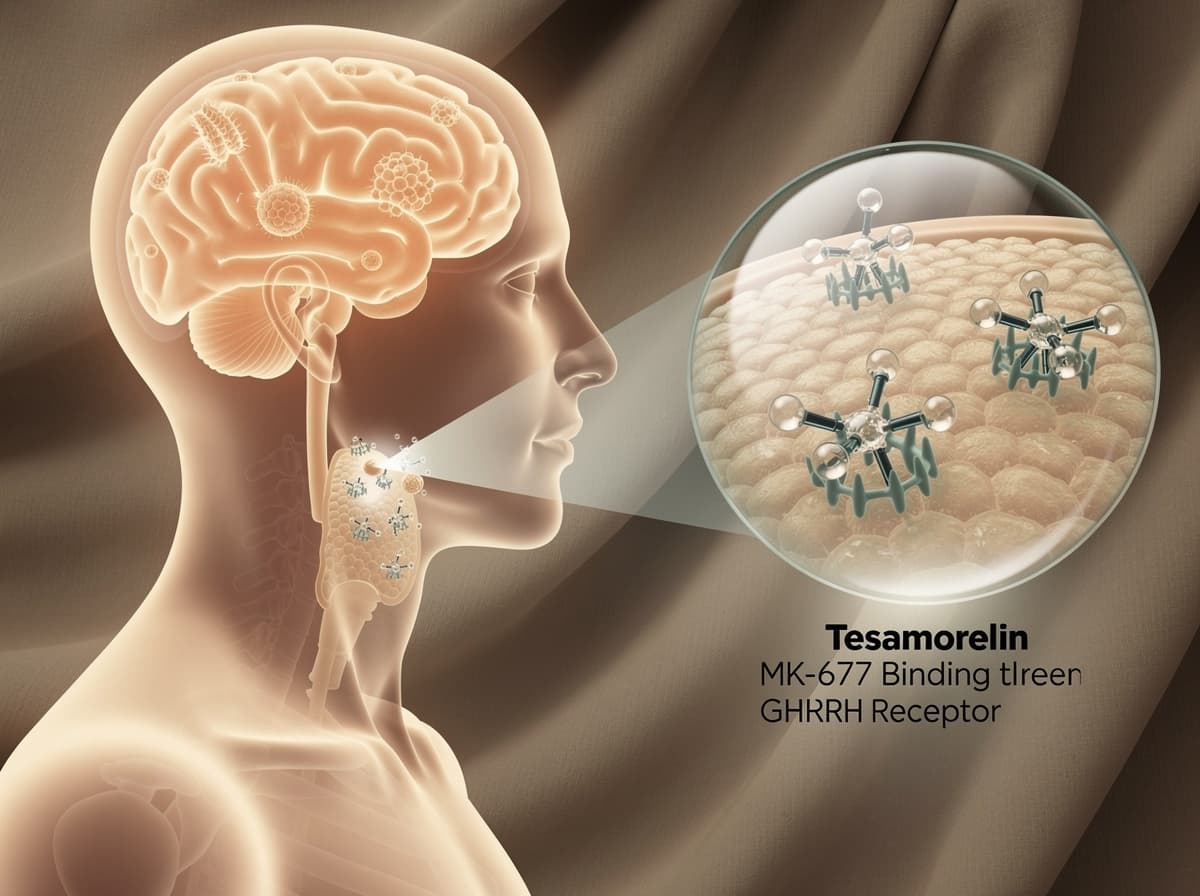
Tesamorelin acts one floor up the endocrine ladder. It is an FDA-approved stabilised GHRH analog, a synthetic version of the full 44-amino-acid GHRH with a trans-3-hexenoic acid modification at the N-terminus that resists enzymatic degradation, with an elimination half-life of only 8 to 11 minutes after a single dose on the current labels, yet a GH response strong enough to drive visceral fat lipolysis. One important factor limiting the development of native GHRH as a viable therapeutic option was its rapid degradation in vivo by the serum enzyme dipeptidylaminopeptidase 4, and synthetic analogs were investigated to render it resistant to hydrolysis through addition of a hydrophobic chain, research that led to the development of tesamorelin.
Mechanistically, tesamorelin binds the GHRH receptor on pituitary somatotrophs and triggers endogenous, pulsatile GH release. That pulsatile pattern preserves the IGF-1 negative-feedback loop, which is the reason GHRH analogues have been associated with fewer metabolic side effects than exogenous GH injections at comparable IGF-1 targets. Because GH preferentially mobilizes visceral fat (VAT has higher GH receptor density and higher basal lipolytic rate than subcutaneous fat), a GHRH-driven GH pulse lands disproportionately on the abdominal organ depot.
Tesamorelin was approved in 2010 for reduction of excess abdominal fat in HIV-infected patients with lipodystrophy, originally marketed as Egrifta and now as Egrifta SV and Egrifta WR by Theratechnologies.
Dosing: MK-677 vs tesamorelin#
The research-published regimens differ in route, timing, and tolerance for variability.
For MK-677, the pivotal trial used a single fixed dose. In the Nass et al. 2008 trial, participants received oral administration of MK-677 25 mg or placebo once daily, with growth hormone, IGF-I, fat-free mass and abdominal visceral fat as the primary endpoints after one year of treatment. Lower-protocol ranges of 10-15 mg per day appear in extended research use, typically taken before bed to align with the natural slow-wave-sleep GH pulse. Research protocols typically range from 10 to 25 mg orally once daily.
For tesamorelin, the dose is fixed across every Phase 3 trial. Every Phase 3 tesamorelin trial used the same regimen: 2 mg subcutaneously, once daily, administered at bedtime, and the bedtime timing is not arbitrary because endogenous GH is secreted in pulses that peak during slow-wave sleep, so a pre-sleep GHRH pulse layers onto the natural rhythm rather than competing with daytime somatostatin tone. The reformulated Egrifta SV uses 1.4 mg subcutaneously once daily, injected into the abdomen with site rotation, and Egrifta WR uses 1.28 mg once daily.
Evidence: what the studies actually show#
This is where the two compounds diverge most sharply. There is no head-to-head randomised trial. The comparison comes from the strongest primary study on each side.
For MK-677, the reference trial is Nass et al., 2008, in the Annals of Internal Medicine. Daily MK-677 significantly increased GH and IGF-I levels to those of healthy young adults without serious adverse effects; with placebo, mean fat-free mass decreased -0.5 kg, however FFM increased 1.1 kg with MK-677 (P less than 0.001 versus placebo). The visceral-fat result is the telling part. There was no significant difference in visceral fat; limb fat increased more with MK-677, and on the metabolic side, fasting glucose increased roughly 5 mg/dL and insulin sensitivity decreased on average. Lean mass went up. Strength did not. VAT did not move.
For tesamorelin, the evidence is denser and the VAT signal is unambiguous. The clinical evidence is not subtle: tesamorelin reduces visceral fat by double-digit percentages in HIV patients with lipodystrophy, with two Phase 3 trials showing 26-week VAT reductions of 15.2% (NEJM 2007) and 10.9% (JAIDS 2010), and about 18% in patients who continued for 12 months. A subsequent MGH liver-fat sub-study used tesamorelin 2 mg subcutaneously daily for 6 months and showed both visceral and hepatic fat reduction, with the mechanism attributed to GH augmentation driving visceral-fat oxidation while preserving the IGF-1 feedback loop.
Translation: MK-677 raises the GH-IGF-1 axis but does not deliver on the visceral-fat outcome most off-label users are chasing. Tesamorelin does.
Side effects and contraindication profile#
The overlapping adverse-event set is GH-axis canonical: IGF-1 elevation, fluid retention, arthralgia, glucose dysregulation. Where they diverge is in magnitude and in the receptor-specific add-ons.
MK-677 carries the ghrelin-receptor side of the ledger. Common side effects include increased appetite, fluid retention or edema, mild muscle pain, and average fasting glucose increased roughly 5 mg/dL. Elevated fasting glucose has been a consistent finding across multiple Merck trials: the 1998 Svensson obese-male study found impaired glucose tolerance on testing, the 2008 Nass two-year trial documented a 0.3 mmol/L rise in fasting glucose, and the 1997 Chapman study in GH-deficient adults noted increases in fasting and postprandial insulin and glucose. The appetite effect is non-trivial in eugonadal users and is the most common reason research subjects gain fat rather than recompose.
Tesamorelin carries the IGF-1 oncology-monitoring lane. The FDA label lists active malignancy as a contraindication, requires IGF-1 monitoring, and flags fluid retention and glucose intolerance. During the Phase 3 clinical trials, the percentages of patients with elevated HbA1c (greater than or equal to 6.5%) from baseline to Week 26 were 4.5% and 1.3% in the EGRIFTA and placebo groups respectively. Long-term cardiovascular safety of tesamorelin has not been established, and tesamorelin is not indicated for weight loss management as it has a weight-neutral effect.
The neutral framing: both shift glucose. MK-677 shifts it more, in a less reversible-looking direction, and on top of an appetite-driving mechanism. Tesamorelin is the cleaner profile in head-to-head terms, with the caveat that it carries an IGF-1-mediated cancer-monitoring requirement that MK-677 also has in spirit but without the regulatory paper trail.

When to choose MK-677#
Four user states where MK-677 is the more defensible starting point:
- The primary goal is sleep architecture and lean-mass preservation in an older, low-IGF-1 baseline, and the user wants to avoid daily injections. The Nass trial supports a fat-free-mass benefit even though it does not support a VAT benefit.
- The user is fully unwilling to inject. Adherence beats theoretical efficacy. Preliminary evidence on adherence in self-administered injectable peptides shows non-trivial dropout.
- Appetite stimulation is desirable, not unwanted, as in research models of cachexia or sarcopenia where caloric intake is the rate-limiter.
- Cost. Tesamorelin is a branded prescription drug with a materially higher price than MK-677.
MK-677 is the wrong choice if the user has a fasting glucose at the top of the normal range, prediabetic HbA1c, or visible visceral adiposity that they actually want to shift. Research suggests the metabolic ceiling will be hit before the body-composition goal is.
When to choose tesamorelin#
Four user states where tesamorelin earns the call:
- The primary, named goal is visceral adipose tissue reduction. This is the indication tesamorelin was approved for, the only compound in this comparison with FDA-grade VAT data, and the effect size (10.9% to 15.2% at 26 weeks) is clinically meaningful.
- Concurrent NAFLD or hepatic-steatosis features. The decrease in liver fat in the MGH study suggests that strategies to reduce visceral adiposity merit further investigation in HIV-infected patients with NAFLD, a condition for which there are no approved treatments.
- The user is already glucose-intolerant or carries metabolic-syndrome risk. GHRH analogues have been shown to correct metabolic abnormalities and body composition changes associated with low GH levels with fewer side effects, particularly with regard to hyperglycaemia, which makes tesamorelin the lower-risk GH-axis intervention in that population, though it still requires HbA1c monitoring.
- The user can commit to daily subcutaneous injection and bedtime timing. Adherence is the gating factor on tesamorelin's effect size; the trial outcomes are reported on near-perfect compliance.
Tesamorelin is the wrong choice if the user has an active or recent malignancy, untreated diabetic retinopathy, or is below 18.
Can you stack them?#
Stacking is not standard practice because the mechanisms converge. MK-677 raises GH via ghrelin-receptor agonism; tesamorelin raises GH via GHRH-receptor agonism. Both endpoints feed into the same IGF-1 pool, and the IGF-1 ceiling is what the FDA label monitors precisely because chronic supraphysiologic IGF-1 is the safety concern. Combining them compounds the IGF-1 elevation, compounds the glucose-intolerance load (which MK-677 dominates), and compounds the fluid-retention signal, without adding a complementary mechanism the way, for example, a GHRH plus a GHRP combination at modest doses theoretically does.
A more defensible amplification strategy at the GH axis pairs a short-acting GHRH analogue with a short-acting ghrelin-receptor peptide (sermorelin or CJC-1295 plus ipamorelin), titrated to a target IGF-1 in the upper-normal range. That is the paired-effect literature. Layering tesamorelin onto MK-677 is not.
Verdict#
For visceral-fat reduction, tesamorelin is the better starting point. The Phase 3 data is unambiguous, the mechanism is targeted (GH preferentially mobilises VAT via higher GH-receptor density in that depot), and the metabolic side effect load is lower per unit of IGF-1 elevation than MK-677's. The trade-off is real: daily subcutaneous injection, FDA-grade monitoring, and a price tag that hurts.
For lean-mass support, sleep depth, and oral convenience in an older adult who is not chasing a VAT outcome, MK-677 is the more defensible pick. The Nass trial supports the FFM gain even if it does not support strength or visceral fat. Just price in the glucose ceiling before starting, because it is the one that ends the cycle.
The compounds are not interchangeable, and the marketing framing that treats them as equivalent oral-versus-injectable versions of the same idea is wrong. They answer different questions.
Quantify the decision before you commit to either#
Both compounds elevate the same axis, but they answer different questions about your physiology. The right starting point depends on baseline IGF-1, fasting glucose, HbA1c, visceral-fat estimate, and tolerance for daily injection. Run the numbers before the catalog page. Use the peptide calculator to map research-published dose ranges to your inputs, walk through the questionnaire to map your health profile (and any recent labs you have) to the right axis, and check how Klarovel works. The decision is not oral versus injectable. The decision is whether your goal is the lean-mass curve or the visceral-fat curve.
Frequently asked questions
Keep reading
Peptides for Inflammation: Mapping BPC-157, KPV, and Thymosins
Peptides for inflammation compared by mechanism and evidence stage: BPC-157, KPV, thymosin alpha-1, and thymosin beta-4, with FDA status and safety notes.
Mounjaro vs Zepbound: Same Drug, Two Different FDA Labels
Mounjaro and Zepbound are the same drug, tirzepatide, at the same doses. The difference is the FDA label: diabetes for Mounjaro, weight loss for Zepbound.
Rybelsus for Weight Loss: Not Approved, and the Pill That Is
Rybelsus is not FDA-approved for weight loss and moves the scale only a little. The oral semaglutide approved for weight loss is the Wegovy pill at 25 mg.