
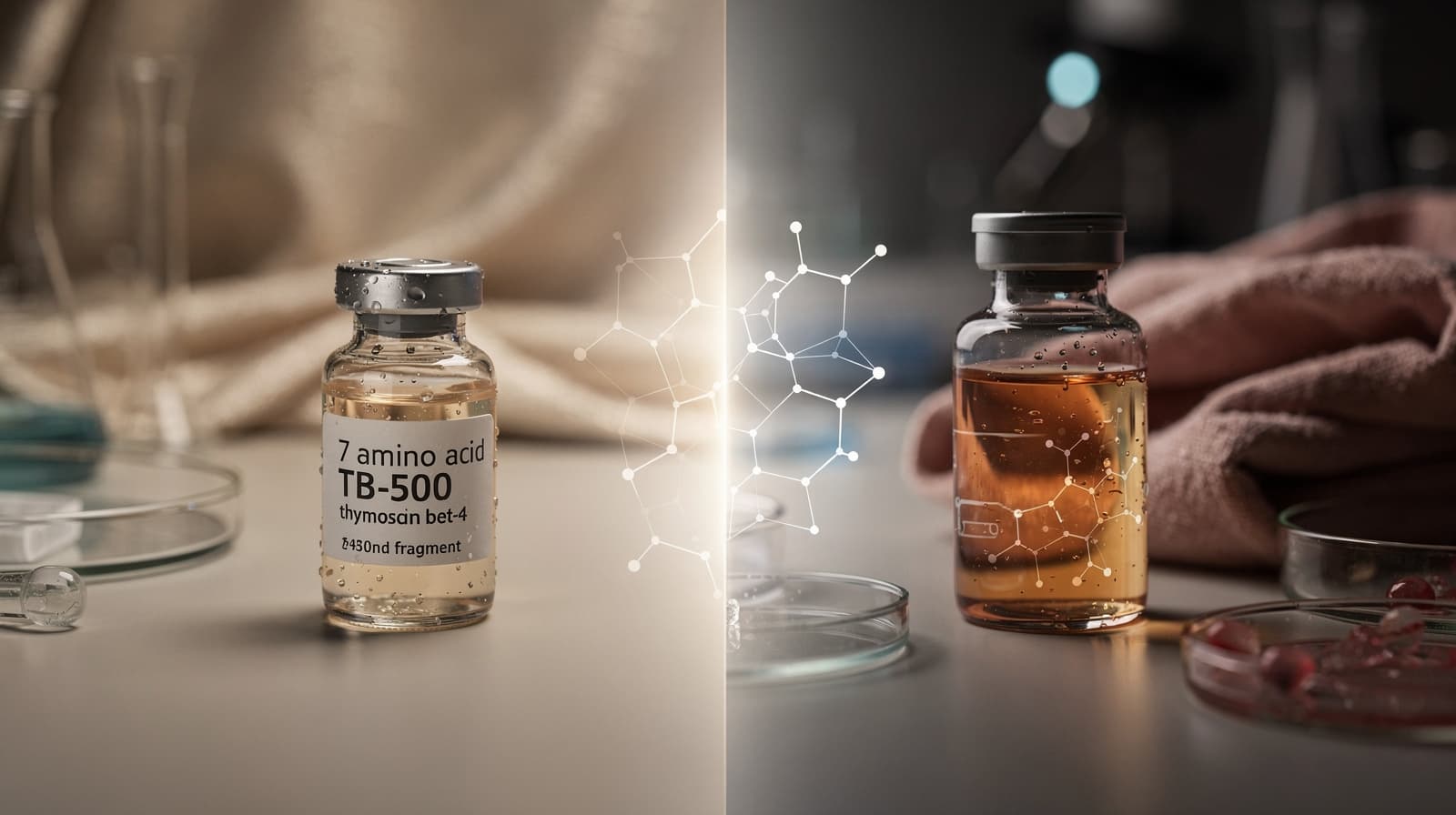
The confusion around TB-500 and thymosin beta-4 sells a lot of vials. Suppliers list them side by side, athletes assume they are interchangeable, and both labels reference the same actin-binding chemistry. They are not the same molecule, and the difference matters for how the peptide is dosed, what evidence supports it, and what regulators say about each. This comparison strips the marketing away and looks at what the primary literature actually shows.
Key takeaways#
- TB-500 is a seven-amino acid synthetic fragment (Ac-LKKTETQ) taken from positions 17-23 of the full 43-amino acid thymosin beta-4 (Tβ4) parent peptide.
- Full-length Tβ4 has multiple human clinical trials (venous ulcers, dry eye, myocardial infarction, healthy-volunteer Phase 1) with a published safety profile; TB-500 has essentially no controlled human trial data.
- Both are prohibited by the World Anti-Doping Agency at all times: the S2 list names "thymosin-β4 and its derivatives, e.g. TB-500". TB-500 has also been on Norway's doping list since September 15, 2026.
- The LKKTETQ motif carries the actin-binding and angiogenic activity, but full-length Tβ4 has additional cytoprotective, anti-inflammatory, and nuclear-transport functions the fragment does not fully replicate.
- Research protocols for injectable Tβ4 in trials use milligram dosing (42-1260 mg range); TB-500 has no consensus research-published dose, which is a red flag for anyone comparing them head-to-head.
How TB-500 works#
TB-500 is a synthetic heptapeptide with the sequence Ac-LKKTETQ. The peptide segment 17-LKKTETQ-23 is the active site within the protein thymosin β4 responsible for actin binding, cell migration and wound healing, and the key ingredient of TB-500 is the peptide LKKTETQ with artificial acetylation of the N-terminus. The N-terminal acetyl group is a stability modification that slows proteolytic degradation of an otherwise very short peptide.
Mechanistically, TB-500 is designed to mimic the actin-binding activity of its parent. Research suggests the fragment engages the same cytoskeletal machinery: a seven amino acid actin binding motif of thymosin beta4 is essential for its angiogenic activity, and in migration assays with human umbilical vein endothelial cells and vessel sprouting assays using chick aortic arches, thymosin beta4 and the actin-binding motif of the peptide display near-identical activity at ~50 nM. That in-vitro equivalence is the strongest scientific argument for using the fragment at all.
However, older biochemistry has shown limits to the fragment story. Neither thymosin beta 4 24-43 nor thymosin beta 4 13-43 inhibit the polymerisation of G-actin, and some structural features in the amino-acid sequence of thymosin beta 4 before position 13 are obligatory for its biological function. In plain terms: not every isolated fragment carries the same activity as the full protein, and the LKKTETQ motif is a specific slice of the actin-binding surface, not the whole molecule.

How thymosin beta-4 works#
Thymosin beta-4 is the naturally occurring parent molecule. Thymosin beta4 is a ubiquitous 43 amino acid, 5 kDa polypeptide that is an important mediator of cell proliferation, migration, and differentiation, and it is the most abundant member of the beta-thymosin family in mammalian tissue and is regarded as the main G-actin sequestering peptide. It is present in essentially every cell type, and its intracellular concentration is high enough to function as a buffer rather than a signalling molecule.
The core mechanism is actin sequestration. Thymosin beta 4 sequesters G-actin at a 1 to 1 ratio and thereby inhibits its polymerisation to F-actin in high salt solution, and oxidation of the single methionine residue at position 6 does not abolish its actin-sequestering properties. By holding monomeric G-actin in reserve, Tβ4 controls the rate at which cells can build the F-actin filaments they need to migrate, extend processes, and remodel tissue.
Beyond actin, full-length Tβ4 has activities the fragment cannot replicate. Research has shown thymosin beta4 is specifically translocated into the cell nucleus by an active transport mechanism, requiring an unidentified soluble cytoplasmic factor, and this peptide may also serve as a G-actin sequestering peptide in the nucleus. It also displays broader repair activity: preclinical data points to angiogenesis, dermal wound closure, and cardioprotection. Thymosin beta4 is angiogenic and can promote endothelial cell migration and adhesion, tubule formation, aortic ring sprouting, and angiogenesis, and it also accelerates wound healing and reduces inflammation when applied in dermal wound-healing assays.
Dosing: TB-500 vs thymosin beta-4#
This is where the comparison gets uncomfortable. Full-length Tβ4 has published research-protocol dose ranges from registered clinical trials. TB-500 does not.
For full-length thymosin beta-4, the most rigorous published human data comes from a Phase 1 intravenous study in healthy volunteers. Four cohorts of ten healthy subjects each received ascending single intravenous doses of 42, 140, 420, or 1260 mg, followed by the same daily dose for 14 days. A separate first-in-human Phase 1 study of recombinant human Tβ4 (NL005) in Chinese healthy volunteers used a very different range: ascending single doses of 0.05, 0.25, 0.5, 2.0, 5.0, 12.5, or 25.0 μg/kg intravenously, with a multi-dose arm at 0.5, 2.0 and 5.0 μg/kg daily for 10 days. The units differ by three orders of magnitude between programmes: the synthetic Tβ4 trial dosed in milligrams, the recombinant trial in micrograms per kilogram. That gap alone tells you research-published Tβ4 dosing is not standardised.
For TB-500, the story is thinner. Research-published doses for the isolated Ac-LKKTETQ fragment in controlled human trials are limited and not standardised. What circulates in the peptide community as "typical TB-500 protocol" numbers has not been validated in registered trials, and Klarovel does not endorse those figures. If a supplier or protocol quotes a specific milligram dose for TB-500 with confidence, ask them for the primary source; the peer-reviewed literature does not contain one.
Evidence: what the studies actually show#
Full-length Tβ4 has clinical trial data. A European double-blind, placebo-controlled, dose-escalation study evaluated safety, tolerability, and enhancement of healing of topical Tβ4 in patients with venous ulcers. The follow-up publication enrolled 73 patients across eight European sites and reported that the safety profile of all doses of administered Tβ4 was deemed acceptable and comparable to placebo, with efficacy findings suggesting a 0.03% dose may have the potential to accelerate wound healing, with complete healing within 3 months in about 25% of patients. A separate review notes that Tβ4 accelerated the rate of repair in phase 2 trials with patients having pressure ulcers, stasis ulcers, and epidermolysis bullosa wounds and that it is safe and well tolerated in that dataset. Wound-repair programmes have been sponsored by RegeneRx Biopharmaceuticals, including a Phase 2 venous stasis ulcer protocol (NCT00832091) and the terminated corneal wound Phase 2 study (NCT00598871).
TB-500 has essentially no controlled human trial data. The peer-reviewed record on the specific Ac-LKKTETQ fragment is dominated by doping-control analytics rather than efficacy work. The foundational analytical paper acknowledged that TB-500 is a veterinary preparation containing a synthetic version of the naturally occurring peptide LKKTETQ, and is claimed to promote endothelial cell differentiation, angiogenesis in dermal tissues, keratinocyte migration, collagen deposition and decrease inflammation, with the study itself focused on developing detection methods in equine urine and plasma. Preliminary evidence for angiogenic and cytoskeletal effects of the LKKTETQ motif comes from in-vitro work on the parent protein, not from human trials of the fragment.

Side effects and contraindication profile#
Full-length Tβ4 has the strongest human safety signal. In the Phase 1 IV study of healthy volunteers, adverse events were infrequent, and mild or moderate in intensity, with no dose limiting toxicities or serious adverse events across the 42-1260 mg range. In the recombinant NL005 Phase 1, there were no dose-limiting toxicities or serious adverse events, and adverse events were mild to moderate in intensity. Wound-repair Phase 2 data described the peptide as safe and well tolerated in that dataset.
TB-500 has no equivalent controlled safety dataset. Anecdotally reported effects include transient headaches, mild lethargy, and injection-site discomfort, but those are user-reported, not trial-derived. There is one additional theoretical concern that applies to both compounds: Tβ4 has been studied for a possible role in tumor biology. Research has shown that in one line of investigation, TB4 induces tumor metastasis and paclitaxel resistance in cell models, with siRNA of TB4 inhibiting cell viability and augmenting caspase-3 activity, and separate work found TB4 expression in B16F10 melanoma cells was increased by hypoxia conditioning in a time-dependent manner, with angiogenesis and HIF-1α expression increased in TB4-transgenic mice. Neither peptide has an established human oncology signal, but the cell-culture data is why active or prior cancer is consistently flagged as a caution in research settings.
Regulatory status is largely shared. Both are prohibited under WADA Section S2 ("thymosin-β4 and its derivatives, e.g. TB-500"). Neither is approved by the FDA for any indication. In the US, the FDA removed the TB-500 fragment from its Category 2 compounding safety list on April 22, 2026, and on July 23, 2026 its Pharmacy Compounding Advisory Committee voted 8 to 6 to recommend TB-500 for the 503A bulks list for wound healing; that is advice, not a rule, so it cannot yet be compounded (FDA). In Norway, TB-500 has been on the doping list since September 15, 2026 (Lovdata).
When to choose TB-500#
The honest answer: in most cases, do not. TB-500 exists mainly because it is cheaper to synthesise than the 43-amino acid parent. Preliminary evidence for the fragment retaining meaningful biological activity is largely inferential from parent-protein studies. That said, three narrow research-context scenarios come up:
- In-vitro cell migration or angiogenesis assays where the researcher specifically wants to isolate the LKKTETQ actin-binding contribution and control for the additional domains of full-length Tβ4.
- Analytical-chemistry work on doping-control detection, where the fragment is the target substance because it is the compound athletes actually source.
- Cost-constrained preclinical models where the researcher has explicit hypothesis coverage from parent-protein data and is treating the fragment as a proxy with known limits.
None of these are consumer wellness use-cases. For everyone else, the fragment is a downgraded version of a molecule with better data.
When to choose thymosin beta-4#
Full-length Tβ4 is the version with actual clinical development history. It is the reasonable choice when:
- The research question tracks endpoints Tβ4 has actually been tested against: dermal wound closure, corneal wound repair, dry-eye ocular surface parameters, or cardiac tissue remodelling in post-infarction models.
- A published dose range from a registered trial matters: the mg-scale intravenous data and the μg/kg recombinant data give researchers primary-source anchoring the fragment cannot match.
- Broader biology than actin sequestration is in scope: nuclear localisation, keratinocyte migration, laminin upregulation, and anti-inflammatory activity have all been studied with the full peptide, not the fragment.
- Regulatory framing needs to be defensible: Tβ4 is the compound named in the RegeneRx and Chinese NL005 programmes, so any research reference points back to a real trial, not a forum post. Klarovel's approach to research-positioning transparency is documented in our disclosures page.
Can you stack them?#
Stacking TB-500 with full-length Tβ4 is not standard practice, because the two compete for the same actin-binding target. The fragment is a truncated version of the parent's active site, so co-administering both is functionally the same as increasing the total dose of the more complete molecule, with no evidence of complementary action. Studies have shown that the LKKTETQ motif and full Tβ4 display near-identical activity at ~50 nM in endothelial migration and vessel sprouting assays, and adhesion to thymosin beta4 was blocked by the seven amino acid peptide, demonstrating it as the major thymosin beta4 cell binding site on the molecule. Blocking the binding site with the fragment does not amplify the parent; it competes with it.
If a stack is on the table for research reasons, the more coherent pairing is Tβ4 (or its fragment) with a mechanistically distinct repair peptide such as BPC-157, which acts through different pathways. That is a separate comparison, not this one.
Verdict#
For virtually every research context outside doping-detection work, full-length thymosin beta-4 is the better-supported choice. The parent peptide has registered clinical trials, published safety data across mg-scale and μg/kg-scale dosing, and a defined mechanism that extends beyond the actin-binding motif. TB-500 is a partial mimic of that mechanism, sold at a lower price point, with no controlled human trials of its own and no standardised research-published dose. The peptide community treats the two as interchangeable because they share a motif, but sharing a motif is not the same as sharing the evidence base. If a reader is comparing them for a wellness rationale, the more honest reframing is: Tβ4 is the compound the trials studied; TB-500 is the compound the vials contain.
Klarovel's position is that neither is appropriate outside a research or clinician-supervised setting, both are WADA-prohibited, and the choice between them should not be based on price. Readers who want to translate this into a personal decision should quantify their own baseline first through the peptide calculator and questionnaire, then work backwards to what evidence actually supports.
The decision, quantified#
The TB-500 versus thymosin beta-4 question is often framed as a preference. It is really a data question. Full-length Tβ4 has trials. The fragment does not. If a reader is choosing between them on price, the choice has already been made against the evidence. If a reader is choosing on mechanism, the mechanism is shared, and the parent covers more of it. Klarovel's editorial position is that these decisions deserve baseline numbers, not vibes. Start with the peptide calculator, route through the questionnaire to surface what your health profile and goals actually point to, and use the how-it-works page to see what the protocol layer looks like before any peptide conversation starts.
Frequently asked questions
Keep reading
Peptides for Inflammation: Mapping BPC-157, KPV, and Thymosins
Peptides for inflammation compared by mechanism and evidence stage: BPC-157, KPV, thymosin alpha-1, and thymosin beta-4, with FDA status and safety notes.
Mounjaro vs Zepbound: Same Drug, Two Different FDA Labels
Mounjaro and Zepbound are the same drug, tirzepatide, at the same doses. The difference is the FDA label: diabetes for Mounjaro, weight loss for Zepbound.

Rybelsus for Weight Loss: Not Approved, and the Pill That Is
Rybelsus is not FDA-approved for weight loss and moves the scale only a little. The oral semaglutide approved for weight loss is the Wegovy pill at 25 mg.