
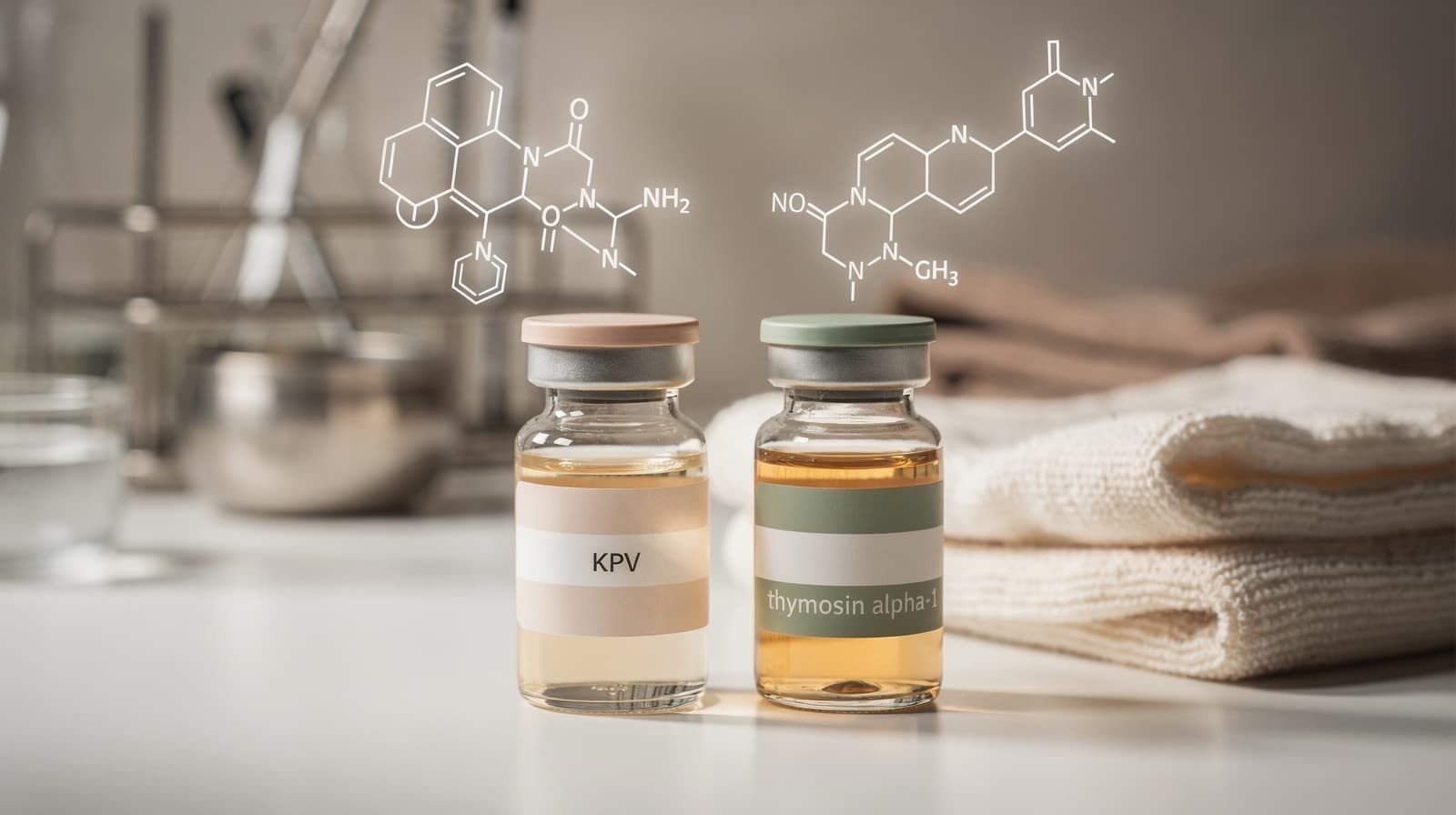
KPV and thymosin alpha-1 get mentioned in the same breath because both show up in "sick day" and gut protocols. That framing hides the actual difference: one is an anti-inflammatory fragment of a pigment hormone, the other is a 28-amino-acid immune regulator sold as a prescription drug (Zadaxin) outside the US, approved in Italy, but not approved by the FDA. This comparison unpacks mechanism, dosing, evidence, and when each is the smarter starting point.
Key takeaways#
- KPV is a three-amino-acid C-terminal fragment of alpha-MSH that calms NF-κB signaling; thymosin alpha-1 (Tα1) is a 28-amino-acid thymic peptide that recalibrates T-cell and dendritic-cell function.
- KPV evidence is preclinical and gut/skin-focused; Tα1 evidence includes Phase III human trials in chronic hepatitis B, sepsis, and cancer adjunct care.
- Research-published KPV protocols cluster at 200-500 mcg daily (oral or subcutaneous); Tα1's clinically validated dose is 1.6 mg subcutaneous twice weekly.
- Neither is FDA-approved, and neither can currently be compounded in the US: an FDA advisory committee voted 4 to 17 against Tα1 in December 2024, and voted 8 to 6 for KPV in July 2026 with no rule yet.
- Pick KPV for localised gut or skin inflammation; pick Tα1 for immunosenescence, post-viral recovery, or chronic viral infection contexts.

How KPV works#
KPV is a tripeptide (Lys-Pro-Val) that corresponds to residues 11-13 of alpha-melanocyte-stimulating hormone. Most of the anti-inflammatory activities of alpha-MSH can be attributed to its C-terminal tripeptide KPV. The elegant part of its pharmacology is the delivery route: PepT1 is normally expressed only in the small intestine, but during inflammatory bowel disease, PepT1 expression gets induced in the inflamed colon, meaning the tissue that is most inflamed upregulates the very transporter that KPV uses for entry. Healthy colonic tissue, which does not express PepT1, remains largely transparent to luminal KPV.
Once inside the cell, KPV works downstream of the receptor level. Research suggests it inhibits nuclear factor kappa B (NF-κB) signaling directly, blocking p65 nuclear translocation and cytokine gene transcription. Studies have shown that KPV attenuates inflammatory responses in colonic epithelial and immune cells and reduces the incidence of colitis in vivo after oral administration. Importantly, KPV is unlikely to mediate its effects through melanocortin receptors and instead appears to act through inhibition of IL-1β functions, which is why it retains the anti-inflammatory profile of alpha-MSH without the pigmentary or appetite effects.
How thymosin alpha-1 works#
Thymosin alpha-1 is a 28-amino-acid peptide originally isolated from thymic tissue. It is marketed as Zadaxin for chronic hepatitis B and as an immune adjuvant. The FDA confirms approval in Italy; the frequently quoted "35 countries" figure comes from the manufacturer's annual report, which the FDA says it cannot independently verify (FDA briefing document). It is not approved in the US. Its mechanism is systemic rather than tissue-local: Tα1 engages Toll-like receptor 9 (TLR9) and MyD88 signaling on dendritic cells, which then coordinate T-cell maturation, natural killer cell activity, and cytokine balance.
Preliminary evidence and confirmed clinical data both describe Tα1 as a bidirectional immune modulator, meaning it can dampen overactive inflammation in sepsis-like states while also amplifying weak immune responses in immunosenescent or lymphopenic patients. Tα1 functions as a true immune modulator, not simply an immune stimulant. That distinction is the whole reason it is being studied in contexts as different as chronic viral hepatitis, oncology adjunct care, and post-viral immune reconstitution. For a deeper mechanistic read see the Klarovel thymosin alpha-1 complete guide.
Dosing: KPV vs thymosin alpha-1#
KPV. Studies in dextran sodium sulfate and trinitrobenzenesulfonic acid colitis models have given KPV orally to mice, either in drinking water (100 μM in the 2008 Dalmasso study) or loaded into nanoparticles, and translated human research protocols typically report 200-500 mcg daily by oral or subcutaneous route, with some protocols extending to 1,000 mcg daily. The upper range is not better supported than the standard range. There is no FDA-approved human indication and no established human pharmacokinetic profile at consumer doses.
Thymosin alpha-1. The recommended dose of Zadaxin (thymalfasin) for chronic hepatitis B is 1.6 mg (900 µg/m²) administered subcutaneously twice a week for 6 to 12 months, with weight-adjusted dosing (40 µg/kg) for patients under 40 kg. Unlike most research peptides, where dosing is extrapolated from animal studies and community anecdote, Tα1 dosing comes directly from randomized controlled trials and decades of pharmaceutical use. The standard 1.6 mg twice-weekly dose was not derived from community experimentation, it was established through formal clinical development, although the FDA notes that no dose-response studies were done, so the minimum effective dose is unknown.
The practical implication: Tα1 has one validated unit dose (1.6 mg), given twice weekly in hepatitis B and every 12 hours in sepsis trials; KPV dosing is still an educated guess borrowed from rodent colitis and dermatitis models.
Evidence: what the studies actually show#
There is no head-to-head trial of KPV vs thymosin alpha-1. The evidence bases sit in different regulatory tiers.
KPV evidence. The evidence base is entirely preclinical, two decades of research, six organ systems, zero human trials. The strongest signal comes from colitis models: oral KPV-loaded nanoparticles restored colonic morphology to near-healthy control levels in mouse ulcerative colitis, and KPV has been shown to be an anti-inflammatory effect in IL-1β-induced peritonitis independent of melanocortin receptor signaling. Skin data is the second strongest tier, with dual anti-inflammatory and antimicrobial activity described at picomolar concentrations.
Tα1 evidence. It has been studied in Phase III clinical trials involving over 4,400 patients, published in hundreds of peer-reviewed papers, and used pharmaceutically for decades across Asia, Europe, and South America. This level of evidence far exceeds that of virtually any other peptide in the research community. Chronic hepatitis B is its registration indication, but when the FDA reviewed that evidence in 2024 it concluded the data were insufficient to determine effectiveness: the one double-blind, placebo-controlled monotherapy trial it identified found undetectable HBV DNA in 20 percent on Tα1 against 21 percent on placebo (FDA briefing document).
The sepsis picture is more mixed. The 2025 TESTS Phase 3 trial in BMJ found no mortality benefit at 28 days (23.4% vs 24.1%, HR 0.99). However, a 2025 updated meta-analysis of 11 RCTs reported a pooled 28-day mortality reduction (OR 0.73, 95% CI 0.59-0.90), but a pooled benefit alongside a null result in the largest, only double-blind trial is the signature of small-study effects. The honest read: Tα1 has a large human trial record whose best-designed trials have not shown clear efficacy, and a favorable safety profile.

Side effects and contraindication profile#
KPV. No serious adverse events have been documented in the peer-reviewed literature, and the published rodent studies report no toxicity signal. The FDA states it found no human exposure data for KPV by any route. Human safety data is essentially community-level: injection-site reactions, occasional flushing at the highest self-reported doses. The absence of human trial data is itself a limitation, not a clean bill of health.
Tα1. The FDA's 2024 review found that in most clinical studies Tα1 was not associated with significant adverse events attributable to it, at 1 to 16 mg for up to twelve months, with local irritation, redness and injection-site discomfort the most common reactions (FDA briefing document).
Overlap: both are injectable peptides with negligible systemic toxicity in published series. Divergence: Tα1 has a real human safety file; KPV does not. Contraindication logic differs, too. Tα1 is contraindicated in solid organ transplant recipients on active immunosuppression. KPV has no established contraindications simply because the human evidence has not been generated. That absence is not equivalent to safety.
When to choose KPV#
Pick KPV when the target is localised inflammation with a clear mucosal or dermatological signal:
- Active gut inflammation contexts (research setting): short courses at 500 mcg oral daily during acute flare windows, then cycled off. The PepT1 upregulation logic gives KPV tissue selectivity that systemic peptides cannot match.
- Inflammatory skin research (eczema, psoriasis, atopic dermatitis): topical or subcutaneous protocols leveraging KPV's picomolar activity.
- Post-viral or post-food-poisoning gut recovery: short protocols where the goal is calming NF-κB, not modulating adaptive immunity.
- Someone already on immunomodulators who needs an anti-inflammatory adjunct without a second immune-active compound.
When to choose thymosin alpha-1#
Pick Tα1 when the target is systemic immune regulation, especially in the context of viral load, immunosenescence, or lymphopenia:
- Chronic viral infection research (hepatitis B, chronic hepatitis C contexts): this is Tα1's registration indication and its largest body of trials, though the FDA judged the hepatitis B efficacy evidence insufficient in 2024.
- Immunosenescence and frequent infection cycles in older research subjects: Tα1's dendritic-cell and T-cell effects address the mechanism most implicated.
- Post-viral recovery with documented lymphopenia: preliminary evidence from COVID-19 cohort studies has associated Tα1 with faster viral clearance and shorter hospital stay in non-severe patients.
- Oncology adjunct research contexts where reducing chemotherapy-related immunosuppression is the goal.
Can you stack KPV and thymosin alpha-1?#
Mechanistically, the two peptides do not conflict. KPV blocks NF-κB transcription in inflamed tissue; Tα1 rebalances adaptive immunity systemically. Their targets are complementary rather than redundant. Combined protocols have been described anecdotally in "sick day" contexts (short courses of KPV for gut symptoms plus Tα1 for immune support during a viral cycle), but no controlled human data supports the stack as a formal protocol.
The practical caution: stacking two dose-adjacent peptides doubles the sourcing, storage, and injection-site complexity, and no research has quantified whether the combined response is supra-additive or simply additive. If a stack is used, keep each peptide at its research-published single-agent dose and do not scale either up because both are present.
Verdict#
Both peptides are valid, but they solve different problems.
For most gut and skin inflammation research contexts, KPV is the more targeted choice. Its PepT1-dependent uptake and downstream NF-κB inhibition give it tissue selectivity that a systemic immune modulator cannot replicate. The trade-off is that KPV has no human trial base, so protocols remain research-grade extrapolations.
For immunosenescence, chronic viral infection, and post-viral recovery contexts, thymosin alpha-1 is the better starting point because it has the far larger human record. It carries decades of pharmaceutical safety data and a defined dose, even though its efficacy in the best-designed trials remains unproven. That is worth more than mechanistic elegance when the goal is confidence in the protocol.
If a research subject presents with both inflamed gut symptoms and a weakened immune profile, the sequencing matters: KPV first for symptomatic inflammation control, Tα1 layered in only if the immune picture (lymphopenia, chronic viral load, senescence markers) justifies the addition. Use the Klarovel intake questionnaire and the peptide calculator to formalise which one the health profile actually points to, and review the regulatory framing on the disclosures page.
The Klarovel position#
KPV and thymosin alpha-1 are not interchangeable. The right answer depends on whether the target is inflammation (KPV) or immune modulation (Tα1), and on how much human evidence the protocol requires. Use the Klarovel peptide calculator to model dosing math for whichever direction fits, and start with the intake flow at /how-it-works to formalise the choice against your health profile rather than symptom guessing.
Frequently asked questions
Keep reading
Peptides for Inflammation: Mapping BPC-157, KPV, and Thymosins
Peptides for inflammation compared by mechanism and evidence stage: BPC-157, KPV, thymosin alpha-1, and thymosin beta-4, with FDA status and safety notes.
Mounjaro vs Zepbound: Same Drug, Two Different FDA Labels
Mounjaro and Zepbound are the same drug, tirzepatide, at the same doses. The difference is the FDA label: diabetes for Mounjaro, weight loss for Zepbound.
Rybelsus for Weight Loss: Not Approved, and the Pill That Is
Rybelsus is not FDA-approved for weight loss and moves the scale only a little. The oral semaglutide approved for weight loss is the Wegovy pill at 25 mg.