
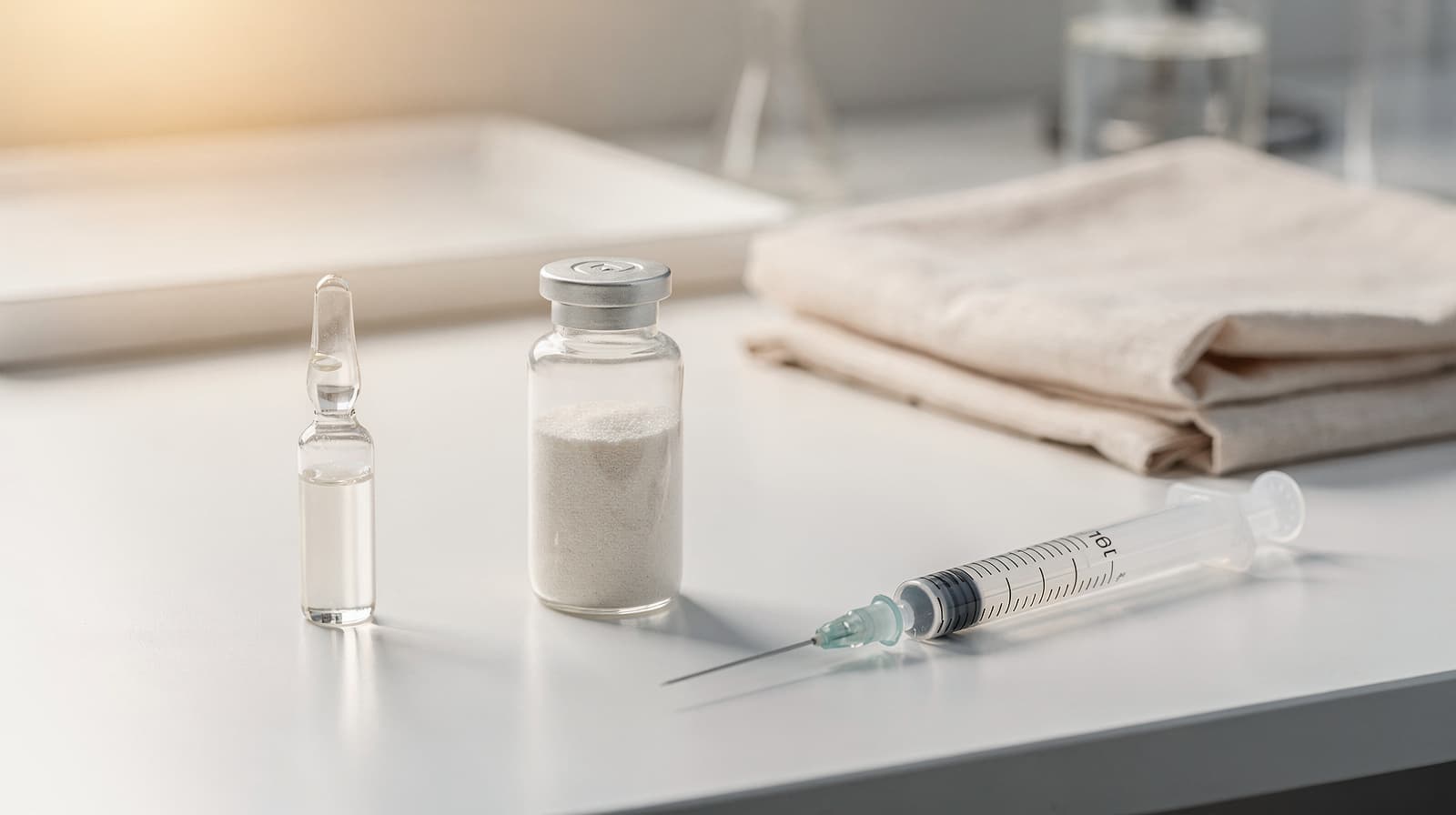
Thymosin alpha-1 (thymalfasin, sold abroad as Zadaxin) is a 28-amino-acid immune peptide that activates dendritic cells through Toll-like receptors. Its reference dose, from hepatitis B trials, is 1.6 mg injected under the skin twice a week. It has one of the largest human evidence bases of any research peptide, 94 indexed clinical trials, yet it is not approved in the United States and cannot be compounded there: an FDA advisory committee voted 4 to 17 against adding it to the 503A bulks list in December 2024 (FDA committee minutes). The largest sepsis trial, reported in 2025, found no mortality benefit. This guide puts those facts together and checks the widely repeated claim that the peptide is approved in more than thirty countries against what regulators actually publish.
Key takeaways#
- Thymosin alpha-1 (Tα1, brand name thymalfasin or Zadaxin) is a 28-amino-acid thymic peptide identical in sequence to the human endogenous form, with a reference subcutaneous dose of 1.6 mg twice weekly used in chronic hepatitis B registration trials.
- Its mechanism is receptor-defined: it engages Toll-like receptors (chiefly TLR2 and TLR9) on dendritic cells, triggering MyD88-dependent signaling and downstream T-cell and NK-cell activation.
- The largest sepsis trial to date (TESTS, phase 3, 1,106 patients, 2025) was null on its primary endpoint: 28-day mortality 23.4 percent on Tα1 against 24.1 percent on placebo, hazard ratio 0.99, P equals 0.93.
- The "approved in 35+ countries" figure traces to a company annual report, not to regulators. The FDA has stated in writing that it cannot independently verify it.
- On 4 December 2024 an FDA advisory committee voted 4 to 17 against allowing thymosin alpha-1 to be compounded in the United States, having reviewed twelve proposed uses and found the evidence insufficient for every one.
- The peptide has a short plasma half-life (around 2 hours), which informs the twice-weekly chronic regimen and the every-12-hour acute dosing patterns used in critical illness research.
A 28-amino-acid thymic peptide with a defined molecular target#
Thymosin alpha-1 was the first individual peptide isolated from the thymic fraction that retained immunological activity. Tα1, brand name Zadaxin and INN thymalfasin, is a small molecule polypeptide with 28 amino acids at about 3.1 kDa . The synthetic form used in research and registered products is chemically identical to the endogenous peptide.
Its mechanism is unusually well characterised for an immunomodulatory peptide. Tα1 acts through Toll-like receptors (TLR2 and TLR9) in myeloid and plasmacytoid dendritic cells, leading to the activation and differentiation of dendritic cells and T cells, as well as the initiation of cytokines such as interferon-gamma and interleukin-2 . Research has shown that the same peptide also engages TLR3, TLR4, and TLR7 pathways depending on cell context, with TLR2/NF-κB, TLR2/p38MAPK, and TLR7/MyD88 cascades feeding into innate and adaptive cytokine production.
The practical consequence is that Tα1 is not a single-axis stimulator, which is why its strongest preclinical signal is in settings where both the innate and adaptive arms are compromised: chronic viral infection, post-chemotherapy immune injury, and sepsis-associated immune paralysis.
The hepatitis B reference dose anchors everything else#
The dosing pattern that defines thymalfasin comes from its chronic hepatitis B registration program. The recommended dose of Zadaxin for chronic hepatitis B, used as monotherapy or with interferon, is 1.6 mg (900 µg/m²) administered subcutaneously twice a week for 6 to 12 months. Patients weighing less than 40 kg should receive a dose of 40 µg/kg. The peptide is supplied as a lyophilized 1.6 mg vial with mannitol and sodium phosphate buffer, reconstituted with sterile water immediately before subcutaneous injection.
Pharmacokinetics constrain the schedule. Thymalfasin has a short elimination half-life of approximately 2 hours, and this rapid clearance means the drug does not accumulate with repeated dosing such as the twice-weekly regimen used for chronic indications. That short half-life is also why acute critical-illness research has tested far more frequent dosing rather than higher single doses.
The 1.6 mg unit dose is essentially the only one validated in registration data. The FDA's 2024 review noted that across the published literature Tα1 has been given in daily doses from roughly 1 to 16 mg for periods ranging from a single day to twelve months, and that the absence of dose-response studies makes it difficult to say what the minimum effective dose even is.
Hepatitis B is where the registered indication sits, and it is routinely described as the peptide's strongest evidence. The registration rests on a pooled analysis of three randomized controlled trials comprising 223 patients, with twice-weekly dosing for six months and follow-up at twelve, showing a delayed therapeutic response arriving twelve months or more after therapy ended.
That delayed-response pattern is mechanistically coherent. Unlike direct-acting antivirals where viral suppression tracks dosing, Tα1's effect on HBV markers tends to appear after the course ends, consistent with immune reconstitution rather than direct antiviral action.
It is worth being precise about how strong "strongest" is. When the FDA reviewed the hepatitis B evidence in December 2024 it concluded it had insufficient evidence to determine the effectiveness of Tα1 for treating HBV infection. The single randomized, double-blind, placebo-controlled trial of Tα1 monotherapy it identified (Mutchnick 1999) found no difference in undetectable HBV DNA at six months after treatment: 20 percent on Tα1 against 21 percent on placebo. Trials adding Tα1 to current standard therapies did not separate from those therapies alone: adding it to pegylated interferon was not superior, and adding it to entecavir produced outcomes the authors described as similar to entecavir by itself.
None of that makes the peptide inert, and the delayed-response signal is real enough to have supported registration in Italy. It does mean the common framing, that hepatitis B is settled and everything else is emerging, does not survive contact with the regulator's own reading of the same trials.
The "approved in 35+ countries" claim traces to a company annual report#
Almost every page written about thymosin alpha-1 states that it is approved in more than thirty countries. The figure is repeated by vendors, clinics and peptide reference sites, usually without a source. It has one.
In its briefing document for the December 2024 advisory committee, the FDA identified where the claim comes from and then declined to stand behind it:
According to the SciClone Pharmaceuticals' 2014 Annual Report, Ta1 is "approved" for use in countries in the Asia-Pacific region, Latin America, Eastern Europe, and the Middle East ... FDA is unable to independently verify these claims of approval in all the specified countries. Ta1 is not approved in the United States, Japan, or Europe (except Italy). Ta1 is not recognized in the European or Japanese Pharmacopoeias.
The number originates in the annual report of the company that sells the product, and the FDA put the word approved in quotation marks. That is not a regulator saying it is approved, which is the distinction the table below is built on.
| Jurisdiction | Status | Brand and indication | Source | Verified? |
|---|---|---|---|---|
| United States | Not approved. Advisory committee voted 4 to 17 against compounding eligibility on 4 December 2024 | None | FDA briefing document and meeting minutes | Yes |
| Italy | Approved | Zadaxin. Manufactured at Patheon Italia, Monza | FDA states Ta1 is not approved in Europe "except Italy" | Yes, via FDA |
| Philippines | Registration lapsed. Issued 20 February 2018, expired 29 December 2021 | Zadaxin, 1.6 mg lyophilised powder for SC injection, Rx-only | Philippine FDA verification portal, registration BR-1260 | Yes |
| Japan | Not approved. Not in the Japanese Pharmacopoeia | None | FDA briefing document | Yes |
| Europe, other than Italy | Not approved. Not in the European Pharmacopoeia | None | FDA briefing document | Yes |
| Asia-Pacific, Latin America, Eastern Europe, Middle East, unnamed | Claimed approved | Hepatitis B and C, vaccine adjuvant, chemotherapy adjuvant | SciClone 2014 Annual Report, as quoted by FDA | No. FDA states it cannot verify |
The Philippine row is the one worth dwelling on. It is a real, checkable regulator record, it confirms the product genuinely was registered there, and it also shows the registration expired in December 2021. The Philippines still appears in current lists of countries where thymosin alpha-1 is approved. One record, checked directly, and it no longer says what the secondary sources say.
The FDA also flagged something sharper in the same document: a website marketing a compounded subcutaneous thymosin alpha-1 product was describing it as FDA-approved. As the agency put it, "FDA has approved no drug products containing Ta1." Klarovel's own catalog entry carried a version of that error until this guide was revised, and it has been corrected. Full status and vote detail sits on the regulatory status page.
The sepsis story is more complicated than the early signal suggested#
Sepsis is the indication where the gap between preliminary enthusiasm and confirmatory data is widest, and it is also the one where the sequence of trials is easiest to misread. The table below is every randomized trial of Tα1 in sepsis that PubMed indexes as a controlled trial, twelve in total, filtered to those testing Tα1 as a distinguishable intervention.
| Trial | Year | n | Design | Tα1 isolated? | Primary result |
|---|---|---|---|---|---|
| TESTS | 2025 | 1,106 | Multicentre, double-blind, placebo-controlled, phase 3, 22 Chinese centres | Yes | Null. 28-day mortality 23.4% vs 24.1%, HR 0.99 (0.77 to 1.27), P = 0.93 |
| ETASS | 2013 | 361 | Multicentre, single-blind, randomized, 6 Chinese hospitals | Yes | 28-day mortality 26.0% vs 35.0%. RR 0.74 (0.54 to 1.02). P = 0.062 unstratified, log-rank P = 0.049 |
| Wang 2011 | 2011 | Severe sepsis cohort | Randomized | Yes | Improved cellular immunity, reduced infection rate |
| Zhang 2008 | 2008 | 120 | Prospective randomized, carbapenem-resistant intra-abdominal sepsis | No, combined with ulinastatin | Better organ-failure scores in the combination arm |
| Chen 2009 | 2009 | Severe sepsis | Prospective randomized | No, plus ulinastatin | Reported benefit for the combination |
| Li 2009 | 2009 | Severe sepsis | Randomized | No, plus ulinastatin | Reported benefit for the combination |
Three things follow from reading the set rather than the headlines.
ETASS did not reach significance on its own primary analysis, though it is almost always cited as a positive trial. Its confidence interval crosses 1 and only the log-rank test came in under 0.05. That is a promising signal in a single-blind trial, not a demonstrated mortality benefit, and the difference matters because it is what TESTS went on to test properly.
TESTS was null, and its subgroups are hypothesis-generating rather than findings. The authors' own conclusion was that the trial "found no clear evidence to suggest that thymosin α1 decreases 28 day all cause mortality in adults with sepsis." Prespecified subgroups did show interactions by age (under 60: HR 1.67, 1.04 to 2.67; 60 or older: 0.81, 0.61 to 1.09; P for interaction 0.01) and diabetes (diabetes 0.58, 0.35 to 0.99; no diabetes 1.16, 0.87 to 1.53; P for interaction 0.04). Subgroup interactions inside a null trial generate the next hypothesis. They do not rescue the result, and the under-60 signal points the wrong way.
Half the older trials cannot isolate the peptide. Several of the frequently cited Chinese sepsis trials gave Tα1 together with ulinastatin, a protease inhibitor, against a control receiving neither. Whatever those trials show, they cannot attribute it to Tα1. A 2025 meta-analysis pooling this literature reported reduced 28-day mortality (OR 0.73, 95% CI 0.59 to 0.90, P equals 0.003), but a pooled estimate that favours treatment while the largest and only double-blind trial in the pool is flatly null is the classic signature of small-study effects. Worth noting too that TESTS was funded in part by SciClone Pharmaceuticals, which sells the product, and it still reported a null result.
COVID-19: a worked example of why retrospective data oversells#
Tα1 was used widely in China during the early COVID-19 waves and the retrospective signal was striking, which is precisely the problem. PubMed indexes 40 records for Tα1 and COVID-19. One of them is a randomized controlled trial, and it is not a treatment trial: a pilot in 194 haemodialysis patients testing whether Tα1 could prevent infection in an immunocompromised group, reported as preliminary. Everything else is observational.
The observational record does not hold together either. A Frontiers in Immunology study of 275 patients found no beneficial effect of Tα1 on restoring CD4+ and CD8+ T lymphocyte counts. A propensity-score-matched cohort of 1,388 non-severe patients found progression to severe COVID-19 of 2.17 percent on Tα1 against 2.71 percent for controls (p equals 0.736), with no significant mortality difference, though viral shedding and hospital stay were shorter. The FDA reviewed the COVID-19 evidence in 2024 as one of twelve proposed uses and did not find it sufficient for any of them.
The pattern across the COVID-19 literature is the pattern across the broader Tα1 literature, and it is a consistent one: signal in immune-compromised hosts, noise in immune-competent ones. That is a coherent story for a peptide whose mechanism is immune reconstitution. It is also a much narrower claim than the volume of published COVID-19 papers implies.

Safety, dosing patterns, and what the catalog actually validates#
Safety is where Tα1 genuinely does better than most of the peptide catalog, and it is the axis the evidence sections above should not be read as undermining. The FDA's own 2024 conclusion was that in most clinical studies Tα1 "has not been associated with significant adverse events attributable to Ta1" across doses of 1 to 16 mg subcutaneously for up to twelve months, with local irritation, redness and injection-site discomfort the most common reactions.
Three specific exceptions are worth naming, because a clean overall record can hide them. FDA identified fatal immune haemolytic anaemia and engraftment failure in stem-cell transplant recipients, ALT flares in chronic hepatitis B, and thyroid-stimulating hormone abnormalities in chronic hepatitis C. The transplant signal is the serious one: in patients undergoing deliberate immunosuppression, an immune-activating peptide can worsen graft-versus-host disease. FDA also flagged that Tα1's use as a flu-vaccine adjuvant has insufficient safety data to establish a dose or regimen, and that as a 28-amino-acid peptide given subcutaneously it carries an immunogenicity risk that the nomination did not address.
For researchers calculating doses, the Klarovel peptide calculator handles the reconstitution math for the 1.6 mg vial and the common 5 mg or 10 mg research vials. Standard dosing patterns in the published literature include:
- Sepsis investigational (TESTS protocol): 1.6 mg every 12 hours for seven days.
- Vaccine adjuvant research: shorter 2 to 4 week courses around vaccination.
- Cancer adjuvant investigational: 1.6 mg daily during chemotherapy cycles, twice weekly between cycles.
Klarovel's curated reference range for general use starts at 0.8 mg twice weekly for someone new to peptides and reaches the 1.6 mg twice-weekly Zadaxin dose for users with some experience, with higher doses reserved for the clinical contexts above.
How thymosin alpha-1 compares to other immune peptides#
Tα1 is mechanistically distinct from the other peptides in the immune cluster. LL-37 is a direct antimicrobial peptide acting at the membrane level. Thymulin is a different thymic peptide acting on the zinc-dependent receptor axis. KPV is a small alpha-MSH fragment with anti-inflammatory rather than immune-priming actions. Tα1 is the one that hits TLR9 specifically, which makes it the candidate for settings where dendritic cell maturation is the rate-limiting step.
For the wider class, Klarovel's pillar on peptides for immune support sets Tα1 against the other immune-axis compounds. For how the evidence weighting works, see how Klarovel evaluates peptide evidence, which weights primary endpoint outcomes in phase 3 trials more heavily than retrospective cohorts. Tα1 is the clearest case for why that ordering exists: read the retrospective COVID-19 literature first and you reach one conclusion, read TESTS first and you reach another.
Direct comparisons: BPC-157 vs thymosin Alpha-1, KPV vs thymosin Alpha-1.
What this means for protocol decisions#
Thymosin alpha-1 has the cleanest mechanism story of any immune peptide in current research circulation and one of the strongest safety profiles in the catalog. The clinical evidence base is a different matter: the definitive sepsis trial was null, the FDA found the hepatitis B evidence insufficient, and the COVID-19 literature is almost entirely observational. The underlying biology, TLR2 and TLR9 engagement on dendritic cells, is durable across the literature and is not what is in question. What is in question is whether that mechanism converts into outcomes, and on the best-designed trials so far it has not been shown to. For researchers building immune-axis protocols, Tα1 is a defensible choice when the indication is immune insufficiency rather than immune competence. Create a Klarovel account to access the dose calculator, the underlying citation catalog, and protocol templates aligned with the peer-reviewed evidence rather than the marketing narrative.
Frequently asked questions
Keep reading

Wegovy Pill: How It Works, How to Take It, and Results
The Wegovy pill is semaglutide 25 mg taken daily, FDA-approved for weight loss in December 2025. How to take it, how well it works, and how it compares.
5-Amino-1MQ Guide: What the NNMT Evidence Actually Shows
5-Amino-1MQ is sold for fat loss, but every published result is preclinical. Read the NNMT mechanism, the circulating dosing range, and its FDA status.

Peptides for Men: What Works by Goal and Evidence Stage
Men search peptides for seven goals: muscle, fat loss, libido, hormones, recovery, hair, longevity. Here is the FDA status and trial evidence behind each.