

Two compounds keep landing in the same search sessions, and the pairing makes almost no clinical sense. MK-677 is a growth hormone secretagogue that raises appetite; tesofensine is a central monoamine reuptake inhibitor built to lower it. This head-to-head lays out mechanism, research-published dosing, evidence quality, and the population where each one has any business being considered.
Key takeaways#
- MK-677 is an oral ghrelin receptor agonist that raises GH and IGF-1 for 24-hour cycles, with the primary body-composition endpoint being roughly 1.1 kg of fat-free mass over 12 months.
- Tesofensine is a triple monoamine reuptake inhibitor (noradrenaline, dopamine, serotonin) developed for obesity, with Phase 2 data showing 9.2% placebo-subtracted weight loss at 0.5 mg over 24 weeks.
- The two compounds oppose each other on appetite and on caloric balance, so stacking them cancels the mechanism of each.
- MK-677 has a diabetogenic signal (fasting glucose +0.3 mmol/L) and a discontinued cardiac safety concern; tesofensine has a cardiovascular signal (heart rate +7.4 bpm at 0.5 mg) and a psychiatric one.
- Neither compound is approved by the FDA or EMA. Tesofensine has completed a Phase 3 program in Mexico, where its application was resubmitted to the regulator in February 2025; MK-677 has never reached approval anywhere.
How MK-677 works: oral ghrelin mimetic, pulsatile GH#
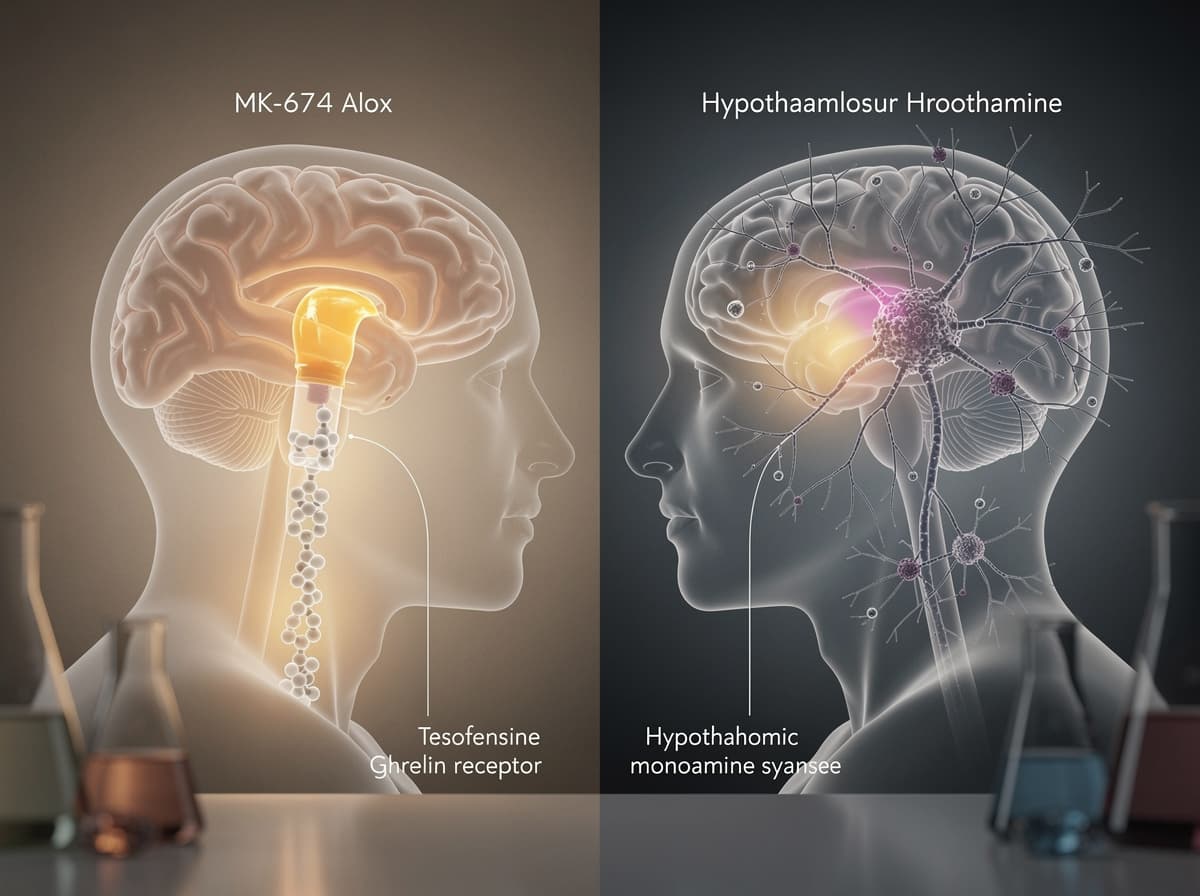
MK-677 (ibutamoren) is a small-molecule, non-peptide agonist of the growth hormone secretagogue receptor GHSR-1a. That is the same receptor endogenous ghrelin binds. Receptor activation drives pulsatile pituitary release of growth hormone, which raises hepatic IGF-1. Because the signal runs through the pituitary rather than clamping serum GH externally, the natural pulsatile pattern is preserved.
The compound has a long duration of action: one oral dose keeps GH and IGF-1 elevated across the 24-hour dosing interval, which permits once-daily dosing. The most cited long-term dataset is Nass et al. 2008 in the Annals of Internal Medicine, a randomised trial in 65 healthy older adults (ages 60-81) that dosed 25 mg once daily. Daily administration of MK-677 raised GH and IGF-1 to those of healthy young adults without serious adverse effects, but the compositional and functional endpoints were more modest than the biomarker response suggested. Merck subsequently ran an Alzheimer's programme (Sevigny et al. 2008) and a hip-fracture programme; neither returned clinical benefit, and the compound was shelved.
How tesofensine works: triple monoamine reuptake inhibition#
Tesofensine (NS2330) is a small molecule originally developed by NeuroSearch for Parkinson's and Alzheimer's disease. It inhibits reuptake of noradrenaline, dopamine, and serotonin in central pathways. The Parkinson's and Alzheimer's programmes failed on their primary endpoints, but a pooled meta-analysis of those trials noted an unexpected dose-dependent weight loss, with roughly 32% of obese subjects on the highest dose (1.0 mg) achieving at least 5% weight reduction after 14 weeks. That signal is what pivoted the compound into an obesity Phase 2 programme.
Mechanistically, tesofensine acts on hypothalamic feeding circuits and reward pathways. The net phenotype is reduced appetite, mild thermogenesis, and modest increases in blood pressure and heart rate. The half-life is roughly 220 hours in humans (approximately 9 days), which produces very slow steady-state accumulation and means a single missed dose does not meaningfully change plasma exposure.
Dosing: MK-677 vs tesofensine#
Research-protocol doses for MK-677 in the peer-reviewed literature cluster tightly around 10-25 mg once daily by mouth. The Nass trial dosed 25 mg/day for 12 months, and the long half-life allows once-daily administration without the pulse-frequency arithmetic that injectable secretagogues require. Community protocols split between fasted-morning and pre-sleep timing. Pre-sleep dosing leans on the observation that MK-677 amplifies the natural nocturnal GH pulse, at the cost of amplifying next-day appetite.
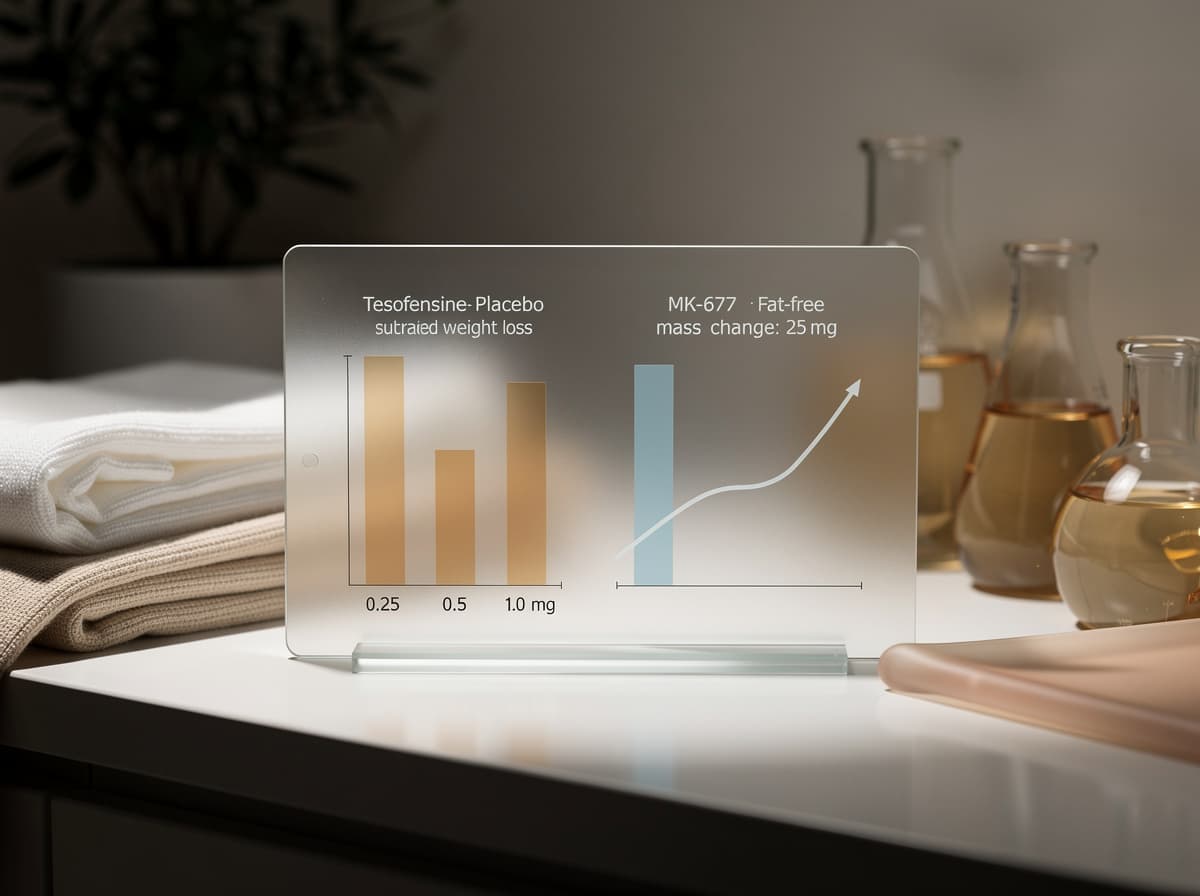
For tesofensine, the research-published dose range is much lower on a milligram basis but produces markedly stronger effects per unit. The Astrup et al. Phase 2b programme tested 0.25 mg, 0.5 mg, and 1.0 mg once daily against placebo over 24 weeks. According to the published trial, the compound produced dose-dependent weight losses of 4.5%, 9.2% and 10.6% greater than diet plus placebo at those three doses respectively, against a 2.0% loss on diet plus placebo. The 0.5 mg dose is the one that carries forward into most subsequent discussion because it captures nearly all the weight loss of 1.0 mg with a lower adverse-event burden.
Do not conflate the mg scales. A gram-for-gram comparison is meaningless: MK-677 at 25 mg and tesofensine at 0.5 mg both sit near the middle of their respective research-dose bands. That is a 50-fold difference in absolute mass, but the compounds hit entirely different targets. Klarovel does not sell, source, or fulfil either compound; the regulatory framing is outlined in our disclosures.
Evidence: what the studies actually show#
For MK-677, the strongest human dataset remains Nass et al. 2008: 65 healthy older adults, 25 mg daily. Fat-free mass increased by approximately 1.1 kg versus a decrease of roughly 0.5 kg on placebo (p < 0.001), and appetite increased as expected from ghrelin receptor agonism. The trial found no change in strength or function. Intracellular water, the trial's marker of body cell mass, rose 0.8 kg versus a 1.0 kg fall on placebo, so the gain was not simply retained extracellular fluid, but it did not translate into function. Fasting glucose rose by approximately 0.3 mmol/L and insulin sensitivity declined. There has been no Phase 3 programme; the Alzheimer's and hip-fracture trials were negative on their clinical primaries.
For tesofensine, the pivotal trial is the Phase 2b published by Astrup et al. in The Lancet in 2008. Tesofensine 0.25 mg, 0.5 mg and 1.0 mg plus diet induced mean weight losses 4.5%, 9.2% and 10.6% greater than diet plus placebo, respectively (p < 0.0001), with diet plus placebo alone producing 2.0%. The interpretation was that tesofensine 0.5 mg might have the potential to produce a weight loss twice that of currently approved drugs, though the authors flagged that these findings needed confirmation in Phase 3. Later Phase 2 work (including trials registered on ClinicalTrials.gov) has continued to report meaningful weight loss. Saniona's partner Medix has since completed a Phase 3 program in Mexico and resubmitted its application to the Mexican regulator, COFEPRIS, in February 2025 (Saniona); there is no FDA or EMA filing.
There is no head-to-head trial between the two compounds and no realistic path to one. They are being evaluated for opposite endpoints in opposite populations.
Side effects and contraindication profile#
MK-677's most concerning non-cardiac effects relate to glucose metabolism. Fasting glucose rose by approximately 0.3 mmol/L (roughly 5 mg/dL) on average in the Nass trial, with modest HbA1c increases and a decline in insulin sensitivity consistent with the known diabetogenic effect of GH excess. Appetite elevation is a feature, not a side effect, but it becomes a problem when the user is trying to remain at caloric maintenance. Fluid retention and mild peripheral edema are common. Muscle pain and lethargy have been reported. There is a signal for congestive heart failure in one hip-fracture study population that pushed Merck away from further development.
Tesofensine's core adverse events are cardiovascular and psychiatric. In the Astrup Phase 2b trial, 0.25 mg and 0.5 mg did not significantly raise systolic or diastolic blood pressure versus placebo, but heart rate rose by 7.4 bpm at 0.5 mg. 6.1% of subjects on the highest dose reported depressed mood, versus 0% on placebo, and this was in a population pre-selected to exclude those with known psychiatric disorders. Dry mouth, nausea, constipation, hard stools, diarrhoea, and insomnia are the most frequent non-cardiac events. Anyone with a history of hypertension, arrhythmia, or major depressive disorder is associated with a substantially worse risk profile than the trial cohort.
The two profiles overlap almost nowhere. MK-677 pressures glucose and fluid balance; tesofensine pressures the cardiovascular and psychiatric systems. That is not a coincidence; it is what happens when the mechanisms sit in different organ systems.
When to choose MK-677#
MK-677 is the more defensible starting point when the goal is GH-axis support in a lean-mass or recovery context, not fat loss. Concrete user states where the compound has been studied and has a plausible rationale:
- Older adults with age-related GH decline, clean fasting glucose (ideally <5.5 mmol/L) and HbA1c below 5.7%, who tolerate an appetite bump.
- Post-injury or post-surgical recovery contexts where fat-free mass preservation matters and the user is not in a caloric deficit.
- Sleep architecture research use, where the compound has been associated with increased slow-wave sleep duration.
- Users who explicitly want an oral non-peptide with once-daily dosing and are willing to accept modest effect sizes.
Do not use MK-677 if the primary objective is fat loss. It will oppose that goal directly through ghrelin receptor agonism.
When to choose tesofensine#
Tesofensine is the more defensible starting point when the goal is central appetite suppression in a research setting and the user's cardiovascular and psychiatric baseline is genuinely clean. Concrete user states:
- Adults with a BMI in the 30-40 range where diet and behavioural modification have plateaued, with no history of mood disorder or arrhythmia.
- Users who have tolerated other centrally-acting appetite modulators (research suggests sibutramine-class tolerance is a reasonable proxy) without hypertensive or mood signals.
- Someone whose blood pressure is well controlled (ideally <125/80 at baseline) and whose resting heart rate has margin to absorb a roughly 7 bpm rise without crossing clinically relevant thresholds.
- Users who want a once-daily oral compound and can accept the very long half-life (approximately 9 days), which makes rapid dose adjustment impractical.
Do not use tesofensine if the primary objective is anabolic support, GH-axis restoration, or recovery. The compound has no mechanism that touches those endpoints.
Can you stack MK-677 and tesofensine?#
Stacking is not standard practice and there is no clinical data supporting the combination. The mechanisms actively oppose each other on the endpoint most users care about: MK-677 drives appetite up through ghrelin receptor agonism, tesofensine drives appetite down through central monoamine reuptake inhibition. Running them together produces an internal contradiction where one arm of the stack is trying to add fat-free mass in a caloric surplus while the other arm is enforcing a deficit. The paired effect is not amplification; it is signal cancellation on the endpoint that matters, with the safety signals of both compounds stacked on top.
If the underlying goal is body-recomposition (fat down, lean up), a more coherent research protocol pairs a single-mechanism fat-loss agent with resistance training and adequate protein, then addresses GH-axis support separately if biomarkers warrant it. Running opposing mechanisms simultaneously is a strategy that only sounds clever until the arithmetic is written out.
Verdict: which one, for which reader#
If the goal is fat loss and the reader fits the cardiovascular and psychiatric inclusion profile, tesofensine has the stronger head-line efficacy data (roughly 9% placebo-subtracted weight loss at 0.5 mg), tempered by the absence of published Phase 3 data or FDA and EMA approval, and by the heart-rate and mood signals. If the goal is lean-mass support in an ageing or recovery context and glucose metabolism is clean, MK-677 has the more mature evidence base (a 12-month randomised trial with clear composition endpoints), tempered by the modest effect size and the diabetogenic pressure.
For most healthy adults who fit neither narrow population, neither is a first-line choice. Sleep, protein, resistance training, and (where clinically indicated in a regulated setting) GLP-1 receptor agonists outperform both on a risk-adjusted basis. The reader who lands on this comparison because their body-composition goal is genuinely mixed should work out which axis their health profile actually points to before touching either compound.
Quantify which one your health profile actually points to#
The interesting question is not "MK-677 vs tesofensine" in the abstract. It is which biomarker gap the reader is actually trying to close: age-related GH decline, or a metabolically resistant fat mass. Run the numbers before running the compound. Start with the peptide dose calculator to model a research protocol against your body weight, review how Klarovel structures its protocol layer, then register to build a monitoring plan around the compound that actually maps to your endpoint.
Frequently asked questions
Keep reading
Peptides for Inflammation: Mapping BPC-157, KPV, and Thymosins
Peptides for inflammation compared by mechanism and evidence stage: BPC-157, KPV, thymosin alpha-1, and thymosin beta-4, with FDA status and safety notes.
Mounjaro vs Zepbound: Same Drug, Two Different FDA Labels
Mounjaro and Zepbound are the same drug, tirzepatide, at the same doses. The difference is the FDA label: diabetes for Mounjaro, weight loss for Zepbound.
Rybelsus for Weight Loss: Not Approved, and the Pill That Is
Rybelsus is not FDA-approved for weight loss and moves the scale only a little. The oral semaglutide approved for weight loss is the Wegovy pill at 25 mg.