

Two of the most-discussed longevity compounds sit on opposite ends of the biological calendar. Epitalon is a four-amino-acid peptide dosed in short annual cycles that has been associated with telomerase activation. NAD+ precursors (NMN and nicotinamide riboside) are daily oral molecules that top up a metabolic cofactor the body already uses billions of times per second. This comparison unpacks what each one actually does, where the human evidence is thin versus solid, and how to decide which layer of the longevity stack to prioritise.
Key takeaways#
- Epitalon (AEDG, Ala-Glu-Asp-Gly) is a synthetic pineal tetrapeptide that has been shown to induce telomerase activity in cultured human cells; NAD+ precursors are B3-vitamin-family molecules that raise circulating NAD+ concentrations in a dose-dependent fashion.
- Human evidence is much stronger for NAD+ precursors: multiple randomised, placebo-controlled trials with blood biomarkers exist for NMN and NR. Epitalon's clinical record is dominated by Russian observational studies and small trials with methodological limits.
- Research-published epitalon protocols use short subcutaneous cycles (typically 5-10 mg/day for 10-20 days, repeated 1-3 times per year); NMN and NR are taken daily by mouth, typically 250-900 mg/day for NMN and 300-1000 mg/day for NR.
- Side-effect burden is low for both in short-to-medium trials, but long-term Western safety data does not yet exist for either. Epitalon lacks any Phase 2/3 trial published in a PubMed-indexed peer-reviewed journal as of 2026.
- For most people building a longevity stack, NAD+ precursors are the more defensible starting point because human trials with placebo controls and NAD+ blood biomarkers are consistently positive. Epitalon becomes reasonable as a layered, cyclical addition for those willing to accept preliminary evidence.
How epitalon works#
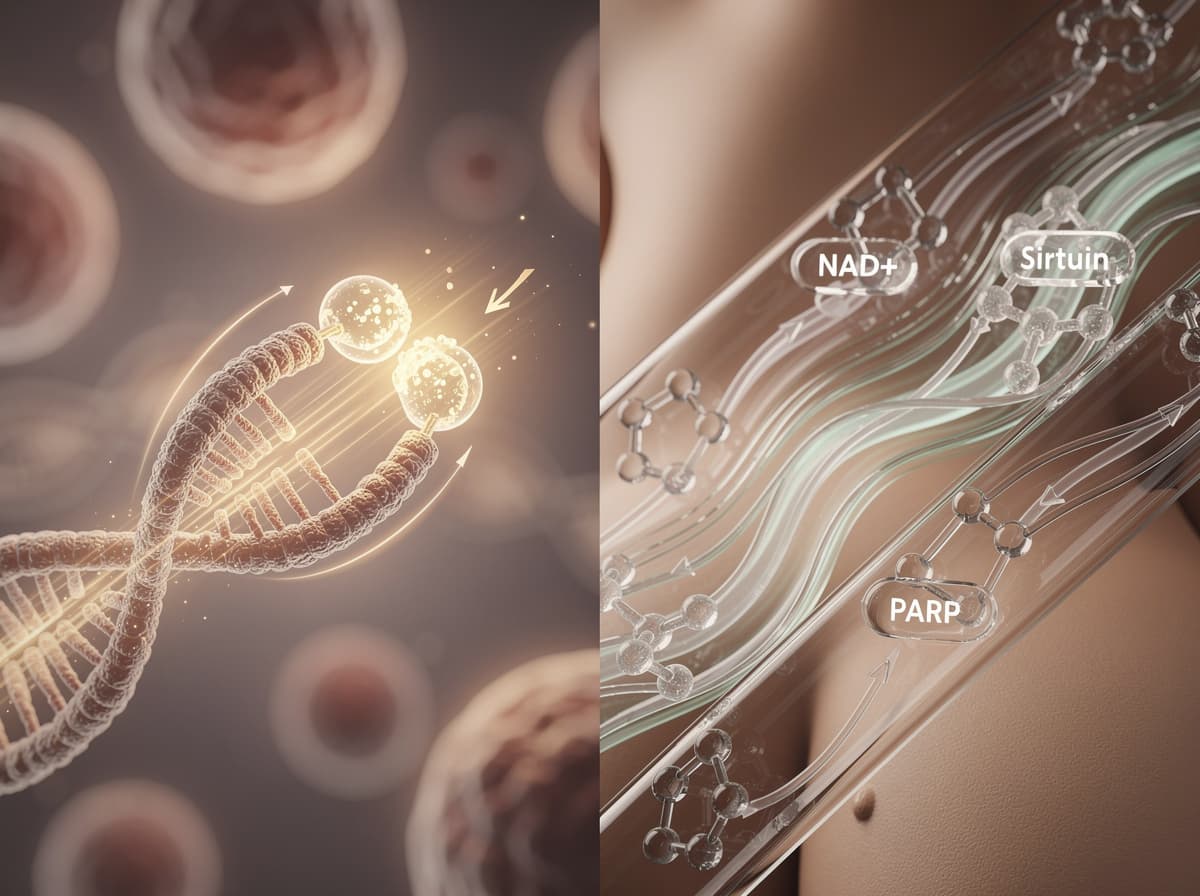
Epitalon is a synthetic tetrapeptide with the sequence Ala-Glu-Asp-Gly, synthesized from the amino acid composition of the bovine pineal extract epithalamin. Its most-cited mechanism is telomerase activation. In human somatic cell cultures, epitalon treatment induces expression of the telomerase catalytic subunit (hTERT), increases enzymatic activity, and produces measurable telomere elongation. A 2025 review in the Overview of Epitalon paper notes that epitalon influences melatonin synthesis, modulates interleukin-2 mRNA, and enhances the activity of several enzymes including telomerase, though the review emphasises that these findings do not close the mechanism question.
The peptide is dosed by subcutaneous injection because oral bioavailability of a tetrapeptide is essentially zero. Half-life in circulation is very short (minutes), which is why protocols use short daily cycles: the biological "signal" is delivered as a pulse rather than a steady-state exposure. Research suggests that the downstream effects (telomerase induction, pineal restoration of melatonin) outlast the peptide itself by weeks to months, which is what justifies the cycle-and-rest cadence used in Russian gerontology clinics.
The important caveat: the large human longevity observations often cited for epitalon were actually conducted using epithalamin (the bovine extract), not the synthetic AEDG tetrapeptide (Khavinson and Morozov, 2003), and the two are related but not identical. That distinction matters when weighing evidence.
How NAD+ precursors work#
NAD+ (nicotinamide adenine dinucleotide) is a coenzyme every cell uses for redox reactions, DNA repair via PARP enzymes, and gene regulation via sirtuins. NAD+ levels decline with age, and the working hypothesis behind supplementation is that restoring youthful NAD+ concentrations restores the enzymatic bandwidth of the systems that depend on it. Direct oral NAD+ is poorly absorbed, so the field uses precursors: nicotinamide mononucleotide (NMN) and nicotinamide riboside (NR).
Both are converted to NAD+ inside cells through the salvage pathway. NR is a smaller molecule and moves through cells via nucleoside transporters; NMN's absorption pathway in humans has been debated, though multiple trials confirm that oral NMN raises blood NAD+ regardless. Studies have shown that NMN supplementation is safe and well tolerated at up to 900 mg oral daily doses, with dose-dependent NAD+ elevation. For NR, in the NADPARK trial in people with Parkinson's disease, 1,000 mg daily for 30 days raised brain NAD levels, augmented the NAD metabolome in blood cells and muscle, and lowered inflammatory cytokines in serum and cerebrospinal fluid.
The mechanism is essentially "refuel the tank." That is philosophically different from epitalon's "flip a switch, then walk away."
Dosing: epitalon vs NAD+ precursors#
Research-published epitalon protocols vary but cluster in a narrow band. A common pattern is about 5 mg per day by subcutaneous injection for 20 days, or 10 mg per day for 10 days, repeated two to three times a year. The "Russian Protocol" as reported in the literature involves 10 mg daily via subcutaneous injection for 10 consecutive days, repeated every 4-6 months. These are research-published patterns, not personal recommendations.
NMN dosing is grounded in a clean dose-response curve. In the 80-participant randomised trial by Yi et al., blood NAD concentrations were statistically significantly increased among all NMN-treated groups at day 30 and day 60 when compared to both placebo and baseline, with the highest levels in the 600 mg and 900 mg groups. Practical daily doses cluster in the 250-600 mg range for general longevity intent, with 900 mg reserved for maximising blood NAD+ ceiling.
NR is dosed higher on a milligram basis because its NAD+-raising efficiency per mg is slightly lower. Clinical safety has been documented, with oral doses ranging from 100 to 2000 mg/d in human trials. Typical daily doses in longevity practice are 300-1000 mg.
Evidence: what the studies actually show#
No head-to-head randomised trial comparing epitalon against NMN or NR exists. The comparison has to be built from each compound's independent evidence base, and the asymmetry is stark.
For NAD+ precursors, the human record is substantial. The NADPARK phase I trial in Parkinson's disease enrolled 30 newly diagnosed patients on 1,000 mg NR or placebo for 30 days and found NR was well tolerated with a significant increase in cerebral NAD levels measured by 31P-MRS. In healthy adults, the Yi et al. dose-response trial mentioned above delivered dose-dependent blood NAD+ elevation with concomitant improvements in the 6-minute walk test and SF-36 quality-of-life score. Preclinical data points to lifespan and healthspan extension in rodents, and human trials have consistently reproduced the NAD+ blood elevation.
For epitalon, the strongest primary evidence lives in cell culture, animal, and observational human work. Animal studies suggest that epitalon increases activity of antioxidant enzymes including superoxide dismutase and glutathione peroxidase, and extends median and maximum lifespan by 12-24% in rodent longevity studies. Preliminary evidence in humans includes small trials in retinitis pigmentosa where parabulbar injections of 5 µg per eye for 10 days enhanced visual acuity, expanded peripheral fields, and reduced scotomas without reported adverse effects. The most-cited human longevity data is a 6-8 year follow-up of 266 elderly participants treated with pineal and thymic peptide preparations (including epithalamin, not synthetic AEDG), published by Khavinson and Morozov in 2003. As of 2026, no Phase 2 or Phase 3 controlled efficacy trial of synthetic epitalon has been published in a PubMed-indexed journal.
Translation: NAD+ precursors have blood biomarker data from placebo-controlled trials. Epitalon has preclinical mechanism data plus older observational human data on a related compound.

Side effects, contraindications, and safety framing#
Both compounds have relatively benign short-term profiles in published trials, but their risk frameworks differ.
NMN shows a clean safety profile in human trials up to 1,200 mg/day: no serious adverse events, with mild reports limited to flushing, nausea, and dizziness at rates comparable to placebo. Human trial history for NMN largely dates from 2021 onward, so long-term safety data beyond 12-24 months is still accumulating. NR is even better documented, with safety established at up to 2,000 mg daily and a NR-SAFE trial testing 3,000 mg/day in Parkinson's patients reporting no dose-limiting toxicity. Theoretical concerns about NAD+ boosters accelerating tumour growth in existing cancers have not been confirmed in human trials but remain a reasonable contraindication for anyone with an active malignancy.
Epitalon's side-effect record is dominated by "no major adverse events reported" claims from Russian sources, which is a lower evidentiary bar than randomised trial safety data. Injection-site reactions and mild transient sleep changes are the most commonly reported issues. The theoretical concern is telomerase activation in premalignant cells, though no clinical case series has documented this signal. The regulatory framing is also different: epitalon is not approved as a medicine in the US, EU or Norway (an FDA advisory committee voted 7 to 4 in July 2026 to recommend it for the 503A compounding list, but no rule has followed, so it cannot yet be compounded; FDA, 2026), while NR and NMN are sold as dietary supplements in the US.
When to choose epitalon#
Epitalon is the more defensible pick when:
- You have already established a baseline longevity stack (sleep, exercise, diet, NAD+ support) and want to add a cyclical, mechanism-distinct layer targeting telomere biology.
- You are drawn to short intensive cycles rather than daily oral routines. The peptide's protocol design suits people who prefer 2-3 focused windows per year over lifetime daily dosing.
- Sleep quality and pineal-melatonin restoration are meaningful subjective goals. This is one of the more consistently reported user experiences during epitalon cycles.
- You are willing to accept preliminary evidence and act on mechanism plausibility rather than placebo-controlled trial data.
When to choose NAD+ precursors#
NMN or NR is the more defensible starting point when:
- You want the compound with the strongest human trial record for the longevity category. Blood NAD+ elevation is documented in multiple placebo-controlled trials.
- You prefer oral daily dosing over injections. Compliance and route matter for a lifetime intervention.
- Your priority is metabolic health, mitochondrial function, or endurance capacity. The 6-minute walk test data and cerebral metabolic imaging point in this direction.
- You are earlier in your longevity journey and want to establish a foundation before layering in cyclical peptides.
Can you stack them?#
Yes, and this is arguably the most sensible framing. The mechanisms do not compete: epitalon acts as a pulsed telomere-biology signal delivered by injection in short cycles, while NAD+ precursors provide daily metabolic cofactor restoration. Common longevity protocols use daily NAD+ support as the background and layer epitalon cycles two or three times a year. There is no documented pharmacological conflict, and no trial has tested the combination formally, so stacking them is a reasoned extrapolation rather than a trial-backed strategy.
The one situation where the pairing is inadvisable: active or recent malignancy. Both compounds have theoretical proliferation concerns (NAD+ fuels DNA-repair machinery that also serves tumour cells; epitalon activates telomerase), and stacking two mechanisms with the same theoretical risk should wait until oncology clearance.
Verdict#
For most people building a longevity stack in 2026, NAD+ precursors are the better starting point. The human evidence base is stronger, the route is oral, the dose-response is documented, and blood NAD+ can be measured to confirm the intervention is doing what it claims. Epitalon is a reasonable second-layer addition for those already running an NAD+ protocol who want cyclical exposure to a mechanism-distinct compound, but recommending it as a first move overstates the human trial base. If the goal is telomere biology specifically, the answer is still to start with NAD+ (which supports the DNA-repair machinery that maintains telomeres) and add epitalon cycles once the foundation is in place.
Build the protocol that matches your health profile#
Both compounds have a reasonable place in a longevity stack, but the right sequencing depends on your health profile, sleep, goals and experience; lab values sharpen the plan when you have them but are never required. Klarovel does not sell peptides. It curates the protocol layer: dose logic, cycle cadence, and the questionnaire that translates your inputs into a specific plan. Start with the peptide calculator to model doses, then run the onboarding questionnaire to see which of these two paths (or both, in sequence) your profile actually points to. Create a free account to save your protocol and track cycles over time.
Frequently asked questions
Keep reading
Peptides for Inflammation: Mapping BPC-157, KPV, and Thymosins
Peptides for inflammation compared by mechanism and evidence stage: BPC-157, KPV, thymosin alpha-1, and thymosin beta-4, with FDA status and safety notes.

Mounjaro vs Zepbound: Same Drug, Two Different FDA Labels
Mounjaro and Zepbound are the same drug, tirzepatide, at the same doses. The difference is the FDA label: diabetes for Mounjaro, weight loss for Zepbound.
Rybelsus for Weight Loss: Not Approved, and the Pill That Is
Rybelsus is not FDA-approved for weight loss and moves the scale only a little. The oral semaglutide approved for weight loss is the Wegovy pill at 25 mg.