
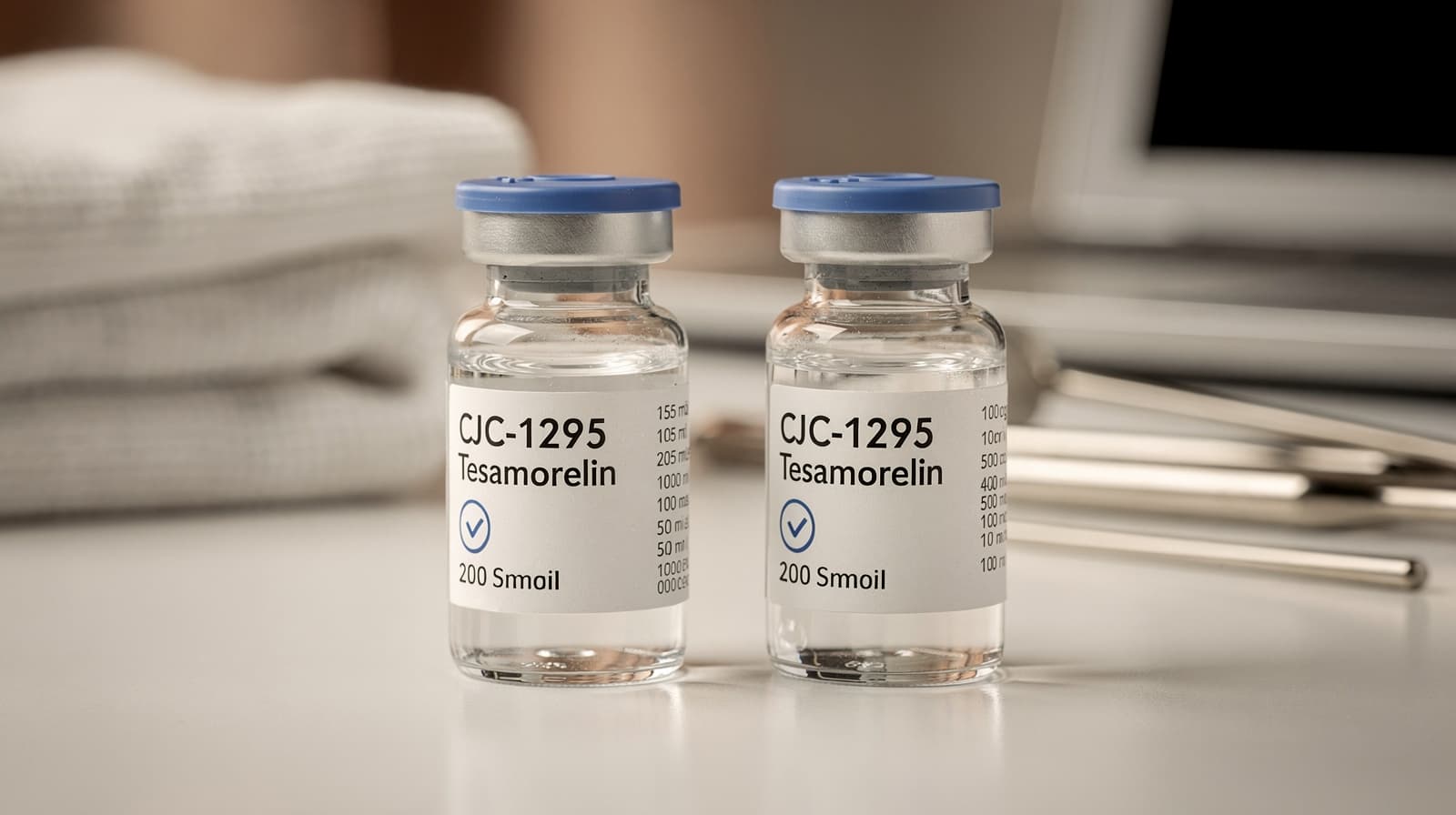
Two molecules. Same receptor family. Wildly different regulatory profiles. CJC-1295 (with DAC) and tesamorelin are both GHRH analogues that signal the anterior pituitary to release growth hormone, but the parallel ends at the receptor. One carries an FDA label and a Lancet-published Phase 3 file; the other carries an albumin-binding tail that stretches a single injection to a full week. This post draws the dividing line so research-context decisions stop relying on vibe.
Key takeaways#
- CJC-1295 with DAC has a half-life of roughly 6 to 8 days because of covalent albumin binding; tesamorelin clears in about 26 minutes intravenously but is dosed daily.
- Tesamorelin is the only FDA-approved GHRH analogue indicated for visceral fat reduction in HIV-associated lipodystrophy; CJC-1295 is research-grade only and was halted at Phase 2.
- In the Phase 3 program, tesamorelin 2 mg subcutaneously daily reduced visceral adipose tissue by roughly 15 to 18 percent over 26 weeks.
- CJC-1295 DAC produced a 2- to 10-fold rise in plasma GH for 6 days and a 1.5- to 3-fold rise in IGF-1 for 9 to 11 days from a single dose in healthy adults.
- Both peptides share an overlapping side-effect cluster (fluid retention, arthralgia, glucose intolerance) because both act through pituitary GH release.
How CJC-1295 works#
CJC-1295 is a 29-amino-acid analogue of GHRH(1-29) modified at four positions to resist proteolytic breakdown by dipeptidyl peptidase IV. The core analogue is linked to a drug affinity complex (DAC) that allows covalent binding to endogenous albumin once injected, extending its half-life to a duration similar to that of albumin itself. Albumin acts as a carrier protein that shields the peptide from kidney filtration and enzymatic clearance.
The pharmacokinetic consequence is the entire reason the molecule exists. A single injection of CJC-1295 DAC may increase plasma GH levels by 2- to 10-fold for 6 days or longer and plasma IGF-1 by 0.5- to 3-fold for 9 to 11 days, with an estimated half-life of about 6 to 8 days in humans.
With multiple doses, IGF-1 levels have been shown to remain elevated for up to 28 days. Receptor binding itself is identical to the non-DAC variant; the DAC tail changes duration, not affinity.
Regulatory history is short and unfinished. CJC-1295 reached Phase 2 development for HIV lipodystrophy in 2006 before that trial was halted. No approval followed. Research-grade CJC-1295 is available from specialised suppliers for laboratory and research-context use only.
How tesamorelin works#
Tesamorelin is structurally bigger and stays closer to native GHRH. It is a synthetic 44-amino-acid polypeptide analogue of human GHRH developed by Theratechnologies and approved by the FDA in 2010, featuring N-terminal modification with a trans-3-hexenoic acid group that gives greater resistance to enzymatic degradation than endogenous GHRH. The modification does not extend the half-life into the multi-day range; it just buys enough stability for a daily subcutaneous dose to do its job.
Mechanistically, tesamorelin binds to pituitary GHRH receptors with high affinity, triggering the natural cascade of growth hormone synthesis and secretion, and stimulates pulsatile GH secretion that mimics natural patterns, increasing serum growth hormone and subsequently IGF-1 levels in a controlled manner. The pulsatile signature is preserved because the molecule clears quickly. Research has shown that tesamorelin restores endogenous pulsatile GH secretion and reduces visceral fat in individuals with HIV infection.
Dosing: CJC-1295 vs tesamorelin#
The two molecules sit on opposite ends of the dosing-frequency spectrum.
For tesamorelin, the dose is fixed by the label. EGRIFTA is indicated for the reduction of excess abdominal fat in HIV-infected patients with lipodystrophy at a recommended dose of 2 mg injected subcutaneously once a day, with the abdomen as the recommended injection site.
In the Phase 3 program, tesamorelin was dosed at 2 mg subcutaneously every day for 52 continuous weeks with no scheduled breaks.
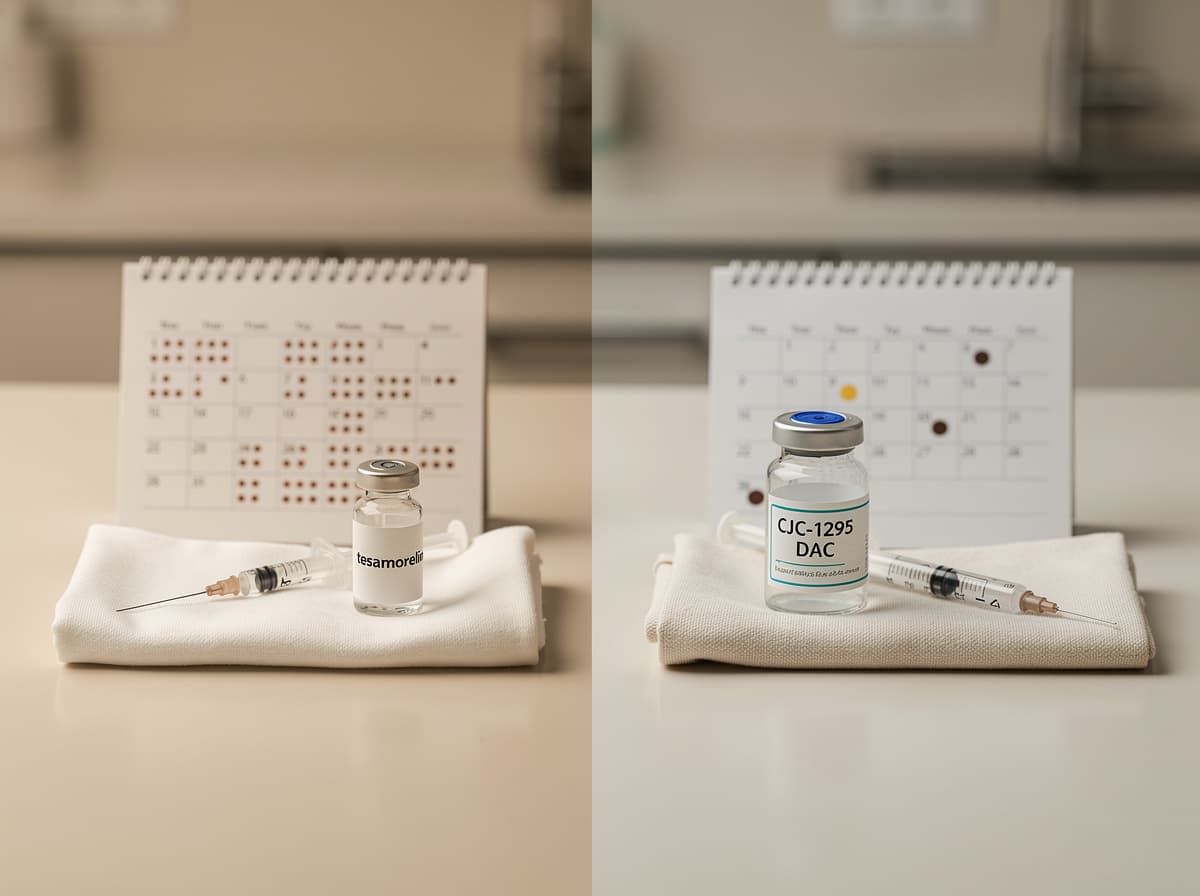
For CJC-1295 with DAC, research-published protocols are weekly or twice-weekly. Most research-planning protocols start at 500 to 1,000 mcg once weekly by subcutaneous injection, with conservative starts common because the 6-8 day half-life means side effects can persist for days. The original Teichman dose-finding work tested up to 60 mcg/kg, and the Phase 1 program reported it as safe and relatively well tolerated at single doses of 30 or 60 mcg/kg.
The practical difference: tesamorelin requires 365 injections per year. CJC-1295 DAC requires roughly 52. That is the compliance gap that originally motivated the DAC modification.
Evidence: what the studies actually show#
There is no head-to-head randomised trial of CJC-1295 versus tesamorelin. The evidence sits in parallel files.
Tesamorelin's pivotal data is the Falutz NEJM 2007 trial and the pooled Phase 3 program. The pivotal evidence comes from two identical Phase 3 trials published in The Lancet that enrolled 816 HIV-positive adults with abdominal fat accumulation, randomised 2:1 to tesamorelin 2 mg daily or placebo for 26 weeks; tesamorelin reduced trunk fat by a mean of 15.2 percent versus 0.5 percent for placebo, and CT-measured VAT decreased 15.2 percent in the treatment group versus a 4.5 percent increase in placebo. The signal extended to liver. In the Stanley Lancet HIV 2019 trial, tesamorelin was shown to robustly decrease liver fat while also preventing fibrosis progression and improving indices of liver inflammation in people living with HIV who had NAFLD.
CJC-1295's human file is much thinner. The foundational dataset is Teichman et al. 2006 in JCEM, which studied healthy adults in ascending single and multiple-dose cohorts. Subcutaneous administration produced sustained, dose-dependent increases in GH and IGF-I levels and was safe and relatively well tolerated, particularly at doses of 30 or 60 microg/kg, with evidence of a cumulative effect after multiple doses. No Phase 3 visceral-fat or body-composition outcome data exists. The evidence is a pharmacokinetic story, not an outcome story.
That asymmetry is the single most important fact in this comparison. Tesamorelin has demonstrated clinical endpoints. CJC-1295 has demonstrated hormonal endpoints.
Side effects and contraindication profile#
The two peptides share a side-effect skeleton because both work by elevating GH and IGF-1. The shared cluster: fluid retention, arthralgia, paraesthesia, carpal tunnel symptoms, and glucose intolerance.
For tesamorelin, the FDA label is explicit. The most common adverse effects above 5 percent are arthralgia, injection site erythema, injection site pruritus, extremity pain, peripheral edema, and myalgia.
Fluid retention thought to be related to induction of GH secretion typically manifests as increased tissue turgor and musculoskeletal discomfort resulting in edema, arthralgia, and carpal tunnel syndrome, with symptoms usually transient or resolving with discontinuance. The glucose signal is real but modest. EGRIFTA treatment can result in glucose intolerance, with elevated HbA1c at or above 6.5 percent seen in 5 percent of tesamorelin patients versus 1 percent on placebo over 26 weeks.
IGF-1 is the metric to watch. Among patients who received EGRIFTA for 26 weeks, 47 percent had IGF-1 levels greater than 2 standard deviation scores and 36 percent had SDS above 3, with this effect seen as early as 13 weeks of treatment. The label recommends dose discontinuation in patients with persistent IGF-1 elevations above 3 SDS, especially when the response is not robust.
For CJC-1295 DAC, the side-effect profile is the same biology with a longer tail. The extended 6 to 8 day half-life means side effects like water retention and joint stiffness can persist for several days after a single injection, because the peptide's sustained GH elevation increases IGF-1 production in the liver, which promotes sodium and water retention through enhanced renal tubular reabsorption (the same mechanism behind the edema seen in chronic GH excess). Facial flushing is a CJC-1295-specific signature that is rarer with tesamorelin. Both peptides are contraindicated in active malignancy, uncontrolled diabetes, and any state where elevated IGF-1 carries unacceptable risk.
The honest divergence: tesamorelin has post-marketing data going back to 2010. CJC-1295's long-term safety beyond the Phase 1/2 horizon has not been characterised.
When to choose CJC-1295#
Choose CJC-1295 with DAC when the research goal is sustained GH-axis modulation with minimal injection burden. Specific scenarios:
- Weekly dosing cadence is a hard requirement (travel, compliance, low needle tolerance).
- The research target is IGF-1 plateau rather than pulsatile GH mimicry.
- The protocol design intentionally separates GHRH stimulation from a paired GHRP secretagogue across days rather than minutes.
- Cost per injection matters and a six-fold reduction in injection frequency carries meaningful protocol weight.
What CJC-1295 is not appropriate for: any context where a regulatory-validated outcome is required. There is no Phase 3 endpoint to point to.
When to choose tesamorelin#
Choose tesamorelin when the goal is documented visceral adipose tissue reduction and the user-state matches the trial population.
-
Diagnosed HIV-associated lipodystrophy. This is the only FDA-approved indication and the only place insurance coverage typically follows.
-
Visceral adiposity in the metabolic-syndrome context where the user wants a peptide with a published Phase 3 effect size, accepting daily injections and IGF-1 monitoring as the cost of evidence.
-
Research interest in NAFLD or liver-fat reduction signals. Research has shown that tesamorelin reduced liver fat and prevented fibrosis progression in HIV-associated NAFLD over 1 year, making it the first strategy shown to be effective against NAFLD among the population with HIV.
-
Glucose tolerance is borderline-but-monitorable. Tesamorelin's daily-clearance profile means the GH signal is not sitting on the pancreas around the clock.
Can you stack them?#
Stacking CJC-1295 DAC with tesamorelin is not standard practice and there is no published trial of the combination. Both molecules occupy the same GHRH receptor on the same somatotroph population. Co-administering them does not produce a complementary action; it produces redundant signalling with additive side-effect risk (fluid retention, IGF-1 SDS escalation, glucose deterioration). The classical pairing logic for GH-axis peptides is GHRH analogue plus a separate GHRP secretagogue such as ipamorelin, because those hit different receptors and amplify each other through complementary mechanisms. Pairing two GHRH analogues does not.
If a research design genuinely calls for both signalling profiles (sustained baseline plus pulsatile peaks), the more defensible architecture is a long-acting GHRH plus a short-acting GHRP, not two GHRH analogues stacked.
Verdict#
For HIV-associated lipodystrophy, the answer is tesamorelin. There is no competitive case. It is the only molecule with a label, a Phase 3 endpoint, and a decade of post-marketing safety data in that indication.
For general GH-axis research outside the lipodystrophy indication, the verdict tilts on what the protocol is trying to measure. If the endpoint is a documented body-composition outcome, tesamorelin still wins because that is the only place such outcomes have been demonstrated. If the endpoint is sustained IGF-1 elevation with minimal injection burden, CJC-1295 DAC has the pharmacokinetic edge and is the more rational choice. The molecules are not interchangeable; they answer different research questions.
The trap is treating CJC-1295's longer half-life as evidence of superiority. It is evidence of convenience. Tesamorelin's daily clearance is a feature, not a flaw, because it preserves the pulsatile GH signature that the receptor evolved to recognise.
Decide on data, not on duration#
The CJC-1295 versus tesamorelin question gets answered correctly only when the research goal is named first. Klarovel does not stock peptides; partner suppliers fulfil. What Klarovel curates is the protocol layer underneath: the bloodwork cadence, the IGF-1 SDS thresholds, the dose-finding logic. Run the peptide calculator against the molecule that matches your endpoint, complete the questionnaire to map your baseline, and review how Klarovel works before the first vial gets reconstituted.
Frequently asked questions
Keep reading
Peptides for Testosterone: Which Axis Actually Works
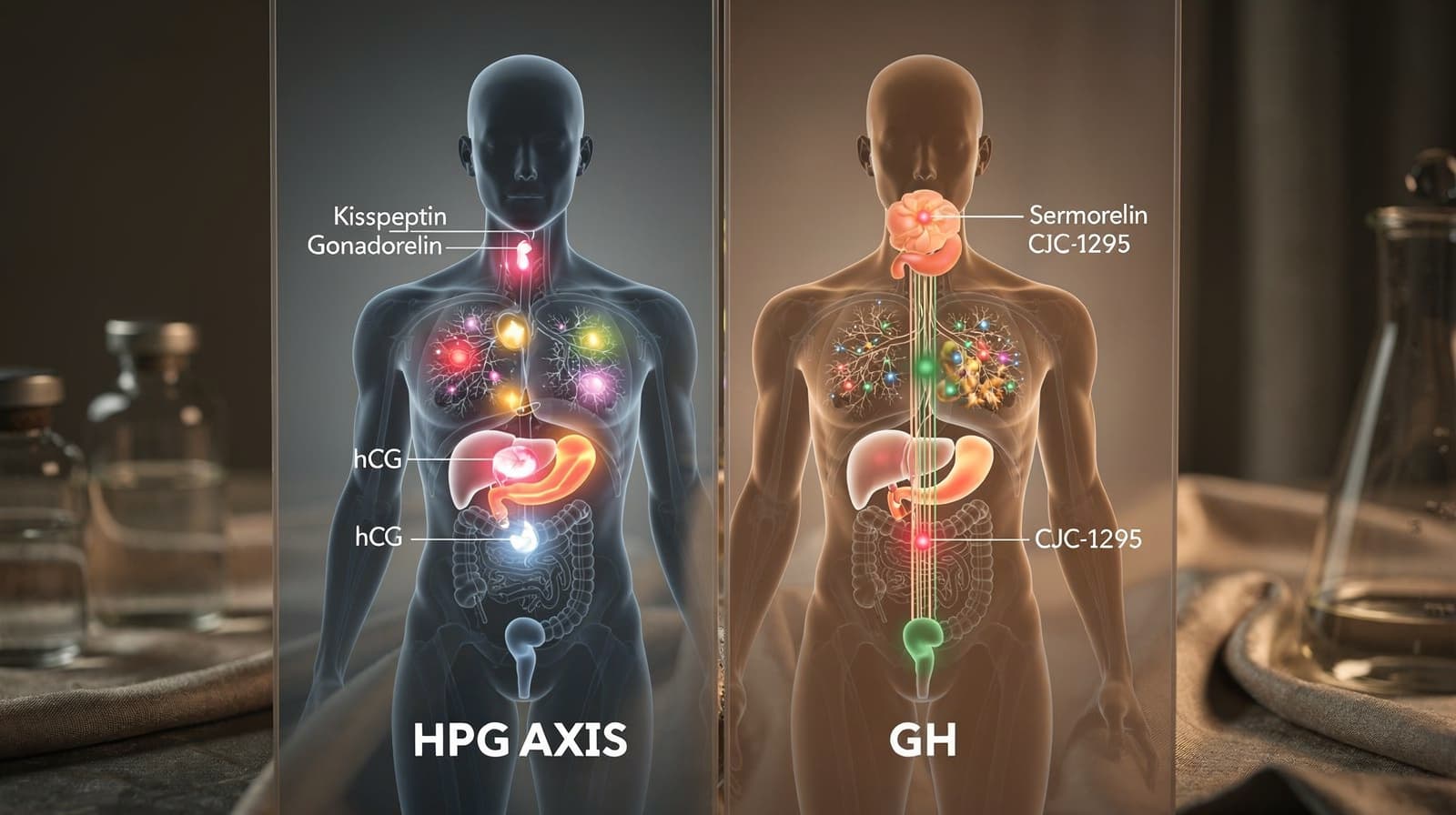
Most peptides for testosterone act on the growth hormone axis and never touch LH. Here is which compounds have measured serum testosterone in men.
Tirzepatide vs Retatrutide: What the 2026 Data Show
Retatrutide reached 28.3% weight loss at 80 weeks; tirzepatide 20.9% at 72. A side-by-side of receptor targets, trial data, tolerability and status.
Semax vs Selank: Mechanism, Evidence, and Stacking
Semax and Selank share a Moscow lab and an intranasal route, but hit different targets. Mechanism, Russian trial data, dosing logic, and 2026 FDA status.