
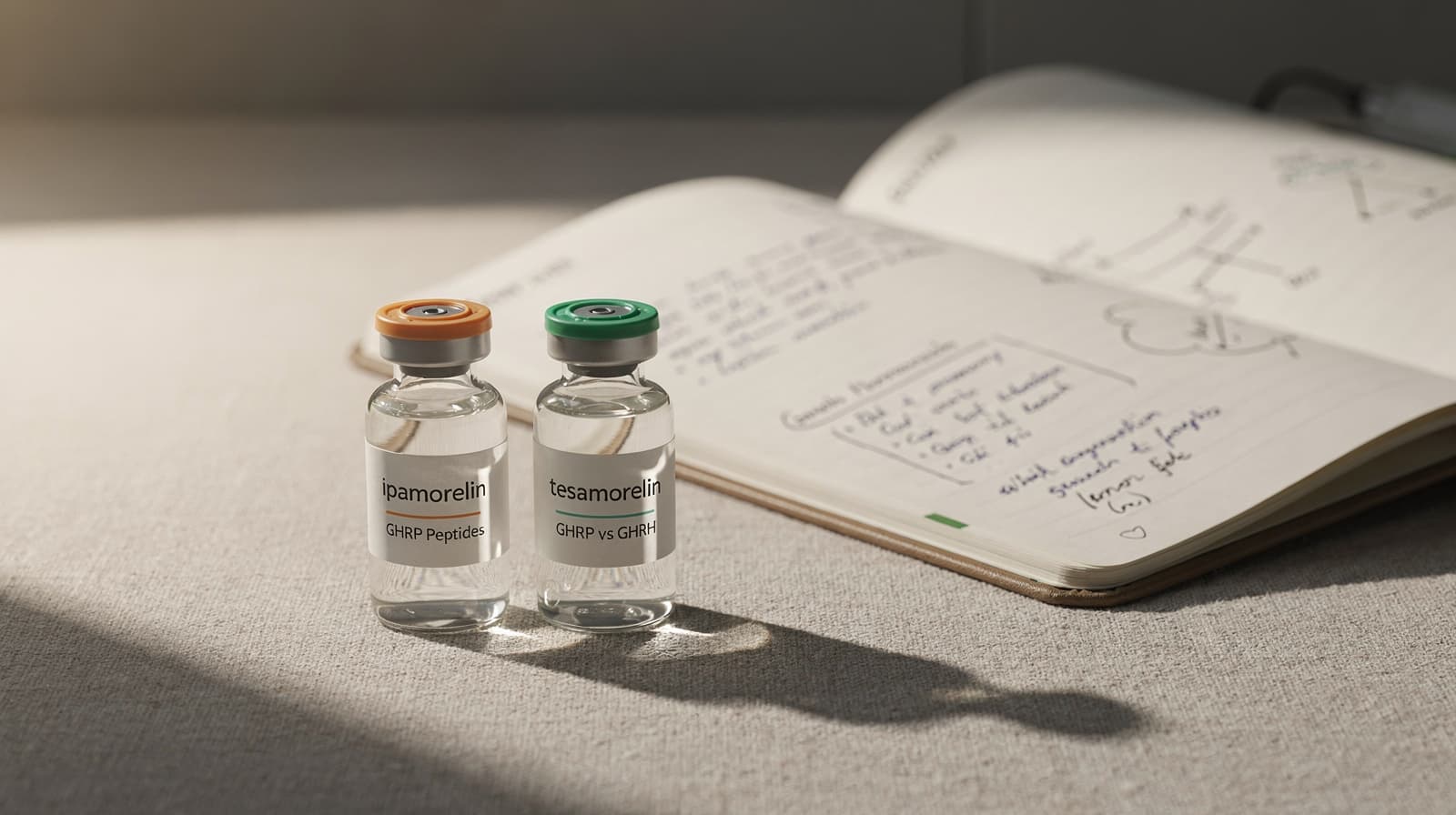
The ipamorelin vs tesamorelin question is really a question about two different layers of the growth hormone axis. One is a selective ghrelin-receptor agonist (GHRP) with clean preclinical pharmacology but thin human data. The other is the only GHRH analogue currently approved and marketed in the US, with a substantial visceral-fat dossier in HIV-associated lipodystrophy. This guide unpacks where each one earns its place, where the evidence is overstated, and how to read the trade-offs honestly.
Key takeaways#
- Tesamorelin is the only GHRH analogue currently approved and marketed in the US, with pivotal Phase III trials in HIV-associated lipodystrophy showing an 11-15% reduction in visceral adipose tissue at 26 weeks.
- Ipamorelin is a selective GHS-R1a (ghrelin-receptor) agonist; the original Raun 1998 pharmacology paper established its hallmark profile of GH release without ACTH, cortisol, or prolactin elevation.
- They act on different receptors and pathways: tesamorelin primes the somatotroph through GHRH-R; ipamorelin amplifies the GH pulse through GHS-R1a. The pairing is supra-additive, not redundant.
- Dose ranges differ by an order of magnitude: ipamorelin 100-300 mcg SC in research-use protocols versus tesamorelin 1.4 mg (Egrifta SV) or 1.28 mg (Egrifta WR) SC once daily on the label, and 2 mg in the pivotal trials. Side-effect profiles diverge accordingly.
- For visceral-fat reduction with documented clinical evidence, tesamorelin wins. For a low-side-effect, pulsatile GH augmentation that respects physiologic rhythm, ipamorelin is the cleaner choice.
How ipamorelin works#
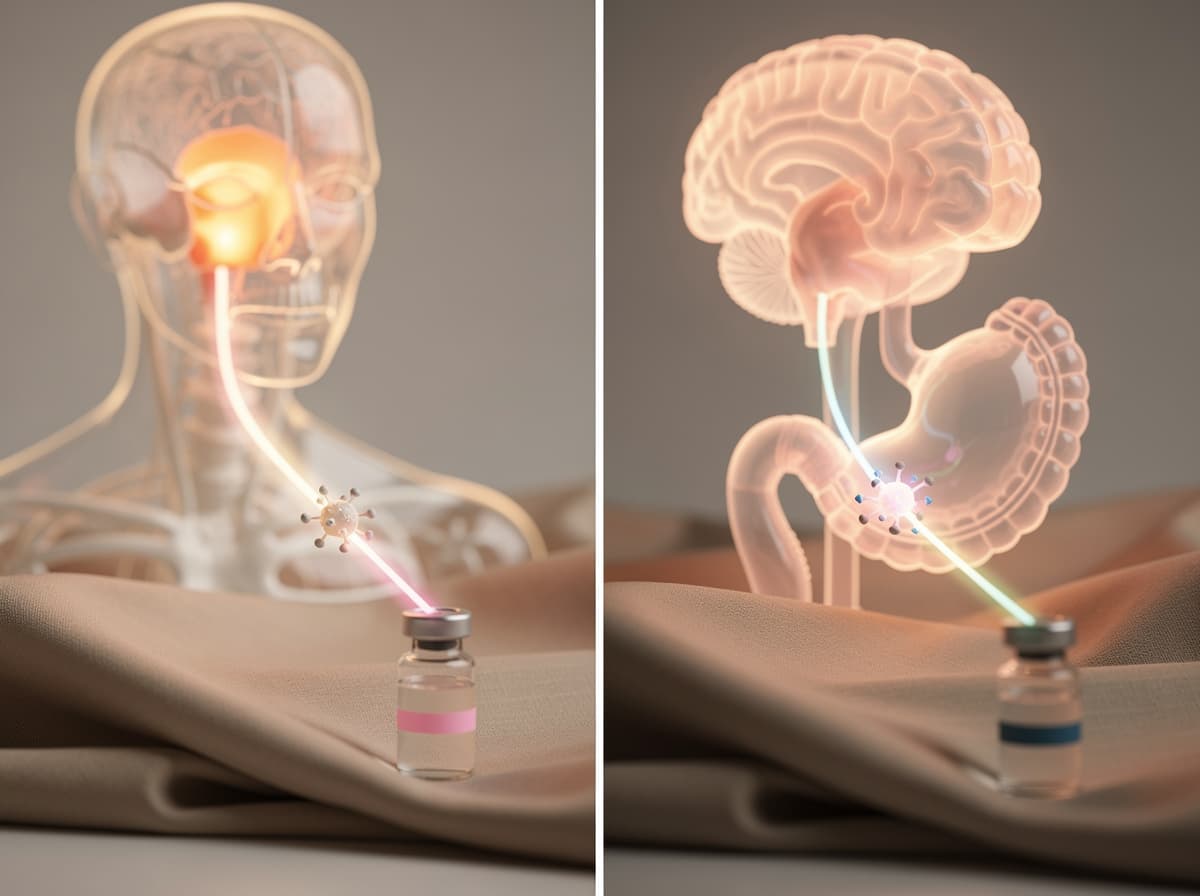
Ipamorelin is a synthetic pentapeptide (Aib-His-D-2-Nal-D-Phe-Lys-NH2) developed by Novo Nordisk in the late 1990s. It is a selective agonist of the growth hormone secretagogue receptor (GHS-R1a), the same receptor activated by endogenous ghrelin. Binding triggers a brief, sharp release of growth hormone from somatotrophs in the anterior pituitary, mirroring the natural pulsatile pattern of GH secretion.
What distinguishes ipamorelin from earlier GHRPs is its receptor selectivity. The original Raun et al. 1998 pharmacology paper showed that ipamorelin did not raise ACTH or cortisol to levels significantly different from GHRH stimulation alone, and this finding held even at doses more than 200-fold above the ED50 for GH release. In direct comparison, GHRP-2 and GHRP-6 produce dose-dependent ACTH and cortisol elevation, and hexarelin can elevate prolactin as well.
Pharmacokinetically, ipamorelin is short-acting. Plasma half-life is roughly two hours; the GH pulse peaks at 30-40 minutes post-injection and returns to baseline by three hours. That kinetic profile is the point: one injection, one physiologic pulse, no sustained receptor occupation.
The human evidence base is thin. Ipamorelin has no FDA approval. Its only randomized efficacy trial, a Phase II in postoperative ileus at 0.03 mg/kg IV twice daily, missed its primary endpoint. Clinical development did not continue after that trial, and the compound entered the research-peptide space without completing efficacy trials. In the US it is not on the 503A bulks list and sits in Category 2 for outsourcing facilities, so it cannot be lawfully compounded.
How tesamorelin works#
Tesamorelin is a stabilized analogue of human growth hormone-releasing hormone (GHRH). Structurally, it consists of a 44 amino acid GHRH sequence modified to resist enzymatic degradation and extend half-life, specifically through a trans-3-hexenoic acid modification at the N-terminus that blocks DPP-4 cleavage. It binds the GHRH receptor on pituitary somatotrophs and stimulates endogenous GH synthesis and release.
Mechanistically, this is the opposite end of the axis from ipamorelin. Where ipamorelin amplifies the pulse through ghrelin-receptor signaling, tesamorelin recruits the GHRH pathway that the hypothalamus normally controls. Tesamorelin amplifies the body's own pulsatile GH release rather than replacing it, and daily dosing keeps IGF-1 raised across the course of treatment, which is why it is dosed continuously rather than in cycles.
Tesamorelin has FDA approval (EGRIFTA SV, and more recently the EGRIFTA WR reformulation) for reducing excess abdominal fat in HIV-infected patients with lipodystrophy. That approval is anchored in two large randomized controlled trials and a long-term safety extension that together enrolled over 800 patients.
Dosing and protocols compared#
The two peptides are dosed on completely different scales, which alone tells you they are not interchangeable.
Research-published ipamorelin protocols typically range from 100 to 300 mcg per subcutaneous injection, with bedtime dosing preferred to align with the natural slow-wave-sleep GH surge. The only formal clinical dose in the human efficacy record is the postoperative-ileus trial, which used 0.03 mg/kg intravenously twice daily for up to seven days. Outside the trial setting, compounded outpatient regimens generally cluster at 100-300 mcg SC once to three times daily. Fasting is conventional (1-2 hours before and 20-30 minutes after the injection) because elevated plasma glucose blunts the GH pulse.
Tesamorelin is dosed in milligrams, not micrograms. The pivotal Phase III trials by Falutz and colleagues used 2 mg subcutaneously daily for 26 weeks, and 2 mg was the dose of the original EGRIFTA. The current formulations are labeled at 1.4 mg once daily for EGRIFTA SV and 1.28 mg once daily for EGRIFTA WR (label), and the two are not interchangeable. Tesamorelin is injected into the abdominal subcutaneous tissue (the labels do not specify a time of day) and is dosed continuously rather than pulsed. The Phase III program documented no tachyphylaxis on continuous daily dosing across 52 weeks.
To translate either of these to a per-mg or weekly plan that matches your bodyweight and goal, run the numbers through our peptide calculator rather than guessing at vial reconstitution.
Evidence: what the studies actually show#
This is where the two compounds part company most clearly.
For ipamorelin, the human evidence is essentially one published Phase II trial in postoperative ileus that failed its primary endpoint, and a small body of pharmacokinetic and selectivity work in healthy volunteers and animal models. The selectivity story is well documented: research suggests ipamorelin reliably releases GH without measurable cortisol or prolactin elevation, but the body-composition and metabolic outcomes that are routinely claimed for it have not been tested in adequately powered human studies. Preliminary evidence from animal work and small open-label series is consistent with modest IGF-1 elevation, but no randomized trial has demonstrated visceral-fat reduction, lean-mass gain, or metabolic improvement in humans on ipamorelin monotherapy.
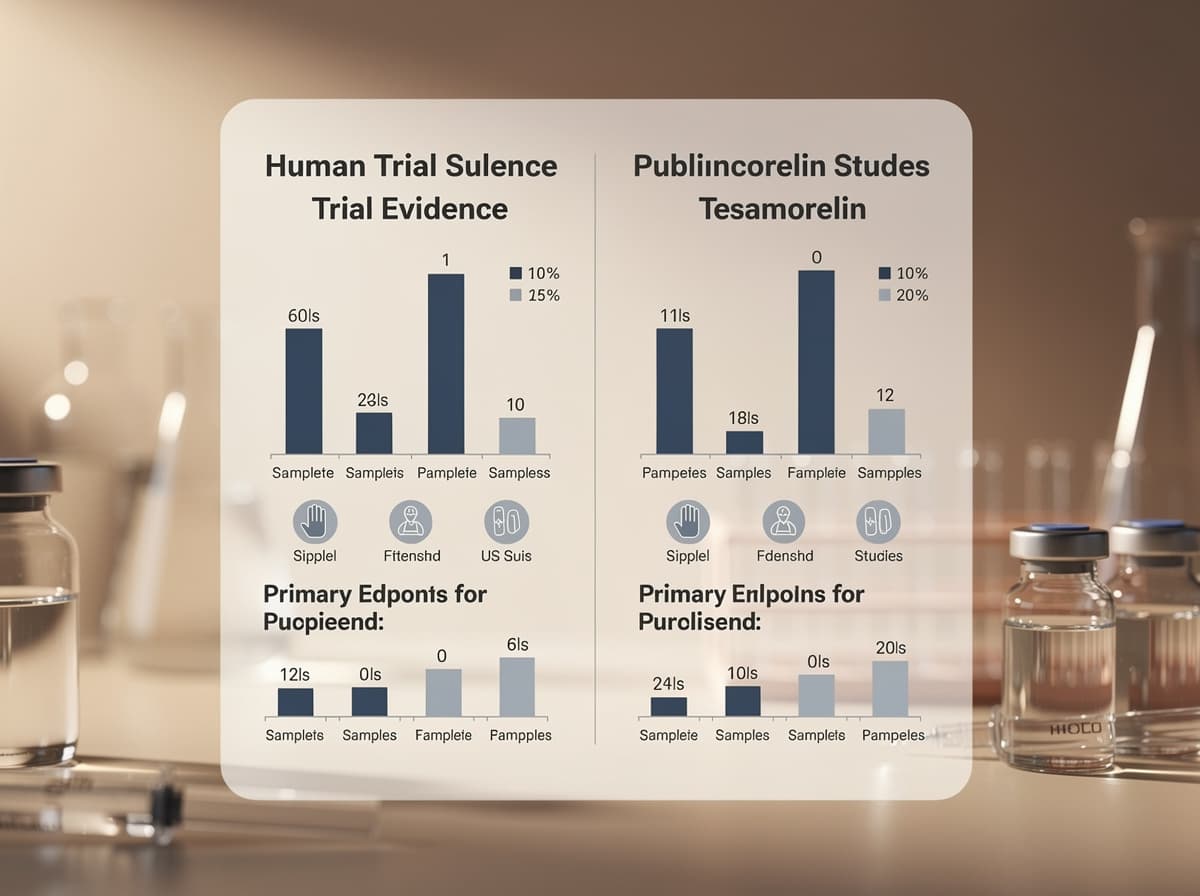
For tesamorelin, the evidence base is substantial. The original Falutz et al. NEJM 2007 trial found a 15.2% reduction in visceral adipose tissue at 26 weeks against a 5.0% rise on placebo, and the second Phase III trial (Falutz et al. 2010) found a 10.9% reduction against 0.6% on placebo, with IGF-1 rising and triglycerides improving. The effect is selective at the tissue level: tesamorelin specifically targets visceral fat without significantly reducing subcutaneous fat or overall body weight, which is the clinically important distinction because visceral fat is the metabolically dangerous depot. Beyond HIV lipodystrophy, Stanley et al. Lancet HIV 2019 extended the evidence into NAFLD, where tesamorelin 2 mg daily for 12 months produced a roughly 37% relative reduction in hepatic fat fraction versus placebo in HIV-associated NAFLD.
In short: tesamorelin has been shown to produce a specific, replicated body-composition outcome in randomized trials. Ipamorelin has not been studied at that level of rigor for any equivalent endpoint.
Side effects, contraindications, and when to choose each#
The safety profiles look superficially similar (both raise GH and IGF-1) but differ in the magnitude and chronicity of that elevation, which changes the risk calculus.
Tesamorelin's adverse-event profile from the Phase III program is led by injection-site reactions (17% of patients versus 6% on placebo, per the label), arthralgia, peripheral edema, paresthesia, and a clinically meaningful rise in IGF-1 that occasionally exceeds the upper limit of normal. Glucose tolerance can worsen modestly, particularly in patients with pre-existing insulin resistance, and the label carries warnings against use in active malignancy, pregnancy, and in patients with hypothalamic-pituitary disorders. The IGF-1 elevation is sustained for the duration of dosing, which is why baseline and on-treatment IGF-1 monitoring is standard.
Ipamorelin's side-effect register at standard research doses (100-300 mcg) is generally milder. Reported effects are associated with the acute GH pulse: head rush, transient paresthesia in hands and feet, mild water retention, injection-site irritation, and occasionally a mild bump in appetite (much less than GHRP-6 or GHRP-2). The selectivity story holds in the published pharmacology: no meaningful cortisol, prolactin, or aldosterone elevation at therapeutic doses. The same IGF-1 contraindication applies in principle: any compound that drives GH/IGF-1 elevation is contraindicated in active malignancy, even if the magnitude of elevation is smaller than with tesamorelin.
Choose tesamorelin when the goal is documented visceral-fat reduction, when there is metabolic context (HIV lipodystrophy, NAFLD, central adiposity with insulin resistance), when the patient can commit to daily injections for 6-12 months, and when IGF-1 monitoring infrastructure exists. The trade-off is cost (substantial) and a real side-effect profile.
Choose ipamorelin when the goal is pulsatile, sleep-aligned GH augmentation with the cleanest available secretagogue profile, when the user wants to avoid sustained IGF-1 elevation, when budget or sourcing makes a multi-month 2 mg/day tesamorelin protocol impractical, or when ipamorelin is being used as one arm of a GHRH+GHRP pairing. Be honest about the evidence ceiling: research suggests selectivity, but durable body-composition outcomes in humans are not yet documented.
Can you stack them?#
Yes, and the rationale is mechanistic rather than marketing-driven. GHRH analogues prime the somatotroph at one receptor; GHRPs amplify the pulse at a complementary receptor. In 18 healthy men, Bowers et al. (1990) found that a low dose of an early GHRP given with GHRH produced a mean peak GH of about 80 µg/L, against about 36 µg/L for GHRH alone and 8 µg/L for the GHRP alone: supra-additive rather than simply summed. That study used GHRP-6 and native GHRH, not tesamorelin and ipamorelin, and the pair discussed here has not been tested together in a published trial. In practice, tesamorelin + ipamorelin blends (commonly 1 mg tesamorelin + 200-300 mcg ipamorelin nightly) are used to recruit both pathways. The trade-off is doubled cost, doubled injection complexity, and IGF-1 elevation that can move into supraphysiological territory faster than either peptide alone. Bloodwork at 4 and 12 weeks becomes mandatory rather than optional. Klarovel's approach is documented in how it works: the stack is only worth running if the bloodwork and the goal justify it.
Verdict#
For visceral fat reduction with replicated randomized-controlled-trial evidence, tesamorelin is the better starting point. The 11-15% VAT reduction at 26 weeks is the most replicated body-composition signal among GH-axis peptides, and the FDA approval reflects a regulatory threshold that no ghrelin-mimetic peptide has cleared. If the user's question is "I have central adiposity and want a peptide with actual human data behind the claim," tesamorelin wins on evidence weight alone.
For a cleaner pulsatile GH augmentation, lower side-effect burden, lower cost, and a research tool that preserves physiologic rhythm, ipamorelin is the more sensible choice, provided the user accepts that the body-composition claims rest on extrapolation rather than human RCTs. For the user who wants both arms of the axis recruited and is willing to monitor IGF-1 closely, the stack is mechanistically justified.
The lazy answer is that they are equivalent. They are not. They sit at different receptors, carry different evidence weight, and serve different goals.
Decide with your health profile, not with marketing#
The honest answer to ipamorelin vs tesamorelin is that the choice is downstream of two questions: what does your health profile look like (including IGF-1, if you have a recent result), and what specific outcome are you trying to move? If you cannot answer those, the comparison is academic. Run your numbers through the peptide calculator, complete the intake questionnaire so the protocol layer can map your health profile against the published evidence, and let the data decide which arm of the GH axis is worth recruiting.
Frequently asked questions
Keep reading
Peptides for Inflammation: Mapping BPC-157, KPV, and Thymosins
Peptides for inflammation compared by mechanism and evidence stage: BPC-157, KPV, thymosin alpha-1, and thymosin beta-4, with FDA status and safety notes.
Mounjaro vs Zepbound: Same Drug, Two Different FDA Labels
Mounjaro and Zepbound are the same drug, tirzepatide, at the same doses. The difference is the FDA label: diabetes for Mounjaro, weight loss for Zepbound.
Rybelsus for Weight Loss: Not Approved, and the Pill That Is
Rybelsus is not FDA-approved for weight loss and moves the scale only a little. The oral semaglutide approved for weight loss is the Wegovy pill at 25 mg.