
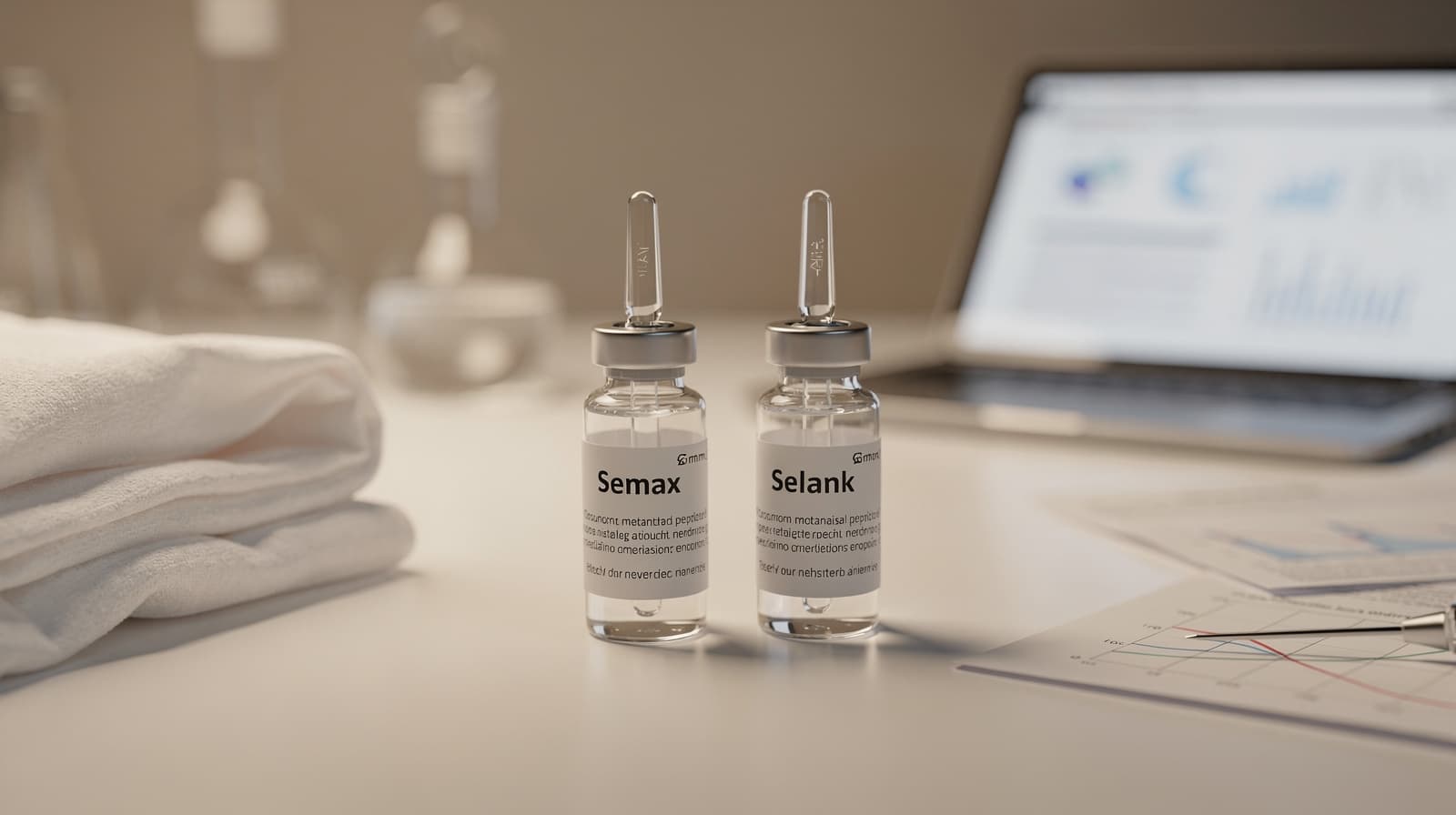
Semax and Selank get treated as a matched pair because they came out of the same Moscow institute, share a Pro-Gly-Pro tail, and both go up the nose. That framing hides the more useful fact: they load different receptors and produce different subjective signals. This post separates the two on mechanism, on what the human data actually says, and on where each one sits with regulators in 2026.
Key takeaways#
- Semax is an ACTH(4-10) analogue (Met-Glu-His-Phe-Pro-Gly-Pro). A single 50 µg/kg dose in rats produced roughly a 1.4-fold rise in hippocampal BDNF protein and a 3-fold rise in exon III BDNF mRNA.
- Selank is a tuftsin analogue (Thr-Lys-Pro-Arg-Pro-Gly-Pro) built for anxiolysis, acting through GABAergic modulation plus inhibition of enkephalin-degrading enzymes.
- Both inhibit human serum enkephalinases in vitro, with reported IC50 values of about 10 µM for Semax and 20 µM for Selank. This is the one mechanism they genuinely share.
- The anchor human trial for Selank randomised 62 patients (30 Selank, 32 medazepam) with anxiolytic results in the same range and additional antiasthenic effects.
- In July 2026 an FDA advisory committee voted 8-5 to recommend Semax for the 503A compounding list. Selank was not on that agenda; its nomination had been withdrawn in 2024.
Semax vs Selank starts with two different parent molecules#
Both peptides came out of the Institute of Molecular Genetics of the Russian Academy of Sciences, which is why they are so often shelved together. The parentage is where they split.
Semax is a heptapeptide built from the melanocortin fragment. It is an analog of the adrenocorticotropin fragment (4-10) which after intranasal application has effects on learning and exerts neuroprotective activity . The ACTH backbone was stripped of its hormonal (corticotropic) activity and stabilised with a C-terminal Pro-Gly-Pro.
Selank took the same stabilisation trick and applied it to an immune peptide. It consists of the short fragment Thr-Lys-Pro-Arg of the heavy chain of human immunoglobulin G plus the tripeptide Pro-Gly-Pro at the end of the molecule, which provides metabolic stability and duration of action . Tuftsin, the parent, is an immunomodulator. That heritage shows up in Selank's cytokine effects, not just its calming ones.
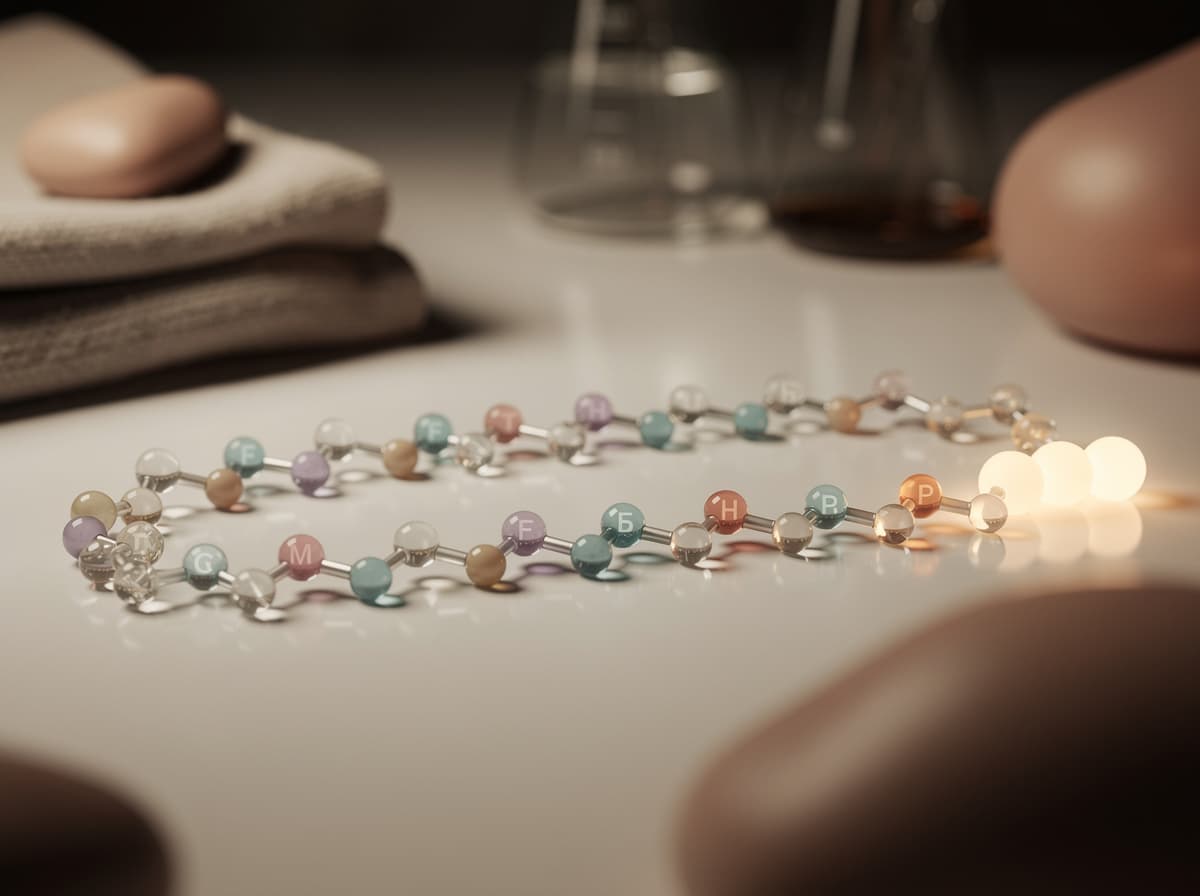
On mechanism, Semax drives plasticity while Selank modulates the brake#
The cleanest way to hold the Semax vs Selank distinction: one pushes neurotrophic signalling upward, the other lowers arousal without sedation.
For Semax, the neurotrophin axis is the dominant story. A single application of 50 µg/kg produced a maximal 1.4-fold increase in BDNF protein, a 1.6-fold increase in trkB tyrosine phosphorylation, and 3-fold and 2-fold increases in exon III BDNF and trkB mRNA respectively in the rat hippocampus , published in Brain Research. The authors suggest Semax affects cognitive brain functions by modulating expression and activation of the hippocampal BDNF/trkB system. Genome-wide work from the same network has since mapped immune and vascular gene expression shifts in focal brain ischaemia models. Semax also touches monoamines: research has shown activation of dopaminergic and serotoninergic systems in rodents, which is the likeliest reason users describe it as sharpening rather than settling.
For Selank, two mechanisms carry most of the weight. The first is GABAergic. Clinical studies reported an anxiolytic effect comparable to classical benzodiazepines, which enhance GABA inhibition by allosteric modulation of GABA-A receptors, and the authors suggest Selank's molecular mechanism may relate to its ability to affect GABAergic system performance . That hypothesis was tested directly in Frontiers in Pharmacology using expression panels of GABA-signalling genes.
The second is enkephalinase inhibition, and here the two peptides overlap. Work published in the Russian Journal of Bioorganic Chemistry found a dose-dependent effect of both heptapeptides on the enkephalin-degrading enzymes of human serum, with inhibitory effects of Semax (IC50 10 µM) and Selank (IC50 20 µM) more pronounced than puromycin and bacitracin . A companion paper reported that Selank dose-dependently inhibited enzymatic hydrolysis of plasma enkephalin with an IC50 of 15 µM , alongside the observation that patients with generalized anxiety showed considerably shortened enkephalin half-life and reduced total enkephalinase activity in blood, but patients with panic disorder and agoraphobia did not . That is the mechanistic bridge between Selank's immune ancestry and its behavioural signal.
The human evidence for Semax vs Selank is Russian, small, and largely unreplicated#
This is the part most comparison articles skip. Both compounds carry Russian marketing authorisation, and both carry an evidence base that Western reviewers read as thin.
Selank's anchor citation is a 2008 comparative trial. Sixty-two patients with generalized anxiety disorder and neurasthenia were studied, with 30 on Selank compared against 32 on medazepam, assessed with Hamilton, Zung and CGI scales plus serum enkephalin activity; the anxiolytic effects of both were similar, but Selank also showed antiasthenic and psychostimulant effects (PubMed 18454096). The same work reported that patients had decreased tau(1/2) leu-enkephalin correlating with symptom severity, and that this parameter rose during Selank administration , which is a rare case of a mechanism marker moving alongside a clinical scale.
Response timing is uneven. A congress report on 20 GAD patients dosed at 2700 µg/day intranasally found that 40% were rapid responders whose Hamilton Anxiety Rating Scale total fell from 20.3 to 7.0 by day 3, while 60% responded gradually, reaching a fall from 16.1 to 6.2 by day 14 (European Psychiatry congress abstract). Planning around a 14-day window rather than a 3-day one is the conservative read.
Semax's strongest human dataset sits in cerebrovascular work, not cognition. A 2018 report from the Gusev group studied 110 patients (43 men, 67 women, mean age 58.0 ± 9.7 years) given 6,000 mcg/day intranasally in two 10-day courses separated by a 20-day interval, with elevated plasma BDNF and improved Barthel index and MRC motor-scale scores across roughly five months of observation (PubMed 29798983). Earlier work in the same lineage was non-randomised, which limits causal reading. Separately, preclinical data points toward antistress activity: a 2024 chronic unpredictable stress study found that systemically administered ACTH(4-10) analogs Semax and melanotan II exerted antidepressant-like effects on anhedonia and hippocampal BDNF levels and attenuated markers of chronic stress load in male rats (PubMed 39442746).
What is missing matters as much. The FDA's own briefing document for the 2026 review notes that Semax was also nominated for ADHD and as a nootropic; ADHD was not evaluated because supporting literature for this use was not found, and "nootropic" has no ICD-10 code or professional society guidelines . Reviewers also reported being unable to locate human pharmacokinetic studies for Semax by any route. Neither compound has a Western randomised controlled trial supporting any indication.
Dosing logic differs more than the Semax vs Selank framing implies#
Because the two compounds pull in different directions, their scheduling logic diverges. Semax is stimulating and dose-dependently arousing, so late-day administration is where sleep complaints appear. Selank's absence of sedation means it can be spread across the day, and Russian protocols are typically structured as short courses rather than open-ended use, commonly 14 days.
The practical consequence: a Semax schedule tends to be front-loaded and cycled, while a Selank schedule is distributed and time-boxed. Volume conversion for intranasal solutions is where most self-directed protocols go wrong, since microgram targets in a nasal spray leave little margin for arithmetic error. The Klarovel peptide calculator exists for exactly that step.
Stacking Semax and Selank is community convention, not trial evidence#
The combined protocol is popular because the pharmacology reads well on paper: one peptide raises neurotrophic tone and monoamine drive, the other lowers arousal and preserves endogenous enkephalins. Their effects are plausibly supra-additive on paper because they enter the pathway at different points and converge only at the enkephalinase step.
Plausible is not demonstrated. There is no published controlled trial of the pair administered together. Functional-imaging work has compared their network-level effects in the same analytical frame, which is useful mechanistically, but it is not a stacking trial. Anyone running both is running an n-of-1 with two variables at once, which makes attribution of any effect impossible. Sequential single-variable trials produce interpretable results; simultaneous introduction does not. That principle sits at the centre of how Klarovel structures protocols.
Regulatory status now separates Semax and Selank more than pharmacology does#
Through 2023 and 2024 the two peptides moved on parallel tracks. Both were placed in Category 2 of the FDA's interim 503A list, the classification for nominated bulk substances the agency flagged for potential safety concerns. Then the paths split. On 20 September 2024 the FDA announced that five substances, including Selank acetate (TP-7), were being removed from Category 2 based on the nominators' withdrawal of their nomination.
Semax stayed in the review process and reached a vote. The FDA scheduled a Pharmacy Compounding Advisory Committee meeting at which the committee discussed Semax-related bulk substances (free base and acetate) alongside emideltide and epitalon . The panel recommended six of the seven peptides under review, including Semax, overriding career scientists who had recommended against including any of the seven, with emideltide the single rejection at 7-6 with one abstention . Semax passed 8-5 and epitalon 7-4.
That changes nothing today. The votes are recommendations, not approvals, and are not binding; the FDA must still decide whether to act through formal rulemaking that realistically runs into 2027, and nothing became legal to compound that was not legal before. Outside Russia, both peptides remain unapproved: Selank is not approved by the FDA or the European Medicines Agency as a finished product with a registered indication , and the same holds for Semax. Research-grade material for either is available from specialised suppliers under research-use terms, and that supply route carries no purity or concentration oversight. Certificate-of-analysis review is not optional in that context.
The Semax vs Selank decision is a question about your bottleneck#
Stop asking which peptide is stronger. Ask what is actually limiting you. If it is arousal, rumination and stress load, the Selank literature is the relevant literature. If it is cognitive drive and neuroplastic tone, Semax is where the mechanistic and human data cluster. Running both at once destroys your ability to know which one did anything, and neither has the safety package that would justify casual layering.
Klarovel does not sell peptides. It builds the protocol layer around them: single-variable sequencing, dose arithmetic that survives scrutiny, and baseline markers recorded before anything changes. Create an account to structure your protocol before you source anything, and run your microgram targets through the peptide calculator first.
Frequently asked questions
Keep reading
Peptides for Testosterone: Which Axis Actually Works
Most peptides for testosterone act on the growth hormone axis and never touch LH. Here is which compounds have measured serum testosterone in men.
Tirzepatide vs Retatrutide: What the 2026 Data Show
Retatrutide reached 28.3% weight loss at 80 weeks; tirzepatide 20.9% at 72. A side-by-side of receptor targets, trial data, tolerability and status.

Semaglutide vs Retatrutide: Head-to-Head Data Review
Semaglutide vs retatrutide compared on weight loss, cardiometabolic outcomes, safety, and regulatory status using the latest 2026 Phase 3 trial data.