
Kisspeptin is the peptide with direct evidence for raising testosterone: in four healthy men, a 22.5-hour infusion of kisspeptin-10 lifted serum testosterone from about 480 to 690 ng/dL (16.6 to 24.0 nmol/L), because it acts on the hormone axis that reaches the testes. GLP-1 receptor agonists are also associated with higher testosterone in men with obesity or type 2 diabetes, while for the growth hormone peptides that top most searches (sermorelin, ipamorelin, CJC-1295) we found no human trial showing a rise in serum testosterone. This piece sorts the category by the axis each compound acts on, and names which ones actually measured androgens in men.
Key takeaways#
- A single intravenous bolus of kisspeptin-10 at 1 µg/kg raised serum LH from 4.1 to 12.4 IU/L within 30 minutes in healthy men, and a 22.5-hour infusion raised serum testosterone from about 480 to 690 ng/dL (16.6 to 24.0 nmol/L).
- Enclomiphene at 12.5 mg and 25 mg raised LH by 5.1 and 7.4 mIU/mL respectively and lifted total testosterone comparably to topical testosterone, without reducing sperm concentration. It is a selective estrogen receptor modulator, not a peptide.
- CJC-1295 produced sustained, dose-dependent rises in GH and IGF-1 in healthy adults. Serum testosterone was not an endpoint in that work, and we found no GH secretagogue trial showing a testosterone rise.
- A 2025 systematic review of 10 studies covering 639 men found GLP-1 receptor agonist use consistently associated with increased total testosterone in men with obesity, type 2 diabetes or functional hypogonadism.
- Kisspeptin-10 remains in Category 2 of the FDA's 503A bulk substances list as of 2026 (it was not among the peptides removed in April 2026), so it cannot be compounded in the United States.
"Peptides for testosterone" names two different hormone axes, and only one of them reaches the testes#
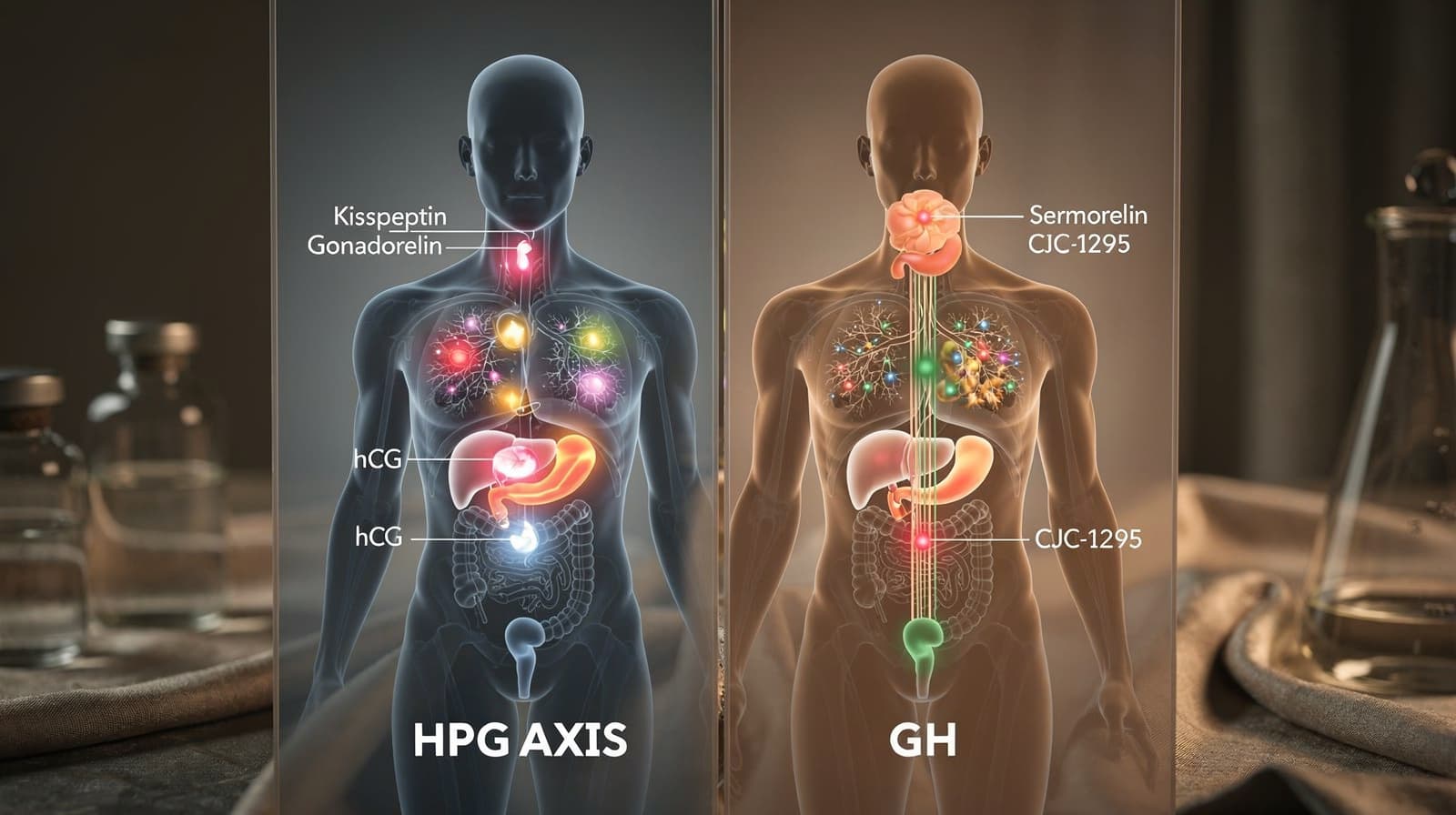
The hypothalamic-pituitary-gonadal (HPG) axis runs from kisspeptin neurons to GnRH neurons, then to pituitary gonadotrophs that release LH and FSH, then to Leydig cells that make testosterone. The growth hormone axis runs from GHRH neurons to pituitary somatotrophs that release GH, then to the liver, which produces IGF-1. These two cascades share a gland and nothing else. There is no branch that lets a GH signal instruct a Leydig cell.
That distinction is the whole article. A kisspeptin peptide enters at the top of the HPG axis and every step below it is androgenic. A GHRH analogue enters the GH axis and every step below it is anabolic and metabolic, never androgenic. When a vendor page lists a kisspeptin peptide beside sermorelin under one heading, it has collapsed two separate endocrine systems into a single marketing bucket, and that collapse produces most of the bad advice in this category.
Mechanism · two hormone axes
Two hormone axes, and only one reaches the testes
The HPG and GH cascades share the pituitary and nothing below it, so a GH-axis peptide has no route to a Leydig cell.
No peptide beats TRT at raising testosterone, and that is the wrong comparison to be making#
No. TRT raises serum testosterone more reliably and more predictably than any peptide studied in men. Peptides work upstream, asking the testes to produce more, so they need an intact axis to respond. The real difference is fertility: TRT suppresses LH and sperm production, while upstream agents do not.
Asking for the best peptide to increase testosterone therefore frames the problem badly. Exogenous testosterone wins on the number and loses on the axis: it reduces serum gonadotropins and intratesticular testosterone, and azoospermia has been reported in a large minority of men on replacement. Upstream agents lose on the number and keep the axis running. Men who want children in the next few years, men who want an exit ramp, and men whose low reading tracks a reversible metabolic cause are the ones for whom the upstream question is worth asking at all.
So the honest version of "best peptide to increase testosterone" is a different question: which compound raises LH in a man whose testes can still answer? Everything below is sorted by that test.
Kisspeptin-10 raises LH within 30 minutes of a single injection, and testosterone follows during a sustained infusion#
Kisspeptin-10 is the shortest kisspeptin fragment with full intrinsic activity at the KISS1R receptor, and it sits at the very top of the HPG axis. In healthy men given intravenous boluses, LH rose in a dose-dependent way with maximal stimulation at 1 µg/kg, from 4.1 to 12.4 IU/L at 30 minutes. A 22.5-hour infusion in four men increased LH from 5.4 to 20.8 IU/L and serum testosterone from 16.6 to 24.0 nmol/L (about 480 to 690 ng/dL). Notably, 3 µg/kg produced a smaller LH response than 1 µg/kg, so more is not more.
In men with type 2 diabetes and mild biochemical hypogonadism, an 11-hour infusion in four men raised LH from 3.9 to 20.7 IU/L and testosterone from 8.5 to 11.4 nmol/L (about 245 to 330 ng/dL), with LH pulse frequency rising from 0.6 to 0.9 pulses per hour. A 2026 study of chronic subcutaneous dosing in healthy men (Yeung et al., Eur J Endocrinol 2026) found that continuous infusion over five days left gonadotropins at vehicle levels while testosterone stayed elevated, whereas an intermittent 8-hours-on schedule sustained gonadotropin increases across 12 days. Kisspeptin-10 is timing sensitive and subcutaneous, which is why technique and scheduling belong in their own guide.
Human data · kisspeptin-10
Kisspeptin-10 lifts LH several-fold, and testosterone follows more modestly
Group means before and after in three studies of men. LH is the direct target; testosterone sits one step further down the axis, so its rise is smaller.
Largest LH rise
- Men with type 2 diabetes: 3.9 to 20.7 IU/L over an 11-hour infusion
More is not more
- 3 µg/kg produced a smaller LH response than 1 µg/kg
Gonadorelin and hCG act further down the same axis, and pulsatility decides whether they do anything#
Gonadorelin is a synthetic decapeptide identical to endogenous GnRH, and it acts one step below kisspeptin, directly on pituitary gonadotrophs. Its behavior is entirely dependent on pattern. Continuous rather than pulsatile GnRH exposure produces a marked decrease in LH and FSH secretion and impairs reproductive function, through receptor desensitisation and downregulation. This is not a nuance. It is the mechanism by which GnRH agonists are deliberately used to suppress testosterone into the castrate range. The same molecule can raise or crush gonadotropins depending on the interval between exposures.
hCG skips the pituitary entirely and binds the LH receptor on Leydig cells. Low-dose hCG given alongside exogenous testosterone has been shown to preserve spermatogenesis by maintaining intratesticular testosterone, which is why it remains the most established fertility-sparing add-on in this space.
Both agents share one prerequisite: responsive testes. In secondary hypogonadism the defect is central and the gonads can still answer an LH signal. In primary hypogonadism the testes themselves have failed, and no amount of upstream signaling reaches a target that cannot respond. Distinguishing the two before anything else is the entire point of measuring LH and FSH alongside testosterone.
Schematic · receptor desensitisation
Gonadotropin output under pulsatile versus continuous GnRH exposure
Pulsed GnRH keeps LH cycling. The same molecule given continuously drives LH down, which is how GnRH agonists suppress testosterone.
Sermorelin and CJC-1295 move IGF-1 while serum testosterone stays flat#
Sermorelin is GHRH(1-29), the shortest fully active fragment of growth hormone-releasing hormone. It was approved in the United States as Geref for pediatric growth hormone deficiency and pituitary diagnostic use, then voluntarily discontinued by the manufacturer for commercial reasons. Because it is the active ingredient of a once-approved drug, 503A pharmacies can still compound it on prescription. That approval history is often borrowed to justify adult use, but the indication was a defined deficiency state in children, and a sermorelin peptide has never been assessed against a serum testosterone endpoint in men.
CJC-1295 is the long-acting version of the same idea. Subcutaneous administration in healthy adults produced sustained, dose-dependent increases in GH and IGF-1, and was described as relatively well tolerated, particularly at 30 or 60 µg/kg. Ipamorelin approaches the pituitary from the ghrelin receptor instead, and its selling point is selectivity: GH release with minimal disturbance of cortisol, ACTH or prolactin. All three are legitimate GH-axis compounds with real pharmacology.
None of them is an androgen agent. The measured outputs are GH pulse amplitude and serum IGF-1. If a page credits a sermorelin peptide with raising testosterone, ask which trial showed it; we could not find one.
GH secretagogues improve sleep and recovery without touching a single androgen marker#
This is where GH secretagogues have a defensible case, and it is not the testosterone case. GH is secreted in pulses with the largest occurring during slow-wave sleep, and IGF-1 activates mTOR signaling in skeletal muscle, which is the mechanistic basis for interest in recovery and lean tissue maintenance. Searches for the best peptides for muscle growth and recovery land on this axis for that reason, and preliminary evidence in adults with documented GH deficiency supports the connection between GH signaling and body composition.
What that literature does not contain is an androgen readout. A protocol built around the best peptides for muscle growth and recovery may support training tolerance and sleep architecture while leaving total testosterone, free testosterone and LH exactly where they started. Those are complementary mechanisms, not the same one.
Readers who arrived here for hypertrophy rather than androgens are in the wrong article, and the GH-axis and bodybuilding guide carries the dose ranges, IGF-1 interpretation and training context that this brief deliberately leaves out.
Enclomiphene does most of the lifting in "peptide" testosterone protocols, and it is not a peptide#
Enclomiphene citrate is the trans isomer of clomiphene, an oral selective estrogen receptor modulator. It is not FDA-approved; it sits in Category 1 of the FDA's 503A bulk substances list, the category compounders may use under FDA's interim policy. It blocks estrogen negative feedback at the hypothalamus and pituitary, which lifts LH and FSH and, downstream, testosterone. In phase II work in men with secondary hypogonadism, enclomiphene and transdermal testosterone both raised total testosterone within two weeks, but with opposite effects on gonadotropins: enclomiphene increased LH and FSH while transdermal testosterone suppressed them. At 12.5 mg and 25 mg, LH rose by 5.1 and 7.4 mIU/mL while the topical comparator fell by 4.4 mIU/mL.
Later reviews concluded that enclomiphene raises testosterone by raising LH and FSH without degrading semen parameters. That combination, a real androgen effect plus preserved fertility, is what most people are actually looking for when they type a peptide query.
It matters because enclomiphene frequently appears inside protocols marketed as peptide stacks. It is a small molecule taken orally. When such a stack produces a testosterone change, enclomiphene is the plausible explanation, and attributing that change to a co-administered GH secretagogue is a category error.
BPC-157 and testagen carry no human testosterone data to argue about#
BPC-157 has a deep preclinical literature and an almost empty human one. A 2025 narrative review found human data exceedingly sparse and concluded the compound should be considered investigational, and a systematic review that screened 544 articles retained 36, of which 35 were preclinical and one was clinical. Serum testosterone has not been an endpoint in any of it.
Testagen is a Khavinson-class tetrapeptide, Lys-Glu-Asp-Gly, named for the testicular tissue extract its sequence was patterned on rather than for the hormone. The proposed mechanism is tissue-specific transcriptional modulation, and the one verified compound-specific study concerns thyroid and pituitary morphology in avian models, not androgens. A testagen peptide is not testosterone and supplies none. Anyone presenting a testagen peptide as an androgen agent is extrapolating from a name.
PT-141 (bremelanotide) belongs in the same column for a different reason. It is FDA approved as Vyleesi for hypoactive sexual desire disorder in premenopausal women and acts on central MC3R and MC4R receptors. It changes desire signaling. It does not change testosterone. Which compounds were actually studied in female participants is sorted compound by compound in the guide to peptides for women.
Stacking two axes buys you two mechanisms, not a bigger testosterone number#
Pairing a GHRH analogue with a ghrelin-receptor agonist produces a larger GH pulse than either alone, because they hit complementary receptors. That is a genuine supra-additive response on the GH axis. It is also entirely contained within the GH axis. Adding kisspeptin or hCG to it adds an androgen mechanism; it does not amplify the androgen effect of the GH compounds, because they have none to amplify. Anyone marketing the best peptide stack for muscle growth as a testosterone protocol is selling axis confusion.
The better-evidenced route to a higher endogenous number is metabolic. A 2025 systematic review of 10 studies in 639 men found GLP-1 receptor agonist use consistently associated with increased total testosterone, particularly in men with obesity, type 2 diabetes or functional hypogonadism, with LH and FSH preserved or increased rather than suppressed. Free testosterone changes were inconsistent, often offset by rising SHBG. Studies have shown the effect is absent in healthy eugonadal men, so this is correction of a reversible cause, not enhancement. The fat loss evidence base carries that literature in full.
Framed properly, a best peptide stack for muscle growth answers a GH-axis question and a metabolic question answers the androgen one.
Nothing here is FDA approved to raise testosterone, so a repeat lab panel beats before and after photos#
No peptide discussed above holds FDA approval for raising testosterone in men; hCG is approved, but for hypogonadotropic hypogonadism, not as a testosterone booster. In 2023 the FDA placed kisspeptin-10, CJC-1295, ipamorelin acetate and BPC-157 in Category 2 of the interim bulk substances lists, the category for substances the agency identified as raising significant safety risks. The nominations for CJC-1295, ipamorelin and BPC-157 were later withdrawn, and by April 2026 they were off the 503A Category 2 list; ipamorelin stays in Category 2 for 503B outsourcing facilities, and kisspeptin-10 stays in 503A Category 2. Leaving Category 2 is not clearance: none of these peptides is on the 503A bulks list or in Category 1, so none can lawfully be compounded. hCG has its own barrier, since the FDA has regulated it as a biologic since March 2020, which takes it outside 503A and 503B compounding altogether. The full FDA and DEA picture is covered separately and this article will not duplicate it.
That regulatory position is exactly why verification has to be biochemical. Searches for peptides for muscle growth before and after return photographs, and photographs cannot distinguish an androgen effect from an IGF-1 effect from water retention. The panel that can: total testosterone, free testosterone, SHBG, LH, FSH, estradiol and hematocrit, drawn at baseline and repeated on the same assay. LH and FSH are the discriminating pair, because a rise in testosterone with suppressed gonadotropins means something entirely different from a rise with elevated ones.
A collection of peptides for muscle growth before and after images is a marketing artifact. A repeat panel is data. Klarovel's peptide calculator exists to keep the arithmetic layer clean while the lab work does the verifying.
Sort by axis first, then ask for evidence#
The category error is upstream of every other mistake here. Once compounds are sorted by the axis they act on, most of the confusion in "peptides for testosterone" disappears, and the remaining question becomes answerable: which agent raises LH in an axis that can respond, and did anyone measure the testosterone. Klarovel curates the protocol layer, not the supply. Create an account to keep your panel history, your calculations and your compound notes in one place instead of scattered across screenshots.
Frequently asked questions
Keep reading
Peptides for Inflammation: Mapping BPC-157, KPV, and Thymosins
Peptides for inflammation compared by mechanism and evidence stage: BPC-157, KPV, thymosin alpha-1, and thymosin beta-4, with FDA status and safety notes.

Mounjaro vs Zepbound: Same Drug, Two Different FDA Labels
Mounjaro and Zepbound are the same drug, tirzepatide, at the same doses. The difference is the FDA label: diabetes for Mounjaro, weight loss for Zepbound.
Rybelsus for Weight Loss: Not Approved, and the Pill That Is
Rybelsus is not FDA-approved for weight loss and moves the scale only a little. The oral semaglutide approved for weight loss is the Wegovy pill at 25 mg.