
"How long does Zepbound take to work" has four different correct answers, and which one you want depends on what you mean by work. The drug reaches peak concentration in a day, changes appetite after the first injection, takes a month to reach steady state, and was still producing weight loss at 72 weeks when the trial ended. Mixing those up is why the drug can feel both immediate and disappointingly slow.
Key takeaways#
- Zepbound is tirzepatide, and it acts on two receptors, not one. GIP and GLP-1 together, which is what separates it from semaglutide.
- Peak plasma concentration comes at a median of 24 hours after injection, with a range of 8 to 72 hours.
- Steady state takes about 4 weeks at any given dose, and every dose increase restarts that clock.
- The slowing of gastric emptying is largest after the first dose and diminishes with time. That is on the label. Feeling less appetite suppression in month three is expected pharmacology, not the drug failing.
- Weight loss had not finished at 72 weeks in SURMOUNT-1. There is no published plateau at the licensed dose.
Two receptors, which is the whole point#
Semaglutide is a GLP-1 receptor agonist. Tirzepatide agonises both the GLP-1 receptor and the glucose-dependent insulinotropic polypeptide receptor, GIP.
GLP-1 agonism is the familiar half: it slows gastric emptying, increases satiety signalling and improves glucose-dependent insulin secretion. GIP agonism adds effects on insulin sensitivity and on how fat tissue handles energy. Research suggests the combination is why the head-to-head trial separated the two drugs rather than finding them equivalent.
This is also why calling Zepbound a GLP-1 drug is imprecise. It captures half the mechanism and hides the half that explains the difference in the numbers.
The four answers to "how long does it take to work"#
From the Zepbound prescribing information and the SURMOUNT-1 trial.
| What you mean by "work" | How long | Source |
|---|---|---|
| Drug reaches peak concentration | 24 hours median, 8 to 72 hour range | Label, pharmacokinetics |
| Appetite noticeably changes | After the first injection, and most strongly then | Label, gastric emptying |
| Blood levels stop climbing | About 4 weeks at a fixed dose | Label, steady state |
| Reaching the top licensed dose | 20 weeks of stepwise escalation | Label, dose escalation |
| Weight loss finishes | Not established. Still declining at 72 weeks | SURMOUNT-1 |
Research has shown the half-life is roughly 5 to 6 days, which is what makes weekly dosing work: the drug never fully clears between injections, and concentration accumulates until steady state.
Every dose increase restarts the 4-week clock. Somebody stepping 2.5 to 5 to 7.5 mg is not at steady state continuously; they are repeatedly climbing toward a new one. That is part of why side effects cluster in the escalation window rather than at the maintenance dose, which the dose ladder sets out per step.
Why it can feel like it stops working#
This is the part most pages get wrong, and the label answers it directly.
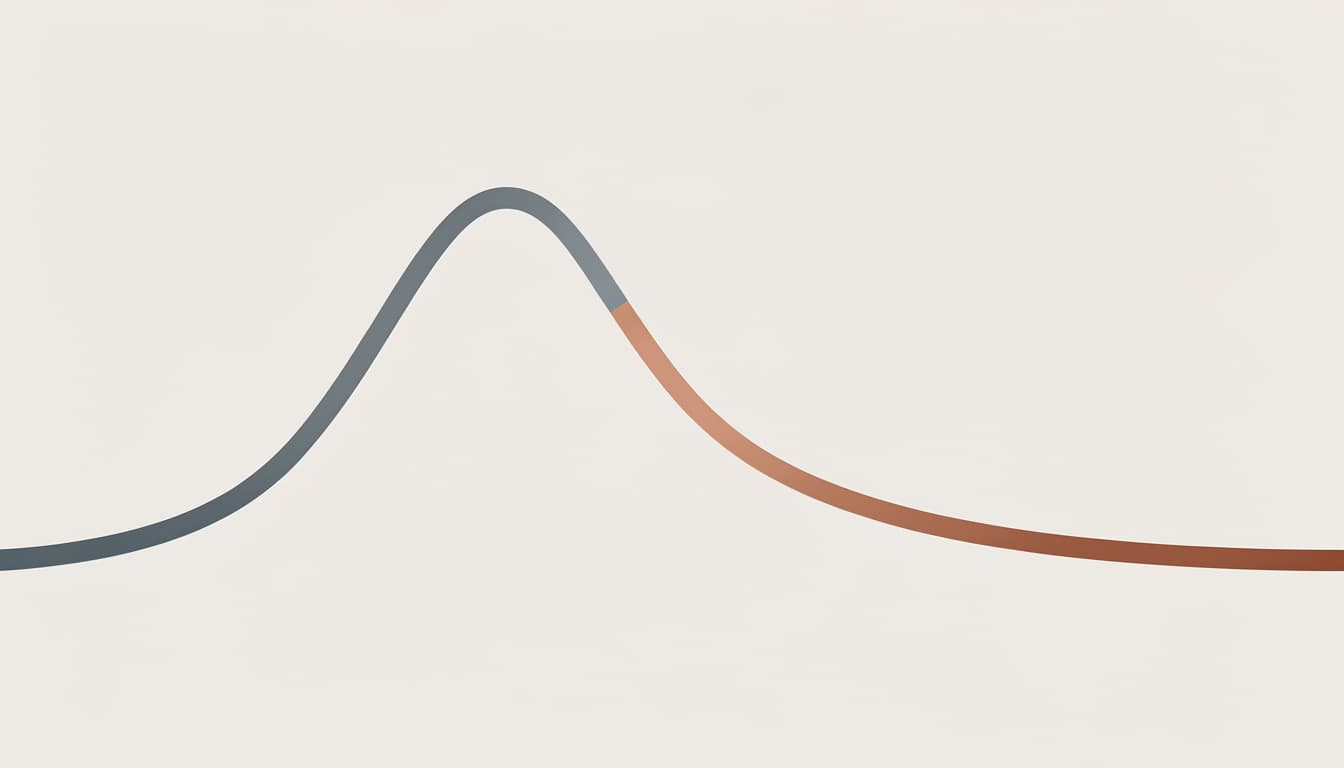
Tirzepatide delays gastric emptying, and the prescribing information states that the delay is largest after the first dose and this effect diminishes over time. Not with tolerance, not with failure, by design of how the drug behaves.
So the common experience, dramatic appetite suppression in the first weeks that softens by month three, is the expected trajectory rather than a sign the drug has stopped. Meanwhile the weight-loss curve in SURMOUNT-1 kept descending through 72 weeks, so the effect that felt like it faded and the effect being measured are not the same effect.
Two practical readings follow. Judging the drug by how strongly it suppresses appetite this week measures the thing that is designed to diminish. And escalating the dose to chase the early feeling is chasing a sensation rather than an outcome, which is how people arrive at a higher dose than they need.
What the results curve actually looked like#
In SURMOUNT-1, 2,539 adults were randomised to 5, 10 or 15 mg or placebo for 72 weeks. Studies have shown separation from placebo was already significant at week 20, which is the point the escalation finishes.
At 72 weeks, on the intention-to-treat estimand, mean weight change was 15.0% at 5 mg, 19.5% at 10 mg and 20.9% at 15 mg, against 3.1% on placebo.
The trial ended before the curve did. There is no published nadir at the licensed doses, which is a different situation from semaglutide's STEP 1, where weight reached its lowest point around week 60 of 68. Klarovel sets the two side by side in semaglutide versus tirzepatide.
The short version#
Zepbound works through two receptors instead of one, and it works on several timescales at once. A day to peak, a first injection to change appetite, a month to steady blood levels, five months to the top dose, and more than seventeen months without the weight curve flattening.
The single most useful thing to know is that the effect you feel most is the one designed to fade, and the effect being measured is not. For the dose schedule these timings track against, see the tirzepatide complete guide. Complete the Klarovel questionnaire to see what the engine recommends from a full health profile.
Frequently asked questions
Keep reading
The Ozempic Pill: Five Semaglutides, Three Shared Doses
Ozempic tablets, Rybelsus and Wegovy tablets are all semaglutide, and three strengths appear on two different products. Here is which is which.

Ozempic Face: What It Is, and Why It Is Not Ozempic
Facial hollowing after rapid weight loss is real, but it tracks how fast the weight comes off, not semaglutide itself. What the body composition data shows.

Peptides for Dementia: What the Clinical Evidence Actually Shows
A clinical look at Cerebrolysin, Semax, and Dihexa for dementia. Trial data, real limits, and why the peptide-dementia story needs honest framing.