

Semaglutide vs tirzepatide is the most-searched comparison in metabolic medicine right now. Until 2025, the answer lived in cross-trial comparison. Then the NEJM published a direct head-to-head trial, and the pharmacology finally matched the indirect data. Tirzepatide produces more weight loss. The question worth asking is which drug is right for a given person, not which is universally better.
The head-to-head trial that settled the efficacy question#

For years, the semaglutide vs tirzepatide debate relied on indirect comparison: look at STEP 1 (semaglutide 14.9%) and SURMOUNT-1 (tirzepatide 20.9%), do the math on similar populations, conclude tirzepatide has a roughly 40% larger effect. The problem with indirect comparison is that patient populations, trial protocols, and endpoints differ enough that numbers aren't perfectly comparable.
The SURMOUNT-5 trial, published in NEJM in 2025, eliminated that uncertainty. It directly randomized adults with obesity and without type 2 diabetes to tirzepatide (up to 15 mg weekly) or semaglutide (up to 2.4 mg weekly), the highest approved doses when the trial ran, and measured body weight at 72 weeks. The 20.2% and 13.7% figures below are the treatment-regimen (intention-to-treat) estimand.
Results at 72 weeks:
- Tirzepatide: −20.2% mean body weight
- Semaglutide: −13.7% mean body weight
- Absolute difference: 6.5 percentage points
- Waist circumference: −18.4 cm (tirzepatide) vs −13.0 cm (semaglutide)
The tirzepatide advantage is real, statistically significant, and clinically meaningful. For a 100-kg starting weight, that's 20.2 kg vs 13.7 kg, a 6.5 kg absolute difference, or approximately 14 pounds.
The mechanism explanation#
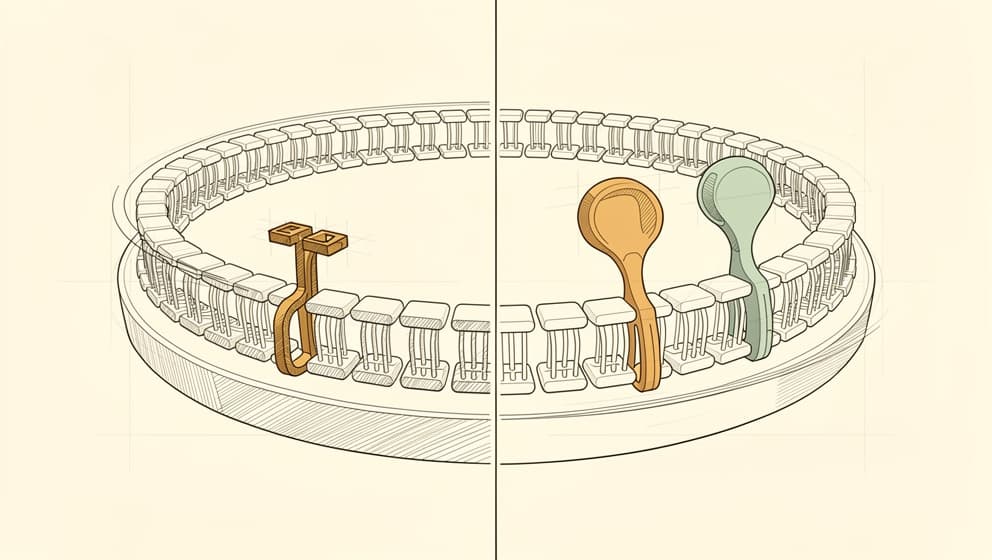
The difference is pharmacology, not chance.
Semaglutide is a GLP-1 receptor agonist. It activates one incretin pathway, the GLP-1 receptor, which suppresses appetite, slows gastric emptying, and stimulates insulin release during meals.
Tirzepatide is a dual GIP/GLP-1 receptor agonist. It activates GLP-1 and adds the second major incretin receptor (GIP). GIP has its own effects on insulin secretion and adipose tissue, and the combination with GLP-1 has been shown to produce synergistic weight loss that neither pathway achieves alone.
This isn't a surprise in retrospect. Preclinical models of dual-agonism predicted tirzepatide would outperform single-agonism by a meaningful margin. The head-to-head trial confirmed the prediction. For the full class mechanism, see the GLP-1 class explained.
The safety and side-effect comparison#
The side-effect profiles are strikingly similar. Both drugs are dominated by gastrointestinal events that concentrate during dose escalation:
| Side effect | Semaglutide 2.4 mg (Wegovy label) | Tirzepatide 5 to 15 mg (Zepbound label) |
|---|---|---|
| Nausea | 44% | 25 to 29% |
| Diarrhea | 30% | 19 to 23% |
| Vomiting | 24% | 8 to 13% |
| Constipation | 24% | 11 to 17% |
| Abdominal pain | 20% | 9 to 10% |
These are cross-trial label figures, not a head-to-head comparison, and on them tirzepatide looks slightly milder. Research suggests GIP activation may offset part of the GLP-1-driven nausea, but that remains a hypothesis, and the label tables come from different trials.
Discontinuation rates due to adverse events are similar: 6.8% on Wegovy 2.4 mg and 4.8% to 6.7% across Zepbound doses in the label trial pools. Serious adverse event rates are comparable.
Both labels carry the same boxed warning and the same two contraindications: a personal or family history of medullary thyroid carcinoma or MEN 2, and prior serious hypersensitivity to the drug. Several other situations are label-level cautions rather than formal contraindications:
- Pregnancy or planned pregnancy (stop when pregnancy is recognized)
- History of pancreatitis (not studied; requires specialist input)
- Severe gastroparesis (not recommended)
- Type 1 diabetes (not a substitute for insulin)
See who shouldn't take peptides for the full framework.
Where semaglutide has the stronger position#
Despite tirzepatide's efficacy advantage, semaglutide has two structural advantages worth weighing:
1. Established cardiovascular benefit. Research has shown, in the SELECT trial, semaglutide 2.4 mg reduced major adverse cardiovascular events by 20% versus placebo in adults with overweight or obesity and established cardiovascular disease, without diabetes. This is the first obesity drug with documented cardiovascular outcome benefit, a category that matters for insurance coverage, clinical guidelines, and long-term decision-making. Tirzepatide's SURPASS-CVOT (NEJM, December 2025) enrolled 13,299 people with type 2 diabetes and cardiovascular disease and found tirzepatide noninferior to dulaglutide on major cardiovascular events (hazard ratio 0.92, superiority not met). The placebo-controlled trial in people with obesity but without diabetes, SURMOUNT-MMO, is still in progress.
2. Longer real-world track record. Semaglutide has been in widespread clinical use since 2017 for type-2 diabetes (Ozempic) and since 2021 for obesity (Wegovy). Tirzepatide is newer: approved 2022 (Mounjaro) and 2023 (Zepbound). More clinical use means more post-market safety data. Both drugs appear safe, but "more safety data" has value.
For a patient with cardiovascular disease, semaglutide remains the first-line choice based on outcome evidence. For a patient optimizing for weight loss alone, tirzepatide has the clearer efficacy case.
The cost-effectiveness angle#

A 2023 analysis in Diabetes, Obesity and Metabolism (Azuri and colleagues) compared the two cross-trial, using SURMOUNT-1 and STEP 1 results and US GoodRx prices from October 2022, and put the cost per 1% of body weight reduction at roughly:
- Tirzepatide: ~$985 per 1% weight reduction
- Semaglutide: ~$1,845 per 1% weight reduction
In that analysis tirzepatide was both cheaper per week and produced more weight loss, so it came out nearly twice as cost-effective per percentage point. Prices have moved since 2022, so treat the dollar figures as dated, but a 2026 cost-effectiveness model built on SURMOUNT-5 reached the same direction of result. This matters particularly for out-of-pocket patients or private insurance with step-therapy rules.
In Norway, a secondary market for this site, the two are not treated alike. Ozempic for type 2 diabetes can be reimbursed on blå resept through an individual application to Helfo, while DMP has declined pre-approved reimbursement for Mounjaro in type 2 diabetes (DMP, Nytt om legemidler 10/2026). Obesity-only use of either is generally full out-of-pocket. Both hold EU marketing authorizations that apply in Norway.
Retatrutide sits above both#
No discussion of semaglutide vs tirzepatide is complete without the retatrutide context. Retatrutide is a triple agonist (GIP + GLP-1 + glucagon) that produced 23.7% mean weight loss at 68 weeks (treatment-regimen estimand) in Phase 3 TRIUMPH-4, a trial in adults with obesity and knee osteoarthritis, 84% of them at a BMI of 35 or above. It is not approved anywhere as of October 2026; Lilly plans to submit it to the FDA in the first quarter of 2027.
The full class picture:
| Drug | Receptors | Weight loss (intention-to-treat, pivotal trial) | Approval |
|---|---|---|---|
| Semaglutide 2.4 mg | GLP-1 | 14.9% (STEP 1, 68 weeks) | Approved |
| Tirzepatide 15 mg | GIP + GLP-1 | 20.9% (SURMOUNT-1, 72 weeks) | Approved |
| Retatrutide 12 mg | GIP + GLP-1 + glucagon | 23.7% (TRIUMPH-4, 68 weeks, knee osteoarthritis population) | Not yet |
For more on retatrutide, see the retatrutide guide.
How to think about the choice#
Five factors determine the right drug for a given person:
- Primary goal. Weight-loss-focused: tirzepatide's efficacy case is stronger. Cardiovascular-risk-reduction-focused: semaglutide's outcome evidence is the category-defining trial.
- Baseline disease. Established cardiovascular disease + obesity → semaglutide first (based on SELECT). Isolated obesity without cardiovascular disease → either, with tirzepatide's efficacy advantage as a tiebreaker.
- Side-effect sensitivity. For patients who've had severe GI side effects on one class-drug previously, tirzepatide's slightly milder profile may matter.
- Cost and coverage. Check insurance coverage (or, in Norway, reimbursement rules) and out-of-pocket pricing before choosing. Tirzepatide's cost-per-efficacy advantage may matter for out-of-pocket scenarios.
- Long-term timeline. Retatrutide is not approved; Lilly plans an FDA submission in early 2027, so it is a factor in long-range planning rather than a current option.
For structured intake that filters across all of these, Klarovel's questionnaire maps symptoms, contraindications and goals (plus blood work, if you have it) against the approved-drug profile. The individual tirzepatide guide and semaglutide guide cover each drug in depth.
The semaglutide vs tirzepatide comparison has a clear winner on the headline efficacy metric. It has no universal winner on the actual clinical question. The right drug is the one that matches the individual, and the framework for choosing is more than a single number from a single trial. For how this pair sits within the wider field, see how the GLP-1 weight-loss medications compared stack up against one another.
Frequently asked questions
Keep reading

Peptides for Inflammation: Mapping BPC-157, KPV, and Thymosins
Peptides for inflammation compared by mechanism and evidence stage: BPC-157, KPV, thymosin alpha-1, and thymosin beta-4, with FDA status and safety notes.
Mounjaro vs Zepbound: Same Drug, Two Different FDA Labels
Mounjaro and Zepbound are the same drug, tirzepatide, at the same doses. The difference is the FDA label: diabetes for Mounjaro, weight loss for Zepbound.

Rybelsus for Weight Loss: Not Approved, and the Pill That Is
Rybelsus is not FDA-approved for weight loss and moves the scale only a little. The oral semaglutide approved for weight loss is the Wegovy pill at 25 mg.