
Retatrutide has no approved dose: the only retatrutide dosage with evidence behind it is Lilly's trial escalation, which starts at 2 mg weekly and steps up every four weeks to a target of 4 mg, 9 mg or 12 mg. At 12 mg it produced a mean 25.0% weight loss at 80 weeks in TRIUMPH-1 counting everyone randomized (28.3% among participants who stayed on treatment). The molecule is not approved anywhere as of October 2026, and Lilly plans to submit it to the FDA in the first quarter of 2027. Understanding the retatrutide peptide requires holding both facts at once.
Retatrutide targets three metabolic receptors at once#
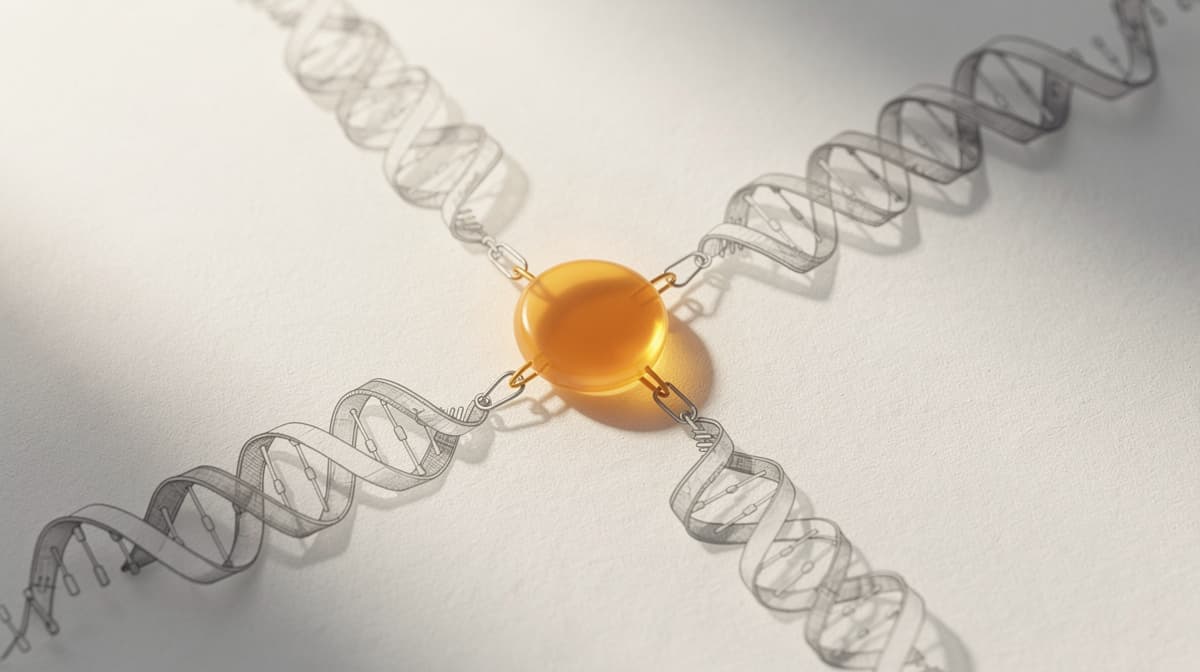
Retatrutide (Lilly code LY3437943) is a first-in-class triple agonist. It is a synthetic 39-amino-acid peptide engineered from a GIP backbone that activates the receptors for gastric inhibitory polypeptide (GIP), glucagon-like peptide-1 (GLP-1), and glucagon in a single molecule. Relative potency differs across the three receptors: retatrutide is more potent at the human GIP receptor than at GLP-1 or glucagon.
The reason to add glucagon to a GLP-1/GIP combination is broader metabolic engagement. Studies have shown GLP-1 suppresses appetite and slows gastric emptying. GIP potentiates insulin secretion and acts on adipose tissue. Glucagon agonism has been shown to raise resting energy expenditure, mobilize hepatic fat, and increase lipolysis. A single weekly subcutaneous dose engages all three pathways.
This is where retatrutide is clinically distinct from the approved GLP-1 medicines. Semaglutide activates one receptor. Tirzepatide activates two. Retatrutide activates three. Each step up the receptor count corresponds to larger average weight-loss effects in head-to-head and cross-trial data.

Phase 2 established the ceiling: 24.2% mean weight loss in 48 weeks#
The Phase 2 obesity trial led by Ania Jastreboff and colleagues (NEJM, 2023, NCT04881760) enrolled 338 adults with obesity. At the 24-week primary endpoint, body-weight changes were -7.2% at 1 mg, -12.9% at 4 mg, -17.3% at 8 mg, and -17.5% at 12 mg, versus -1.6% on placebo. At 48 weeks, the 12 mg dose had produced a mean 24.2% body-weight reduction.
For context, the comparable 48-week to 68-week endpoints for semaglutide 2.4 mg weekly sit near 14.9%, and tirzepatide 15 mg weekly reached approximately 20.9% at 72 weeks in SURMOUNT-1. Retatrutide's Phase 2 numbers were, at the time of publication in 2023, the largest weight reductions documented for any pharmacotherapy in a general obesity population.
The Phase 2 tolerability profile was class-typical: gastrointestinal events that were dose-dependent, mostly mild to moderate, and concentrated in the dose-escalation period. Nausea reached roughly 60% at the 12 mg dose; vomiting, diarrhea, and constipation followed at lower rates.
Phase 3 confirmed the signal, and introduced a new one#
TRIUMPH-4 was the first Phase 3 readout for retatrutide, announced in December 2025. The trial enrolled 445 adults with obesity and co-occurring knee osteoarthritis, measured body weight and pain at 68 weeks, and compared retatrutide 9 mg and 12 mg to placebo.
The efficacy numbers:
- 12 mg: 23.7% mean body-weight reduction at 68 weeks (treatment-regimen), 28.7% (efficacy estimand)
- 9 mg: 20.0% (treatment-regimen), 26.4% (efficacy estimand)
- 12 mg: 58.6% of participants achieved ≥25% body-weight loss (efficacy estimand)
- Systolic blood pressure: -14.0 mmHg at 12 mg (efficacy estimand)
- Osteoarthritis pain: WOMAC pain down roughly 75% on both retatrutide doses versus 40% on placebo (efficacy estimand, post-hoc percentage)
TRIUMPH-1, the general-obesity trial (2,339 adults without diabetes), followed in May 2026 and was published in NEJM in September 2026. At 80 weeks, mean weight change on the treatment-regimen estimand was −17.6% at 4 mg, −23.7% at 9 mg and −25.0% at 12 mg versus −3.9% on placebo; on the efficacy estimand the same arms reached −19.0%, −25.9% and −28.3% versus −2.2%. TRIUMPH-2 (adults with type 2 diabetes, The Lancet, September 2026) reached −18.8% at 12 mg versus −5.1% on placebo at 80 weeks on its primary treatment-regimen analysis, and TRIUMPH-3 (severe obesity plus established cardiovascular disease, topline only) reported up to −22.6% versus −3.2% on the efficacy estimand.
The safety profile, however, introduced signals that are worth taking seriously. The TRIUMPH-4 release reported that dysesthesia (altered skin sensation, often described as tingling or burning) occurred in 20.9% of patients at 12 mg versus 0.7% on placebo; in TRIUMPH-1 the rate was 12.5% at 12 mg versus 0.9%. The mechanism has not been established; the signal is associated with the higher doses, and the events were generally mild and rarely led to discontinuation.
Discontinuation because of adverse events in TRIUMPH-4 was 18.2% at 12 mg, 12.2% at 9 mg, and 4.0% on placebo; Lilly noted the rates tracked baseline BMI and included discontinuations for perceived excessive weight loss. A meta-analysis pooling three retatrutide RCTs (878 patients) found a risk ratio of 6.70 (p = 0.002) for treatment discontinuation at the 12 mg dose relative to placebo.
Retatrutide dosage chart: there is no approved dose, only trial protocols#
This is the question the search volume is actually asking, and it has an uncomfortable answer.
Retatrutide is not approved by any regulator. There is no label, no approved posology, and therefore no such thing as a correct retatrutide dose. What exists is the escalation used in Lilly's own trials, and anyone publishing a "retatrutide dosing guide" is either reproducing that protocol or reporting what people do informally. Those are very different objects and most pages do not separate them.
Here is the retatrutide dosing schedule as run in the trials, which is the only escalation with evidence behind it. It comes from the TRIUMPH-4 readout. Participants started at 2 mg once weekly and stepped up every four weeks.
| Step | Weekly dose | Weeks | Is it a target dose? |
|---|---|---|---|
| 1 | 2 mg | 1 to 4 | No. Everyone starts here |
| 2 | 4 mg | 5 to 8 | Yes in TRIUMPH-1 and TRIUMPH-2 |
| 3 | 6 mg | 9 to 12 | No. Escalation step only |
| 4 | 9 mg | 13 to 16 | Yes in TRIUMPH-1, -2, -3 and -4 |
| 5 | 12 mg | 17+ | Yes. The highest studied dose |
Two things follow that are worth stating plainly.
The target dose is not a single number. Across the TRIUMPH program, 4 mg, 9 mg and 12 mg are all target doses depending on the trial arm. A page that answers "the retatrutide dose is 12 mg" is quoting the highest arm and calling it the dose.
6 mg is a waypoint, not a destination. Like the 2.5, 7.5 and 12.5 mg steps in tirzepatide's ladder, it exists to get people to a studied dose tolerably, and has no efficacy readout of its own.
The retatrutide titration is also shorter than the approved comparator's. Five steps at four weeks each puts the highest studied dose at week 17, against week 21 for tirzepatide's six-step ladder. That is one step fewer to reach the top of the range, and the reason is tolerability pacing rather than a claim that retatrutide is gentler. What the retatrutide triple agonist adds is glucagon-receptor activity on top of the GIP and GLP-1 pair, and the retatrutide weight loss figures below are what that third receptor buys.
What the doses actually produced#
TRIUMPH-4 reported both of its studied target doses:
| Dose | Weight change, ITT | Weight change, on-treatment |
|---|---|---|
| 9 mg | −20.0% | −26.4% |
| 12 mg | −23.7% | −28.7% |
The gap between the two columns is the same estimand distinction that runs through this whole drug class: the first counts everyone randomized, the second conditions on staying on treatment. The figure in general circulation is 28.7%.
The tolerability cost rises with the dose#
Discontinuation for adverse events reached 18.2% at 12 mg against 4% on placebo, and the dysesthesia signal, an abnormal skin sensation not seen at this rate in the other incretins, ran up to 21%. Research suggests this is the trade the higher arm buys in TRIUMPH-4: roughly two to four additional points of weight loss over 9 mg (2.3 on the efficacy estimand, 3.7 on the treatment-regimen estimand), at a materially worse tolerability profile.
Retatrutide vs tirzepatide vs semaglutide: the efficacy gap is real#
Direct head-to-head trials of the three molecules do not yet exist. Cross-trial comparison is imperfect, but the endpoints are close enough to be informative:
| Drug | Receptor class | Highest-studied dose | Weight loss | Timepoint |
|---|---|---|---|---|
| Semaglutide | GLP-1 | 2.4 mg weekly | 14.9% | 68 wk (STEP 1) |
| Tirzepatide | GIP + GLP-1 | 15 mg weekly | 20.9% | 72 wk (SURMOUNT-1) |
| Retatrutide | GIP + GLP-1 + glucagon | 12 mg weekly | 23.7% | 68 wk (TRIUMPH-4, knee OA population) |
| Retatrutide | GIP + GLP-1 + glucagon | 12 mg weekly | 25.0% | 80 wk (TRIUMPH-1) |
All five figures are treatment-regimen (treatment-policy) estimands, which count everyone randomized. The stepwise pattern tracks with the stepwise addition of receptor engagement. A direct comparison is coming: TRIUMPH-5 (NCT06662383) randomizes adults with obesity to retatrutide or tirzepatide, with primary completion listed for late 2026. Until then, retatrutide-specific side effects (dysesthesia, a larger heart-rate signal, higher discontinuation at the top dose) need to be evaluated on their own terms rather than assumed to be a straight extension of the GLP-1 class.
Beyond obesity: T2D, MASLD, and cardiovascular signals#

Retatrutide's clinical program extends well past weight loss.
In Phase 2b type-2 diabetes data (Lancet 2023), retatrutide produced HbA1c reductions that compared favorably to active comparators. The pooled meta-analysis of three RCTs reported a mean HbA1c reduction of -0.91% overall and -1.54% at the 12 mg dose, with systolic blood-pressure reductions of -9.88 mmHg and diastolic reductions of -3.88 mmHg.
A Phase 2a trial in metabolic dysfunction-associated steatotic liver disease (MASLD), published in Nature Medicine (2024), showed meaningful reductions in liver fat content at doses used for obesity, a finding that matters because MASLD currently has limited approved pharmacotherapy.
A dedicated cardiovascular and renal outcomes trial (TRIUMPH-Outcomes) is running. TRIUMPH-3, which enrolled adults with severe obesity and established cardiovascular disease, was a weight trial rather than an outcomes trial: its prespecified cardiovascular analyses were underpowered and did not show a reduction in events (MACE-3 hazard ratio 1.12, 95% CI 0.64 to 1.96), per Lilly's July 2026 topline. Surrogate markers (blood pressure, lipids, hsCRP, liver fat) point in a favorable direction, but the cardiovascular endpoint that insurers and regulators care about will take years.
Retatrutide is not approved anywhere: what that means today#
As of October 2026, retatrutide is not FDA-approved, not authorized by the European Medicines Agency, and not authorized by DMP (the Norwegian Medicines Agency). All four core TRIUMPH registrational trials have now reported: TRIUMPH-4 in December 2025, TRIUMPH-1 in May 2026, and TRIUMPH-2 and TRIUMPH-3 in July 2026, alongside TRANSCEND-T2D-1 in type 2 diabetes. Lilly says it plans to submit a Biologics License Application to the FDA in the first quarter of 2027, once its chemistry, manufacturing and controls package is complete (Lilly, September 2026). A submission is an application, not an approval.
In practical terms:
- Legally, retatrutide is not an approved medicine. It is not available through pharmacies in the US, EU, or Norway, and Lilly states it is legally available only to participants in its clinical trials. Any product sold under the retatrutide name outside a trial has not been through any approval process, and its identity and purity cannot be assumed.
- Klarovel does not sell, source, or fulfil peptides. See our disclosures page for how Klarovel covers investigational compounds.
- Structural oversight matters. Retatrutide's Phase 3 discontinuation rate, its dysesthesia signal, and its activity across three metabolic axes make it a molecule where structured screening is not optional. Klarovel's intake questionnaire asks about pregnancy and breastfeeding, active or past cancer, high blood pressure, heart disease, kidney and liver disease, and thyroid problems. A personal or family history of medullary thyroid carcinoma or MEN 2, an exclusion in every TRIUMPH trial, belongs in the conversation with a clinician.
Direct comparisons: Cagrilintide vs retatrutide, Semaglutide vs retatrutide, Tirzepatide vs retatrutide.
What to watch in the next twelve months#
Five data points will shape the retatrutide story through 2027: the TRIUMPH-5 head-to-head against tirzepatide; the full TRIUMPH-3 publication; the TRANSCEND-T2D program readouts; extended safety follow-up on dysesthesia and heart rate; and the BLA submission Lilly has scheduled for the first quarter of 2027.
The early returns read like a new ceiling for pharmacological weight loss. The open questions are long-term tolerability, the real-world durability of effect after discontinuation, and whether the regulatory picture moves from trials to prescription by 2027 or 2028. For now, retatrutide sits at the edge of approved medicine: promising, not yet approved, and not the right fit for everyone.
Anyone genuinely considering a retatrutide protocol should start with a structured health profile, not with a product SKU. Blood work sharpens the picture where someone already has it, but the questionnaire is what the engine actually reads. Start with the Klarovel questionnaire to see whether the molecule fits the profile at all. From there the reconstitution calculator handles the arithmetic, the tirzepatide dosage chart shows what a ladder looks like once a regulator has approved one, and the broader guide to peptides for weight loss shows where the triple agonist sits in the wider field.
Frequently asked questions
Keep reading
Kisspeptin Peptide: What Human Trials Show About HPG Axis
Kisspeptin peptide switches on the brain's reproductive axis. See what human trials actually show about LH timing, testosterone, and dosing limits.

LL-37 Peptide: Evidence, Risks, and Unanswered Questions
LL-37 peptide kills bacteria by rupturing membranes, but human evidence stops at topical ulcer trials and one gene-therapy study, not injections.

Wegovy Pill: How It Works, How to Take It, and Results
The Wegovy pill is semaglutide 25 mg taken daily, FDA-approved for weight loss in December 2025. How to take it, how well it works, and how it compares.