
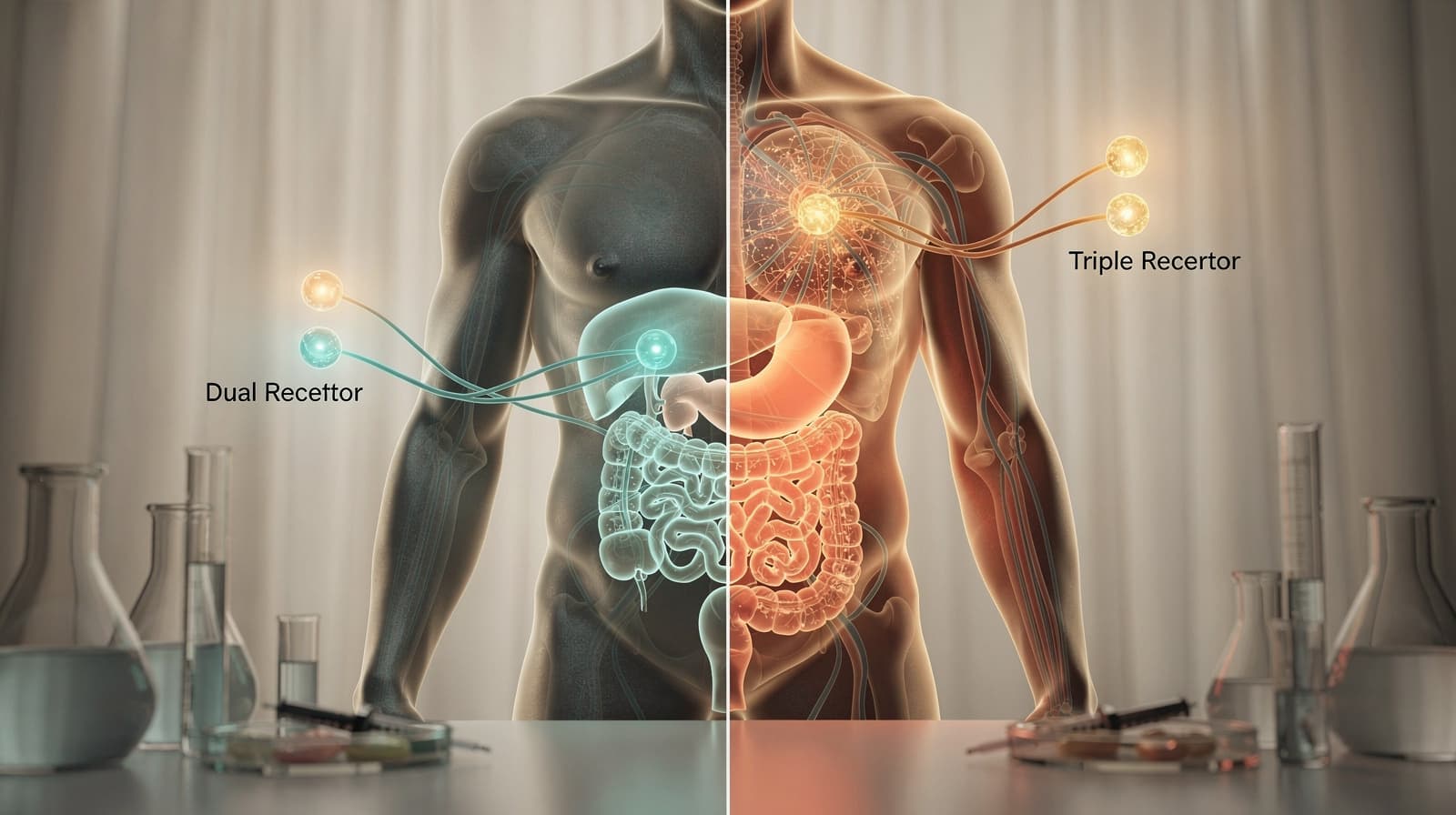
Retatrutide produces more weight loss than tirzepatide but is not approved anywhere: 25.0% at 12 mg over 80 weeks in TRIUMPH-1, against 20.9% for tirzepatide 15 mg over 72 weeks in SURMOUNT-1, both counting everyone randomized (28.3% versus 22.5% among participants who stayed on treatment). Tirzepatide (Zepbound, Mounjaro) is FDA-approved with a completed cardiovascular outcomes trial, while retatrutide's extra receptor, glucagon, comes with more discontinuation for side effects at its top dose. No head-to-head trial has reported, so the gap is cross-trial arithmetic. This piece maps where the two compounds actually diverge: receptor pharmacology, trial magnitude, tolerability slope, and regulatory reality as of October 2026.
Key takeaways#
- Tirzepatide activates two receptors (GLP-1 and GIP). Retatrutide activates three, adding the glucagon receptor, which acts on energy expenditure rather than appetite.
- In SURMOUNT-1, tirzepatide 15 mg produced 20.9% mean weight reduction at 72 weeks. In TRIUMPH-1, retatrutide 12 mg produced 25.0% at 80 weeks on the same treatment-regimen basis, or 28.3% among participants who stayed on treatment, with 45.3% of that group losing 30% or more.
- The extra effect carries a tolerability cost: retatrutide discontinuation from adverse events ran 4.1%, 6.9% and 11.3% at 4 mg, 9 mg and 12 mg versus 4.9% on placebo.
- Tirzepatide has completed a cardiovascular outcomes trial (SURPASS-CVOT, 13,299 participants). Retatrutide has none finished, so its long-term risk picture is still open.
- No head-to-head trial has reported. TRIUMPH-5 is the registered direct comparison, and until it reads out every "vs" number here is cross-trial arithmetic.
The tirzepatide vs retatrutide difference is one receptor, and it is not a small one#
Tirzepatide is a single peptide that agonises the GLP-1 and GIP receptors. Retatrutide keeps both and adds the glucagon receptor (GCGR). Preclinical work on retatrutide (LY3437943) described a receptor balance intended to deliver glucose control, lipid changes and weight reduction through both decreased energy intake and increased energy expenditure .
That last clause is the whole story. GLP-1 and GIP agonism work mostly on the intake side: satiety, gastric emptying, glucose-dependent insulin secretion. Glucagon agonism works on the spending side, through hepatic lipid oxidation and thermogenesis. Activated alone it would raise blood glucose, which is why the incretin arms matter: they hold glycaemia while the glucagon arm draws down hepatic fat. The effects are not additive in a simple sense, they are complementary, hitting different halves of the energy-balance equation.
The hepatic signal is the cleanest evidence that the third receptor does something the first two do not. In a phase 2a substudy in participants with steatotic liver disease, mean relative liver-fat change at 24 weeks was -81.4% at 8 mg and -82.4% at 12 mg versus +0.3% on placebo, and normal liver fat (under 5%) was reached by 79% and 86% of those groups respectively, against 0% on placebo . Research suggests this exceeds what weight loss alone would predict at that timepoint.
On magnitude, retatrutide leads tirzepatide by roughly four to six points, in separate trials#
The tirzepatide benchmark is SURMOUNT-1. It randomized 2,539 participants with obesity or overweight to once-weekly tirzepatide 5, 10 or 15 mg or placebo for 72 weeks, including a 20-week escalation period . At 15 mg with monthly brief lifestyle counselling, participants lost 20.9% of baseline weight at 72 weeks versus 3.1% on placebo . On the efficacy estimand (participants who stayed on treatment), mean loss was 22.5%, 39.7% of the 15 mg group reached at least 25% reduction against 0.3% on placebo, and fat mass fell about three times more than lean mass (33.9% versus 10.9%), per Lilly's publication summary .
The retatrutide benchmark moved twice in the past year. Phase 2 came first: in the 48-week NEJM trial of 338 adults, least-squares mean weight change was -8.7% at 1 mg, -17.1% at 4 mg, -22.8% at 8 mg and -24.2% at 12 mg versus -2.1% on placebo . Then phase 3. In TRIUMPH-1, published in NEJM in September 2026, the primary treatment-regimen analysis gave mean weight change at 80 weeks of −17.6% at 4 mg, −23.7% at 9 mg and −25.0% at 12 mg, against −3.9% on placebo. On the efficacy estimand, which Lilly's press releases lead with, the same arms reached 19.0%, 25.9% and 28.3% against 2.2% on placebo. On that efficacy basis, 45.3% of the 12 mg group reached 30% or more, a threshold long associated with bariatric surgery, and participants with baseline BMI 35 or above who entered a study extension reached an average of 30.3% at 104 weeks, with 65.3% of the 12 mg group dropping below the obesity BMI threshold by week 80, per Lilly's topline release.
Two caveats keep this honest. First, compare like with like: 25.0% against 20.9% on the treatment-regimen estimand, or 28.3% against 22.5% on the efficacy estimand, a gap of about four to six points. Second, the trials differ in duration (72 versus 80 weeks), population and escalation schedule, so the gap is an estimate, not a measured difference.

Tolerability, not efficacy, is where tirzepatide vs retatrutide gets interesting#
Both compounds are gastrointestinal in their side-effect signature. The difference is the slope. In phase 2, the most common retatrutide adverse events were gastrointestinal, dose-related, mostly mild to moderate, and partially mitigated by a lower 2 mg starting dose instead of 4 mg; dose-dependent heart-rate increases peaked at 24 weeks and declined thereafter .
Phase 3 quantified the dropout curve. Discontinuations rose with dose: 4.1%, 6.9% and 11.3% at 4, 9 and 12 mg, against 4.9% on placebo , and vomiting was reported by 10.6%, 22.8% and 25.3% of retatrutide participants versus 4.8% on placebo, with upper respiratory infections, urinary tract infections and mild to moderate dysesthesia also observed . The dysesthesia signal has no equivalent in the tirzepatide label and deserves watching.
The practical read is that dose choice matters more than compound choice. The 4 mg arm, reached with a single escalation step, still delivered 17.6% at 80 weeks on the treatment-regimen estimand (19.0% on the efficacy estimand) , a few points short of tirzepatide's 15 mg result at a discontinuation rate below placebo. Studies have shown the same pattern across the incretin class: the top dose buys percentage points and pays in titration attrition.
For tirzepatide, the comparative tolerability data are more mature. In SURPASS-CVOT, gastrointestinal adverse events occurred in 42.5% of tirzepatide-treated patients versus 35.9% on dulaglutide, with other adverse events similar .
Tirzepatide has outcome data; retatrutide has weight data#
This is the asymmetry most comparisons skip. Weight loss is a surrogate. Events are the endpoint that changes guidelines.
Tirzepatide has cleared that bar. In the double-blind SURPASS-CVOT noninferiority trial published in NEJM in December 2025, tirzepatide was noninferior to dulaglutide for the composite of cardiovascular death, myocardial infarction or stroke in patients with type 2 diabetes and atherosclerotic disease, with 6,586 assigned to tirzepatide and 6,579 to dulaglutide . Reported alongside were an approximately 8% relative reduction in three-point MACE and a 16% reduction in all-cause mortality versus dulaglutide, with larger reductions in blood pressure and lipids . The full report is available via NEJM. A post hoc cardiorenal analysis found the composite endpoint in 23.7% of tirzepatide patients versus 27.4% on dulaglutide (HR 0.84, 95% CI 0.79-0.90) .
Retatrutide's surrogate markers look strong. A meta-analysis of randomized trials found systolic blood pressure down 6.79 mmHg, diastolic down 2.46 mmHg, total cholesterol down 21.88 mg/dL, LDL-C down 13.10 mg/dL and triglycerides down 40.90 mg/dL . In phase 2, 41% of the combined 8 mg group and 30% of the 12 mg group discontinued at least one antihypertensive during 48 weeks . That is preliminary evidence of cardiometabolic benefit, not proof of event reduction. TRIUMPH-Outcomes is the long-term cardiovascular and renal outcomes trial, with a primary composite broader than classic three-point MACE, including heart-failure events alongside cardiovascular death, non-fatal MI and non-fatal stroke .
Indication breadth follows the same pattern. Tirzepatide already carries approvals beyond weight: type 2 diabetes in May 2022, chronic weight management in November 2023, and moderate-to-severe obstructive sleep apnea in adults with obesity in December 2024 , the latter documented in the FDA announcement. Retatrutide's phase 3 program is chasing similar ground: TRIUMPH-4 reported 23.7% mean weight loss at 68 weeks in participants with obesity and knee osteoarthritis, alongside reductions in knee pain, and Lilly says the TRIUMPH data package supports submissions for obesity, knee osteoarthritis pain and obstructive sleep apnea . TRIUMPH-3, run in adults with established cardiovascular disease, did not show a reduction in cardiovascular events in its underpowered prespecified analysis (MACE-3 hazard ratio 1.12, 95% CI 0.64 to 1.96), per Lilly's July 2026 topline.

Availability, not pharmacology, decides the tirzepatide vs retatrutide question in 2026#
Tirzepatide is dispensable today. In Norway it is marketed as Mounjaro since November 2024, approved for both weight reduction and type 2 diabetes, with around 3,700 users by the end of 2024 according to FHI. Reimbursement is the constraint rather than access: as of April 2026 there is no pre-approved blue-prescription reimbursement for weight indications in Norway .
Retatrutide is not purchasable as a prescribed product anywhere. It remains investigational under Eli Lilly's phase 3 program, with no FDA approval, no EMA approval and no prescription pathway . Lilly states that retatrutide is legally available only to participants in its clinical trials, and material sold under the name outside a trial carries no identity, purity or sterility assurance comparable to a licensed product. Klarovel does not sell, stock or fulfil peptides; the protocol layer is what Klarovel curates. Our disclosures page sets out that boundary.
The data package is now largely assembled. Following positive TRIUMPH-2 and TRIUMPH-3 readouts in July 2026, all four core registrational trials have reported, with a Biologics License Application expected in Q1 2027 . TRIUMPH-2 covers obesity with type 2 diabetes and TRIUMPH-3 covers obesity with established cardiovascular disease . TRIUMPH-1 was published in NEJM and TRIUMPH-2 in The Lancet in September 2026; TRIUMPH-2's primary treatment-regimen result was −18.8% at 12 mg versus −5.1% on placebo at 80 weeks.
The comparison that will actually settle this has not reported#
Everything above is indirect. TRIUMPH-5 (NCT06662383) is the phase 3, double-blind head-to-head trial comparing retatrutide with tirzepatide in adults with obesity, with percent change in body weight at week 80 as the primary outcome and primary completion listed for November 2026. It is the first direct randomized comparison of the two molecules . Cross-trial gaps of this size have shrunk before when tested directly, and they have also held. The SURMOUNT-5 precedent is instructive: in a 751-participant head-to-head, least-squares mean change at week 72 was -20.2% for tirzepatide versus -13.7% for semaglutide , roughly consistent with the cross-trial estimate at the time.
Until TRIUMPH-5 reads out, the defensible statement is narrow: retatrutide's phase 3 magnitude exceeds tirzepatide's phase 3 magnitude in separate trials, at a higher titration-attrition cost, without outcome data. If you are building a tracking protocol around either compound, our peptide calculator handles the escalation arithmetic, and how it works explains where protocol structure ends and prescriber judgement begins. For the previous step in this receptor sequence, see the tirzepatide versus semaglutide comparison.
The honest verdict on tirzepatide vs retatrutide#
Retatrutide is the more interesting molecule and tirzepatide is the more usable one. That is not a hedge, it is the state of the evidence in October 2026: one compound with 25.0% at 80 weeks (28.3% on treatment) and no approval, one with 20.9% at 72 weeks, a completed outcomes trial across 13,299 patients and three approved indications. Anyone framing this as a settled hierarchy is skipping the trial that will decide it.
Klarovel builds the protocol layer around compounds like these: escalation logic, tracking cadence, and the documentation that makes a prescriber conversation productive rather than adversarial. Create an account to structure your own tracking before the next TRIUMPH readout changes the arithmetic again.
Frequently asked questions
Keep reading
Peptides for Inflammation: Mapping BPC-157, KPV, and Thymosins
Peptides for inflammation compared by mechanism and evidence stage: BPC-157, KPV, thymosin alpha-1, and thymosin beta-4, with FDA status and safety notes.
Mounjaro vs Zepbound: Same Drug, Two Different FDA Labels
Mounjaro and Zepbound are the same drug, tirzepatide, at the same doses. The difference is the FDA label: diabetes for Mounjaro, weight loss for Zepbound.
Rybelsus for Weight Loss: Not Approved, and the Pill That Is
Rybelsus is not FDA-approved for weight loss and moves the scale only a little. The oral semaglutide approved for weight loss is the Wegovy pill at 25 mg.