
Searches for peptides for inflammation tend to land on two kinds of pages: shallow explainers that never name a mechanism, or dense immunology papers built around a single receptor. Neither helps a reader trying to understand four compounds at once. This post maps BPC-157, KPV, thymosin alpha-1, and thymosin beta-4 side by side, by mechanism and by how far each has moved from rodent data to human evidence.
Key takeaways#
- BPC-157's proposed anti-inflammatory action centers on the VEGFR2-Akt-eNOS pathway, a mechanism documented in rodent models rather than in large human trials.
- KPV reduced colitis severity in mouse models and, in at least one study, kept working even in animals lacking a functional MC1 receptor.
- Thymosin alpha-1 operates mainly through TLR9 and TLR2 signaling on dendritic cells, while thymosin beta-4 works through actin regulation and NF-kB suppression, two distinct routes to related outcomes.
- The FDA placed BPC-157, KPV, and TB-500 in Category 2 of its compounding list in September 2023, then its advisory committee voted 8-6 in July 2026 to recommend them for inclusion, a recommendation that is not yet final.
- Human safety data remain thin: the first published intravenous BPC-157 safety pilot enrolled only two adults.
No Single Peptide Is 'Best' for Inflammation: Evidence Stage Determines the Right Starting Point#
There is no single best peptide for inflammation, because the four most discussed candidates act on different tissues through different pathways and sit at different points in the evidence pipeline. BPC-157 and KPV have the deepest animal literature on gut and joint inflammation. Thymosin alpha-1 has the most human clinical history of the group, approved abroad as an immune adjuvant.
Ranking these compounds from best to worst would misrepresent what the research actually shows. A peptide with primarily preclinical data points is not automatically weaker than one with early human studies; it is simply earlier in a different research arc. BPC-157's gut and joint data come almost entirely from rats and mice. Thymosin alpha-1, by contrast, has decades of use abroad under the name thymalfasin, mostly for hepatitis and as a cancer treatment adjunct. Comparing these on a single "best peptide for inflammation" scale erases the fact that they were tested in different species, different tissues, and different disease models.
What a reader can reasonably do is match the evidence stage to the question they are actually asking. Someone curious about gut-specific signaling has a different starting point than someone interested in systemic immune activity. Research suggests the useful question is not "which peptide for inflammation wins," but "which mechanism matches the tissue and evidence stage I care about." That reframing carries through every section below.
BPC-157 Reduces Gut and Joint Inflammation in Animal Studies, With Human Evidence Still Preliminary#
BPC-157 is an anti-inflammatory candidate in rodent models of gastric ulcer, tendon, and joint injury, but almost none of that evidence yet comes from controlled human trials. The peptide is a synthetic 15-amino-acid fragment derived from a protein found in human gastric juice, and its research history runs back more than two decades through the University of Zagreb laboratory that first isolated it.
The proposed mechanism runs through angiogenesis and nitric oxide signaling rather than a single dedicated receptor. Work from Hsieh and colleagues found that BPC-157 increases expression of vascular endothelial growth factor receptor 2 (VEGFR2) and drives its internalization, a step that switches on Akt and, downstream, endothelial nitric oxide synthase (eNOS). That cascade produces local nitric oxide, which relaxes vessels and supports new blood vessel growth into damaged tissue. Early gastric ulcer studies in rats found that BPC-157 administration produced a higher ulcer-inhibition ratio than the reference compound famotidine in several injury models, with regeneration of glandular epithelium and thicker granulation tissue visible on histology.
Preclinical mechanism · rodent data
BPC-157 is proposed to route through VEGFR2 and eNOS toward local repair
A linear signaling chain from receptor activation to nitric oxide output, drawn from rodent and endothelial cell studies.
Whether BPC-157 is an anti-inflammatory compound in humans the way it appears to be in rats is still an open question. Published human data are limited to three small pilot studies: a 12-patient interstitial cystitis trial with bladder injections, a small knee-pain case series, and a 2025 intravenous safety pilot that enrolled just two healthy adults at doses up to 20 mg. That safety pilot found no measurable changes in cardiac, hepatic, renal, or thyroid markers, and plasma levels returned to baseline within 24 hours. None of these studies used a control arm large enough to settle the anti-inflammatory question definitively. The honest summary: BPC-157's anti-inflammatory profile is associated with strong rodent mechanistic data and a thin, early human safety record, not an established clinical effect.
KPV Targets Melanocortin Receptors to Calm Inflammatory Bowel Signaling#
KPV is a three-amino-acid fragment of alpha-melanocyte-stimulating hormone (alpha-MSH) studied for its ability to calm intestinal inflammation in colitis models. The name comes from its sequence: lysine, proline, valine, the C-terminal tripeptide of the full alpha-MSH molecule. Alpha-MSH's anti-inflammatory activity has been shown to run partly through melanocortin-1 receptor (MC1R) signaling, which inhibits NF-kB and downstream pro-inflammatory cytokines such as TNF-alpha.
KPV peptide gut inflammation research, however, complicates a simple receptor story. A landmark 2008 study tested KPV in two mouse models of inflammatory bowel disease: dextran sodium sulfate (DSS) colitis and CD45RBhi transfer colitis. The peptide produced earlier recovery, stronger weight regain, and reduced inflammatory infiltrates confirmed by lower myeloperoxidase activity in colon tissue. Critically, the same study tested KPV in mice carrying a nonfunctional MC1 receptor and found the anti-inflammatory effect persisted, meaning KPV's gut activity is at least partially independent of the melanocortin receptor pathway that gives the tripeptide its name.
That nuance matters for anyone mapping KPV peptide gut inflammation evidence against the broader melanocortin system. Related research on melanocortin-1 receptor agonists in colitis models, including a formulation called PL8177, supports the idea that melanocortin signaling broadly dampens intestinal inflammation through NF-kB inhibition and a shift of immune cells toward a regulatory phenotype. KPV appears to tap a related but distinct route, transported into intestinal epithelial and immune cells via the PepT1 peptide transporter rather than through classical receptor binding alone. The practical takeaway is that KPV's gut evidence is strong at the animal level and specific to colitis models; broader claims about skin or airway inflammation remain comparatively preliminary evidence.
Thymosin Alpha-1 and Thymosin Beta-4 Modulate Immune Cell Activity Through Different Receptors#
Thymosin alpha-1 and thymosin beta-4 share a name family but act through almost entirely separate mechanisms, which is why grouping them together in casual conversation causes confusion. Thymosin alpha-1 immune modulation research centers on innate immune receptors, while thymosin beta-4 works at the level of the cell's internal skeleton.
Thymosin alpha-1 is a 28-amino-acid peptide derived from prothymosin alpha, and it has the longest clinical history of any compound in this comparison, marketed abroad as thymalfasin for hepatitis B, hepatitis C, and as a cancer treatment adjunct. Its primary mechanism runs through Toll-like receptors: studies have shown that thymosin alpha-1 activates TLR9 and TLR2 on dendritic cells, triggering dendritic cell maturation, cytokine secretion, and a shift toward Th1-polarized T-helper responses. This thymosin alpha-1 immune modulation pathway was demonstrated genetically in mouse models of fungal infection, where protection required intact TLR and MyD88 signaling rather than simply correlating with it.
Thymosin beta-4, and its synthetic fragment TB-500, take a different path entirely. The dominant mechanism is G-actin sequestration: thymosin beta-4 binds monomeric actin and regulates the pool available for polymerization into filaments, a process that governs how fast cells like fibroblasts and keratinocytes can migrate toward an injury. TB-500 tissue repair research also points to a second, separate effect. Cardiac studies found that thymosin beta-4 suppresses NF-kB activation and p65 subunit phosphorylation, reducing pro-inflammatory signaling independent of its actin-binding activity. A corneal inflammation study using TNF-alpha-stimulated human cells found the same pattern: thymosin beta-4 treatment measurably decreased nuclear NF-kB protein levels and reduced p65 phosphorylation. TB-500 tissue repair and TB-500 anti-inflammatory activity may therefore operate as two linked but mechanistically distinct effects of the same molecule.
Mechanism divergence · preclinical data
Thymosin alpha-1 and beta-4 act through separate pathways
Two distinct molecular routes from the same peptide family, ending in different cellular effects.
Neither pathway makes one compound superior for inflammation generally. They answer different questions: thymosin alpha-1's immune modulation is about how the body recognizes and responds to pathogens or abnormal cells, while thymosin beta-4's tissue repair signaling is about how quickly and cleanly damaged tissue closes. A researcher interested in systemic immune tone and one interested in localized wound resolution are, in effect, looking at different proteins that happen to share a name.
Peptide Side Effects and US Regulatory Status Shape Who Should Consider Them#
Peptide side effects and the compounds' shifting US regulatory status are inseparable from any serious discussion of their use, because the two factors largely explain why access and sourcing quality vary so widely. None of the four peptides discussed here is FDA-approved as a prescription compound for inflammation; all exist in a regulatory gray zone defined by the FDA's 503A compounding list.
On September 29, 2023, the FDA placed BPC-157, TB-500, KPV, and more than a dozen other peptides into Category 2 of its interim 503A compounding list, a designation meant for substances the agency judges to carry significant safety concerns for compounding purposes. A 2023 FDA briefing on BPC-157 nominations noted that the agency did not identify clinical studies supporting several of the proposed human uses. Thymosin alpha-1 had a different path: the FDA removed it from Category 2 in September 2024 after its nominator withdrew the filing, a procedural move rather than a safety clearance. Then, on July 23 to 24, 2026, the FDA's Pharmacy Compounding Advisory Committee voted 8 to 6 to recommend BPC-157, KPV, and TB-500 for inclusion on the formal 503A list, against the recommendation of FDA staff. That vote is advisory only; a final rule would still require a public notice-and-comment process. For the complete breakdown of what each category means and how the rulemaking timeline works, are-peptides-legal-us covers the FDA and DEA status in full.
Regulatory record · FDA 503A actions
Three years of reversal on BPC-157, KPV, and TB-500 compounding status
Dated FDA actions showing how these peptides moved from restricted to provisionally recommended, without yet reaching final approval.
Documented peptide side effects across this group are generally mild in the limited human data available: injection site irritation, transient flushing, and headache appear most often in case reports and small pilot studies. Preclinical data points toward a favorable short-term tolerability profile for BPC-157 and KPV specifically, but sample sizes remain too small to rule out rarer effects. For the complete side-effect catalog across injectable research peptides, including what is documented versus anecdotal, are-peptides-safe covers that ground in depth so this post will not repeat it.
Anyone who decides a specific peptide fits their research interest still needs to understand handling and administration mechanics before going further; how-to-inject-peptides covers reconstitution, storage, and injection technique separately from the mechanism questions this post addresses. Given how unsettled the regulatory picture remains, it is worth reading disclosures to understand how Klarovel frames research-stage compounds before drawing conclusions from any single source, including this one.
Mapping Mechanisms Beats Chasing a Single Winner#
The honest picture across BPC-157, KPV, thymosin alpha-1, and thymosin beta-4 is one of distinct mechanisms at different evidence stages, not a leaderboard with a single champion. Research suggests each compound answers a different question about inflammation, from gut-specific signaling to systemic immune tone to tissue-level NF-kB suppression, and preliminary evidence from animal and small human studies supports further investigation of all four without settling the matter for any of them. Readers who want to model a specific protocol against their own parameters can start with the peptide calculator, review how Klarovel's research membership works at how-it-works, and register to track sourcing, dosing math, and regulatory status in one place as the FDA's 503A rulemaking continues to move.
Frequently asked questions
Keep reading

Mounjaro vs Zepbound: Same Drug, Two Different FDA Labels
Mounjaro and Zepbound are the same drug, tirzepatide, at the same doses. The difference is the FDA label: diabetes for Mounjaro, weight loss for Zepbound.
Rybelsus for Weight Loss: Not Approved, and the Pill That Is
Rybelsus is not FDA-approved for weight loss and moves the scale only a little. The oral semaglutide approved for weight loss is the Wegovy pill at 25 mg.
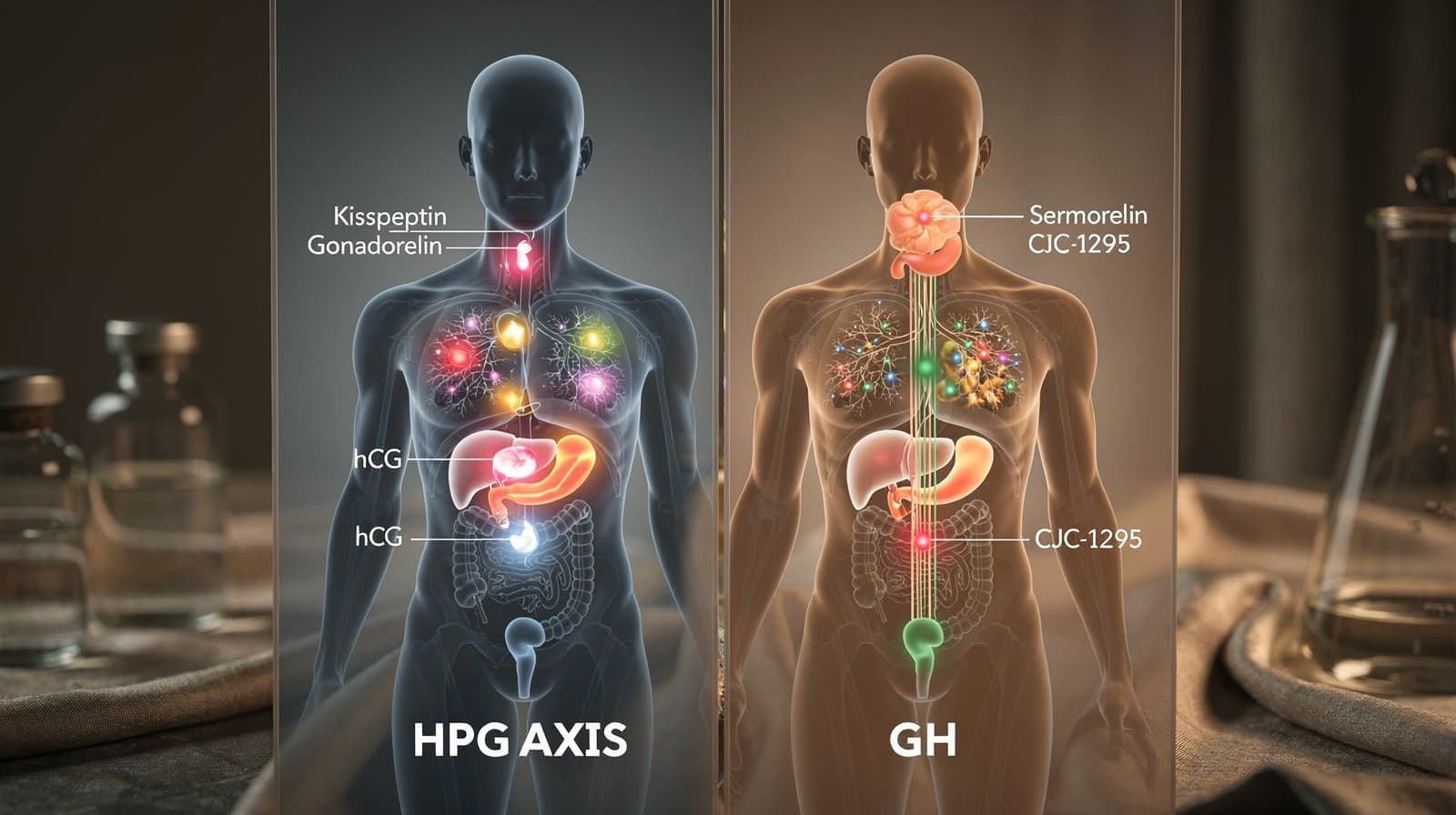
Peptides for Testosterone: Which Axis Actually Works
Most peptides for testosterone act on the growth hormone axis and never touch LH. Here is which compounds have measured serum testosterone in men.