
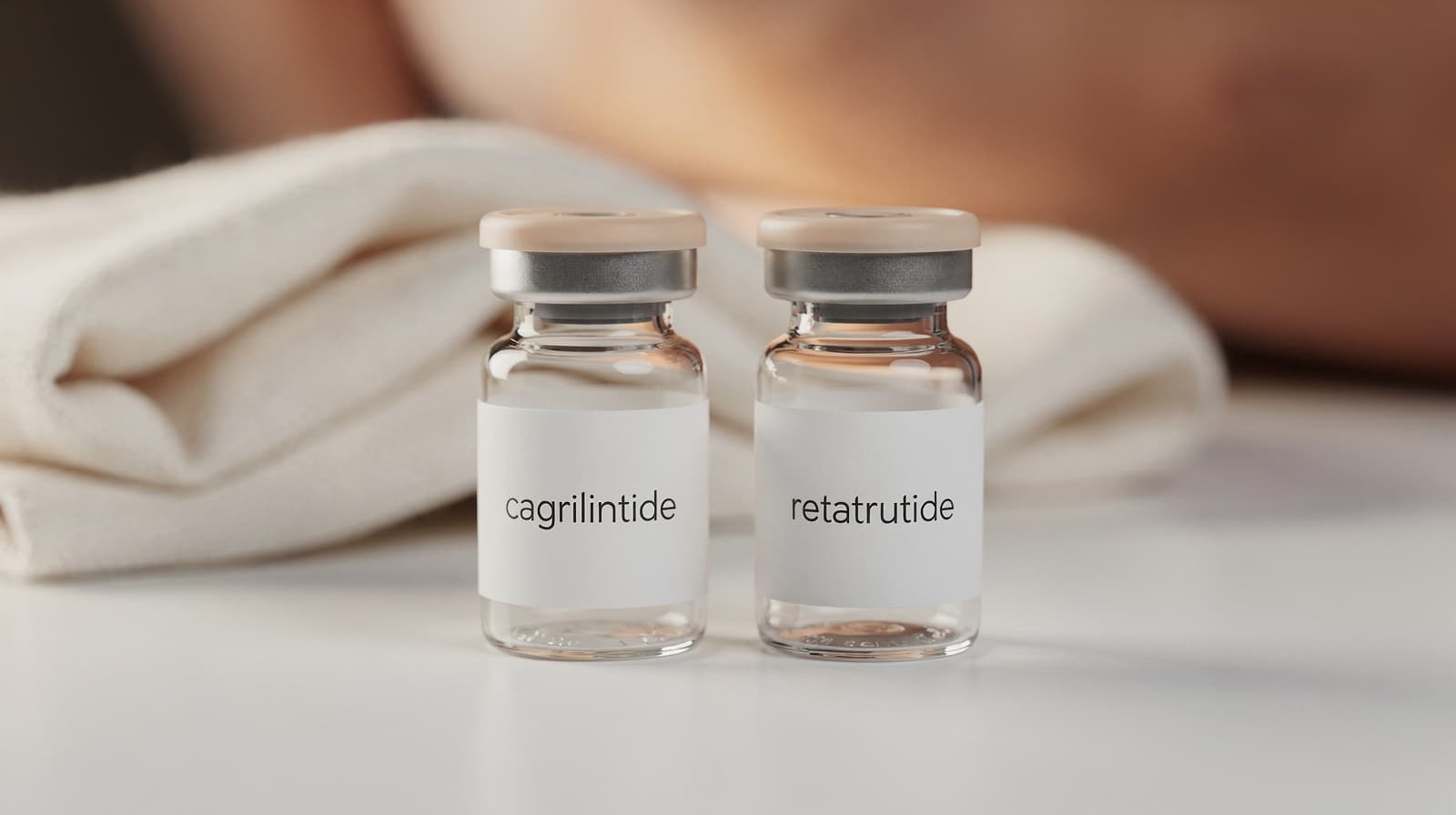
Cagrilintide and retatrutide are the two most-watched names in the next wave of obesity pharmacology, but they belong to entirely different categories. One is a long-acting amylin analogue designed to be paired with semaglutide; the other is a single-molecule triple agonist with some of the largest weight-loss numbers published in an anti-obesity trial. This piece sets the two side by side on efficacy, dosing, tolerability, and the decision rule for choosing between them.
Key takeaways#
- Cagrilintide is a long-acting amylin analogue; monotherapy produced roughly 10.8% weight loss at 4.5 mg over 26 weeks in phase 2, and 11.5% at 2.4 mg over 68 weeks in the phase 3 REDEFINE 1 trial.
- Retatrutide is a triple agonist at GLP-1, GIP, and glucagon receptors; in phase 2 the 12 mg dose reached 24.2% mean weight loss at 48 weeks, and in the phase 3 TRIUMPH-1 trial 25.0% at 80 weeks counting everyone randomized.
- The two are not interchangeable: cagrilintide is built to be combined (CagriSema with semaglutide), while retatrutide is a maximum-effect single molecule with a heavier side-effect burden.
- Retatrutide carries a dose-dependent resting heart-rate increase and a dysesthesia signal that have not been reported as signals for cagrilintide monotherapy.
- Neither compound is approved as of October 2026. Novo Nordisk filed CagriSema with the FDA in December 2025 and expects a decision in Q4 2026; Lilly plans to submit retatrutide in Q1 2027.
How cagrilintide and retatrutide work (and why the mechanisms matter)#
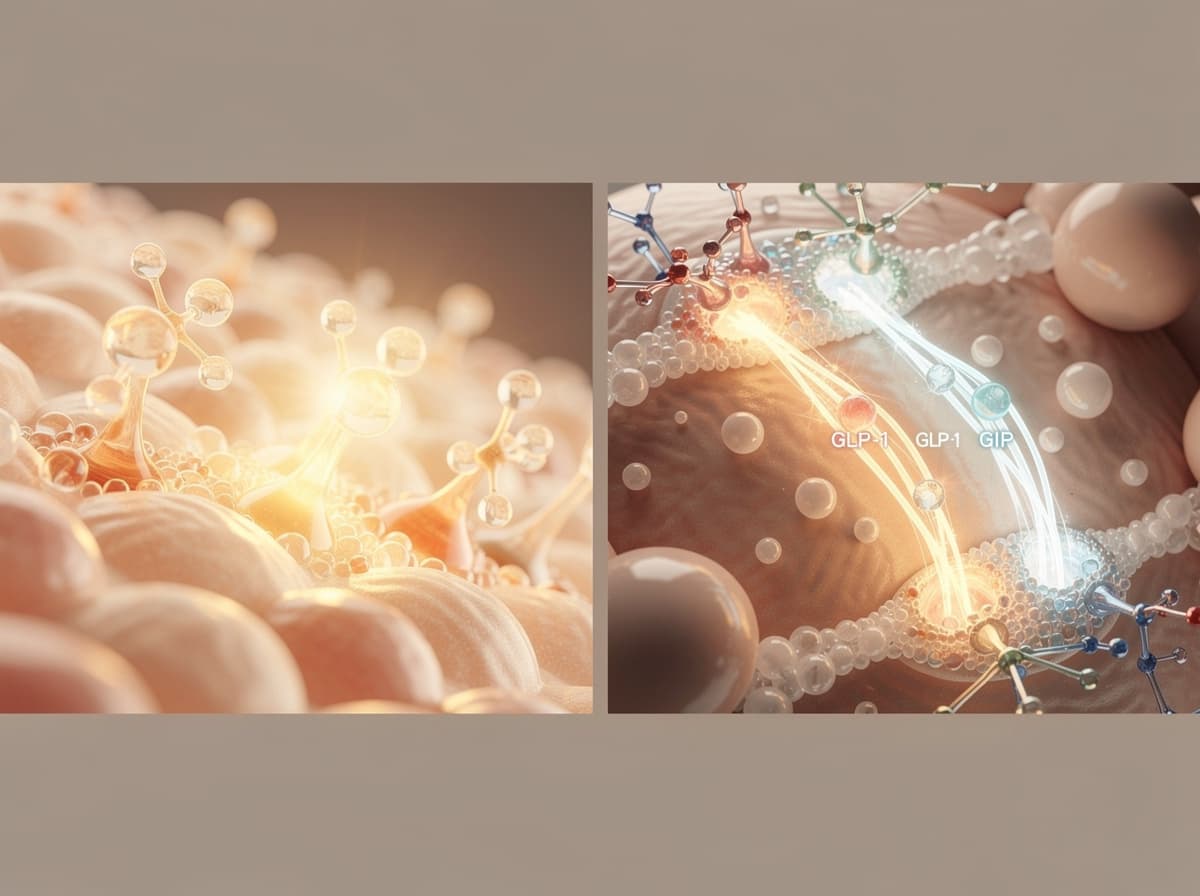
Cagrilintide is a long-acting acylated analogue of amylin, the pancreatic hormone co-secreted with insulin. It activates central amylin receptors and the calcitonin receptor to slow gastric emptying, suppress glucagon, and reduce food intake, with a structure engineered for once-weekly subcutaneous dosing. Structural work using cryo-electron microscopy has shown how cagrilintide engages AMY1, AMY2, AMY3, and CTR receptors, with a lipid modification and an ionic lock that confer the solution stability behind its weekly cadence. Functionally, cagrilintide hits a single hormonal axis (amylin / calcitonin) and is positioned as a partner molecule rather than a stand-alone maximum-effect agent.
Retatrutide is a different category of molecule. It is a triple agonist of the glucose-dependent insulinotropic polypeptide (GIP), glucagon-like peptide 1 (GLP-1), and glucagon receptors, given once weekly by subcutaneous injection. The glucagon arm is the differentiator: in addition to the appetite suppression and delayed gastric emptying contributed by GLP-1 and GIP, glucagon receptor activity raises energy expenditure and drives hepatic fat mobilisation. That third axis is the leading explanation for both the larger weight-loss numbers and the additional side-effect channels (resting heart rate, dysesthesia), although the mechanism behind those two signals has not been established.
The practical implication is that these molecules are answering different design questions. Cagrilintide is asking, "How do we add a complementary, well-tolerated lever on top of semaglutide?" Retatrutide is asking, "How much weight loss can a single molecule produce if you pull three incretin axes simultaneously?"
Dosing: cagrilintide vs retatrutide#
Research protocols for cagrilintide are well documented. The phase 2 dose-finding trial by Lau et al. in The Lancet randomized 706 adults to five doses (0.3, 0.6, 1.2, 2.4, and 4.5 mg once weekly), plus 99 to liraglutide 3.0 mg daily and 101 to placebo, with a dose-escalation period of up to 6 weeks. The 2.4 mg and 4.5 mg arms were the efficacy leaders. In the CagriSema combination program the established dose pairing is 2.4 mg cagrilintide with 2.4 mg semaglutide, both once weekly, reached through a parallel titration of roughly 16 weeks from 0.25 mg to manage gastrointestinal tolerability.
Retatrutide phase 2 used a stepwise titration starting at either 2 mg or 4 mg, escalating over 12 weeks to maintenance doses of 1, 4, 8, or 12 mg once weekly. The published NEJM phase 2 protocol noted that gastrointestinal side effects were partially mitigated with a 2 mg starting dose rather than 4 mg. The 8 mg and 12 mg arms drove the headline efficacy numbers, and every Phase 3 TRIUMPH trial now starts at 2 mg and steps up every four weeks to a target of 4, 9 or 12 mg. These are research-published doses cited from the trial record, not personalised protocols.
Evidence: what the studies actually show#
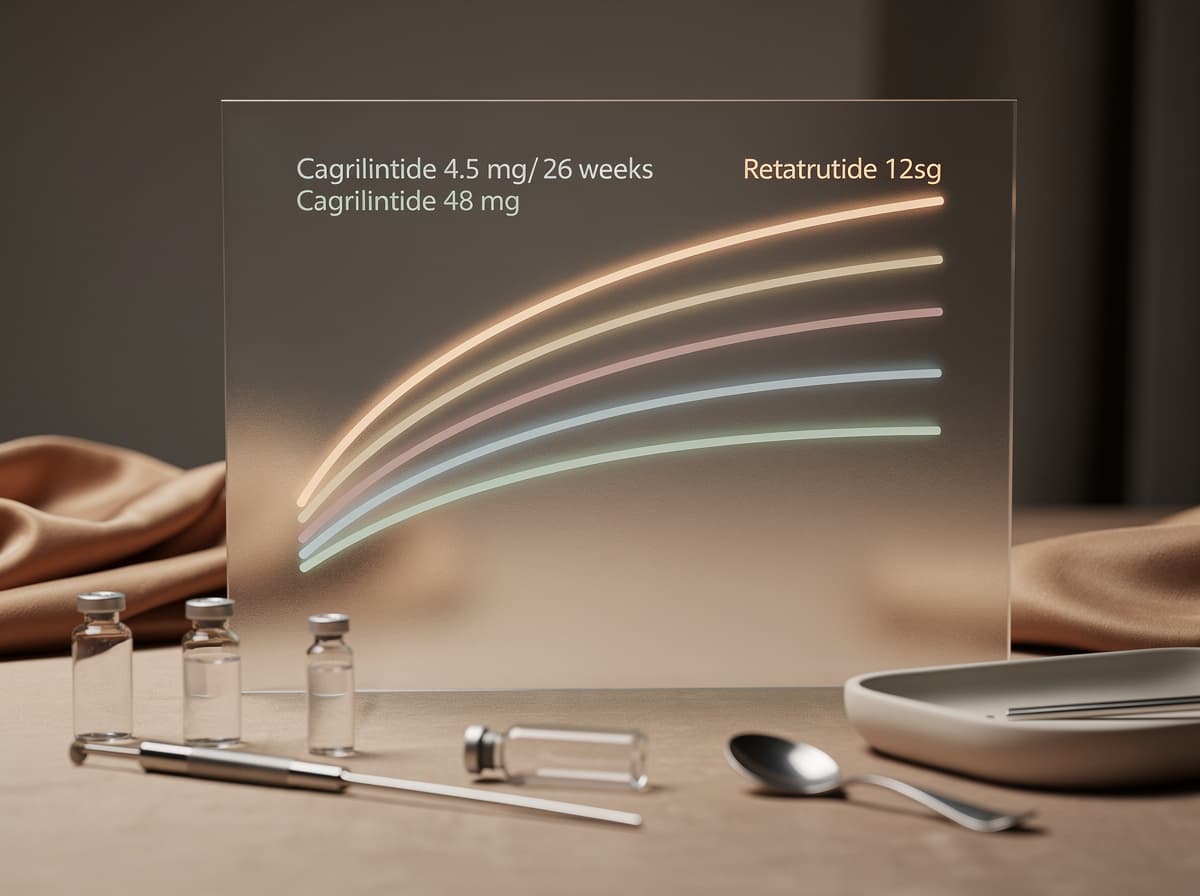
For cagrilintide monotherapy, the 26-week phase 2 dose-finding trial reported, from a baseline weight of approximately 100 kg, weight loss of 9.7% at 2.4 mg and 10.8% at 4.5 mg, against 3.0% with placebo (trial-product estimand). The active liraglutide 3.0 mg comparator landed at roughly 9.0%, putting cagrilintide 4.5 mg modestly ahead of the best-in-class GLP-1 daily injectable at the time. In the phase 2 CagriSema trial in type 2 diabetes by Frias et al., cagrilintide alone delivered 8.1% weight loss at 32 weeks versus 5.1% for semaglutide alone and 15.6% for the combination. Phase 3 REDEFINE 1 data, published in NEJM in 2025, reported 20.4% weight loss at 68 weeks with CagriSema versus 14.9% with semaglutide alone and 11.5% with cagrilintide alone (treatment-policy estimand).
Retatrutide now has Phase 3 data too. In TRIUMPH-1 (NEJM, September 2026), the 12 mg dose produced 25.0% weight loss at 80 weeks counting everyone randomized, or 28.3% among participants who stayed on treatment.
For retatrutide, the phase 2 NEJM trial by Jastreboff et al. reported substantial dose-dependent weight reduction. At 48 weeks, least-squares mean percentage changes were −8.7% at 1 mg, −17.1% at 4 mg, −22.8% at 8 mg, and −24.2% at 12 mg, against −2.1% with placebo. At 12 mg, 93% of participants reached a 10% weight reduction and 83% reached 15%. A separate phase 2a MASLD substudy reported liver fat reductions of 81.4% and 82.4% at the 8 mg and 12 mg doses, with 79% and 86% of participants reaching normal liver fat (defined as <5%) at 24 weeks. Cagrilintide does not have equivalent published MASLD data at this stage.
The directional read is clear: retatrutide 12 mg roughly doubles the magnitude of weight loss seen with cagrilintide monotherapy, and comes in ahead of CagriSema (25.0% at 80 weeks versus 20.4% at 68 weeks, both counting everyone randomized). The two trial populations and durations are not identical, so this is not a true head-to-head, but the gap is wide enough that the ordering is stable.
Side effects and contraindication profile#
Cagrilintide's side-effect profile is predominantly gastrointestinal. The phase 2 monotherapy trial reported gastrointestinal adverse events in 41% to 63% of participants across cagrilintide doses, versus 32% on placebo, mostly mild to moderate and non-serious. Injection-site reactions were observed but also non-serious. Cagrilintide does not engage glucagon or GIP receptors, and the dose-dependent heart-rate and dysesthesia signals seen with retatrutide have not been reported as signals for cagrilintide monotherapy.
Retatrutide carries a heavier and broader tolerability burden. Phase 2 data showed that the most frequently reported adverse events were gastrointestinal, dose-related, and mostly mild to moderate, with a lower starting dose partially mitigating them. Beyond GI events, two retatrutide-specific signals matter. First, dose-dependent increases in heart rate that peaked at 24 weeks and declined thereafter; glucagon receptor activity is a candidate explanation, but the mechanism has not been established. Second, dysesthesia (altered skin sensation), observed in 12.5% of the 12 mg group in TRIUMPH-1 and 20.9% in TRIUMPH-4, versus under 1% on placebo; its mechanism is also unknown, though research suggests it is associated with the higher doses. Neither signal has been reported for cagrilintide.
When to choose cagrilintide, when to choose retatrutide#
Cagrilintide is the more conservative choice when the goal is to layer a complementary mechanism on top of semaglutide, when gastrointestinal tolerability is the deciding constraint, or when the user has a cardiovascular profile (resting tachycardia, palpitations, history of arrhythmia) that makes a dose-dependent heart-rate increase unacceptable. It also fits adults whose research question is paired-mechanism amplification rather than maximum single-molecule effect, given that CagriSema is further along the regulatory path: Novo Nordisk filed it with the FDA in December 2025, while Lilly plans to submit retatrutide in Q1 2027.
Retatrutide is the stronger candidate when the primary goal is the largest possible weight reduction documented in a published trial, when MASLD (liver fat) reduction is a parallel endpoint of interest, or when the user is willing to trade a heavier side-effect burden (nausea, heart-rate increase, dysesthesia risk) for a single-molecule regimen without combination logistics. It is also the better fit for adults whose metabolic profile (high HbA1c, elevated liver fat, large weight-loss target) maps onto the populations where retatrutide has been shown to deliver the strongest effect sizes.
Can you stack cagrilintide and retatrutide?#
Stacking is not standard research practice and is not represented in any published trial. The conflict is mechanistic, not just regulatory. Retatrutide already engages GLP-1, GIP, and glucagon receptors at saturating doses; adding cagrilintide layers another central appetite-suppression axis (amylin / calcitonin) on top of an already maximally stimulated incretin system. Tolerability would compound (nausea, gastric emptying delay, heart-rate effects) without a clear additional efficacy ceiling to chase. The combination strategy that has been validated is CagriSema, where cagrilintide pairs with semaglutide (a GLP-1 mono-agonist), not with a triple agonist. For any reader weighing combinations, the established research pairing is cagrilintide with semaglutide, not with retatrutide.
Verdict#
For most adults whose primary goal is the largest possible weight reduction documented in a published trial, retatrutide is the stronger candidate; the 12 mg arm reached 24.2% mean weight loss at 48 weeks in phase 2 and 25.0% at 80 weeks in phase 3, versus 10.8% for cagrilintide monotherapy at 26 weeks in phase 2 and 11.5% at 68 weeks in phase 3. For adults who prioritise tolerability, combinability with semaglutide, and a cleaner cardiovascular profile, cagrilintide (especially as CagriSema) is the more conservative and better-validated choice. The two are not interchangeable: retatrutide is a maximum-effect bet with a heavier side-effect tax, while cagrilintide is a slower, gentler instrument designed to be paired. Choose based on which constraint (efficacy ceiling vs. tolerability and combinability) is actually binding for the research question.
For readers planning to quantify which compound their health profile and goals actually point to, the peptide calculator provides dose modelling against the published trial ranges, and the Klarovel questionnaire maps a user profile to a protocol pathway. The companion piece on the CagriSema combination is the natural next read if cagrilintide came out ahead for you. Both are referenced in our disclosures.
Pick the protocol your health profile actually points to#
Cagrilintide and retatrutide are not the same instrument. One is a gentle, pair-friendly amylin lever; the other is a maximum-effect single molecule with a heavier side-effect tax. The right question is not which is "better" but which constraint is binding for you. Quantify the trade-off with the Klarovel peptide calculator, then map your profile to a protocol pathway in the questionnaire and create an account to track outcomes against the published trial benchmarks.
Frequently asked questions
Keep reading
Peptides for Inflammation: Mapping BPC-157, KPV, and Thymosins
Peptides for inflammation compared by mechanism and evidence stage: BPC-157, KPV, thymosin alpha-1, and thymosin beta-4, with FDA status and safety notes.
Mounjaro vs Zepbound: Same Drug, Two Different FDA Labels
Mounjaro and Zepbound are the same drug, tirzepatide, at the same doses. The difference is the FDA label: diabetes for Mounjaro, weight loss for Zepbound.
Rybelsus for Weight Loss: Not Approved, and the Pill That Is
Rybelsus is not FDA-approved for weight loss and moves the scale only a little. The oral semaglutide approved for weight loss is the Wegovy pill at 25 mg.