
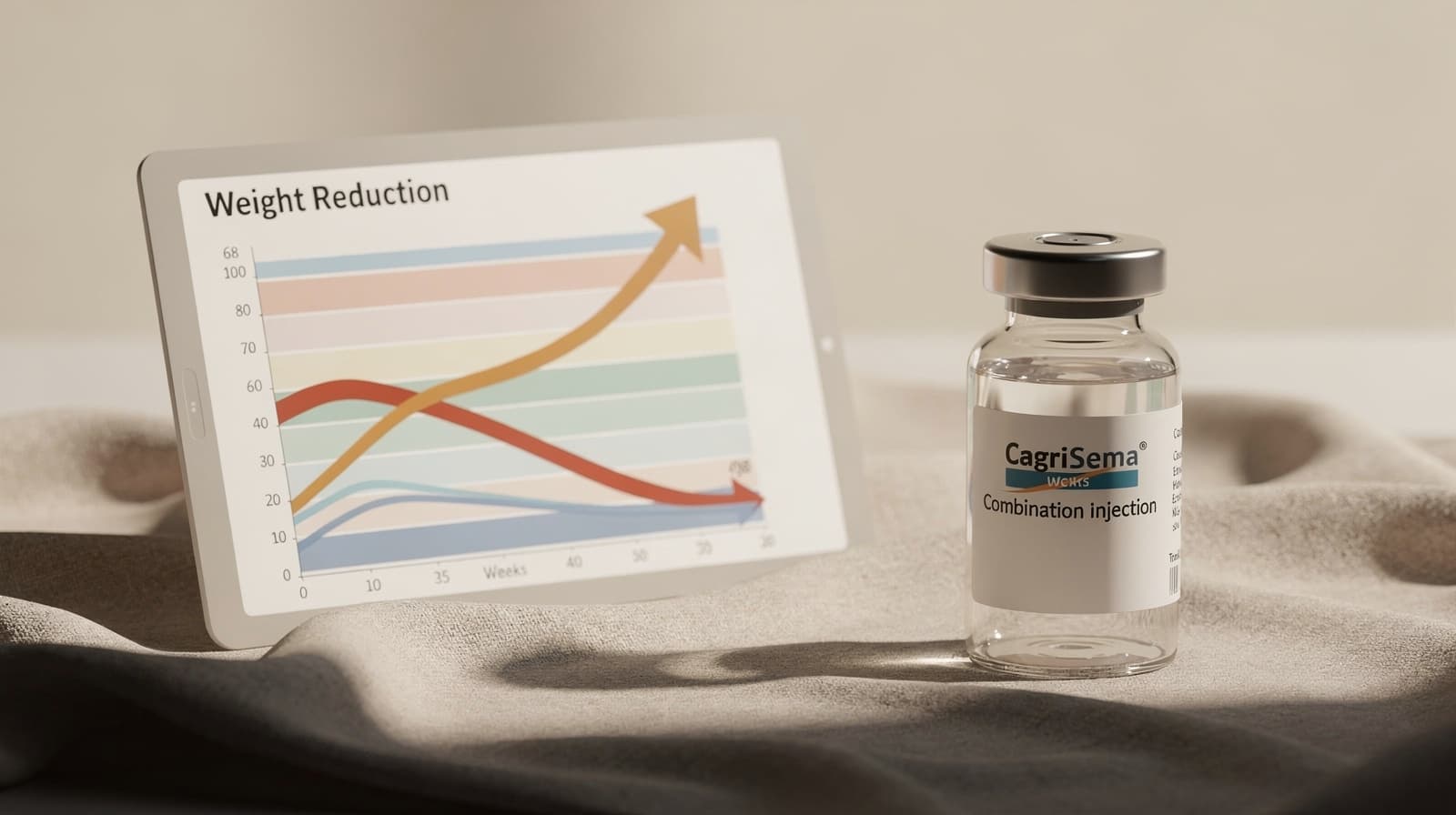
CagriSema is a once-weekly injection combining cagrilintide 2.4 mg, an amylin analogue, with semaglutide 2.4 mg, and it produced 20.4% average weight loss over 68 weeks in REDEFINE 1 counting everyone randomized (22.7% among participants who stayed on treatment), against 14.9% for semaglutide alone on the same basis. It is not yet FDA-approved: Novo Nordisk filed in December 2025 and expects a decision in the fourth quarter of 2026. In the open-label head-to-head REDEFINE 4 trial it did not meet non-inferiority against tirzepatide 15 mg at 84 weeks (20.2% versus 23.6% counting everyone randomized; 23.0% versus 25.5% if all had adhered). This piece unpacks what the REDEFINE program actually showed and how the pairing differs from a GLP-1 alone.
Key takeaways#
- CagriSema is a fixed-dose, once-weekly subcutaneous combination of cagrilintide 2.4 mg (an amylin analogue) and semaglutide 2.4 mg (a GLP-1 receptor agonist).
- In REDEFINE 1 (n=3,417, no diabetes), CagriSema produced 20.4% mean weight loss at 68 weeks under the treatment-policy estimand, versus 14.9% with semaglutide alone and 11.5% with cagrilintide alone; under the trial-product estimand CagriSema reached 22.7%.
- In REDEFINE 2 (n=1,206, with type 2 diabetes), CagriSema produced 13.7% weight loss versus 3.4% with placebo (15.7% versus 3.1% on treatment), and 73.5% of patients reached HbA1c ≤6.5%.
- In the head-to-head REDEFINE 4 trial at 84 weeks, CagriSema did not meet its non-inferiority endpoint against tirzepatide 15 mg: 20.2% versus 23.6% (treatment-regimen), 23.0% versus 25.5% (if all participants adhered).
- In September 2026, a lower CagriSema 1.0/1.0 mg dose beat tirzepatide 5 mg on weight loss in type 2 diabetes (REIMAGINE 5) and produced 21.0% weight loss versus 2.0% on placebo in obesity (REDEFINE 9), both on the efficacy estimand.
- Novo Nordisk filed the FDA submission in December 2025; a decision is expected in the fourth quarter of 2026.
CagriSema stacks two independent satiety pathways in a single weekly shot#
The combination is not a new molecule. It is a co-formulation of two distinct peptides that hit different receptors. CagriSema is a fixed-dose combination of a long-acting amylin analogue, cagrilintide 2.4 mg and semaglutide 2.4 mg. The two molecules induce weight loss by reducing hunger, increasing feelings of fullness and thereby help people eat less and reduce their calorie intake.
Semaglutide is the familiar half of the pair. It acts as a GLP-1 receptor agonist, slowing gastric emptying and signaling fullness through gut-brain pathways. Cagrilintide is the newer component, and it works through a completely separate receptor system. Amylin receptors are located on specific nuclei of the dorsal-vagal-complex located within the hindbrain, the nucleus tractus solitarius (NTS), area postrema (AP), and dorsal motor nucleus of the vagus nerve. Research has shown that the area postrema is one of the rare brain regions that sits outside the blood-brain barrier, which lets a peripherally injected peptide produce central satiety effects directly.
A 2025 eBioMedicine knockout-mouse study showed why this matters mechanistically: AMY1R and AMY3R are necessary for the neuronal activation upon cagrilintide administration. Those receptor subtypes are simply not engaged by GLP-1 agonists, which is why pairing the two compounds produces a supra-additive response rather than redundant signaling.
REDEFINE 1 showed 20.4% weight loss in adults without diabetes#
The pivotal trial in adults without diabetes is the dataset that drove the FDA submission. The design was rigorous: a phase 3a, 68-week, multicenter, double-blind, placebo-controlled and active-controlled trial enrolled adults without diabetes who had a body-mass index of 30 or higher or a BMI of 27 or higher with at least one obesity-related complication. Participants were randomly assigned in a ratio of 21:3:3:7 to receive the combination of semaglutide at a dose of 2.4 mg and cagrilintide at a dose of 2.4 mg, semaglutide alone at a dose of 2.4 mg, cagrilintide alone at a dose of 2.4 mg, or placebo, plus lifestyle interventions for all groups.
The headline efficacy numbers, published in the New England Journal of Medicine, are clinically meaningful. The estimated mean percent change in body weight from baseline to week 68 was –20.4% with cagrilintide–semaglutide as compared with –3.0% with placebo (estimated difference, –17.3 percentage points; 95% confidence interval, –18.1 to –16.6; P<0.001). When the analysis is restricted to participants who adhered to treatment (the trial-product estimand), the number climbs higher. Studies have shown that in the trial-product estimand analysis, reductions reached 22.7% and 2.3%, respectively, corresponding to an absolute weight loss of -21.6 kg with combination therapy.
Comparator arms tell the rest of the story. Research suggests CagriSema beats each component alone by a wide margin: in REDEFINE 1, participants lost an average of 20.4% of their body weight with CagriSema at week 68, compared to 11.5% with cagrilintide, 14.9% with semaglutide, and 3% with placebo.
Responder rates are where the combination really separates from semaglutide monotherapy. 91.9% of the combination group lost at least 5% of baseline weight, while 53.6% lost ≥20%. Further, 34.7% achieved ≥25% loss, and 19.3% achieved ≥30% loss. By contrast, semaglutide alone yielded 14.8% of patients achieving ≥25% weight loss, and cagrilintide alone yielded 6.5%.

Body composition and metabolic markers improved alongside the weight number#
A weight-loss headline is only useful if the underlying body composition holds up. The REDEFINE 1 DXA subgroup gave the answer. In the DXA subgroup (n = 252), the data showed that 67% of the weight reduction originated from fat mass and 33% from lean soft tissue. This ratio of fat-to-lean mass reduction is consistent with established obesity therapies and suggests that metabolic function is preserved during weight loss. Fat mass decreased by 17.0 kg with the combination, compared to 3.4 kg with the placebo, whereas lean mass decreased by 8.4 kg, compared to 2.6 kg.
Cardiometabolic markers moved in the right direction too. Preliminary evidence from ObesityWeek 2025 post-hoc analyses reported that with CagriSema treatment, systolic blood pressure was reduced by -10.9 mmHg over 68 weeks (versus -8.8 mmHg with semaglutide 2.4 mg and -2.1 mmHg with placebo). Among participants with prediabetes at baseline, the combination therapy significantly improved systolic blood pressure, waist circumference, lipid levels, and glycemic control, with 88% of participants with prediabetes returning to normoglycemia.
A particularly striking outcome was BMI category shift. Research has shown that 54% of those initially classified with obesity moved into the non-obese BMI range by study end vs. 11.1% with placebo.
REDEFINE 2 showed weaker results in adults with type 2 diabetes#
The second pivotal trial enrolled a metabolically different population, and the numbers reflect it. A total of 1206 patients underwent randomization to either the cagrilintide–semaglutide group (904 patients) or the placebo group (302 patients). The estimated mean change in body weight from baseline to week 68 was −13.7% in the cagrilintide–semaglutide group and −3.4% in the placebo group (estimated difference, −10.4 percentage points; 95% confidence interval, −11.2 to −9.5; P<0.001).
That pattern, where weight loss is blunted in patients with type 2 diabetes versus those without, is a class-wide phenomenon for GLP-1 based therapies. The glycemic effect was strong, however. The percentage of patients who had a glycated hemoglobin level of 6.5% or less was 73.5% in the cagrilintide–semaglutide group and 15.9% in the placebo group.
When adherence is factored in, the trial-product estimand pushes the number higher: after 68 weeks, patients adhering to cagrilintide/semaglutide treatment experienced a 15.7% weight loss, significantly higher than the 3.1% loss observed with placebo.
REDEFINE 4 put CagriSema directly against tirzepatide and missed non-inferiority#
The head-to-head trial against Eli Lilly's tirzepatide is the comparison investors and clinicians had been waiting for. The February 2026 Novo Nordisk readout reported that REDEFINE 4 was an 84-week trial investigating CagriSema (a fixed dose combination of cagrilintide 2.4 mg and semaglutide 2.4 mg) compared to tirzepatide 15 mg, both administered once-weekly and subcutaneously. The trial included 809 randomized people with obesity and one or more comorbidities and with a mean baseline body weight of 114.2 kg.
The result was not what Novo Nordisk had positioned the market to expect. When evaluating the effects of treatment, if all people adhered to treatment, people treated with CagriSema 2.4 mg/2.4 mg achieved a weight loss of 23.0% after 84 weeks compared to 25.5% with tirzepatide 15 mg. On the treatment-regimen estimand, which counts everyone randomized, the figures were 20.2% versus 23.6%, and the trial did not achieve its primary endpoint of non-inferiority for CagriSema versus tirzepatide.
The trial was open-label, which Novo Nordisk argued may have favored the established comparator, and Novo is now pursuing higher-dose protocols. The company confirmed that high-dose CagriSema 2.4 mg/7.2 mg, an efficacy and safety phase 3 trial, is planned to be initiated in the second half of 2026 in adults with obesity. The bet is that pushing the semaglutide component to 7.2 mg may close the gap with tirzepatide.

Safety profile is consistent with the GLP-1 class#
Gastrointestinal events dominated the adverse event profile in both pivotal trials, which is expected for any GLP-1-containing regimen. In REDEFINE 1, research suggests discontinuation rates due to adverse events were low, with 5.9% for CagriSema versus 3.5% for placebo in REDEFINE 1 and 8.4% with CagriSema versus 3% with placebo in REDEFINE 2. In REDEFINE 1, adverse events were mainly gastrointestinal, (79.6% in the CagriSema group vs 39.9% with placebo) including nausea (55% vs 12.6%), constipation (30.7% vs 11.6%), and vomiting (26.1% vs 4.1%).
Studies have shown that gastrointestinal adverse events, including nausea, vomiting, diarrhea, constipation, or abdominal pain, were mainly transient and mild-to-moderate in severity. Preclinical data points and trial safety adjudication also covered the standard set of concerns: safety signals of special interest, including pancreatitis, gallbladder events, neoplasms, and suicidal ideation, were adjudicated by blinded expert committees.
Regulatory status: filed December 2025, decision expected Q4 2026#
Novo Nordisk completed its FDA submission in late 2025. The official company announcement confirms that CagriSema for weight management was submitted to the US FDA in December 2025 based on the REDEFINE 1 and REDEFINE 2 pivotal trials. In September 2026 Novo said a decision is expected in the fourth quarter of 2026 (Novo Nordisk).
The same September 2026 announcement added two phase 3 readouts at a lower 1.0 mg/1.0 mg dose, both on the efficacy estimand. In REIMAGINE 5, adults with type 2 diabetes lost 12.4% on CagriSema 1.0/1.0 mg versus 9.1% on tirzepatide 5 mg at 60 weeks (superior), with non-inferior HbA1c reduction. In REDEFINE 9, adults with overweight or obesity lost 21.0% versus 2.0% on placebo at 68 weeks.
The broader REDEFINE program is still running. The REDEFINE 11 phase 3 trial exploring CagriSema 2.4/2.4 mg full weight-loss potential in obesity is expected to report data during the first half of 2027. The CagriSema profile may continue to evolve as the higher-dose and longer-duration readouts come in.
How CagriSema compares to current options#
For someone weighing the options on paper, the rough hierarchy emerging from 2025-2026 data looks like this:
- Semaglutide 2.4 mg (Wegovy): ~15% mean weight loss at 68 weeks. Established cardiovascular outcomes data. Approved and widely available.
- Tirzepatide 15 mg (Zepbound): ~20.9% mean weight loss at 72 weeks. Dual GLP-1/GIP agonist. Approved for obesity and type 2 diabetes.
- CagriSema 2.4/2.4 mg: 20.4% mean weight loss at 68 weeks counting everyone randomized (22.7% on treatment, REDEFINE 1) and 20.2% at 84 weeks (23.0% on treatment, REDEFINE 4). Pending FDA approval.
- High-dose CagriSema 2.4/7.2 mg: Phase 3 planned to start in the second half of 2026; targeting closure of the tirzepatide gap.
The mechanistic argument for CagriSema is the amylin pathway. Cagrilintide works through a brain pathway that semaglutide and tirzepatide do not touch. GLP-1 drugs suppress appetite primarily through receptors in the gut, brainstem, and area postrema. Cagrilintide acts on amylin receptors concentrated in the hypothalamus and area postrema, affecting both homeostatic hunger (your body's energy-balance system) and hedonic hunger (the reward-driven desire to eat palatable food). This mechanistic independence is why combining cagrilintide with semaglutide produces more weight loss than either drug alone.
For protocol planning around individual components, the Klarovel peptide calculator covers dose-conversion for cagrilintide and semaglutide separately, and the cagrilintide complete guide covers the amylin pharmacology in more detail.
The bottom line on the amylin-GLP-1 stacking thesis#
CagriSema is the first late-stage validation that amylin pathway engagement adds meaningfully on top of best-in-class GLP-1 therapy. The 20.4% weight-loss number (22.7% on treatment) is not the largest in the obesity pipeline, but it is the first phase 3 evidence that a non-incretin mechanism can compound with semaglutide in a clinically useful way. For people thinking carefully about the next decade of metabolic protocols, this is the data point that matters most. For where CagriSema lands against the rest of the field, see how the GLP-1 weight-loss medications compared stack up. To explore how the underlying peptides fit into a structured wellness protocol, register for a Klarovel account or review how the platform works.
Frequently asked questions
Keep reading
Peptides for Inflammation: Mapping BPC-157, KPV, and Thymosins
Peptides for inflammation compared by mechanism and evidence stage: BPC-157, KPV, thymosin alpha-1, and thymosin beta-4, with FDA status and safety notes.
Mounjaro vs Zepbound: Same Drug, Two Different FDA Labels
Mounjaro and Zepbound are the same drug, tirzepatide, at the same doses. The difference is the FDA label: diabetes for Mounjaro, weight loss for Zepbound.
Rybelsus for Weight Loss: Not Approved, and the Pill That Is
Rybelsus is not FDA-approved for weight loss and moves the scale only a little. The oral semaglutide approved for weight loss is the Wegovy pill at 25 mg.