

Dementia does not respond well to marketing. Families searching for something, anything, past donepezil and memantine deserve a clear read of what the peptide literature actually contains, where the signal is real, and where the promises outrun the data. This piece walks through the three peptides most often raised in that conversation: Cerebrolysin, Semax, and Dihexa.
Key takeaways#
- An estimated 57.4 million people were living with dementia worldwide in 2019, a number forecast to reach 152.8 million by 2050 (GBD 2019 Dementia Forecasting Collaborators, Lancet Public Health 2022).
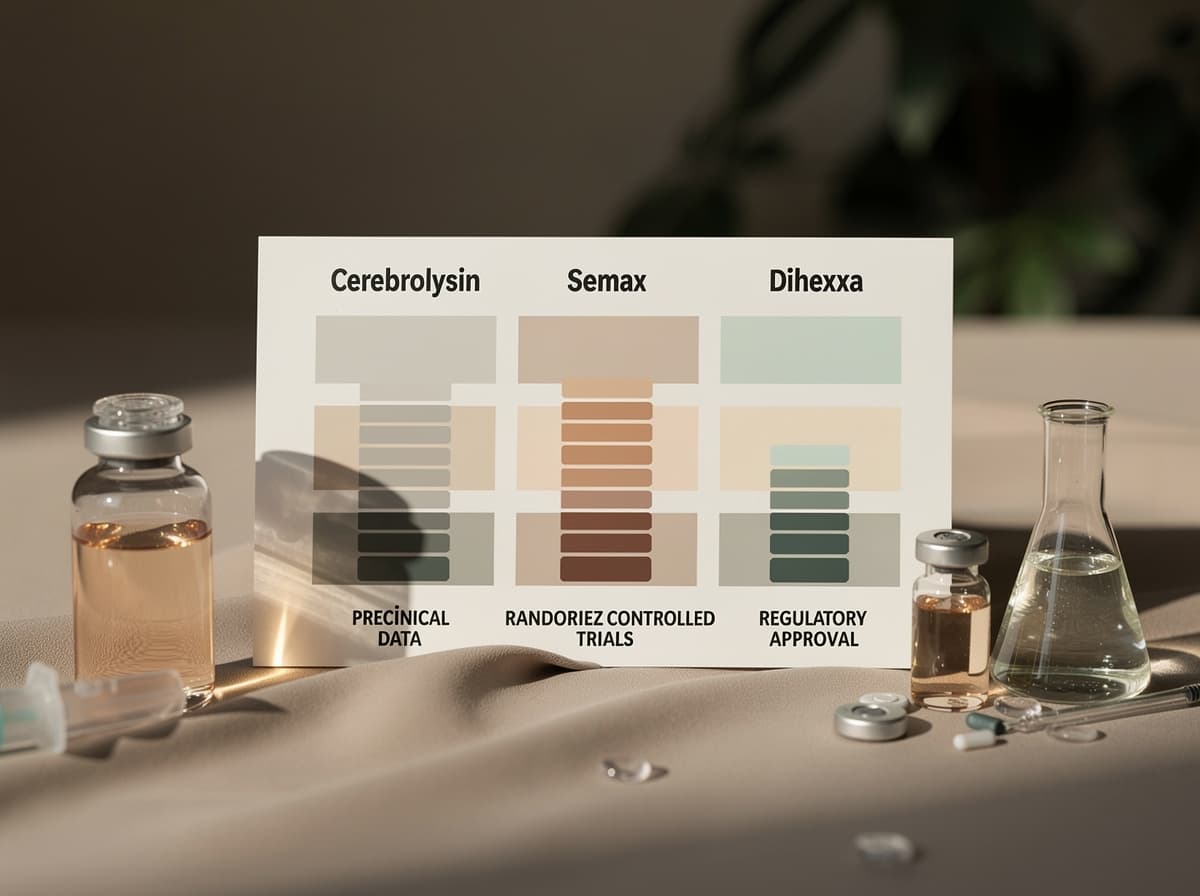
- Cerebrolysin is the only peptide in this class with multiple randomised placebo-controlled trials in dementia populations; the 2019 Cochrane update concluded the supporting evidence base remains weak.
- In a 242-patient vascular dementia trial, IV Cerebrolysin 20 mL produced an ADAS-cog+ improvement of 10.6 points at week 24 versus 4.4 for placebo.
- Semax and Dihexa data in dementia are almost entirely preclinical; no completed human Alzheimer's trial exists for either.
- Peptides are not approved dementia therapies in the US, EU, or Norway. Any protocol belongs inside physician-supervised research, not self-experimentation.
The dementia gap is why peptides keep resurfacing#
Standard care for Alzheimer's disease and vascular dementia has plateaued for two decades. Cholinesterase inhibitors and memantine offer modest symptomatic benefit; the newer FDA-approved anti-amyloid antibodies, lecanemab (Leqembi) and donanemab (Kisunla), are indicated for Alzheimer's disease at the mild cognitive impairment or mild dementia stage, with amyloid pathology confirmed before treatment, and carry a boxed warning for amyloid-related imaging abnormalities (ARIA) (Kisunla label). Meanwhile, the demographic curve keeps steepening. The Global Burden of Disease forecast puts the number of people with dementia at 152.8 million by 2050, up from 57.4 million in 2019, driven by population ageing and growth; the age-standardized prevalence itself is forecast to stay roughly flat (Lancet Public Health, 2022).
That gap creates pressure. Patients and families look at compounds with any published cognitive signal. Peptides sit near the top of that list because a handful of them (particularly Cerebrolysin) have been in clinical use outside the US for decades, and because their proposed mechanisms (neurotrophic support, synaptogenesis, reduced amyloid interaction) speak directly to the pathology.
The honest framing: research suggests certain peptides modulate biological targets relevant to dementia. That is not the same as reversing disease.

Cerebrolysin has the deepest evidence base, and its ceiling is honest#
Cerebrolysin is a porcine-brain-derived mixture of low-molecular-weight peptides and free amino acids. It is a mixture of 80% low-molecular-weight peptides and 20% free amino acids; various studies have shown that the agent's multiple effects include promotion of neuroprotection, neuroplasticity, and neurogenesis, and it is approved in many countries for treatment of Alzheimer's disease, stroke, and traumatic brain injury, although not in the United States.
The strongest single trial is the Guekht et al. multicenter vascular dementia study. Intravenous Cerebrolysin 20 mL was administered once daily over two treatment cycles as add-on therapy to acetylsalicylic acid. At week 24, ADAS-cog+ score improved by 10.6 points in the Cerebrolysin group, compared with 4.4 points in the placebo group (least squares mean difference, -6.17; P < .0001 vs placebo). CIBIC+ showed a mean improvement of 2.84 in the treatment arm and 3.68 in the placebo arm, a treatment difference of 0.84 (P < .0001 vs placebo).
Meta-analytic work is broadly consistent. The 2013 Cochrane review of Cerebrolysin in vascular dementia pooled six trials with 597 participants and found significant improvements on both MMSE and ADAS-cog+ scales. In mild-to-moderate Alzheimer's disease, a Karger meta-analysis of randomised double-blind placebo-controlled trials concluded that this meta-analysis provides evidence that Cerebrolysin has an overall beneficial effect and a favorable benefit-risk ratio in patients with mild-to-moderate AD.
Now the ceiling. The 2019 Cochrane update is more sobering. Analyses were limited by heterogeneity, and the included papers had high risk of bias. If there are benefits of Cerebrolysin, the effects may be too small to be clinically meaningful. There have been no new studies of Cerebrolysin in vascular dementia since the last Cochrane Review. Cerebrolysin continues to be used and promoted as a treatment for vascular dementia, but the supporting evidence base is weak. Where details of funding were available, all studies were supported by the pharmaceutical industry.
That is the real picture: a positive signal that has been shown across multiple RCTs, moderated by heterogeneity, industry funding, and geographic concentration of trials. Cerebrolysin belongs in conversations about mild-to-moderate dementia. It does not belong in conversations framing it as a solution.
Semax has preclinical amyloid data, no human dementia trials#
Semax is a synthetic heptapeptide fragment of ACTH developed at the Institute of Molecular Genetics in Moscow. Its cognitive claim rests on neurotrophic activity, principally BDNF upregulation.
The most recent relevant data comes from a 2025 Acta Naturae study in APPswe/PS1dE9 transgenic mice, the standard Alzheimer's model. The study assessed the effect of Semax and its derivative on behavioral characteristics and development of amyloidosis in transgenic APPswe/PS1dE9/Blg mice acting as a model of Alzheimer's disease. The open field, novel object recognition, and Barnes maze tests demonstrated that both Semax and its derivative improved cognitive functions in mice. Histological examination showed that these peptides reduced the number of amyloid inclusions in the cortex and hippocampus of the animals' brains.
There is also a mechanistically distinct signal. Preclinical data points to Semax interfering with copper-catalysed amyloid-beta aggregation, a pathway that operates independently of its BDNF effects.
What Semax lacks: any completed randomised controlled trial in human dementia populations. Its long clinical use in Russia is for stroke recovery and cognitive complaints, not diagnosed Alzheimer's disease or vascular dementia. Translating strong rodent behavioral improvements to human dementia outcomes has failed for dozens of compounds before it. The molecule is interesting; the evidence is preliminary.
Dihexa is the most speculative candidate, and the retraction matters#
Dihexa is an orally active peptidomimetic derived from angiotensin IV, engineered at Washington State University to cross the blood-brain barrier and drive synaptogenesis, proposed to act through the HGF/c-Met pathway. In Journal of Pharmacology and Experimental Therapeutics work and the accompanying press coverage, the researchers note that at its core dementia results from a combination of diminished synaptic connectivity among neurons and neuronal death in the entorhinal cortex, hippocampus, and neocortex. Previous attempts to develop protein neurotrophic factors as therapeutics has been limited by their inability to cross the blood-brain barrier, and the need to manufacture such agents by recombinant methods, which is costly. The development of dihexa has seemingly overcome these impediments by virtue of its oral activity, demonstrated pro-cognitive/anti-dementia activity, and anticipated low manufacturing costs.
Preclinical results have been described as unusually strong. A 2021 study in Brain Sciences is meaningful because it comes from outside the original lab. It reports that dihexa restored spatial learning on the Morris water maze in APP/PS1 Alzheimer's-model mice and reduced glial activation and pro-inflammatory cytokines, and that the PI3K inhibitor wortmannin reversed its anti-inflammatory and anti-apoptotic effects, implicating PI3K/AKT signaling.
Then the caveats stack up quickly. The 2014 paper that established the HGF/c-Met mechanism was retracted in 2025 after a Washington State University investigation found falsified or fabricated data (JPET retraction notice), and two related 2011 papers from the same lab are also retracted. No human trial has ever been completed. And in a 2025 European market-surveillance study of 159 nootropic samples seized or tested by official medicines laboratories, 69% came from the illegal supply chain, with adulterated, unauthorised, and research-chemical products all represented (EDQM, 2025). That is a serious combination: a retracted mechanistic backbone, zero human efficacy data, and a supply chain where product identity cannot be taken on trust.
Dihexa also targets HGF/c-Met, a pathway associated with tumour progression in some tissues. That is not a fatal safety signal, but it is a reason unsupervised use is unwise.
Bottom line on Dihexa: it is a preclinical curiosity with unresolved provenance issues, not something to source and self-administer for a family member with dementia.
What a responsible framing looks like#
A few principles hold across every conversation about peptides for dementia.
First, diagnosis precedes protocol. Alzheimer's disease, vascular dementia, Lewy body dementia, and frontotemporal dementia have different biology, different trajectories, and different responses to any intervention. Cerebrolysin trials cluster around mild-to-moderate AD and vascular dementia; extrapolating to other subtypes has no evidence behind it.
Second, peptides sit alongside standard care, not in place of it. Cholinesterase inhibitors, memantine, cardiovascular risk management, sleep, hearing correction, structured cognitive engagement, and physical activity have larger and better-supported effects than any research peptide currently available.
Third, product quality matters more than most people realise. Cerebrolysin is a manufactured pharmaceutical product available in many countries but not the US. Semax and Dihexa are almost entirely gray-market outside Russia, where quality varies wildly and identity and purity cannot be assumed.
Fourth, monitoring is not optional. Any peptide protocol in a dementia context needs baseline cognitive testing (MMSE, MoCA, ADAS-cog when possible), regular follow-up, and a clear off-ramp if measurable change does not occur. Klarovel's peptide calculator helps translate published trial doses into structured research protocols; the how it works page explains how protocols are safety-checked by the Klarovel engine.
Where the field is actually heading#
Two trends are worth watching. The first is renewed regulatory interest in previously overlooked neuroactive peptides. In the US, the FDA removed Semax from its Category 2 compounding list in April 2026, and on July 24, 2026 its Pharmacy Compounding Advisory Committee voted 8 to 5 to recommend Semax for the 503A bulks list (for cerebral ischemia, migraine, and trigeminal neuralgia, not dementia) (FDA, 2026). The vote is advice, not a rule; until FDA acts, Semax cannot be compounded. Selank is not on any US compounding list.
The second is combination protocol research. Preliminary evidence exists for Cerebrolysin plus donepezil producing better outcomes than either alone in mild-to-moderate AD; that logic (peptide neurotrophic support layered onto standard cholinergic care) is more scientifically defensible than peptide monotherapy for dementia.
Neither trend converts peptides into approved dementia therapy. Both suggest the research layer is still active.
The honest position on peptides and dementia#
The peptide-dementia story has one compound with real (if bounded) clinical evidence, two compounds with interesting preclinical data and serious translational gaps, and a marketing landscape that consistently oversells all three. Families dealing with cognitive decline deserve better than that. The right posture is neither reflexive dismissal nor reflexive enthusiasm; it is careful reading of the trial data, honest conversation with the treating neurologist, and a protocol layer that respects how much is still unknown.
If a family is considering a research peptide protocol as part of a physician-supervised plan, structured dose modelling and engine-checked protocols exist for exactly that reason. Create a Klarovel account to access the cognitive protocol templates and the calculator, and read the disclosures for what Klarovel does and does not do.
Frequently asked questions
Keep reading
The Ozempic Pill: Five Semaglutides, Three Shared Doses
Ozempic tablets, Rybelsus and Wegovy tablets are all semaglutide, and three strengths appear on two different products. Here is which is which.
How Does Zepbound Work, and How Long Until It Does?
Zepbound acts on two receptors, not one. The label gives four different answers to how long it takes to work, depending on which effect you mean.

Ozempic Face: What It Is, and Why It Is Not Ozempic
Facial hollowing after rapid weight loss is real, but it tracks how fast the weight comes off, not semaglutide itself. What the body composition data shows.