

Anxiety research has quietly moved past the SSRI-versus-benzodiazepine debate. A small group of neuropeptides, studied for decades in Russian clinical programs and more recently in Western neuroimaging labs, sit at the intersection of GABAergic signaling, endogenous opioid stabilization, and neurotrophic plasticity. This article walks through what the literature on peptides for anxiety actually demonstrates, where the evidence is strong, and where the gaps remain.
Key takeaways#
- Selank, a heptapeptide derived from tuftsin, produced anxiolytic effects similar to the benzodiazepine medazepam in a 62-patient Russian trial, with added antiasthenic effects and no reported sedation. Tolerance and withdrawal have not been formally studied.
- Selank's proposed mechanism involves allosteric modulation of GABA-A receptors, inhibition of enkephalin degradation, and rapid upregulation of hippocampal BDNF in rats.
- Intranasal oxytocin (24 IU) has been shown in placebo-controlled trials to reduce amygdala reactivity and subjective fear in social contexts, with mixed results on broader social-anxiety treatment outcomes.
- Semax overlaps with Selank but is more often associated with cognitive activation than primary anxiolysis; the two are commonly studied together.
- Western peer-reviewed replication remains limited; most foundational clinical work was conducted in Russia, and long-term safety data beyond 14-day courses is sparse.
Why peptides entered the anxiety conversation in the first place#
Conventional anxiolytics carry well-documented trade-offs. Russian research groups reframed the question in the 1990s by asking whether short regulatory peptides could modulate the same GABAergic system without the dependence and cognitive blunting profile. Commonly used anxiolytics in clinical practice are focused on pharmacological modulation of brain GABA system activity, and as a rule their use presents a wide spectrum of clinical issues such as dependence and memory impairment; there is increasing appreciation of the role of neuropeptides and bioactive lipids in the pathophysiology of mood and anxiety disorders as "mild" agents.
That framing matters. Peptides do not generally produce the binary on-off effect of a benzodiazepine. They modulate signaling networks. The result is a slower, more diffuse anxiolytic profile that preliminary evidence suggests preserves cognitive function and avoids the rebound rise in anxiety that follows benzodiazepine discontinuation.
Selank has the strongest clinical signal of any peptide studied for anxiety#
Selank (Thr-Lys-Pro-Arg-Pro-Gly-Pro) is a synthetic analogue of tuftsin extended with a Pro-Gly-Pro tail for metabolic stability. The peptide consists of the short fragment Thr-Lys-Pro-Arg of the heavy chain of human immunoglobulin G and the tripeptide Pro-Gly-Pro at the end of the molecule, which provides metabolic stability and duration of action of the drug.
The foundational human evidence comes from a comparative trial against medazepam. Sixty-two patients with generalized anxiety disorder and neurasthenia were studied; the effect of selank in 30 patients was compared to that of medazepam in 32 patients, with state assessed using Hamilton, Zung, and CGI psychometric scales and enkephalin activity measured in blood serum. The anxiolytic effects of both drugs were similar but selank had additional antiasthenic and psychostimulant effects. The trial is summarized in a ResearchGate-indexed publication and forms the basis for Selank's regulatory approval in Russia.
Subsequent work in Frontiers in Pharmacology confirmed the mechanistic overlap. Clinical studies have shown that Selank had an anxiolytic effect comparable to that of classical benzodiazepine drugs, which can enhance the inhibitory effect of GABA by allosteric modulation of GABA-A receptors.

The mechanism is multi-pathway, not single-target#
Selank does not work like a benzodiazepine despite producing a comparable clinical endpoint. The combined administration of Selank and diazepam amplifies their anxiolytic action, suggesting that Selank not only modulates GABA-A receptors allosterically but engages additional pathways.
The first is endogenous opioid stabilization. Selank inhibits the enzymes that break down enkephalins, the body's own opioid peptides involved in stress buffering. Selank, as well as the related peptide drug Semax, have been found to inhibit enzymes involved in the degradation of enkephalins and other endogenous regulatory peptides, and this action may be involved in their effects.
The second is neurotrophic. A 2008 study published in Doklady Biological Sciences showed that intranasal Selank elevates BDNF transcript levels rapidly in the rat hippocampus. Selank has also been found to rapidly elevate the expression of brain-derived neurotrophic factor (BDNF) in the hippocampus of rats. A follow-up published in Bulletin of Experimental Biology and Medicine demonstrated downstream behavioral relevance. The effects of Selank on memory impairment and BDNF content were analyzed in outbred rats receiving 10% ethanol for 30 weeks. Selank at 0.3 mg/kg per day for 7 days produced a cognitive-stimulating effect in 9-month rats not exposed to ethanol and prevented the formation of ethanol-induced memory and attention disturbances during alcohol withdrawal. Selank prevented ethanol-induced increase in BDNF content in the hippocampus and frontal cortex, confirming the involvement of the neurotrophin mechanism related to BDNF production in the effect of Selank.
The third is monoaminergic. Selank modulates the expression of Interleukin-6 and the balance of T helper cell cytokines, and in Wistar rats influences the concentration of monoamine neurotransmitters and induces the metabolism of serotonin.
Selank produces anxiolysis without the sedation trade-off#
This is the clinical signature that distinguishes the peptide from classical anxiolytics. Animal studies showed exploration and vertical activity rising rather than falling, the opposite of the suppression profile seen with benzodiazepines. Preclinical data points to an activating, not a sedating, anxiolytic mechanism, and the 62-patient comparative trial against medazepam reported anxiolysis with added antiasthenic and mild psychostimulant effects in humans. A 2017 rat study in Behavioural Neurology summarized the background this way: It was shown that the anxiolytic effect of Selank is comparable to that of classical benzodiazepine drugs and that the basis of their mechanism of action may be similar, suggesting that the presence of Selank may change the action of classical benzodiazepine drugs.
Semax overlaps but is the cognitive sibling, not the primary anxiolytic#
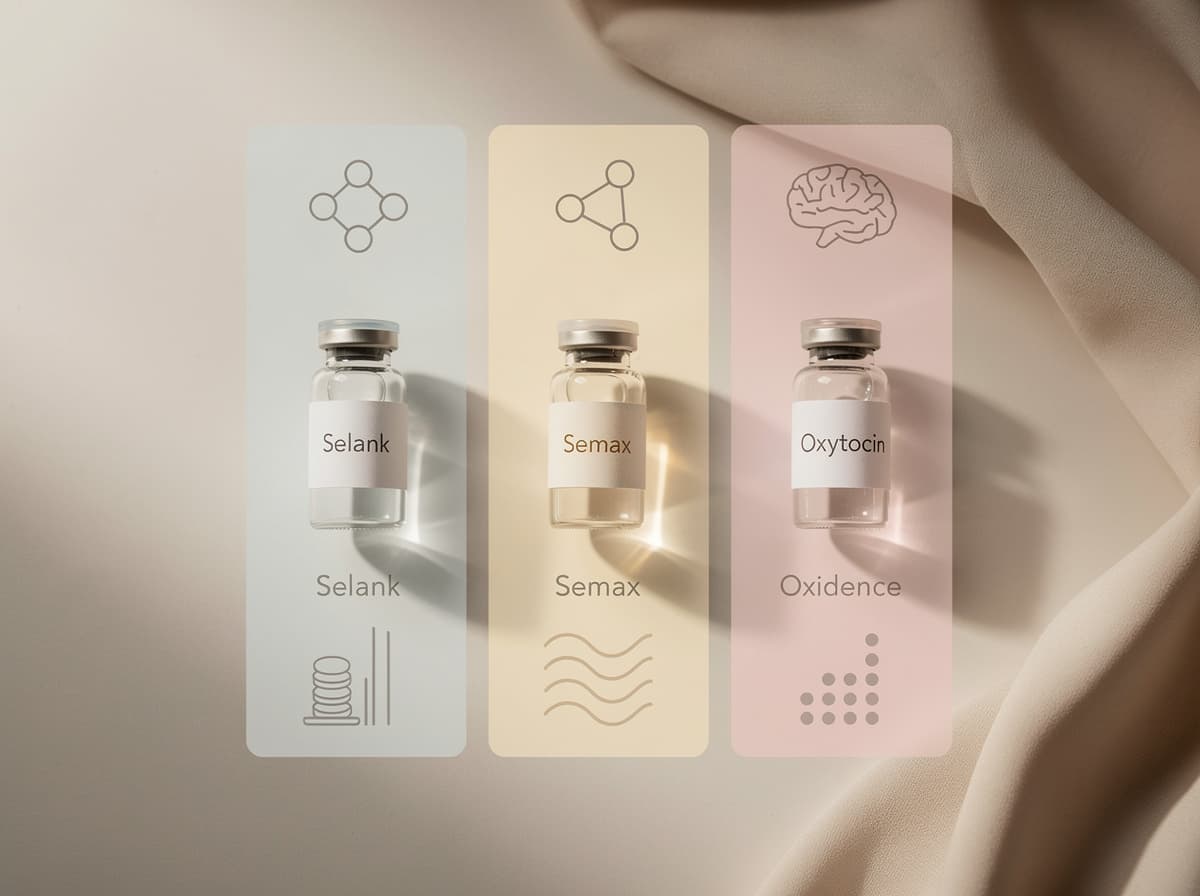
Semax is the ACTH(4-10) analogue developed in the same Russian research program. The two peptides are frequently studied as a pair, and the literature consistently positions them as complementary rather than interchangeable. Selank is a synthetic peptide derived from tuftsin and has been studied primarily in Russia for its potential anxiolytic and stress-reducing effects, reportedly without the sedative properties associated with many conventional anxiolytics. Semax is a synthetic analog of the ACTH(4-10) fragment and has been researched for its potential role in supporting memory, attention, and cognitive function, as well as possible neuroprotective effects. Mechanistically, Selank is known for GABA modulation, while Semax has been shown in some studies to influence neurotrophic factors such as BDNF upregulation and other pathways involved in neuroprotection.
For readers thinking about anxiety specifically, Selank is the more direct candidate. Semax is associated with cognitive activation and may be added when anxiety presents with brain fog or amotivation, not as a standalone anxiolytic.
Oxytocin has a distinct evidence base focused on social anxiety#
Oxytocin sits in a different research lineage. It is studied less as a generalized anxiolytic and more as a modulator of social-threat processing. A 2009 randomized controlled trial tested intranasal oxytocin as an adjunct to exposure therapy. In humans, oxytocin nasal administration reduces social-threat perception and improves processes involved in communication and the encoding of positive social cues; the study administered 24 IU of oxytocin or placebo in combination with exposure therapy to twenty-five participants with primary diagnosis for social anxiety disorder. The result was nuanced. Participants administered with oxytocin showed improved positive evaluations of appearance and speech performance as exposure treatment sessions progressed, but these effects did not generalize to improve overall treatment outcome from exposure therapy.
More recent work has clarified the neural mechanism. A naturalistic fMRI study of 67 healthy men found that oxytocin selectively reduced subjective fear in social contexts but not in non-social contexts; on the neural level oxytocin enhanced left middle cingulate cortex activation and its functional connectivity with the contralateral amygdala, with both neural indices inversely associated with subjective fear following oxytocin.
The honest summary: oxytocin shifts how the brain processes social threat, but converting that signal into a durable clinical anxiolytic effect has been inconsistent across trials.
The honest limitations#
A serious review has to name the gaps. Key limitations include: clinical trials were conducted in Russia with limited sample sizes and have not been independently replicated in Western research settings; most published studies are in Russian-language journals with limited international peer review; long-term safety data beyond 14-day courses is sparse; and placebo-controlled, double-blind methodology is not consistently documented across all studies. A separate review framed the same issue directly: the evidence base for Selank is substantial by the standards of research peptides but skewed in an important way: the overwhelming majority of published studies are Russian-language, conducted at Russian research institutions, and indexed on PubMed only in abstract translation. No Western randomized controlled trials have been completed.
That does not invalidate the signal. It does mean that anyone evaluating peptides for anxiety should weight the mechanism evidence (which is reproducible across cell culture, rodent, and human studies) more heavily than effect-size claims drawn from small, underpowered trials.
Where peptides fit alongside foundational care#
Anxiety responds to sleep, exercise, sunlight, breath work, and exposure-based behavioral interventions. Research suggests that peptide protocols layer on top of those foundations rather than replace them. Selank and oxytocin both appear to amplify the effect of complementary inputs (benzodiazepine pharmacology in Selank's case, exposure therapy in oxytocin's case) rather than work as monotherapy. The combined effect observed when Selank and diazepam were given together to chronically stressed rats is the clearest example of that combinatorial signature, though it has not been tested in humans.
For protocol-literate readers, the practical implication is that dose, timing, and stack design matter as much as compound choice. The Klarovel peptide calculator handles the reconstitution math; the broader question of which compounds fit a given goal is what the engine at /how-it-works is built to answer.
The bottom line#
Peptides for anxiety are not a replacement for psychiatric care, and the field is small enough that overselling the evidence would be a mistake. But the mechanism work on Selank in particular is reproducible, the human signal is real even if the trials are underpowered by Western standards, and the absence of the classical sedation-dependence profile makes the category worth understanding. Readers ready to think through protocol design with primary-source rigor can create a Klarovel account and start there.
Frequently asked questions
Keep reading

The Ozempic Pill: Five Semaglutides, Three Shared Doses
Ozempic tablets, Rybelsus and Wegovy tablets are all semaglutide, and three strengths appear on two different products. Here is which is which.

How Does Zepbound Work, and How Long Until It Does?
Zepbound acts on two receptors, not one. The label gives four different answers to how long it takes to work, depending on which effect you mean.

Ozempic Face: What It Is, and Why It Is Not Ozempic
Facial hollowing after rapid weight loss is real, but it tracks how fast the weight comes off, not semaglutide itself. What the body composition data shows.