
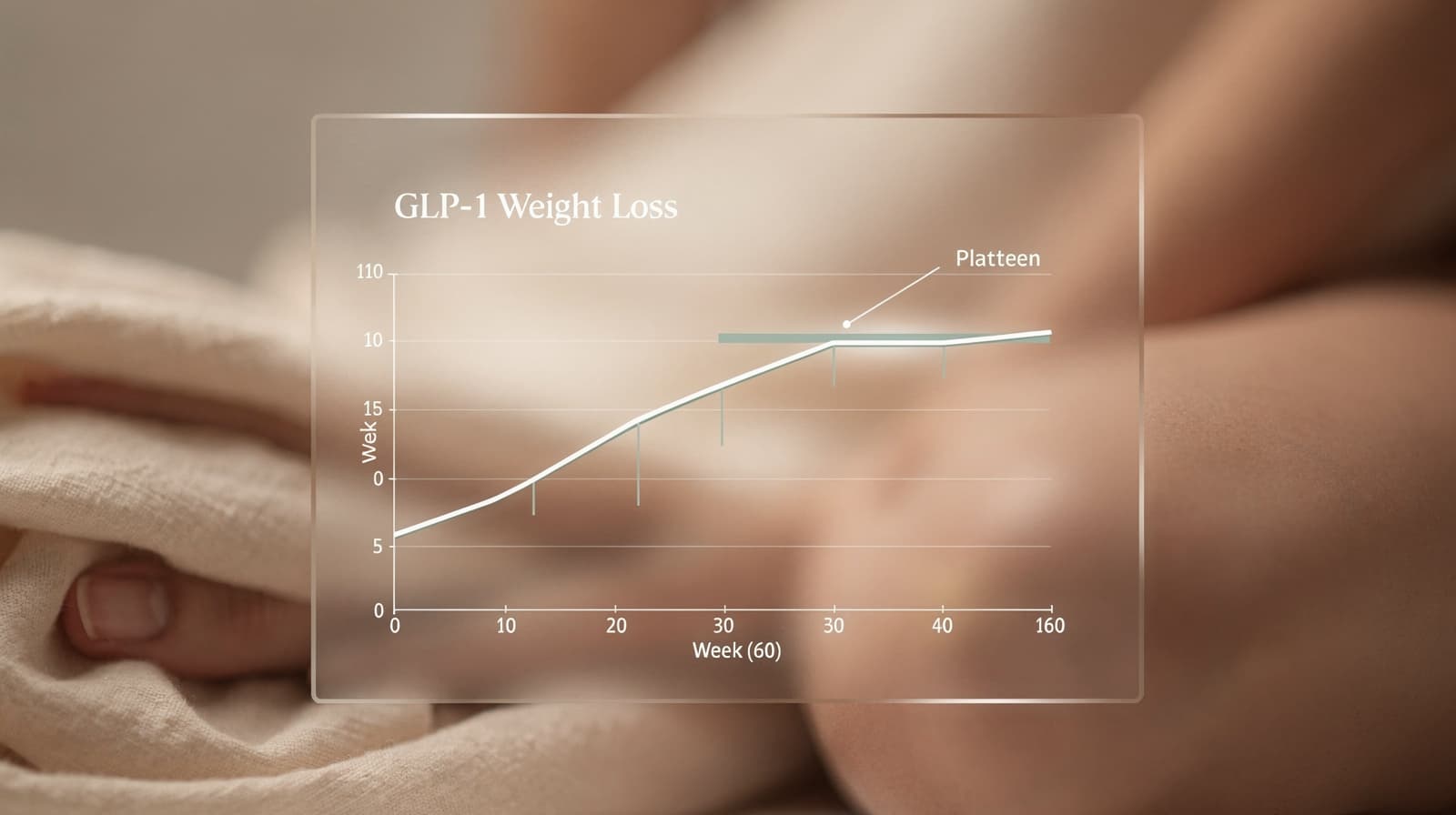
The GLP-1 plateau is the moment a user calls a clinic in frustration. The scale has not moved for three weeks, the appetite suppression feels weaker, and the obvious question follows: has the molecule stopped working? The honest answer is more interesting than yes or no. This article unpacks what the registration trials actually showed, why the plateau is built into the physiology, and which adjustments have evidence behind them.
Key takeaways#
- In the STEP 5 trial, semaglutide 2.4 mg produced weight loss that plateaued around week 60 and stabilised at a mean 15.2% reduction through week 104.
- For tirzepatide in SURMOUNT-1, median time to plateau ranged from 24 to 36 weeks depending on baseline BMI category.
- The plateau reflects a new body weight equilibrium, not pharmacological failure: the appetite-feedback circuit has been shifted, not switched off.
- Discontinuation reverses the effect quickly. In the STEP 1 extension, participants regained roughly two-thirds of their lost weight within one year of stopping.
- Resistance training paired with 1.2-2 g/kg/day protein is the most evidence-backed lever for preserving lean mass during and after the plateau.
The plateau is a feature of the system, not a bug#
Every effective obesity intervention eventually flattens. A 2024 NIH-affiliated modelling paper makes the point directly: every obesity intervention eventually results in a body weight plateau after which no further weight loss occurs. The interesting variable is how long the descent lasts and where it settles. GLP-1 receptor agonists weaken the appetite feedback control circuit, which is why their plateau arrives later and lower than the plateau seen with calorie restriction alone.
The mechanism became sharper in 2026. NIH researchers using two-photon imaging in mouse hindbrain neurons reported that semaglutide drives weight loss through cAMP-dependent signalling in GLP1R-expressing hindbrain neurons. The same group noted that while initial weight loss is substantial, the effect plateaus even with continued treatment, and that the intracellular signal varies neuron by neuron. In plain language: the brain accommodates the drug, and that accommodation has a ceiling.

What the registration trials actually showed#
Numbers anchor expectations. In STEP 5, the two-year semaglutide study, the trajectory was unambiguous: weight loss plateaued after approximately week 60 and was maintained for the remainder of the study, with a mean 15.2% reduction at week 104 versus 2.6% on placebo. STEP 4, the withdrawal-design trial, found that participants who stayed on semaglutide reached a plateau between week 60 and week 68 and ended with a 17.4% reduction over the entire trial.
Tirzepatide tells a related story with different numbers. A post-hoc analysis of SURMOUNT-1 and SURMOUNT-4 reported that across BMI categories (overweight, class I, II, III), median time to weight plateau in SURMOUNT-1 was 24.3, 26.0, 36.1, and 36.1 weeks respectively. Higher starting BMI was associated with a longer descent before plateau. At the 15 mg dose, participants reached a mean 20.9% weight loss by week 72, with a slower but still downward curve in later months.
The plateau definition itself is now codified. SURMOUNT-MAINTAIN, the active maintenance trial, defines plateau as less than 5% body weight change within a 12-week interval following an initial 60-week weight-loss period. That is the threshold to remember: a fortnight of unchanged scale is not a plateau. A flat trimester is.
Why the body resists further loss#
Three forces converge near the plateau point.
Metabolic adaptation. As body mass falls, total daily energy expenditure falls with it. A person who reaches 80 kg by losing 25 kg burns fewer calories than a person who has always weighed 80 kg, because lean mass loss, hormonal shifts, and reduced non-exercise activity compound. Long-term data on hormonal adaptations to weight loss have shown these signals persist for years after the loss event, not weeks.
Receptor dynamics and tachyphylaxis. Continuous GLP-1 receptor stimulation produces some receptor adaptation. The 2026 NIH cAMP-imaging work suggests the intracellular signal can be sustained with PDE4 inhibition in preclinical models, which research suggests is a plausible explanation for why the response attenuates over months.
Caloric set-point recalibration. GLP-1 receptor agonism lowers the body's defended weight, but not to zero. Once the new equilibrium is reached, the appetite suppression that drove the early deficit no longer produces a deficit, because intake and expenditure have re-balanced at the lower mass.
Frontiers in Endocrinology summarised the STEP data succinctly: both weight reduction and improvements in HbA1c, blood pressure and lipid profile reached a plateau after 60 weeks and were sustained with continued use for another year. The cardiometabolic benefits do not plateau and then vanish; they hold.
The lean mass question changes the equation#
A plateau on the scale obscures what is happening underneath. Body composition matters more than total weight at this stage.
A 2026 systematic review and meta-analysis in International Journal of Obesity concluded that while GLP-1 RAs are effective in reducing fat body mass, strategies to preserve or enhance skeletal muscle mass, such as resistance training and adequate protein intake, should be integral to obesity management. A 2025 Frontiers paper put a finer point on the mechanism: resistance training, rather than aerobic exercise, attenuates lean body mass loss during weight-loss diets in adults with overweight or obesity.
The practical numbers from a 6-month prospective cohort of 200 GLP-1 users with structured guidance were striking: participants lost approximately 13% of body weight but only about 3% of muscle mass. Without that guidance, clinical trial averages suggest 25-40% of total weight loss comes from lean mass, a ratio that has been shown to compromise long-term metabolic health.
The consensus protein target across recent reviews sits at protein intakes greater than 1.2 g/kg/day, evenly distributed across meals, combined with aerobic activity and structured resistance training.
How to respond when the plateau hits#
The evidence base supports a small, ordered list of interventions. Stack them in this sequence rather than all at once.
- Verify the plateau definition. Twelve weeks of less than 5% change is a plateau. Three weeks of static weight, especially in the second half of a menstrual cycle or after a high-sodium week, is noise.
- Audit protein and resistance training. This is the single highest-yield change. Aim for 1.2-2 g/kg/day protein and two to three resistance sessions per week. The supra-additive response of GLP-1 plus structured resistance work is the cleanest finding in the recent literature.
- Re-examine caloric intake honestly. Appetite suppression early in treatment masks how much intake had to drop to drive the original deficit. As the suppression normalises, intake creeps. A 7-day weighed log is uncomfortable and informative.
- Discuss dose optimisation with a prescriber. Some users are on a sub-maximal dose. SURMOUNT-1 data showed that even late responders who did not hit 5% loss by week 12 reached clinically meaningful loss by week 25 on average, particularly at higher doses.
- Consider whether the goal has changed. Maintenance of a 15% loss is itself a clinically meaningful outcome. A plateau at that level is the medication holding off the body's regain pressure, which preliminary evidence from withdrawal arms confirms is substantial.

What stopping looks like (and why most regain)#
The discontinuation data settle one debate. The STEP 1 extension followed participants for 52 weeks after withdrawal and found that one year after withdrawal of once-weekly semaglutide 2.4 mg and lifestyle intervention, participants regained two-thirds of their prior weight loss, with similar reversion across cardiometabolic variables. The authors' conclusion was direct: findings confirm the chronicity of obesity and suggest ongoing treatment is required to maintain improvements.
This is the framing that resolves the plateau anxiety. The plateau is the medication doing maintenance work. Stop it, and the equilibrium shifts back. Continue it, and the new lower weight holds. Pair it with resistance training and adequate protein, and the body composition behind the scale number keeps improving even when the total mass does not.
The plateau is the protocol working#
A GLP-1 plateau is not a malfunction. It is the body finding a new equilibrium that the molecule is actively defending. The trial data are clear that the loss flattens, the cardiometabolic gains hold, and discontinuation reverses both. The interventions with real evidence behind them are unglamorous: enough protein, real resistance training, an honest intake audit, and a prescriber conversation about dose. Klarovel curates the protocol layer that sits around these molecules so the plateau becomes a planning question rather than a panic moment. Start by registering for full protocol access, model your dosing in the peptide calculator, or read how the Klarovel model works before the next refill window.
Frequently asked questions
Keep reading
The Ozempic Pill: Five Semaglutides, Three Shared Doses
Ozempic tablets, Rybelsus and Wegovy tablets are all semaglutide, and three strengths appear on two different products. Here is which is which.

How Does Zepbound Work, and How Long Until It Does?
Zepbound acts on two receptors, not one. The label gives four different answers to how long it takes to work, depending on which effect you mean.

Ozempic Face: What It Is, and Why It Is Not Ozempic
Facial hollowing after rapid weight loss is real, but the paper that named it says it is not a semaglutide effect. What the body composition data shows instead.