

The phrase "peptides for focus" gets typed into search bars by people who want a cleaner alternative to a fourth espresso or a stimulant refill. The honest answer is more layered: three peptides dominate the cognitive literature, each targets a different mechanism, and the evidence for attention specifically is thinner than the marketing pages suggest. This article walks through what the primary research on Semax, Selank, and Dihexa actually reports, where the human data ends, and how to think about the risk side of the ledger.
Key takeaways#
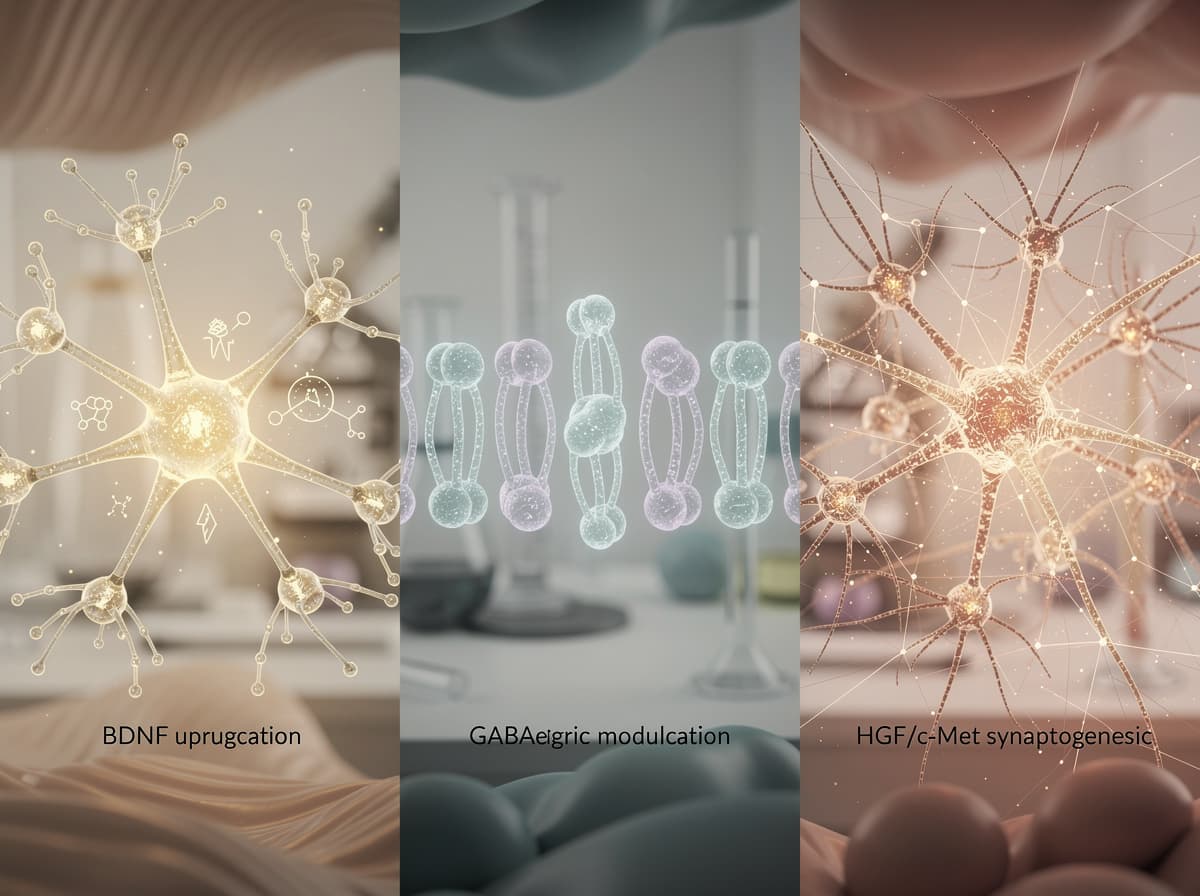
- Semax is a synthetic ACTH(4-10) analog that has been shown to raise hippocampal BDNF and trkB expression in rodents, with human data concentrated in Russian stroke and cognitive-impairment cohorts rather than healthy attention studies.
- Selank is a tuftsin-derived heptapeptide whose focus benefit is largely indirect: research suggests it lowers anxiety through GABAergic modulation, which in turn removes a common brake on sustained attention.
- Dihexa promotes synaptogenesis in preclinical models, through a proposed HGF/c-Met mechanism whose key 2014 paper was retracted in 2025; published human clinical trials do not exist and theoretical oncology concerns remain unresolved.
- None of these peptides are FDA-approved for cognitive enhancement; all sit in a research-grade category with variable regulatory status across jurisdictions.
- The most defensible use case is time-limited, protocol-driven exploration under professional oversight, not open-ended daily stimulation.
Semax targets the attention system through BDNF, not stimulation#
Semax is the peptide most people mean when they say "nootropic peptide." It is a synthetic heptapeptide derived from the N-terminal ACTH(4-10) fragment, originally developed in Soviet-era Russian neuroscience for stroke and cognitive impairment applications.
The mechanistic story is reasonably well characterized. In rat hippocampus, a single 50 μg/kg dose produced a 1.4-fold increase in BDNF protein and a 1.6-fold increase in trkB tyrosine phosphorylation, with the authors concluding that Semax acts on cognitive brain functions by modulating the hippocampal BDNF/trkB system. That is a plasticity mechanism, not a stimulant one, which is why the felt effect is often described as clarity rather than acceleration.
Human data is where the caveats stack up. Russian clinical research has examined Semax nasal drops in stroke recovery, developmental disorders in children, and optic nerve disease. In healthy adults, the best-known study is small: in a double-blind test with 16 male operators, 1 mg of intranasal Semax (about 16 mcg/kg) was followed by more correct responses on an attention and memory task the next morning than placebo, 71% against 41% (Kaplan et al., 1996). A 2018 resting-state fMRI study in 24 healthy volunteers (14 on Semax, 10 on placebo) examined Semax effects on the default mode network, one of the few peer-reviewed English-language datasets in healthy adults. Notably, no randomized controlled trial of Semax in ADHD has been published in an indexed journal, despite a 2006 hypothesis paper proposing exactly that indication.

Selank removes the anxiety brake on sustained attention#
Selank is the second peptide in the Russian nootropic pair. It is a tuftsin-derived heptapeptide (Thr-Lys-Pro-Arg-Pro-Gly-Pro) developed at the Institute of Molecular Genetics of the Russian Academy of Sciences, engineered as an anxiolytic and immunomodulator, and approved in Russia in 2009 for generalized anxiety disorder and neurasthenia.
The focus angle is easy to misread. Selank does not sharpen attention the way a stimulant would. Instead, preliminary evidence suggests it works by lowering the anxiety load that fragments concentration. In rodent anxiety models, Selank reduces anxiety-like behaviour without the sedation typical of benzodiazepines, and its GABAergic action is proposed to occur through allosteric modulation distinct from direct benzodiazepine binding (Kasian et al., 2017). In the 62-patient Russian trial against medazepam, its anxiolytic effect was similar, with added antiasthenic and mild psychostimulant effects (Zozulya et al., 2008).
The cognitive-adjacent data adds a second layer. A 2003 study documented that Selank activated the learning process in rats with initially poor learning ability, with effects apparent after a single dose, and later work extended similar findings to memory in alcohol-intoxicated rodents. The mechanism appears to combine serotonin modulation, GABAergic anxiolysis, and modest BDNF upregulation. For a knowledge worker whose focus problem is really an anxiety problem, this profile is more relevant than a raw stimulant.
The published record still leans heavily on rodent work and small Russian human trials. Larger, controlled attention-endpoint studies in healthy adults are absent.
Dihexa operates on a structural level, not a chemical one#
Dihexa sits in a different category. It is an angiotensin IV derivative that binds hepatocyte growth factor and amplifies signaling through the c-Met receptor. In preclinical characterization by the Harding laboratory, Dihexa acted synergistically with HGF to promote c-Met signaling, including effects on cell motility and proliferation, and studies have shown effects on hippocampal spinogenesis and synaptogenesis. The central paper for that mechanism, Benoist et al. (2014), was retracted in 2025 after a Washington State University investigation found falsified or fabricated data (JPET retraction notice), so the c-Met mechanism should be treated as an open question.
That structural mechanism explains why Dihexa is discussed differently from Semax and Selank. Rather than modulating neurotransmitter tone, it was proposed to potentiate an existing signaling relationship in tissue where HGF is present and c-Met is expressed, which in hippocampal tissue governs synaptogenesis, dendritic arborization, and neural survival under stress.
The problems begin where the marketing pages get loud. Dihexa did not improve cognitive functions in rats with normal cognition; the impressive effect sizes came from aged and Alzheimer-model animals with existing deficits. No studies in humans have been published to date, and no studies in animals or humans have examined long-term safety. The theoretical oncology concern is real: c-Met activation is implicated in tumor biology, and Dihexa has a long half-life. Treating Dihexa as an established focus tool overstates what the research supports.
The mechanism map matters more than the marketing#
The three compounds solve different problems, and picking one because it is the loudest name on a forum is how people waste money and take on avoidable risk.
- Attention that fades with mental fatigue: the mechanistic case is strongest for Semax, where BDNF/trkB upregulation is associated with sustained cognitive performance rather than acute arousal. In the small Kaplan study, healthy operators given 0.25 to 1.0 mg intranasally (about 4 to 16 μg/kg) performed better on attention and memory tasks for up to 20 to 24 hours.
- Focus disrupted by background anxiety: Selank's anxiolytic profile without sedation is the more targeted mechanism. Research suggests the anxiolysis itself is what unlocks concentration.
- Age-related cognitive slippage: Dihexa's synaptogenic mechanism is the theoretical fit, but the absence of human trials means this is a research question, not a protocol.
None of the three should be treated as interchangeable with prescription stimulants, and none has been shown to outperform basic sleep, aerobic conditioning, and structured attention training in head-to-head comparisons because those head-to-head studies have not been run.
Delivery, dosing, and the regulatory picture are all messy#
Semax and Selank are typically administered intranasally in Russian clinical practice, where both are approved medicines. None of the three is FDA-approved in the United States, and none can currently be compounded there. Semax left FDA's Category 2 compounding list in April 2026, and on July 24, 2026 the Pharmacy Compounding Advisory Committee voted 8 to 5 to recommend it for the 503A bulks list; that is advice, not a rule, and no rule has been proposed (FDA, 2026). Selank is not on any US compounding list. In the European Union and Norway, none of the three is registered as a licensed medicinal product; DMP (Norway's medicines agency) and EMA have not issued authorizations. Current status per compound is on the regulatory status tracker.
Dihexa is the outlier on delivery: it is orally active and crosses the blood-brain barrier in rats, which is unusual among peptides. That property is often marketed as an advantage, but it also means systemic exposure is broader and the theoretical c-Met concern is not limited to the CNS.
Klarovel does not sell, source, or stock any of these compounds. The protocol layer, dose modeling, cycle structure, and monitoring cadence is what Klarovel brings to the table. You can model reconstitution and dosing scenarios with the peptide calculator before committing to any protocol.
What responsible protocol design looks like#
The pattern that separates useful exploration from expensive theater is protocol discipline. That means:
- A defined objective, measured with something more rigorous than felt sense. Cognitive tests, reaction-time apps, or structured work-output logs beat vibes.
- A time-limited cycle, typically 10-30 days, with a documented washout. Continuous daily use of BDNF-modulating peptides has not been characterized in long-term human studies.
- A single-variable window. Changing sleep, caffeine, training, and adding a peptide simultaneously guarantees you learn nothing.
- Baseline and endpoint labs where relevant. Semax and Selank have limited peripheral effects in published data; Dihexa is a different risk category and warrants oncology-adjacent screening.
For readers new to this framework, the how-it-works page covers the protocol structure Klarovel uses, and the disclosures page documents the wellness-research positioning explicitly. For deeper mechanism reading, the cognitive peptides guide sits in the same cognitive cluster.
The bottom line for anyone actually considering this#
Peptides for focus are not a shortcut and they are not a scam. They are a small set of compounds with real mechanistic rationale, uneven human evidence, and regulatory status that requires you to do your own diligence. Semax has the deepest cognitive-endpoint literature, Selank has the cleanest anxiolytic mechanism, and Dihexa is the most interesting and least established of the three. The right move is not to pick a favorite from a Reddit thread. It is to define the problem you are actually solving, run a time-limited protocol with measurable endpoints, and treat the whole thing as a hypothesis rather than a fix. If that framework fits how you want to work, create an account and start with the protocol tools rather than the molecules.
Frequently asked questions
Keep reading
The Ozempic Pill: Five Semaglutides, Three Shared Doses
Ozempic tablets, Rybelsus and Wegovy tablets are all semaglutide, and three strengths appear on two different products. Here is which is which.

How Does Zepbound Work, and How Long Until It Does?
Zepbound acts on two receptors, not one. The label gives four different answers to how long it takes to work, depending on which effect you mean.

Ozempic Face: What It Is, and Why It Is Not Ozempic
Facial hollowing after rapid weight loss is real, but it tracks how fast the weight comes off, not semaglutide itself. What the body composition data shows.