

Brain fog used to be a vague complaint. After the pandemic it became a measurable neurological pattern, and the search for compounds that can blunt it has pulled a handful of cognitive peptides into the spotlight. This article walks through what the research actually shows about peptides for brain fog, why post-viral cognitive dysfunction is biologically distinct from ordinary fatigue, and where the evidence is strong, thin, or simply absent.
Key takeaways#
- Long-COVID brain fog is driven by measurable neuroinflammation, blood-brain barrier disruption, and microglial activation, not by perceived laziness or stress alone.
- Long COVID affects at least 10% of those with severe disease, and many experience neurological symptoms and brain fog.
- Semax and Selank are the two cognitive peptides with the most published human data, both originally developed in Russia for stroke and anxiety indications.
- Dihexa shows extraordinary preclinical potency at driving synaptogenesis but has no human trials in post-viral cognitive dysfunction.
- No peptide is approved anywhere for long-COVID brain fog; the strongest pharmacological cases remain mechanistic rather than outcome-based.
Brain fog is a real neuroinflammatory signal, not a vague complaint#
The first useful reframe is biological. Cognitive dysfunction represents one of the most persistent and disabling features of Long COVID, yet its molecular underpinnings remain incompletely understood. Key processes include persistent neuroinflammation, blood-brain barrier disruption, endothelial dysfunction, immune dysregulation, and neuroendocrine imbalance.
Microglial activation and cytokine release (e.g., IL-6, TNF-alpha) promote synaptic dysfunction and neuronal injury, while activation of inflammasomes such as NLRP3 amplifies CNS inflammation.
The clinical picture that follows is consistent across cohorts. This constellation of cognitive symptoms is commonly described by patients as "brain fog" and encompasses memory deficiencies, reduced attention span, slowed information processing, and executive dysfunction. Crucially, the deficits are not gated by infection severity. Notably, these impairments have been reported even in individuals with mild or asymptomatic acute infection and may persist for months.
Imaging data backs the symptom reports. Magnetic resonance images and objective cognitive tests recorded before and after SARS-CoV-2 infection have revealed reduced grey matter in the orbitofrontal cortex and parahippocampal gyrus and reduced global brain size correlated with impaired cognitive performance in those who had been infected. There is a partial recovery curve. In a cohort of 138,818 patients post-COVID-19 and 5,985,227 non-infected controls, one study found that the risk of most (69%) self-reported long-COVID symptoms, including brain fog, became non-significant at 2 years post-infection in non-hospitalized individuals. That is the natural-history baseline against which any intervention has to be judged.
A 2024 JAMA Network Open randomized trial of lithium aspartate for long-COVID cognitive dysfunction is a useful calibration point. In a randomized clinical trial including 52 participants, lithium aspartate, 10 to 15 mg/d, for 3 weeks provided no significant improvements to fatigue or cognitive dysfunction scores. Even more sobering, the NIH-funded RECOVER-NEURO trial reported that "None of our rehabilitation approaches to treatment for cognitive long COVID proved to be effective. Detecting a benefit for one of the interventions was made more difficult because participants in all 5 treatment arms showed modest improvements," the lead author told the RECOVER initiative. The therapeutic field is genuinely open.

Why peptides became a candidate class for cognitive recovery#
Most cognitive peptides under study share a common thread: they target the neurotrophic and neuroinflammatory axes that the long-COVID literature keeps implicating. They are short amino acid sequences, typically delivered intranasally, that have been shown to modulate BDNF, NGF, and microglial signaling in animal models. None of them is a stimulant in the classical sense.
The mechanistic logic is straightforward. If brain fog is downstream of microglial overactivation and reduced synaptic plasticity, then compounds that dampen neuroinflammation while supporting brain-derived neurotrophic factor signaling are at least biologically plausible candidates. That is a hypothesis, not a clinical guarantee, and the gap between preclinical mechanism and verified human outcomes is the most important thing for readers to keep in view.
Semax: the most clinically studied cognitive peptide#
Semax is a synthetic ACTH(4-10) analog originally developed at the Russian Academy of Sciences. Semax is used in Russia for stroke, dyscirculatory encephalopathy, Parkinson's, ocular nerve atrophy, and for newborns with neurological deficits. That regulatory history is unusual: most "research peptides" lack any approved indication anywhere.
The mechanistic file is reasonably mature. Research suggests Semax upregulates BDNF and NGF and modulates dopaminergic and serotonergic tone. The peptide Semax, which exhibits neuroprotective and nootropic properties, is a long-acting memory enhancer. In a 2025 transgenic Alzheimer model, intranasal administration of Semax or its derivative Heptapeptide improves the cognitive function in the mouse model of Alzheimer's disease. Both Semax and Heptapeptide significantly reduce the amyloid load in the animal brain. The full paper is available through PubMed Central.
Human data, while limited in English-language journals, is not absent. One trial in fatigued shift workers reported a single intranasal administration of the peptide at a dosage of 16 mcg/kg of body weight, the effects lasted for 24 hours. Participants who received Semax demonstrated a 71% accuracy rate on a memory test, in stark contrast to the average 41% rate observed in the control group. The honest caveats: most clinical trials were conducted within the Russian healthcare system and published in Russian journals such as Zhurnal Nevrologii i Psikhiatrii. This limits Western access and independent evaluation. The research quality varies: some studies meet international standards with proper controls and blinding, while others lack the methodological rigor expected by FDA or EMA.
No published trial has tested Semax specifically against long-COVID brain fog. The translation from "fatigued shift workers" or "post-stroke cognitive deficit" to "post-viral cognitive dysfunction" is a reasonable mechanistic bet, not a verified outcome.
Selank: the anxiolytic with a neuroinflammation profile#
Selank is a heptapeptide derived from the immunoglobulin G fragment tuftsin, with a C-terminal Pro-Gly-Pro extension that extends its half-life. The interesting feature for brain fog discussions is its dual profile: anxiolytic plus immunomodulatory.
Selank is a synthetic analog of taftsin extended with a C-terminal Pro-Gly-Pro tripeptide to increase metabolic stability and duration of action. Selank has a pronounced anxiolytic and nootropic effect and is highly effective in the treatment of anxiety and anxiety-asthenic disorders, leading to activation and optimization of cognitive brain function, learning processes, and memory. Along with these functions, Selank also has pronounced immunotropic activity and is able to induce the secretion of interferons.
The cytokine angle is what makes it a candidate worth discussing in the brain-fog context. Research has shown that Selank reduces pro-inflammatory cytokines (IL-6, TNF-alpha, IL-1-beta) under stress conditions, the same cytokine families implicated in long-COVID neuroinflammation. A 2019 study in Bulletin of Experimental Biology and Medicine found that in the object recognition test, Selank produced a cognitive-stimulating effect in 9-month rats not exposed to ethanol and prevented the formation of ethanol-induced memory and attention disturbances developing during alcohol withdrawal. In ex vivo experiments, Selank prevented ethanol-induced increase in BDNF content in the hippocampus and frontal cortex.
Selank and Semax are often discussed as complementary. They hit different receptor systems and are commonly paired in protocols: Semax skews cognition-forward, Selank skews calm-forward. Preliminary evidence suggests amplified effects when used together, but no controlled trial has formally tested the combination against placebo for post-viral cognitive symptoms.
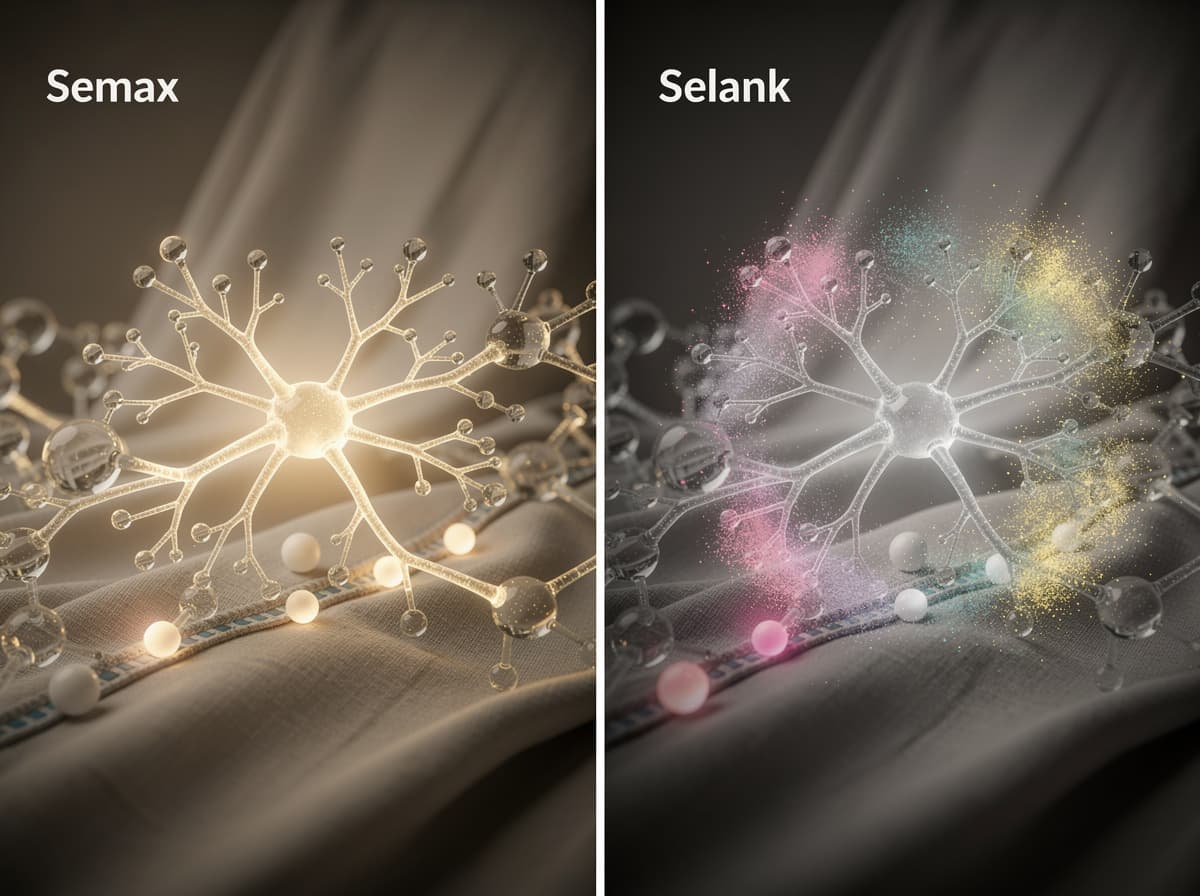
Dihexa: extraordinary potency, almost no human data#
Dihexa is the wildcard. It is a synthetic hexapeptide derived from angiotensin IV, developed at Washington State University. In preclinical models, it has demonstrated extraordinary potency at driving synaptogenesis and hippocampal connectivity, reportedly 7 orders of magnitude (10 million times) more potent than BDNF itself in hippocampal organotypic slice assays, making it one of the most powerful pro-cognitive compounds studied to date.
The mechanism is structurally distinct. Unlike Semax, which acts primarily through BDNF upregulation and dopaminergic enhancement, Dihexa works by potentiating the HGF/c-Met signaling axis (hepatocyte growth factor and its receptor), which drives dendritic spine formation and synaptogenesis independent of BDNF.
The problem is that nearly all of the evidence is preclinical. There are no published randomized trials in humans, and certainly none in long-COVID populations. The same potency that makes it interesting is also a reason for caution: a compound that aggressively drives synaptogenesis and activates growth-factor pathways has unresolved questions around oncogenic risk and maladaptive wiring that simply have not been answered yet. For a post-viral cognitive recovery scenario, this is at the speculative frontier rather than the practical toolkit.
What a careful approach to peptides for brain fog looks like#
A few principles fall out of the literature.
First, do not skip the workup. Brain fog symptoms overlap with thyroid dysfunction, anemia, sleep apnea, depression, and ME/CFS. Studies have shown the importance of comprehensive assessment before any cognitive intervention. Any peptide protocol stacked on top of an undiagnosed thyroid issue or untreated sleep apnea is fighting the wrong battle.
Second, weight the time-course expectations correctly. Memory consolidation and executive function improvements are more cumulative; most users report peak benefit at 7 to 14 days of consistent use. Clinical trials measured primary cognitive outcomes at Day 28. If a user expects a stimulant-like rush from a peptide that works through neurotrophic adaptation, they will draw the wrong conclusion at day three.
Third, plan around the natural recovery curve. The two-year improvement signal in non-hospitalized long-COVID cohorts means that any uncontrolled n-of-1 trial will tend to attribute spontaneous recovery to whatever the user happened to be taking. Track baselines. Use the same cognitive task each week. The Klarovel peptide calculator and the protocol templates in how it works are built around exactly this kind of structured tracking.
Fourth, and most importantly, be honest about the evidence ceiling. The most rigorous public synthesis to date, the RECOVER-NEURO arm summarised by the NIH RECOVER initiative, shows that even well-funded behavioural and device interventions struggled to outperform comparison arms. The peptide evidence base for long-COVID brain fog specifically is preliminary. Anyone marketing peptides as a verified solution is overselling.
The honest position on peptides and brain fog#
The biology lines up. Post-viral brain fog is a neuroinflammatory and neurotrophic problem, and cognitive peptides act on neuroinflammatory and neurotrophic pathways. That makes the category worth taking seriously. It does not make any individual peptide a verified answer for long-COVID cognitive dysfunction. Semax has the deepest clinical file, Selank has the most relevant cytokine profile, and Dihexa has the most striking preclinical numbers and the thinnest human evidence. Klarovel's role is to keep that distinction clear, build protocols on top of proper baselines, and refuse to oversell what the data does not yet support. If that posture matches how a reader wants to approach their own cognitive recovery, the next step is to register for an intake and start with the baseline workup rather than the peptide.
Frequently asked questions
Keep reading
The Ozempic Pill: Five Semaglutides, Three Shared Doses
Ozempic tablets, Rybelsus and Wegovy tablets are all semaglutide, and three strengths appear on two different products. Here is which is which.
How Does Zepbound Work, and How Long Until It Does?
Zepbound acts on two receptors, not one. The label gives four different answers to how long it takes to work, depending on which effect you mean.

Ozempic Face: What It Is, and Why It Is Not Ozempic
Facial hollowing after rapid weight loss is real, but the paper that named it says it is not a semaglutide effect. What the body composition data shows instead.