

Few molecules in male hormone research generate more confusion than human chorionic gonadotropin. It sits at the intersection of fertility clinics, testosterone replacement protocols, and bodybuilding folklore, and the signal-to-noise ratio reflects that. This guide walks through what the peer-reviewed literature actually says about hCG in men: what it does at the receptor level, why clinicians add it to testosterone replacement, what the dose-response data look like, and where the real safety questions live.
Key takeaways#
- hCG binds the same testicular LH receptor that pituitary luteinizing hormone uses, which is why it can stimulate Leydig cells to make intratesticular testosterone even when the brain has stopped signalling.
- Exogenous testosterone suppresses intratesticular testosterone, and azoospermia has been reported in about 40% of men on testosterone replacement; hCG is the only fertility-sparing option in this class that is FDA-approved for use in men.
- In healthy men on weekly testosterone enanthate, 500 IU hCG every other day for three weeks left intratesticular testosterone 26% above baseline and 250 IU left it 7% below, against a 94% fall with placebo.
- A randomised comparison in 282 hypogonadal men found 5,000 IU of hCG twice weekly produced testosterone responses similar to 50 mg clomiphene daily.
- Since March 23, 2020 the FDA regulates hCG as a biologic, so it cannot be compounded under 503A or 503B; legitimate US supply is an FDA-licensed product on prescription.
- The most consistent dose-dependent side effect is elevated estradiol from aromatisation, which can drive gynecomastia at higher doses.
How hCG actually works in the testis#
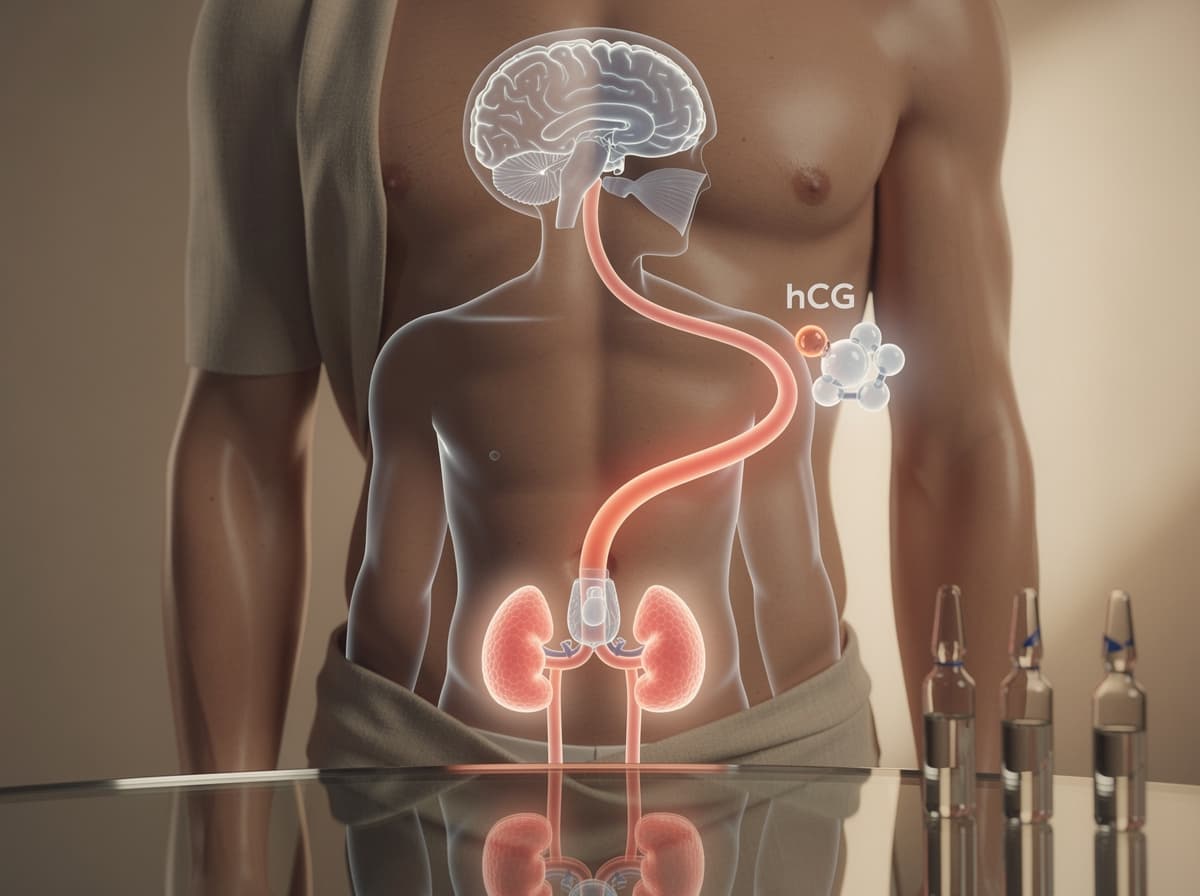
hCG is a glycoprotein hormone built from an alpha and a beta subunit. hCG is a hormone comprising of an α and a β-subunit, and hCG and LH share an identical α-subunit. The shared structure is the entire pharmacological story: because hCG looks enough like luteinizing hormone at the receptor, it binds the LH receptor on Leydig cells and triggers the same steroidogenic cascade. Luteinizing hormone acts on the Leydig cells, stimulating steroid production.
That receptor crosstalk matters because spermatogenesis is not driven by serum testosterone. It is driven by intratesticular testosterone (ITT), a local concentration that in healthy men runs roughly 80 times higher than serum testosterone (baseline serum testosterone was 1.2% of ITT in Coviello et al., JCEM 2005). High intratesticular testosterone levels, usually higher than serum testosterone levels, seem to be necessary for healthy spermatogenesis in men. When a man injects exogenous testosterone, his pituitary stops sending LH, the Leydig cells go quiet, and ITT collapses even though serum testosterone looks fine on labs. Exogenous testosterone suppresses intratesticular testosterone production, which is an absolute prerequisite for normal spermatogenesis, and cessation of exogenous testosterone should be recommended for men desiring to maintain their fertility.
hCG is how clinicians keep the Leydig cells working when the upstream signal has been silenced.
Why TRT alone breaks fertility and what hCG does about it#
The fertility cost of testosterone replacement is not theoretical. Testosterone replacement therapy results in decreased serum gonadotropins and intratesticular testosterone, and impairs spermatogenesis, leading to azoospermia in 40% of patients. The American Urological Association guideline states that exogenous testosterone should not be prescribed to men who are currently trying to conceive (strong recommendation), and that clinicians may use aromatase inhibitors, hCG, SERMs or a combination in testosterone-deficient men who want to maintain fertility (conditional recommendation). Of those agents, the guideline notes, only hCG is FDA-approved for use in men.
The mechanism for this rescue is straightforward. hCG acts as an LH analogue, binding the same receptors and stimulating local testosterone production inside the testis. hCG is similar in structure to luteinising hormone, which is a hormone produced by the pituitary gland that stimulates the production of testosterone in the testes, and hCG acts as a LH analogue, binding to the same receptors in the testes and stimulating the production of testosterone.
In a randomised study of 29 healthy men given 200 mg testosterone enanthate weekly, adding hCG every other day for three weeks kept intratesticular testosterone near baseline in a dose-dependent way, while placebo let it fall by 94% (Coviello et al., JCEM 2005). In a Baylor retrospective series of 26 hypogonadal men on TRT plus 500 IU hCG every other day, no man became azoospermic, semen parameters held steady, and nine contributed to a pregnancy during follow-up; the authors concluded the combination may preserve fertility in men who want it while on TRT.
For men who already arrived at the fertility clinic with azoospermia from prior testosterone use, the rescue pathway is more aggressive. One retrospective series of 49 men used 3,000 IU of hCG subcutaneously every other day combined with clomiphene, tamoxifen, anastrozole, or recombinant FSH depending on the case, and documented return of spermatogenesis or improved counts in 47 of them, after an average of 4.6 months.
What the dose-response data actually show#
Most dosing arguments online happen because people skip the intratesticular testosterone data. The numbers are unusually clean. In the University of Washington study, ITT ended 25% below baseline with 125 IU every other day, 7% below with 250 IU and 26% above with 500 IU, after three weeks of testosterone suppression (Coviello et al., JCEM 2005; small groups, and none of the hCG arms differed significantly from baseline). The separate Baylor series showed that 500 IU every other day maintained semen parameters in men on testosterone, with nine of 26 men contributing to a pregnancy.
Translated into practical research protocols:
-
Testicular size preservation only (no fertility goal): 250 to 500 IU every other day (roughly 875 to 1,750 IU a week) is the range in which ITT stayed near baseline in the Coviello study.
-
Active fertility protocol on TRT: 500 IU every other day is the most consistently cited dose in published series.
-
Monotherapy for symptoms with normal testosterone (no TRT): a retrospective series used varying doses of HCG (range: 1000–3000 international units, twice a week) with a mean dose of roughly 1,529 IU. The FDA label regimens for hypogonadotropic hypogonadism are higher: 500 to 1,000 units three times a week, or 4,000 units three times a week for six to nine months.
-
Post-TRT axis restart: higher pulsed doses, typically dropped before transitioning to a SERM.
The 5,000 IU twice-weekly comparison against clomiphene is instructive for a different reason (Habous et al., BJU Int 2018). Patients were randomly assigned to one of three groups: 50 mg of CC, 5000 IU of HCG two times per week, or a combination, for 3 months, and the abstract reports mean testosterone rising from 2.31 to 5.17 nmol/L (about 67 to 149 ng/dL, which it calls a 223% increase), with no significant difference between the groups. The trial did not compare hCG doses, so it says nothing about a ceiling. What it shows is that a high hCG dose was no better than an oral SERM at raising testosterone over three months.
hCG as monotherapy: the "normal testosterone but symptomatic" question#
One of the more interesting recent lines of research is hCG used alone in men who feel hypogonadal but whose serum testosterone is technically above the 300 ng/dL TRT threshold. A 2022 retrospective chart review from the University of Miami (Zucker et al., Cureus 2022) included 31 men, aged 25 to 79, experiencing hypogonadal symptoms with average testosterone levels above 300 ng/dL, who received varying doses of HCG, range 1000 to 3000 IU twice a week.
The symptom data were striking. When evaluated for improvement of ED and low libido, 86% (19/22) and 80% (20/25) of patients reported improvement of each symptom, respectively. Equally important was what did not change: there was no significant change in serum T, FSH, PSA, HCT, estradiol, A1c or LH across the follow-up window. No thromboembolic events or hCG side effects, including headache, gynecomastia, and gastrointestinal issues, were observed.
This is a small, single-centre, uncontrolled chart review, every man with erectile dysfunction was also on a separate ED treatment, and serum testosterone did not change, so it should not be read as a green light. It is, however, preliminary evidence that the LH signal itself, independent of the serum testosterone number, may matter for some men.
Side effects, real and overstated#
The side effect profile of hCG is dominated by one mechanism: aromatisation. Stimulating the Leydig cells produces testosterone, and a fraction of that testosterone is converted to estradiol by aromatase. HCG mimics LH to stimulate testicular testosterone production; the resulting increase in aromatisation raises oestradiol levels.
That single pathway explains most of what shows up in the published adverse event lists:
-
Gynecomastia. This is the side effect most consistently associated with hCG in men, and it is dose-dependent. Gynaecomastia is a recognised adverse reaction to HCG, caused by elevated oestradiol stimulating oestrogen receptors in male breast tissue, leading to glandular proliferation.
-
Mood and emotional lability. Reported in some series, attributed to shifting estradiol-to-testosterone ratios.
-
Injection site reactions. Pain, redness, and local swelling are the most common patient-reported issues.
-
Thromboembolism. The FDA label lists arterial thromboembolism among the principal serious reactions when hCG is used with menotropins in infertility treatment. It is not an established signal in men on low-dose protocols, but clotting history still belongs in pre-treatment screening.
A second category is worth flagging because the marketing world will not. The FDA label lists prostatic carcinoma and other androgen-dependent neoplasms as contraindications, since the testosterone rise hCG generates is androgen-receptor active. Anyone with a PSA trend that needs investigation should resolve that before considering an hCG protocol.
Where hCG sits versus clomiphene and enclomiphene#
The most common alternative to hCG in hypogonadism is a selective estrogen receptor modulator like clomiphene citrate or its purified isomer enclomiphene. Mechanistically these sit one step upstream of hCG: instead of mimicking LH at the testis, SERMs block estrogen feedback at the hypothalamus and pituitary, so the brain releases more of its own LH and FSH. Kisspeptin sits higher still, on the GnRH neurons themselves, which is the axis map laid out in peptides for testosterone.
The trade-offs are well documented. Clomiphene is oral, cheaper, and easier to obtain in most jurisdictions. Off-label use of SERMs, such as clomiphene citrate, are effective for maintaining testosterone production long-term and offer the convenience of representing a safe, oral therapy. hCG works regardless of whether the pituitary is functional, which is why it, usually with FSH when sperm production is the goal, is the standard fertility option in hypogonadotropic hypogonadism where the upstream signal is genuinely missing; SERMs need a pituitary that can respond. HCG can be very effective, with no side effects on fertility, and safe for patients with secondary hypogonadism, however, HCG can be expensive or not easily available depending on the country.
A regulatory note that changes the supply question: on March 23, 2020 approved hCG products were deemed biologics licenses, and biologics are not eligible for the 503A and 503B compounding exemptions (FDA). The lawful US source is an FDA-licensed hCG product on prescription; hCG sold as a research chemical is an unapproved biologic. Klarovel does not stock or sell peptides. For dose math, the peptide calculator converts the IU labelling on hCG vials to volume per click, which is where most research protocol errors happen.
How Klarovel approaches hCG protocols#
hCG sits in an unusual category. It has decades of peer-reviewed data, a clear mechanism, and a defined place in mainstream urology guidelines, yet most of the consumer-facing content about it is either bodybuilding lore or weight-loss marketing. The protocol design questions, dose, frequency, monitoring cadence, when to add a SERM or aromatase inhibitor, are exactly where most men get the worst advice.
Klarovel does not sell peptides or anything else. We curate the protocol layer, the lab interpretation framework, and the comparison logic between hCG, SERMs, and TRT. Read how it works for the full model, or skim our disclosures for the boring legal version.
The bottom line on hCG for men#
hCG is one of the better-characterised molecules in male hormone research. It does one thing, it does it through one receptor, and the dose-response curve is unusually well documented. The questions worth spending time on are not whether it works, but at what dose, for which goal, and with what monitoring. For how it compares with the other compounds in this area, see Klarovel's pillar on peptides for sexual health. Build that protocol on primary data, not on the loudest voice in a forum.
Create a free Klarovel account to access the full protocol library, lab interpretation tools, and the peptide calculator that does the IU-to-volume math correctly the first time.
Frequently asked questions
Keep reading

Kisspeptin Peptide: What Human Trials Show About HPG Axis
Kisspeptin peptide switches on the brain's reproductive axis. See what human trials actually show about LH timing, testosterone, and dosing limits.

LL-37 Peptide: Evidence, Risks, and Unanswered Questions
LL-37 peptide kills bacteria by rupturing membranes, but human evidence stops at topical ulcer trials and one gene-therapy study, not injections.

Wegovy Pill: How It Works, How to Take It, and Results
The Wegovy pill is semaglutide 25 mg taken daily, FDA-approved for weight loss in December 2025. How to take it, how well it works, and how it compares.