

TB-500 is a synthetic 7-amino-acid fragment of thymosin beta-4 (TB4), the actin-binding sequence LKKTETQ, and has become the companion peptide to BPC-157 in most tissue-repair conversations. It is not FDA-approved, and there are no published human studies of TB-500 itself; the human trials in this space tested full-length thymosin beta-4. In July 2026 an FDA advisory committee voted 8 to 6 to recommend TB-500 for the 503A compounding list, but no rule has followed. Where BPC-157 acts primarily through angiogenesis and fibroblast mobilisation, TB-500 works through a different pathway, actin binding, cell migration, and broad anti-inflammatory modulation. The two peptides are often stacked because their mechanisms are complementary, not redundant.
What TB-500 is#
TB-500 is a synthetic peptide corresponding to a 7-amino-acid fragment of native thymosin beta-4 (TB4): Leu-Lys-Lys-Thr-Glu-Thr-Gln (LKKTETQ), residues 17 to 23, the core of TB4's actin-binding domain. The FDA lists it as "thymosin beta-4, fragment (LKKTETQ), also known as TB-500" (FDA). TB4 itself is a naturally-occurring 43-amino-acid peptide found abundantly in platelets, wound fluid, and many other tissues. It plays roles in actin sequestration, wound healing, and cellular migration across multiple tissue types.
The shorter fragment is far easier to synthesize than the 43-amino-acid parent. The case that it keeps the parent's repair activity rests mainly on mouse work: a synthetic peptide containing the actin-binding domain promoted dermal wound repair in diabetic and aged mice (Philp et al., 2003). For practical purposes TB-500 and "thymosin beta-4 fragment" refer to the same research compound, though products sold under the TB-500 name are not always the fragment.
TB-500 is administered subcutaneously or intramuscularly. Unlike BPC-157, which shows site-specific effects favouring injection near injury, TB-500's pharmacology appears more systemically uniform, any subcutaneous injection site distributes broadly through tissues.
The mechanism: actin binding and cell migration#
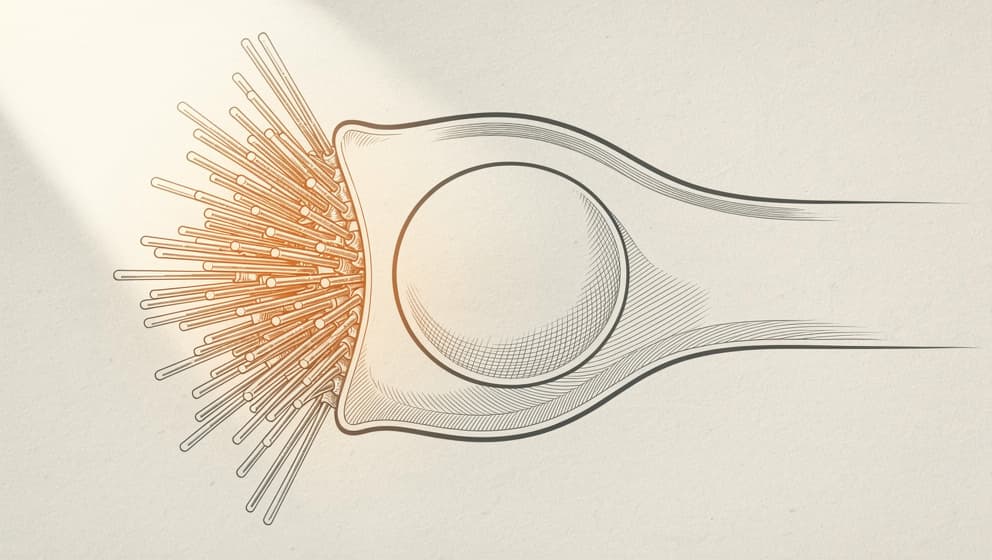
TB-500's primary mechanism is actin sequestration. Actin is the cytoskeletal protein that gives cells their shape and powers their movement. TB-500 binds to monomeric G-actin, regulating the dynamic balance between G-actin and filamentous F-actin that cells need to migrate, divide, and remodel.
Studies have shown the downstream effects across multiple preclinical models:
- Cell migration: immune cells, fibroblasts, and stem cells move more readily to injury sites
- Angiogenesis: endothelial cell migration supports new blood vessel formation, complementing BPC-157's VEGFR2-driven angiogenesis
- Myocyte regeneration: in preclinical cardiac models, including Smart et al. (Nature, 2007), full-length thymosin beta-4 has been shown to mobilize epicardial progenitor cells and support recovery after ischaemic injury
- Anti-inflammatory modulation: reduces pro-inflammatory cytokine expression, particularly in cardiac and muscle tissue
- Collagen remodelling: supports orderly collagen deposition in healing tissue rather than disorganised scar formation
The mechanism is broader than BPC-157's. BPC-157 targets fibroblast migration and vascular sprouting specifically. TB-500 affects almost every cell type that migrates.
Preclinical evidence#

The preclinical literature on native TB4 is substantial; studies of the TB-500 fragment itself are few:
- Cardiac tissue repair: multiple studies show improved cardiac function after myocardial infarction in animal models
- Wound healing: accelerated re-epithelialisation and reduced scarring in dermal wound models
- Muscle recovery: faster functional and structural recovery in muscle trauma models
- Tendon and ligament: improved tensile strength and cellular infiltration in healing connective tissue
- Neurological protection: preliminary evidence for reduced stroke damage in rodent models
The breadth of the preclinical work on the parent protein is comparable to BPC-157's. What's missing is the same thing that's missing for BPC-157: large-scale human outcome trials.
Human clinical evidence#
There is human trial data in this space, and the useful question is not whether it exists but what it was run on. PubMed indexes eight clinical trials under thymosin beta-4. Every one of them tested the full 43-amino-acid parent peptide, not the 7-amino-acid fragment sold as TB-500.
| Study | Molecule | Design | n | Route and dose | Indication | Outcome | TB-500? |
|---|---|---|---|---|---|---|---|
| Wang 2021 | Recombinant human Tβ4 (NL005) | Phase I, first-in-human, randomised, double-blind | 54 healthy | Intravenous, single and multiple dose, 7 cohorts | Safety, PK, anti-drug antibody | Safety and pharmacokinetics characterised | No |
| Ruff 2010 | Synthetic Tβ4 | Randomised, placebo-controlled, single and multiple dose | 40 healthy | Intravenous, 42 / 140 / 420 / 1260 mg, then daily for 14 days | Safety and PK, with a view to myocardial infarction | Tolerated across the dose range | No |
| Sosne 2015 | Tβ4 as RGN-259, 0.1% | Phase 2, randomised, double-masked, placebo-controlled | 9 | Topical ocular, 6 times daily for 28 days | Severe dry eye | 35.1% less ocular discomfort than vehicle at day 56 | No |
| Guarnera 2007 | Tβ4 | Double-blind, placebo-controlled, dose-escalation | 24 per group, 3 groups | Topical, 10 sites across Italy and Poland | Venous ulcers | Design report; trial ongoing at publication | No |
| Guarnera 2010 | Tβ4, "a synthetic copy of the naturally occurring 43 amino-acid peptide" | Phase 2, double-blind, placebo-controlled, dose-escalation, 8 European sites | 73 | Topical | Venous ulcers | Safety comparable to placebo; 0.03% dose may accelerate healing | No |
| Zhu 2016 | Tβ4 used to pre-treat cells, not administered | Randomised pilot | 10 | Cell transplantation | Acute STEMI | Progenitor-cell survival | No |
Three things follow, and the third is the one that changes a protocol decision.
The human column is "no" in every row. Not because the research is missing, but because it was done on a different molecule. TB-500 is the fragment; the trials used the parent.
The routes do not match either. The human work is intravenous and topical. TB-500 research protocols are subcutaneous. A dry-eye drop and a 14-day intravenous infusion tell you very little about a weekly subcutaneous injection.
Neither do the doses. Ruff's cohorts received 42 to 1260 mg intravenously. TB-500 protocols run 2 to 2.5 mg subcutaneously, which is roughly 17 to 630 times lower, of a different molecule, by a route with different bioavailability. Where a number in the human literature looks reassuring, check which molecule, which route and which order of magnitude produced it before carrying it across.
Dosing and administration#

Research-use TB-500 protocols converge on a loading-plus-maintenance structure:
- Loading phase: 2–2.5 mg twice weekly for 4–6 weeks (4–5 mg per week)
- Maintenance phase: 2–2.5 mg once weekly, or every 2 weeks
- Route: subcutaneous injection, any site
- Typical cycle: 8–12 weeks total for acute injury recovery
Dosing is in mg, not mcg, TB-500 is used in larger amounts than BPC-157. Reconstitution math: a 5 mg TB-500 vial reconstituted with 2 mL of bacteriostatic water gives 2.5 mg/mL. A 2 mg dose equals 0.8 mL = 80 syringe units. A 2.5 mg dose equals exactly 1 mL = 100 units. The Klarovel peptide calculator handles any vial size.
Because TB-500 is weekly rather than daily, the vial count stays low, but the loading phase consumes twice what maintenance does. At 2.5 mg twice weekly a single 5 mg vial covers one week of loading; on once-weekly maintenance the same vial covers two. A 12-week cycle of six weeks loading plus six of maintenance works out at 45 mg, or about nine 5 mg vials.
Side effects and safety#
The TB-500 safety profile in preclinical data and research-use experience is benign:
- Injection-site irritation (minor, transient)
- Brief lethargy or fatigue in the 24 hours after dosing
- Occasional mild headache
- No drug interactions of clinical significance have been characterised
There is no published human study of TB-500 itself. In the trials of full-length thymosin beta-4 listed above, no serious adverse events were reported, but those used a different molecule, route and dose.
Regulatory status#
TB-500 is not approved as a medicine in the United States, the European Union, or Norway.
- United States. The FDA placed the fragment in Category 2 (substances that may present significant safety risks in compounding) in 2023 and removed it on April 22, 2026, after the nomination was withdrawn. On July 23, 2026 the Pharmacy Compounding Advisory Committee voted 8 to 6, with one abstention, to recommend TB-500 for the 503A bulk drug substances list for wound healing, against the FDA review team's recommendation; members who voted no cited limited efficacy data and tumour-progression questions (FDA). That is advice, not a rule, so a 503A pharmacy still cannot compound it. Klarovel's regulatory status page carries the current position.
- Sport. The WADA Prohibited List names "thymosin-β4 and its derivatives, e.g. TB-500" under S2 (growth factors), prohibited at all times (WADA).
- Norway. DMP has not authorised TB-500 for any indication, and TB-500 has been on the Norwegian doping list since September 15, 2026, which makes acquiring, possessing or using it without lawful authority unlawful (Lovdata).
Klarovel does not sell, source, or fulfil peptides.
TB-500 vs BPC-157#
The two peptides are often conflated, but their mechanisms are distinct:
| BPC-157 | TB-500 | |
|---|---|---|
| Amino acids | 15 | 7 (fragment of 43 aa parent) |
| Primary mechanism | VEGFR2, Akt-eNOS, fibroblast migration | Actin binding, cell migration |
| Best preclinical evidence for | Tendon, ligament, GI mucosa | Cardiac, skin wounds, muscle, stroke (mostly full-length TB4) |
| Dose magnitude | Hundreds of mcg daily | Milligrams weekly |
| Injection proximity | Prefer near injury | Any site |
| Typical cycle length | 4–8 weeks daily | 8–12 weeks weekly |
The reason protocols often stack them is that their mechanisms are complementary. BPC-157 promotes local angiogenesis and fibroblast recruitment; TB-500 supports broader cell migration and tissue remodelling. For the stack discussion, see BPC-157 + TB-500 stack. For the individual comparison, see BPC-157 vs TB-500.
Direct comparisons: TB-500 vs ghk-cu, TB-500 vs thymosin Beta-4.
Practical summary#
TB-500 is a systemic tissue-repair peptide with strong preclinical breadth and limited human clinical evidence. Its actin-binding mechanism complements BPC-157 rather than duplicating it. Research-use protocols typically run a 4–6 week loading phase at 2–2.5 mg twice weekly, followed by reduced-frequency maintenance.
For anyone considering TB-500:
- Klarovel's questionnaire handles the screening
- The peptide calculator handles the reconstitution math, and the BPC-157 and TB-500 calculator does it per component if you are running the pair
- The titration calculator builds week-by-week schedules
- The reconstitution guide covers the mechanics
TB-500's case is not weaker than BPC-157's. It's just different: broader mechanism, more systemic, less site-specific. That makes it a useful peptide to have in the research-protocol toolkit, not a drop-in substitute. For how it sits next to the other tissue-repair compounds, the peptides for healing overview maps the full cluster.
Frequently asked questions
Keep reading
Kisspeptin Peptide: What Human Trials Show About HPG Axis
Kisspeptin peptide switches on the brain's reproductive axis. See what human trials actually show about LH timing, testosterone, and dosing limits.
LL-37 Peptide: Evidence, Risks, and Unanswered Questions
LL-37 peptide kills bacteria by rupturing membranes, but human evidence stops at topical ulcer trials and one gene-therapy study, not injections.

Wegovy Pill: How It Works, How to Take It, and Results
The Wegovy pill is semaglutide 25 mg taken daily, FDA-approved for weight loss in December 2025. How to take it, how well it works, and how it compares.