

BPC-157 and TB-500 are the two most-researched tissue-repair peptides in the research-use community. They're often grouped together as "the healing stack." Mechanistically they are not the same. Understanding the difference is the difference between a protocol designed around a specific mechanism and a protocol that's just hoping for effect. Neither is FDA-approved, and in July 2026 an FDA advisory committee voted 8 to 6 to recommend both for the 503A compounding list; no rule has followed, so neither can yet be legally compounded in the US.
The mechanism divergence#
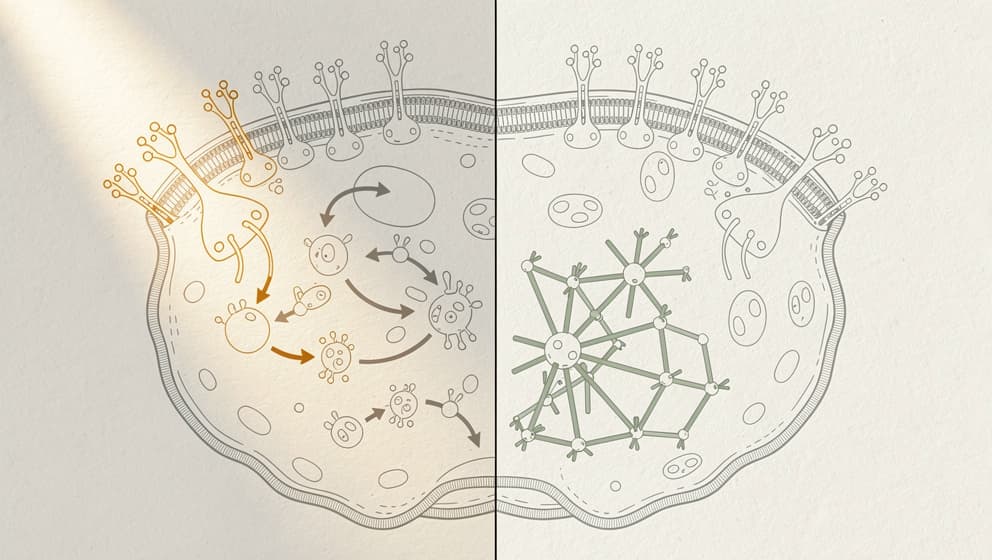
The clearest way to understand BPC-157 vs TB-500 is to look at what pathways each one activates.
BPC-157 activates:
- VEGFR2 (vascular endothelial growth factor receptor 2), drives angiogenesis
- The Akt-eNOS axis, supports endothelial function and nitric oxide signalling
- FAK and paxillin phosphorylation in fibroblasts, drives cell migration to injury sites
- Growth-hormone receptor expression upregulation, amplifies GH-axis signalling
TB-500 activates:
- G-actin binding, regulates cytoskeletal dynamics across all motile cells
- Cell migration pathways, immune cells, fibroblasts, stem cells, endothelial cells
- Anti-inflammatory signalling, reduces pro-inflammatory cytokines (particularly in cardiac and muscle tissue)
- Collagen remodelling, supports orderly deposition during tissue repair
The overlap is angiogenesis (both affect new blood vessel formation) and fibroblast mobilisation (both support it, via different pathways). The divergence is what each does best. For the full mechanism breakdown, see the BPC-157 guide and TB-500 guide.
The use-case distribution#

Where the preclinical and applied-research evidence concentrates differs meaningfully. One caveat on the TB-500 column: most of that evidence was generated with full-length thymosin beta-4 (43 amino acids), not the 7-amino-acid TB-500 fragment (LKKTETQ), and the FDA noted at its July 2026 advisory committee meeting that there are no studies of TB-500 itself.
| Use case | Best supported by |
|---|---|
| Tendon injuries | BPC-157 |
| Ligament injuries | BPC-157 |
| GI mucosal injury / inflammation | BPC-157 |
| Cardiac tissue repair | TB-500 |
| Dermal wound healing | TB-500 |
| Muscle repair (traumatic) | TB-500 (preclinical slightly ahead) |
| Systemic anti-inflammatory | TB-500 |
| Stroke/neuroprotection | TB-500 (very preliminary) |
For a tendinopathy or ligament strain, the BPC-157 literature is deeper. For cardiac or broadly systemic repair, TB-500's actin-binding mechanism and preclinical data are stronger. For many musculoskeletal indications (muscle tears, post-surgical recovery, general connective tissue), both have evidence and the stack is a reasonable protocol.
Dose and frequency differences#

The dosing regimens are structurally different, which affects protocol logistics:
| Dimension | BPC-157 | TB-500 |
|---|---|---|
| Typical dose | 250–500 mcg | 2–2.5 mg |
| Typical frequency | 1–2× daily | 2× weekly (loading), 1× weekly or per 2 wks (maintenance) |
| Cycle length | 4–8 weeks | 8–12 weeks (including loading + maintenance) |
| Vial consumption | about 3 vials (5 mg) for 8 weeks at 250 mcg daily; more at higher doses | ~9 vials (5 mg) over 12 weeks |
| Route | SC, prefer near injury | SC, any site |
BPC-157 is higher-frequency/lower-per-dose. TB-500 is lower-frequency/higher-per-dose. A protocol that uses both has a daily BPC-157 injection and a weekly TB-500 injection on a schedule that can run in parallel.
The injection-proximity question#
One of the practical differences between the two peptides is location sensitivity.
BPC-157's preclinical literature, indexed in PubMed, suggests that subcutaneous injection near the injury site produces better outcomes than systemic injection. Research has shown this proximity advantage in animal models. For a knee injury, injecting in the adjacent soft tissue; for an Achilles tendon, nearby calf tissue; for elbow tendinopathy, the surrounding forearm. The mechanism appears to be local tissue gradient effects, where higher concentrations of BPC-157 near the target tissue are associated with more local angiogenesis and fibroblast recruitment.
TB-500 doesn't show the same proximity effect in preclinical models. Its systemic distribution via actin binding means any subcutaneous site produces similar tissue-level exposure. Injection in the abdomen, thigh, or arm works roughly equivalently.
Practical implication: for a single-peptide protocol targeting a specific injury, BPC-157's proximity advantage matters. For a stacked protocol, BPC-157 goes near the injury and TB-500 goes wherever is convenient.
Why protocols stack them#
The stacking argument rests on mechanism complementarity:
- Angiogenesis coverage: BPC-157's VEGFR2-driven angiogenesis + TB-500's endothelial cell migration = broader new-vessel formation
- Fibroblast support: BPC-157 drives fibroblast migration to injury; TB-500 supports their subsequent function
- Timeline: BPC-157's daily high-frequency dosing keeps the acute repair signal constant; TB-500's weekly dosing maintains the systemic anti-inflammatory and cell-migration backdrop
- Coverage for unknown injury components: in complex injuries (e.g., sports injuries with simultaneous tendon, muscle, and connective-tissue damage), the combined mechanism coverage is broader than either alone
The counter-argument is that evidence for the combination is weaker than for either individually. No published head-to-head trial compares stack vs mono-therapy. Most "stack works better" claims are mechanism-based and case-series-derived rather than clinical-trial-proven.
For the stack-specific protocol, see BPC-157 + TB-500 stack.
Side effects and safety, both benign#
Each peptide has been shown to have a benign short-term safety profile in preclinical and limited human data:
- No serious adverse events reported in the published BPC-157 pilot studies; TB-500 itself has no published human study, and the human safety data come from trials of full-length thymosin beta-4
- Common minor events: injection-site irritation, transient mild fatigue, infrequent mild nausea
- No drug-drug interactions of clinical significance characterised
The contraindication framework is also similar:
- Active or recent malignancy (both promote mechanisms tumours exploit)
- Pregnancy and breastfeeding (no safety data)
- Under 21 (not appropriate)
See who shouldn't take peptides for the full framework.
How to decide#
Three filters answer the BPC-157 vs TB-500 question for most cases:
-
What's the primary injury?
- Tendon, ligament, GI → BPC-157
- Cardiac, dermal wound → TB-500 (evidence mostly from full-length thymosin beta-4)
- Muscle, mixed soft-tissue → either or both
-
What's the dosing preference?
- Daily injection schedule fits your routine → BPC-157 is straightforward
- Weekly injection schedule fits your routine → TB-500 works
- Willing to do both → stack is reasonable
-
What's the budget?
- Lower-cost single-peptide protocol → BPC-157 is typically cheaper per month
- More comprehensive coverage → stack increases cost proportionally
For anyone building a protocol, Klarovel's questionnaire maps injury type, contraindications, and goals against the research catalogue. The peptide calculator handles dose math for either peptide. The titration calculator builds week-by-week schedules.
BPC-157 and TB-500 are both legitimate tools. Which one is right depends on what's actually broken. The most common mistake is using either without a specific indication, because that's when the evidence-to-outcome gap matters most. For the wider context on how each fits alongside the rest of the tissue-repair options, the peptides for healing overview maps the full cluster.
Frequently asked questions
Keep reading
Peptides for Inflammation: Mapping BPC-157, KPV, and Thymosins
Peptides for inflammation compared by mechanism and evidence stage: BPC-157, KPV, thymosin alpha-1, and thymosin beta-4, with FDA status and safety notes.
Mounjaro vs Zepbound: Same Drug, Two Different FDA Labels
Mounjaro and Zepbound are the same drug, tirzepatide, at the same doses. The difference is the FDA label: diabetes for Mounjaro, weight loss for Zepbound.

Rybelsus for Weight Loss: Not Approved, and the Pill That Is
Rybelsus is not FDA-approved for weight loss and moves the scale only a little. The oral semaglutide approved for weight loss is the Wegovy pill at 25 mg.