

TB-500 and GHK-Cu both get filed under "recovery peptides," but the resemblance ends there. One is a 7-amino-acid fragment of thymosin beta-4 that mobilises actin and pushes angiogenesis. The other is a copper-binding tripeptide that resets gene expression and collagen turnover in skin. This guide compares the two on mechanism, the actual human evidence, dosing realities, side-effect profiles, and the decision rule for when each is the smarter choice.
Key takeaways#
- TB-500 is a soft-tissue and vascular agent: its parent peptide Tβ4 has angiogenic and anti-inflammatory activity and accelerated dermal repair in phase 2 trials for pressure, stasis, and epidermolysis bullosa wounds.
- GHK-Cu is a dermal and connective-tissue copper-signaling peptide: research suggests it modulates a large set of human genes, raises collagen synthesis, and behaves as an antioxidant.
- No human study of TB-500 itself exists; the human trials tested full-length thymosin beta-4, which has phase 1 and phase 2 safety data. GHK-Cu's human record is topical; injectable GHK-Cu has essentially no published trial dose range.
- Neither is FDA-approved or currently compoundable in the US. An FDA advisory committee voted 8 to 6 for TB-500 in July 2026 with no rule yet; injectable GHK-Cu goes to the same committee before the end of February 2027. TB-500 is prohibited by WADA (S2) and on Norway's doping list.
- Practitioner TB-500 protocols are systemic (subcutaneous, mg-scale) and not derived from trials; GHK-Cu's strongest evidence base is topical at 2-4 mg/mL.
- Stacking is mechanistically plausible (different receptor systems, complementary action on repair phases) but not validated in any head-to-head human trial.
How TB-500 works#
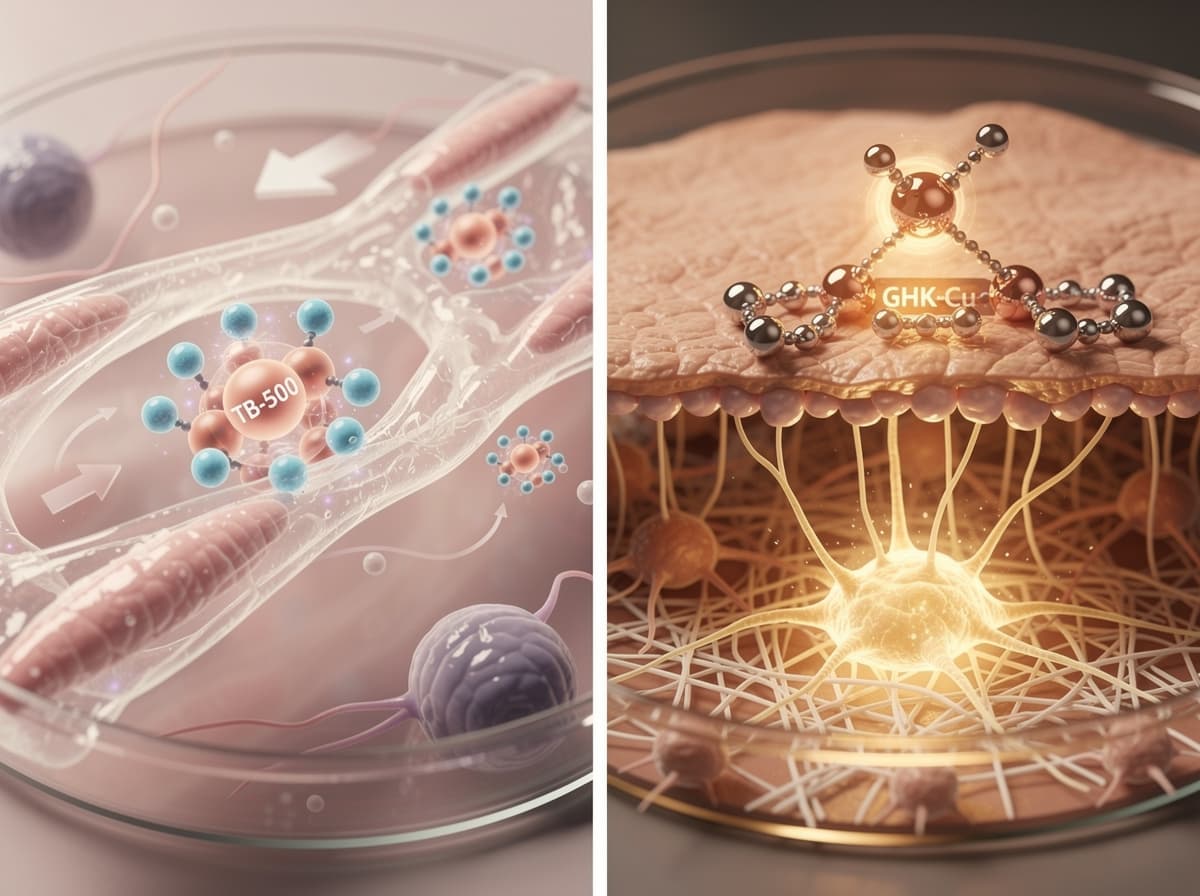
TB-500 is the synthetic 17-23 fragment of thymosin beta-4 (Tβ4), the seven amino acids LKKTETQ, taken from an actin-sequestering protein found at high concentrations in spleen, lungs, thymus, brain, and heart. Tβ4 was found to have angiogenic and anti-inflammatory activity and to be elevated in platelets that aggregate at wound sites. The fragment retains the actin-binding motif, which is the structural argument for expecting it to share the parent's effects on endothelial cell migration, progenitor recruitment, and repair. Most of that biology was demonstrated with full-length Tβ4, not with the fragment.
Preclinical evidence is broad. A 2026 scoping review covering PubMed, Europe PMC, and ClinicalTrials.gov screened 1772 records and included 80 studies; the evidence base was weighted toward in vitro designs, with most studies evaluating Tβ4 rather than TB-500 and the most common tissue categories being wound/skin/soft tissue, vascular/endothelial, ocular/cornea, and bone. Direct musculoskeletal data (tendon, ligament, muscle, cartilage) is sparser than the marketing copy suggests.
How GHK-Cu works#
GHK-Cu is glycyl-L-histidyl-L-lysine bound to a copper(II) ion, isolated from human plasma by Loren Pickart in 1973. Its mechanism runs through three layered effects. First, its copper-binding structure enhances copper transport into and out of cells and promotes wound healing through several different but related pathways. Second, GHK-Cu suppresses the acute-phase response by inhibiting cytokine production, behaving as both an anti-inflammatory and an antioxidant. Third, and most interesting from a research perspective, GHK-Cu modulates expression of a large number of human genes, which is the mechanism most often invoked to explain its breadth of dermal and connective-tissue effects.
Functionally, this means GHK-Cu has been shown to raise collagen and glycosaminoglycan synthesis in skin fibroblasts, support new blood-vessel formation, and influence stem-cell activity in dermal hair follicles. The fingerprint is fundamentally dermal-trophic; it is not a primary actin or growth-hormone agent.
Dosing and evidence: what the studies actually show#
There is no human dosing data for TB-500 itself. The closest human data are for full-length Tβ4. A Chinese first-in-human study of recombinant Tβ4 (NL005) tested single intravenous doses from 0.05 to 25 μg/kg and multiple-dose cohorts at 0.5, 2.0, and 5.0 μg/kg daily for 10 days; adverse events were mild to moderate and no dose-limiting toxicities were reported. RegeneRx registered a cardiac trial of intravenous Tβ4 (NCT01311518) at far higher doses (1200 mg or 450 mg), but it was withdrawn before enrolling anyone. Research-context subcutaneous protocols in the community literature typically reference 2-2.5 mg twice weekly for a loading phase followed by a weekly maintenance dose, though these protocols are not derived from controlled human trials and should be treated as preliminary evidence rather than validated regimens.
For GHK-Cu, the strongest evidence is for topical use at 2-4 mg/mL in creams and serums, the concentration band that has been shown to produce minimal local irritation across decades of cosmetic safety dossiers. Injectable GHK-Cu has no published trial dose range; community protocols cluster around 1-2 mg subcutaneously, but research-published doses for injectable GHK-Cu are limited and not standardised.
The clinical evidence reads as a study in contrasts. For TB-500's parent peptide, the most cited primary work is the 2004 Nature paper by Bock-Marquette et al., which showed that Tβ4 promoted cardiomyocyte migration and survival and improved cardiac function after myocardial infarction in mice. A dose-response study in a rat embolic stroke model identified an optimal dose of 3.75 mg/kg for long-term neurological recovery at day 56. The first-in-human Phase 1 trial of recombinant Tβ4 (NL005) randomly enrolled 54 subjects for single-dose and 30 for multiple-dose intravenous administration in healthy Chinese volunteers, reporting no dose-limiting toxicities. Dermal phase 2 trials of Tβ4 in patients with pressure ulcers, stasis ulcers, and epidermolysis bullosa wounds accelerated the rate of repair and were safe and well tolerated. None of these studies used the TB-500 fragment.
For GHK-Cu, the evidence concentrates in dermatology and gene-expression work rather than registered trials. Pickart's 2018 gene-data review summarised that GHK-Cu protected mouse lung tissue from induced acute lung injury, suppressed inflammatory-cell infiltration, raised superoxide dismutase activity, and reduced TNF-α and IL-6 through inhibition of NFκB p65 and p38 MAPK. The topical cosmetic literature consistently associates GHK-Cu with improved skin elasticity, reduced photodamage, and faster post-procedure recovery, but head-to-head systemic-injection trials versus TB-500 do not exist.

Side effects, contraindications, and when to choose each#
The side-effect profiles diverge in instructive ways. For TB-500 there is no human safety data; the phase 1 single- and multiple-dose intravenous study of full-length recombinant Tβ4 in 84 healthy volunteers reported no dose-limiting toxicities, with mild to moderate adverse events. The theoretical concern most often raised is Tβ4's controversial role in tumor biology: although the molecule has been associated with metastatic cancer states in some reports, Tβ4 was equally introduced as a candidate tumor suppressor in male breast cancer and demonstrated tumor-suppressive function in myeloma. The honest read is that the oncology signal is unresolved, which is why Klarovel's engine blocks TB-500 for anyone with active cancer or a cancer history.
For GHK-Cu, the topical safety record is among the longest in cosmetic dermatology, with decades of use at 2-4 mg/mL. The principal hazards sit on the injectable side: copper-load concerns in patients with Wilson's disease or any disorder of copper metabolism, plus the local irritation, sterile-abscess, and infection risks that attend any unregulated injectable. There is no validated injection protocol, which is the single largest gap in the GHK-Cu evidence base.
Choose TB-500 when the goal is systemic soft-tissue repair, post-injury angiogenesis, dermal wound healing in a research setting, or cardiac-tissue protection scenarios. Studies have shown its strongest preclinical signals in vascular, endothelial, ocular, and dermal contexts. Its parent peptide is also better characterised for injection, with phase 1 human safety data, though that data does not transfer automatically to the fragment.
Choose GHK-Cu when the goal is skin remodelling, collagen support, scar modulation, post-procedure recovery (microneedling, laser), hair-follicle stimulation, or any objective where a topical route is sufficient. The topical formulation is where the preliminary evidence is deepest and the safety record longest. Injectable GHK-Cu is the most evidence-thin format across both peptides and should be approached as exploratory.
Can you stack them, and what is the verdict?#
Stacking is mechanistically defensible. TB-500 drives angiogenesis and recruits progenitor cells via the actin axis, while GHK-Cu drives fibroblast collagen synthesis and gene-expression remodelling via copper signalling. Those are complementary action profiles, not redundant ones. The pairing has been used informally in research-protocol communities for post-surgical and dermal-injury contexts, with TB-500 systemic and GHK-Cu topical. No controlled human trial has tested the combination, so the supra-additive response remains preliminary.
The verdict: for most soft-tissue, vascular, or systemic repair contexts, TB-500 is the stronger starting point because its parent peptide's mechanism is directly tied to angiogenesis and progenitor mobilisation, and that parent has formal human safety data. Note that TB-500 is prohibited in sport (WADA S2) and on Norway's doping list, and GHK-Cu is not named on the WADA list. For skin remodelling, cosmetic recovery, and topical-route applications, GHK-Cu is the better-evidenced and safer choice. They are not interchangeable, and the "which is stronger" framing collapses once the goal is specified.
Run the decision against your own health profile, not the marketing copy#
The honest answer to "TB-500 or GHK-Cu" is almost never the same for two readers. Goal, route, baseline inflammation, copper status, and risk tolerance all change the call. Build the decision from the data you actually have: run the structured questionnaire, use the peptide protocol calculator to map your goal to the right mechanism, and read how the research-protocol layer works before committing to either compound.
Frequently asked questions
Keep reading
Peptides for Inflammation: Mapping BPC-157, KPV, and Thymosins
Peptides for inflammation compared by mechanism and evidence stage: BPC-157, KPV, thymosin alpha-1, and thymosin beta-4, with FDA status and safety notes.
Mounjaro vs Zepbound: Same Drug, Two Different FDA Labels
Mounjaro and Zepbound are the same drug, tirzepatide, at the same doses. The difference is the FDA label: diabetes for Mounjaro, weight loss for Zepbound.
Rybelsus for Weight Loss: Not Approved, and the Pill That Is
Rybelsus is not FDA-approved for weight loss and moves the scale only a little. The oral semaglutide approved for weight loss is the Wegovy pill at 25 mg.