
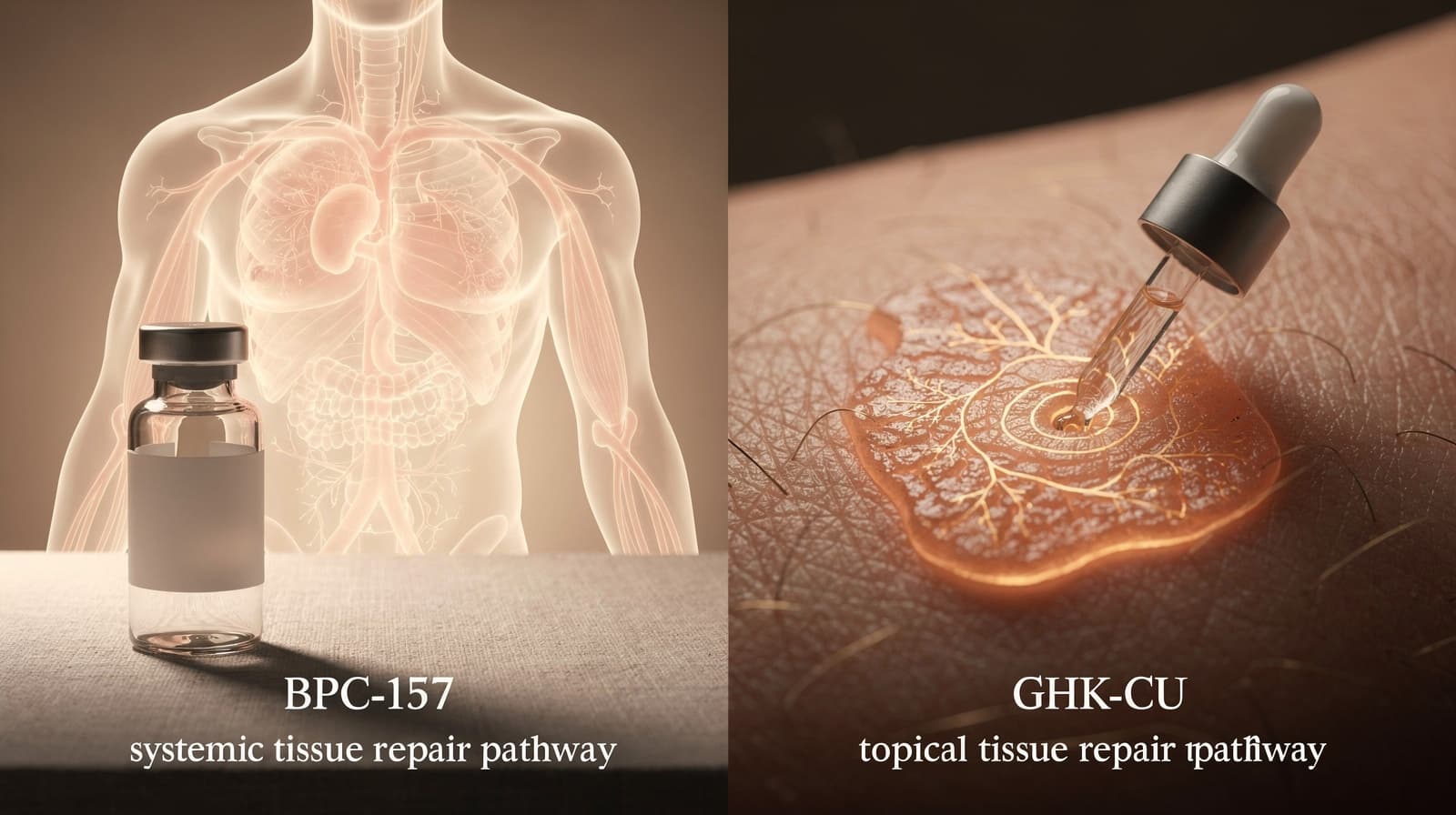
Two peptides dominate the "tissue repair" conversation, and they almost never compete for the same job. BPC-157 is a systemic pentadecapeptide with a rat-study record on gut, tendon and ligament. GHK-Cu is a copper-bound tripeptide with the strongest randomised human evidence on skin and surface wounds. This post settles which one fits which problem, what each actually does at the receptor level, and where the stacking question lands.
Key takeaways#
- BPC-157 is a systemic gastric pentadecapeptide with a deep preclinical record on musculoskeletal and gut tissue; almost no randomised human data exists.
- GHK-Cu is a topical copper tripeptide with small but real randomised human trials on wrinkles, diabetic ulcers and post-laser skin.
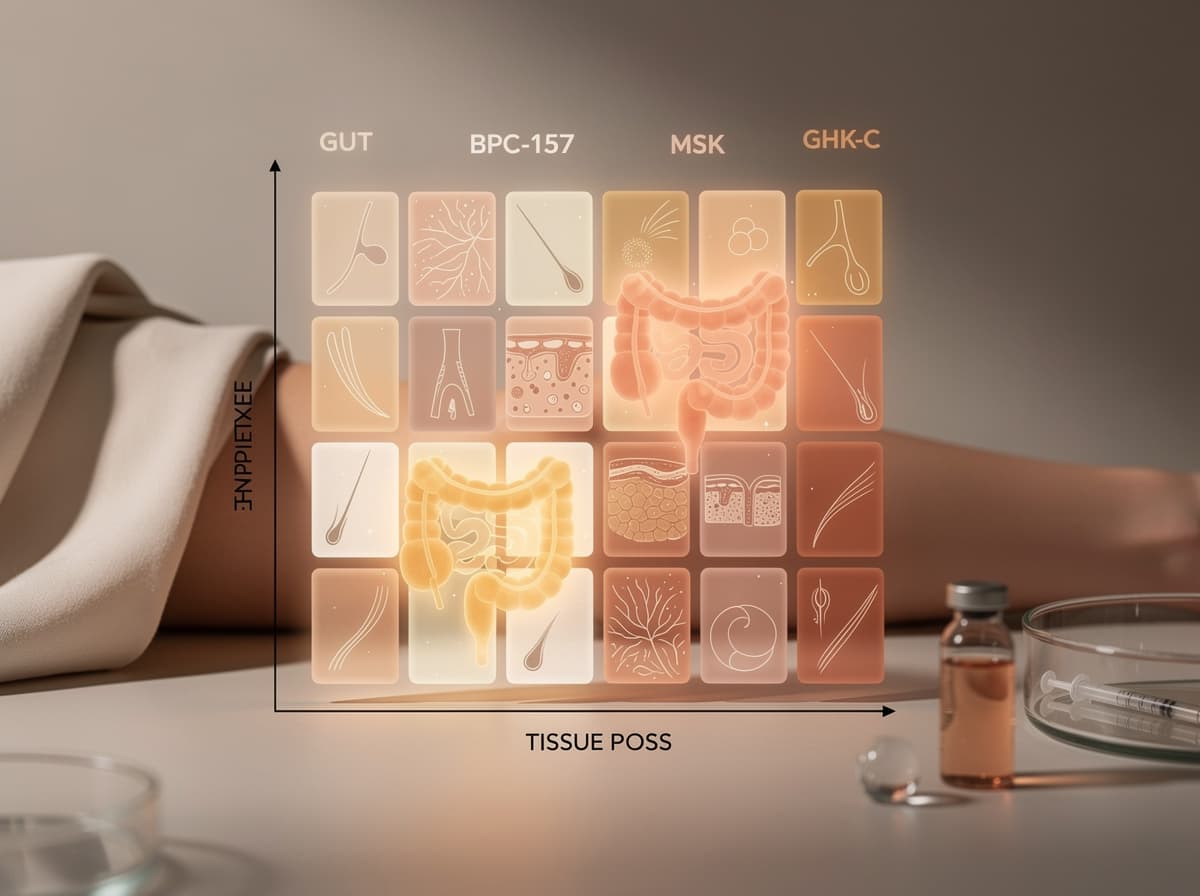
- For tendon, ligament, gut-lining or post-injury MSK repair, BPC-157 is the more relevant candidate; for skin, scar, hair-follicle and post-procedure facial recovery, GHK-Cu is.
- Side-effect profiles are mild in published work but radically different: GHK-Cu risks topical copper irritation, BPC-157 risks the unknowns of unapproved systemic peptides.
- Stacking is mechanistically reasonable but redundant for most goals; pick the peptide that matches the tissue you actually want to repair.
How BPC-157 works#
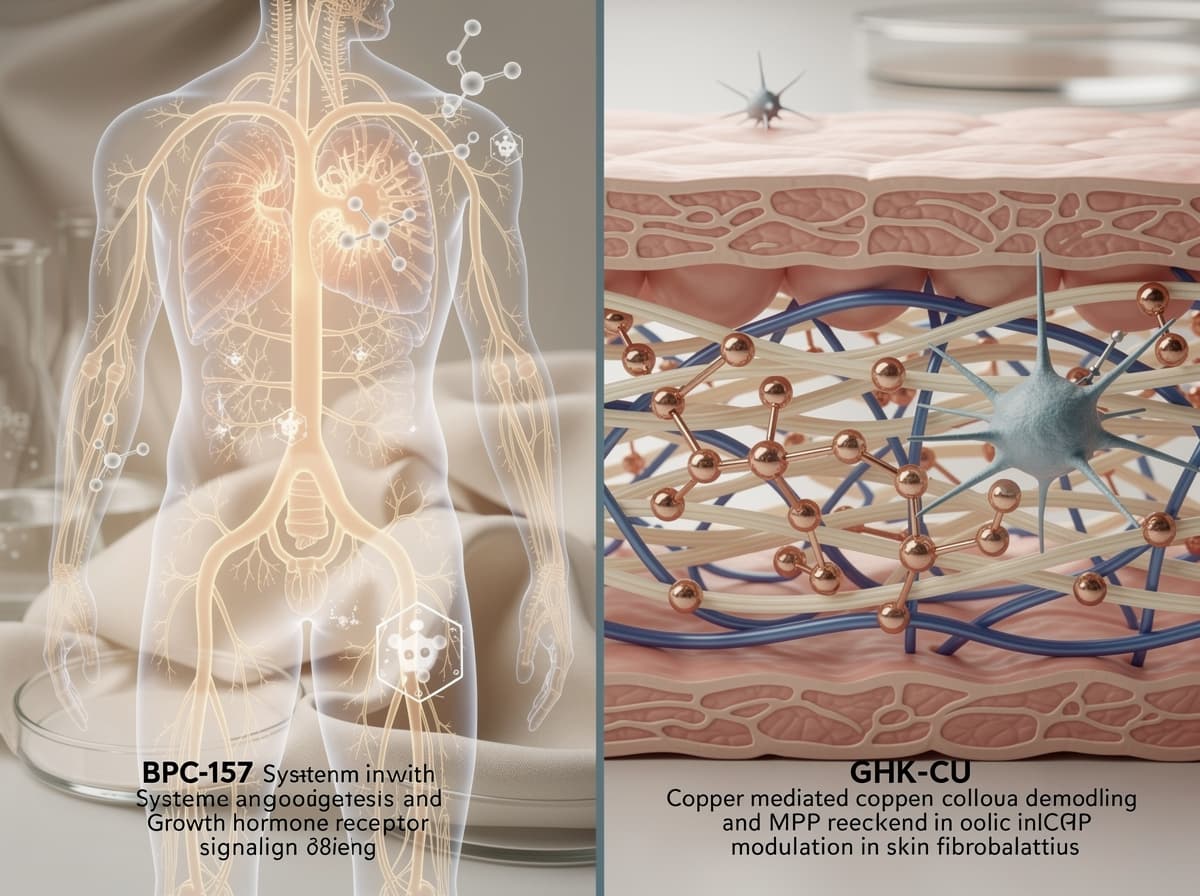
BPC-157 is a 15-amino-acid sequence derived from a protective fragment of human gastric juice. In rat models it has been shown to improve transected Achilles tendon healing, transected quadriceps healing and tendon-to-bone reattachment, with one study reporting that BPC-157 improved healing functionally and biomechanically with increases in Achilles functional index, load to failure, stiffness and collagen type I deposition. A mechanistic paper has shown that BPC-157 up-regulates the growth-hormone receptor on tendon fibroblasts in a dose- and time-dependent way, which preliminary evidence suggests is one route through which it amplifies the proliferative response to circulating GH.
Routes used in published preclinical work include intraperitoneal injection, oral water and topical cream. Half-life in plasma is short, but the stable gastric pentadecapeptide BPC 157 appears to remain active when given orally in drinking water, which is part of why the research literature treats it as orally bioavailable. The published preclinical signal is consistent across gut, muscle, tendon, ligament and bone; the human signal is limited to three small uncontrolled pilot studies and early-2000s ulcerative colitis trials of a BPC-157 enema that were reported only as conference abstracts.
How GHK-Cu works#
GHK-Cu is glycyl-L-histidyl-L-lysine complexed with copper(II). It is an endogenous human tripeptide that circulates in plasma and declines with age. Research has shown that GHK-Cu modulates collagen, elastin and metalloproteinase expression in human dermal fibroblasts at nanomolar concentrations, and influences a wide gene-expression footprint involving tissue remodelling, angiogenesis and antioxidant defence.
Unlike BPC-157, GHK-Cu's clinical record is predominantly topical and dermatological. It is associated with collagen synthesis, angiogenesis and modulated expression of glycosaminoglycans, proteoglycans and metalloproteinases, and animal wound models and a randomized, vehicle-controlled trial in diabetic foot ulcers (Mulder et al., 1994) reported faster wound closure. The copper ion is not a passive carrier; it is required for the lysyl-oxidase and superoxide-dismutase activities that drive the cosmetic and wound-healing signal.
Dosing: BPC-157 vs GHK-Cu#
Research-published doses for BPC-157 in humans are not standardised; the entire injectable dose conversation is extrapolated from rat work using allometric scaling, and the field has not produced a randomised dose-finding trial. Preclinical protocols typically use microgram-per-kilogram or nanogram-per-kilogram ranges given intraperitoneally, orally or topically. No dose-finding trial in humans exists, so no dose is established in the peer-reviewed literature. Klarovel's protocols use a curated BPC-157 band (starting at 200 to 300 mcg, with a standard dose of 250 to 500 mcg depending on experience), drawn from practitioner protocols rather than from a trial, and the engine enforces both ends of that band.
GHK-Cu's dosing conversation is mostly topical. The diabetic-ulcer trial used a gel of the copper complex (Iamin) applied daily after debridement. Cosmetic use is far more dilute: an industry survey reviewed by the Cosmetic Ingredient Review panel in 2014 reported GHK (tripeptide-1) in leave-on products at up to 0.001%, with peptide use below 10 ppm described as customary (CIR, 2014). Injectable GHK-Cu, where Klarovel's curated band is 1 mg to 2 mg per dose, has no human trial behind it.
The practical implication: the two peptides are not interchangeable on a dosage spreadsheet. Neither has a dose-finding trial for injection; the human evidence for GHK-Cu sits almost entirely on topical products.
Evidence: what the studies actually show#
For BPC-157, the strongest evidence is preclinical and consistent. A muscle-crush study has shown that BPC 157 improved muscle healing macroscopically, microscopically and functionally, with reductions in haematoma, edema and post-injury contracture. A separate Achilles-tendon-detachment study reported substantial increases in load to failure and stiffness, and a myotendinous-junction model has shown that BPC 157 restores tissue that does not heal spontaneously in rat controls. No randomised, placebo-controlled human trial on tendon or ligament outcomes has been published.
For GHK-Cu, the strongest evidence is the topical cosmetic trial. Application data reported a 31.6% reduction in wrinkle volume compared to Matrixyl 3000 and a 55.8% reduction in wrinkle volume and 32.8% reduction in wrinkle depth compared to control serum. A separate randomized, evaluator-blinded, vehicle-controlled diabetic-ulcer trial reported a median 98.5% closure of plantar ulcers with GHK-Cu gel versus 60.8% with vehicle, a closure rate three times faster than standard care and vehicle, and fewer infections (7% versus 34%) (Mulder et al., 1994). A small randomized trial after CO2 laser resurfacing (13 patients) found no objective difference in redness or wrinkles but higher patient satisfaction with GHK-Cu (Miller et al., 2006). An active proof-of-concept trial, CuHeal, is evaluating topical GHK-Cu gel against vehicle in standardised punch-biopsy wounds. GHK-Cu has small but real randomised human evidence; BPC-157 essentially does not.
Side effects and contraindication profile#
Both peptides have a benign published safety profile, but they accumulate risk differently.
BPC-157's preclinical literature reports no significant toxicity, and the three small human pilot studies reported no adverse effects. The risks in current real-world use are mostly the risks of any unapproved systemic peptide: sourcing variability, endotoxin load, reconstitution sterility and the absence of long-term human pharmacovigilance. Theoretical concerns about angiogenesis in occult tumour tissue have been raised but not demonstrated in humans.
GHK-Cu's topical safety profile is well characterised. The Cosmetic Ingredient Review panel concluded in 2014 that GHK peptides are safe at the low concentrations used in skincare (up to about 0.001% for GHK, under 10 ppm typical), based on negative repeated-dose toxicity, irritation and sensitisation data. Real-world topical issues are mostly limited to mild irritation, transient blue-green staining at high concentrations, and rare copper sensitivity. Injectable GHK-Cu is a separate conversation and carries the same sourcing-and-sterility caveats as any unapproved peptide.
Overlap: both are mild in published work. Divergence: BPC-157 risk is the unknown of systemic, unapproved use; GHK-Cu risk is local irritation in a well-mapped cosmetic envelope.
When to choose BPC-157#
- A tendon, ligament or muscle-belly injury that is not resolving on conservative rehab, and the user is operating in the research-use lane with informed expectations.
- Post-surgical MSK recovery where the preclinical angiogenesis and collagen-organisation signal is the most relevant mechanism.
- Gut-lining concerns, where the rat colitis and ulcer data are deepest and the only controlled human trial (in ulcerative colitis) was reported as an abstract.
- Stacking with a GH-axis protocol where the growth-hormone-receptor up-regulation on tendon fibroblasts is mechanistically complementary.
When to choose GHK-Cu#
- Post-procedure facial recovery (laser, peel, microneedling) where the published cosmetic-trial evidence is the strongest match.
- Skin-quality goals: wrinkle volume, dermal thickness, elasticity, where research has shown direct collagen and elastin upregulation.
- Hair-follicle support, where the dermal-papilla and angiogenesis signal is mechanistically aligned.
- Surface wound healing in research contexts where preliminary evidence on diabetic-ulcer closure rates is the most relevant outcome.
Can you stack BPC-157 and GHK-Cu?#
Yes, mechanistically, because they act on different tissues through different pathways: BPC-157 systemically on the vascular and GH-receptor axis, GHK-Cu locally on copper-dependent enzymes in skin. There is no published interaction or contraindication between them. The combined response would be additive at most, not supra-additive, because they do not converge on the same receptor.
The honest answer is that stacking is rarely the right question. If the goal is a tendon, the stack does not improve on BPC-157 alone. If the goal is skin quality, the stack does not improve on topical GHK-Cu alone. Stacking is only defensible when a user has both problems simultaneously (e.g., a post-surgical patient with skin closure and underlying MSK repair), and even then the peptides should be evaluated against the two outcomes independently.
Verdict#
BPC-157 and GHK-Cu are not rivals. They share the marketing label "tissue repair" and almost nothing else. BPC-157 is the more relevant candidate when the tissue is internal, mechanical and connective: tendon, ligament, muscle belly, gut lining. GHK-Cu is the more relevant candidate when the tissue is surface, vascular-and-collagenous: skin, scar, follicle, wound bed. For most users asking the comparison question in good faith, GHK-Cu is the better-documented starting point because part of its evidence base is human, randomised and topical, and BPC-157 is the more powerful candidate when the target tissue is one the preclinical record actually addresses. Pick by tissue, not by marketing.
Make the decision your health profile points to#
The peptide that wins for you is the one that matches your tissue, your goal and your existing protocol context. Run your inputs through the peptide calculator, check the full BPC-157 protocol guide and the GHK-Cu protocol guide, step back to the peptides for healing overview for how both fit the wider tissue-repair picture, and review the regulatory framing on the disclosures page. When you are ready to formalise the decision with your health profile (blood work optional), create a Klarovel account and see how Klarovel works end to end.
Frequently asked questions
Keep reading
Peptides for Inflammation: Mapping BPC-157, KPV, and Thymosins
Peptides for inflammation compared by mechanism and evidence stage: BPC-157, KPV, thymosin alpha-1, and thymosin beta-4, with FDA status and safety notes.
Mounjaro vs Zepbound: Same Drug, Two Different FDA Labels
Mounjaro and Zepbound are the same drug, tirzepatide, at the same doses. The difference is the FDA label: diabetes for Mounjaro, weight loss for Zepbound.
Rybelsus for Weight Loss: Not Approved, and the Pill That Is
Rybelsus is not FDA-approved for weight loss and moves the scale only a little. The oral semaglutide approved for weight loss is the Wegovy pill at 25 mg.