
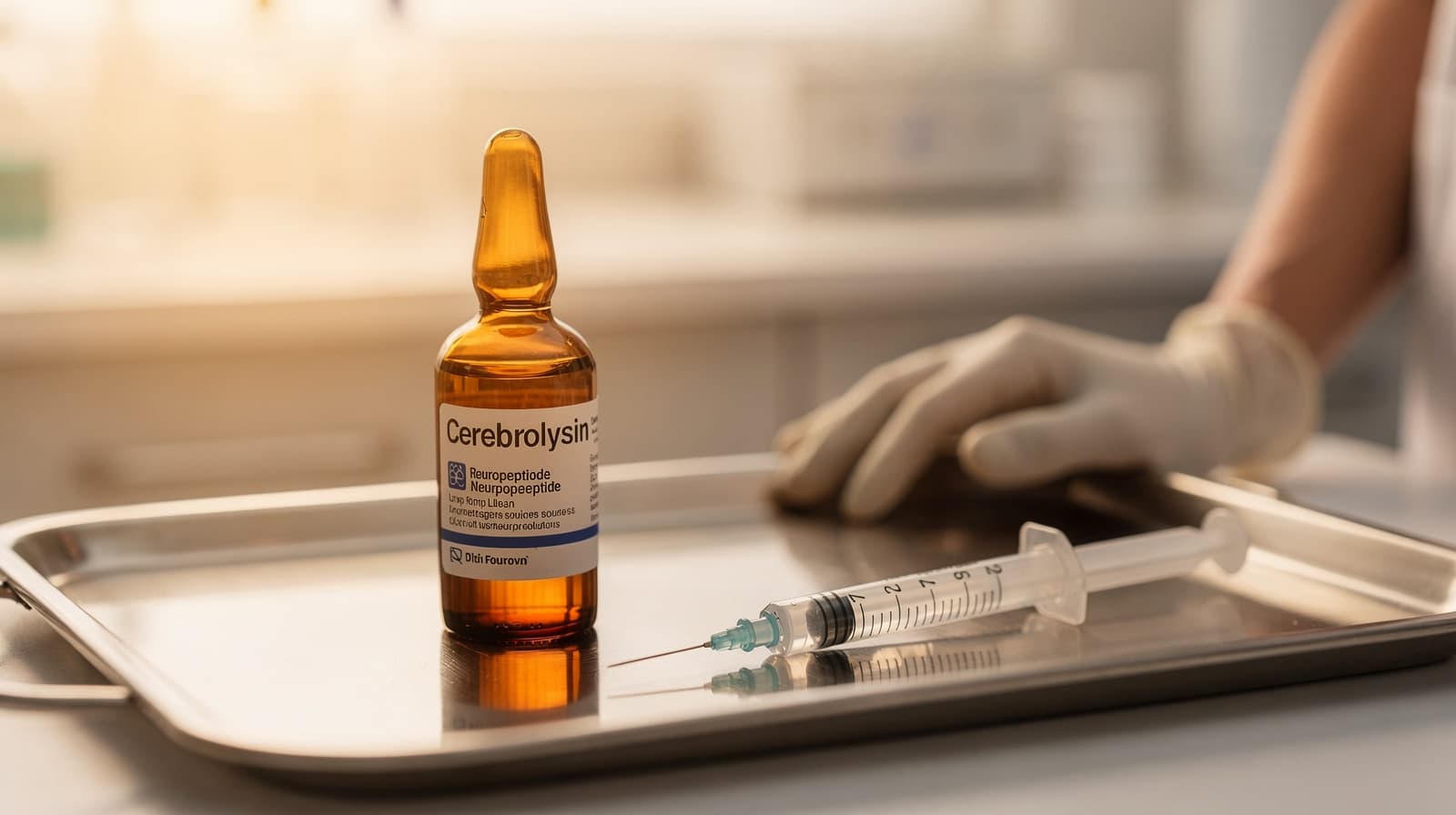
Cerebrolysin sits in an unusual category: a porcine-derived peptide mixture with over five decades of clinical use abroad, hundreds of published trials, and zero approval in the United States. The signal is real, the noise is loud, and the protocol layer is where most users get it wrong. This guide unpacks the mechanism, the trial data across stroke, dementia and traumatic brain injury, the dosing logic, and the safety boundaries researchers should respect.
Key takeaways#
- Cerebrolysin is not a single peptide. It is an enzymatic hydrolysate of pig brain tissue, roughly 25% low-molecular-weight peptide fragments and 75% free amino acids.
- The mechanism is receptor-mediated, not generalised: peptide fragments engage Trk receptors and mimic endogenous neurotrophic factors such as BDNF, NGF and GDNF.
- The strongest trial signals come from moderate-to-severe traumatic brain injury (CAPTAIN series) and mild-to-moderate Alzheimer's disease at 30 mL/day, with smaller and inconsistent effects in acute ischemic stroke.
- Standard cycles run 5-20 mL/day intravenously or intramuscularly for 10-20 consecutive days, repeated 2-4 times per year. Higher is not reliably better.
- Cerebrolysin is not FDA-approved. It is approved in roughly 50 countries under varying evidentiary thresholds, and contraindicated in epilepsy, severe renal failure, and porcine allergy.
Cerebrolysin is a peptide hydrolysate, not a designer molecule#
The compound's biology starts with its source. Cerebrolysin is a neuropeptide preparation derived from porcine brain tissue through a controlled enzymatic hydrolysis process. The resulting compound is a mixture of low-molecular-weight peptide fragments and free amino acids, the most therapeutically significant of which can cross the blood-brain barrier.
That composition matters for dosing logic. Approximately 25% of the Cerebrolysin solution by weight consists of active peptide fragments, while the remaining 75% is composed of free amino acids. The peptide fraction contains fragments with molecular weights below 10,000 daltons, a threshold considered important for blood-brain barrier permeability. Russian molecular-biological profiling has identified active peptide fragments of nerve growth factor, enkephalins, orexin, halanin within the mixture, which helps explain its multiple downstream actions.
The clinical relevance is that Cerebrolysin behaves less like a small molecule with one binding pocket and more like a broad neurotrophic stimulus. That distinction frames every trial result that follows.
The mechanism is receptor-mediated, not vague neuroprotection#
Older marketing material described Cerebrolysin as a generic "brain support" agent. The current mechanistic picture is more specific. Research suggests the active fragments engage tyrosine kinase receptors in the same family that BDNF and NGF use. According to mechanistic reviews, Cerebrolysin's peptides bind Trk receptors and activate PI3K/Akt and MAPK/ERK signaling cascades, which has been shown to drive neuronal survival, dendritic spine formation, and endogenous BDNF upregulation.
Preclinical data points to measurable structural effects. Cultured-neuron work has shown increased dendritic spine density after exposure, with that effect blocked by Trk inhibitors, indicating receptor-dependent action rather than nonspecific trophic noise.
Animal stroke models have also been informative. Research has shown that Cerebrolysin augments the proliferation, differentiation, and migration of adult subventricular zone neural progenitor cells, contributing to neurogenesis , which may explain part of the post-stroke functional signal seen in larger trials.
Trial data is strongest in TBI and Alzheimer's, weakest in acute stroke#
This is where most internet write-ups overreach. The evidence base is not uniform across indications, and honest reading requires separating the strong signals from the weak ones.
Traumatic brain injury#
The CAPTAIN trial series is the cleanest dataset Cerebrolysin has. A prospective meta-analysis summarised results from the CAPTAIN trial series, evaluating Cerebrolysin for moderate-severe traumatic brain injury as an add-on to usual care. The study included two phase IIIb/IV prospective, randomized, double-blind, placebo-controlled clinical trials. Eligible patients with a Glasgow Coma Score between 6 and 12 received 50 mL of Cerebrolysin or saline per day for ten days, followed by two additional treatment cycles with 10 mL per day for 10 days.
The primary results: a small-to-medium sized effect in favour of Cerebrolysin, statistically significant at Day 30 and at Day 90 (Day 30: MWcombined = 0.60, p = 0.0156; Day 90: MWcombined = 0.60, p = 0.0146) . Effect sizes were modest but reproducible across two independent trials. Read the CAPTAIN II results in Neurological Sciences.
Alzheimer's disease#
In mild-to-moderate Alzheimer's, the 30 mL/day dose has the most replication. Studies have shown that Cerebrolysin was significantly more effective than placebo at 4 weeks for cognitive function (SMD -0.40 points; 95% CI -0.66 to -0.13; p = 0.0031) and at both 4 weeks and 6 months for global clinical change (4 weeks OR 3.32; 6 months OR 4.98) . A 2015 meta-analysis published in Dementia and Geriatric Cognitive Disorders concluded the compound has a favourable benefit-risk ratio in this population.
Dose-response is non-linear. In a 24-week trial, patients received iv infusions of 10, 30 or 60 mL Cerebrolysin or placebo five days/week for the first four weeks and thereafter two iv infusions per week for eight weeks , and 30 mL outperformed both lower and higher doses on several endpoints. More is not better.
Acute ischemic stroke#
Here the data is genuinely mixed. A randomised, placebo-controlled, double-blinded study showed a medium-to-large superiority of Cerebrolysin versus placebo on the NIHSS at day 30. A similar effect size was reported for the mRS and the CGI. The improvements of neurological deficits and global functions were robust and of high clinical relevance.
But a separate meta-analysis reached the opposite reading. According to that pooled analysis, no statistically significant result was detected for cerebrolysin in the analysis of mRS, BI, and safety outcomes compared with placebo, indicating that cerebrolysin seemed to be safe but of little benefit to acute ischemic stroke patients . A more recent 2025 systematic review of 14 RCTs found enhanced early neurological recovery with comparable safety, but acknowledged that long-term functional outcomes remain unconfirmed.
The honest summary: Cerebrolysin may support early neurological recovery after ischemic stroke, but the effect on 90-day functional independence is not settled.

Dosing protocols depend on the indication, not on bodyweight#
Cerebrolysin is administered parenterally, intravenously or intramuscularly. Oral peptides of this size do not survive the gut. Standard published protocols cluster around the following ranges:
- Alzheimer's disease: 30 mL/day IV, 5 days per week for 4 weeks, often followed by a taper of 2 infusions per week for 8 weeks.
- Acute ischemic stroke: 30 mL/day IV for 10-21 days, started within 72 hours of onset.
- Moderate-to-severe TBI: 50 mL/day IV for 10 days, then two follow-on cycles of 10 mL/day for 10 days each.
- Cognitive support (research context): lower-volume cycles of 5-10 mL/day for 10-20 days, repeated 1-3 times per year.
A 30 mL dose is the most validated reference point. As one current trial protocol notes, a dosage of 30 mL once daily of Cerebrolysin is considered to be effective for the treatment of mild to moderately severe Alzheimer's Disease as shown in clinical studies and it has also shown efficacy in preliminary stroke trials .
For protocol planning, the Klarovel peptide calculator can help convert published trial regimens into per-cycle volumes and scheduling. For broader context on how Klarovel structures protocol education versus supply, see how it works.
Safety profile is favourable in trials but not risk-free#
Across pooled stroke data, the safety picture is reassuring. A meta-analysis pooled 2202 patients from twelve randomized clinical trials, registering non-statistically significant differences between Cerebrolysin and placebo throughout main and subgroup analyses. The lowest rate of serious adverse events, as compared to placebo, was observed for the highest dose of Cerebrolysin (50 mL), highlighting a moderate reduction (RR = 0.6).
Common, transient adverse effects associated with Cerebrolysin in clinical experience include headache, dizziness, anxiety or agitation, weight changes, and a sensation of feeling hot. Injection-site reactions and nausea are also reported. Serious events are rare but include hypersensitivity (the compound is porcine-derived), rare seizure activity in predisposed individuals, and hypotension with overly rapid IV infusion.
Two contraindications deserve emphasis. The patent literature explicitly notes that acute renal failure is a contraindication for the said agent , and the product is not recommended in active epilepsy. Pregnancy and breastfeeding are also exclusion criteria in most national labels.
Regulatory status: approved abroad, unapproved in the US#
This is where users get tripped up by overstated availability claims. Cerebrolysin holds regulatory approval in Austria, Russia, China, South Korea, and more than 50 countries globally for indications including acute ischemic stroke, traumatic brain injury, vascular dementia, and Alzheimer's disease. The European Medicines Agency has not issued an EU-wide centralised approval; approvals are held at the national level in individual European countries.
The US picture is clearer: as of 2026, Cerebrolysin is not approved by the FDA for any indication. It holds regulatory approval in more than 50 countries but has never been reviewed under a US New Drug Application. No US pharmaceutical channel exists for Cerebrolysin.
For Norwegian and EU readers, status varies country by country and Klarovel does not stock or sell Cerebrolysin. Research-grade material is available through specialised suppliers operating under their own national frameworks. Klarovel curates the protocol and education layer only. See disclosures for the full positioning.
Where Cerebrolysin fits relative to other neurotrophic peptides#
Several smaller synthetic peptides are studied alongside Cerebrolysin in nootropic and neurorecovery contexts, particularly Semax, Selank and Dihexa. They are not interchangeable. Cerebrolysin is a multi-peptide hydrolysate delivered parenterally over multi-week cycles; Semax is a single heptapeptide typically given intranasally; Dihexa is an oral angiotensin IV analog. The combined action across these compounds is complementary rather than redundant, but only Cerebrolysin has the multi-thousand-patient trial base in TBI and dementia.
Researchers stacking peptides should plan cycles around the longest agent (Cerebrolysin) and treat shorter-acting compounds as adjuncts during that window, not the other way around.
Direct comparisons: Cerebrolysin vs semax.
The bottom line on Cerebrolysin#
Cerebrolysin is one of the few peptide compounds with a multi-decade clinical record, hundreds of trials, and a defensible mechanistic story. It is also one of the most overhyped. The honest reading is that 30 mL/day cycles have shown reproducible effects in moderate Alzheimer's disease and the CAPTAIN TBI series, with weaker and less consistent benefit in acute ischemic stroke. It is not FDA-approved, it is not a casual nootropic, and it requires parenteral administration with proper screening.
For researchers planning a protocol, the right next step is to map a cycle to your published reference indication, verify supplier provenance independently, and run the dosing math before the first injection. Open a Klarovel account to access the structured protocol library, or jump straight to the peptide calculator to size your cycle against the trial data above.
Frequently asked questions
Keep reading
Peptides for Men: What Works by Goal and Evidence Stage
Men search peptides for seven goals: muscle, fat loss, libido, hormones, recovery, hair, longevity. Here is the FDA status and trial evidence behind each.
Peptides for Women: What the Female Trial Data Shows
Most peptide trials enrolled mostly men. This guide sorts every compound by whether women were actually studied, from PT-141 and GLP-1s to BPC-157.

Peptides for Skin: What the Human Evidence Supports
Most skin peptides are cosmetics, not medicines. This pillar separates the one approved melanocortin drug from tanning analogues and topical actives.