
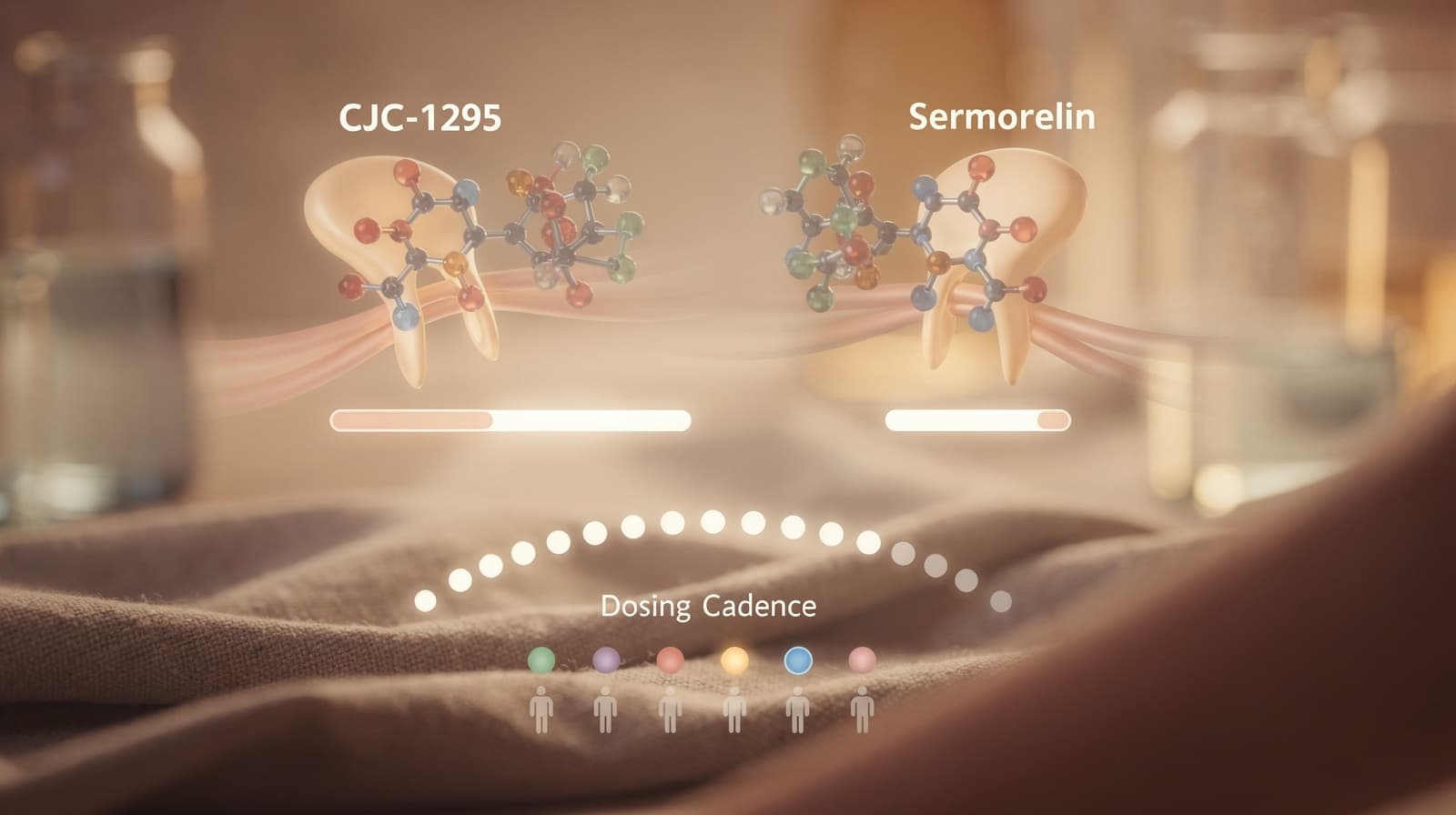
CJC-1295 and sermorelin both bind the same pituitary receptor, but their pharmacokinetics live in different time zones. One asks the user for a nightly injection that mimics natural growth-hormone pulses; the other rides a synthetic albumin tether that keeps the signal humming for a week. This guide separates the marketing from the published human data, then offers a decision rule for which compound a research protocol should start with.
Key takeaways#
- Both CJC-1295 and sermorelin are GHRH analogs that bind the same pituitary GHRHR, but their half-lives differ by roughly three orders of magnitude.
- Sermorelin has a circulating half-life of about 10 to 15 minutes and was historically dosed once nightly; CJC-1295 with DAC has an estimated half-life of 5.8 to 8.1 days and supports once-weekly cadence.
- Sermorelin is the one compound in this pair with FDA approval history (Geref, approved in 1990 as a diagnostic test and in 1997 to treat pediatric GH deficiency), discontinued by its maker in 2008; the FDA later determined it was not withdrawn for safety or effectiveness.
- CJC-1295 has no regulatory approval and cannot be compounded in the US after a 0 to 13 FDA advisory committee vote in December 2024; its strongest human evidence is two 2006 ascending-dose trials in healthy adults, with no extended efficacy data published since.
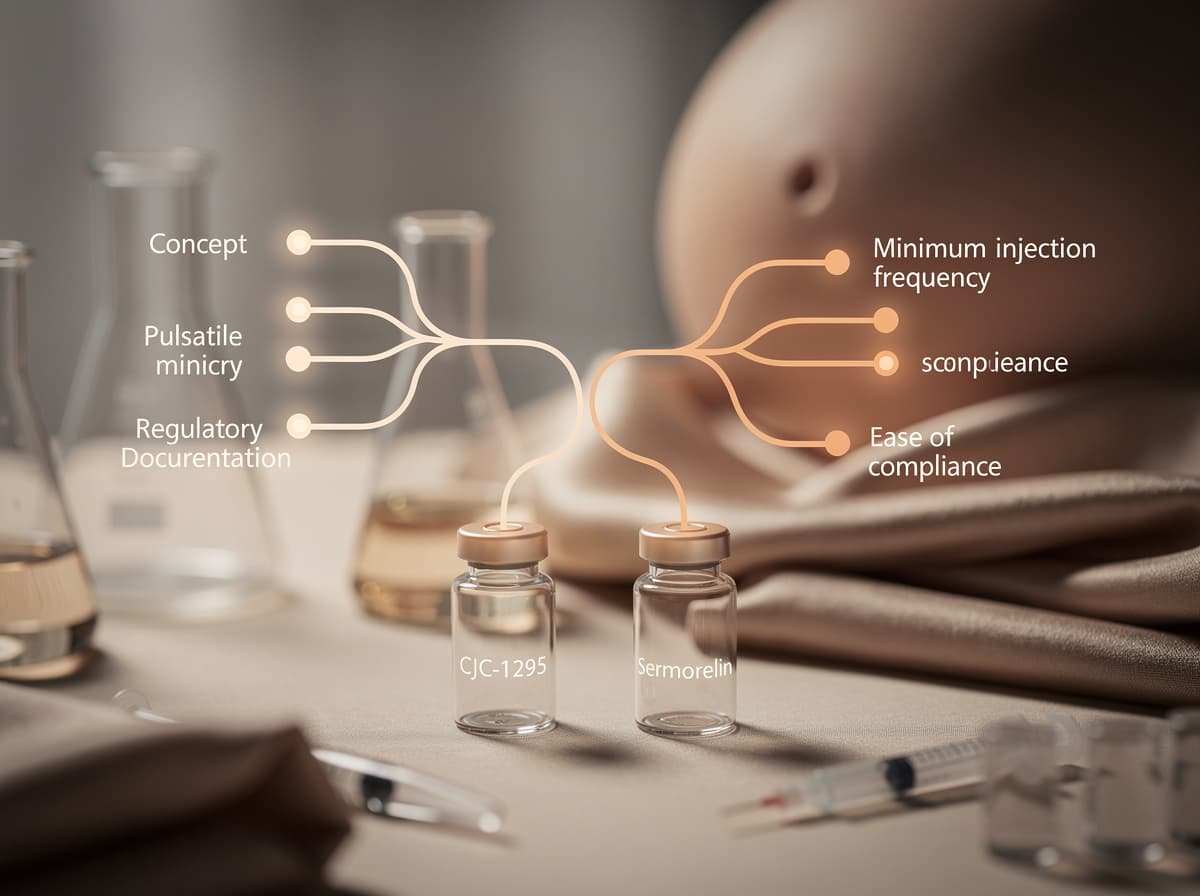
- For research protocols that prioritize pulsatile GH mimicry, sermorelin is the more conservative starting point. For protocols built around minimum injection burden, CJC-1295 with DAC is the structurally distinct option.
How CJC-1295 works#
CJC-1295 is a synthetic 30-amino-acid GHRH analog with two structural tricks. First, four amino-acid substitutions in the GHRH(1-29) backbone confer resistance to DPP-IV cleavage, extending plasma stability. Second, a maleimidopropionic-acid linker (the Drug Affinity Complex, or DAC) covalently binds the molecule to circulating serum albumin once injected, hijacking albumin's multi-day clearance window. The result is a GHRH agonist that activates the pituitary GHRHR continuously for roughly a week per dose.
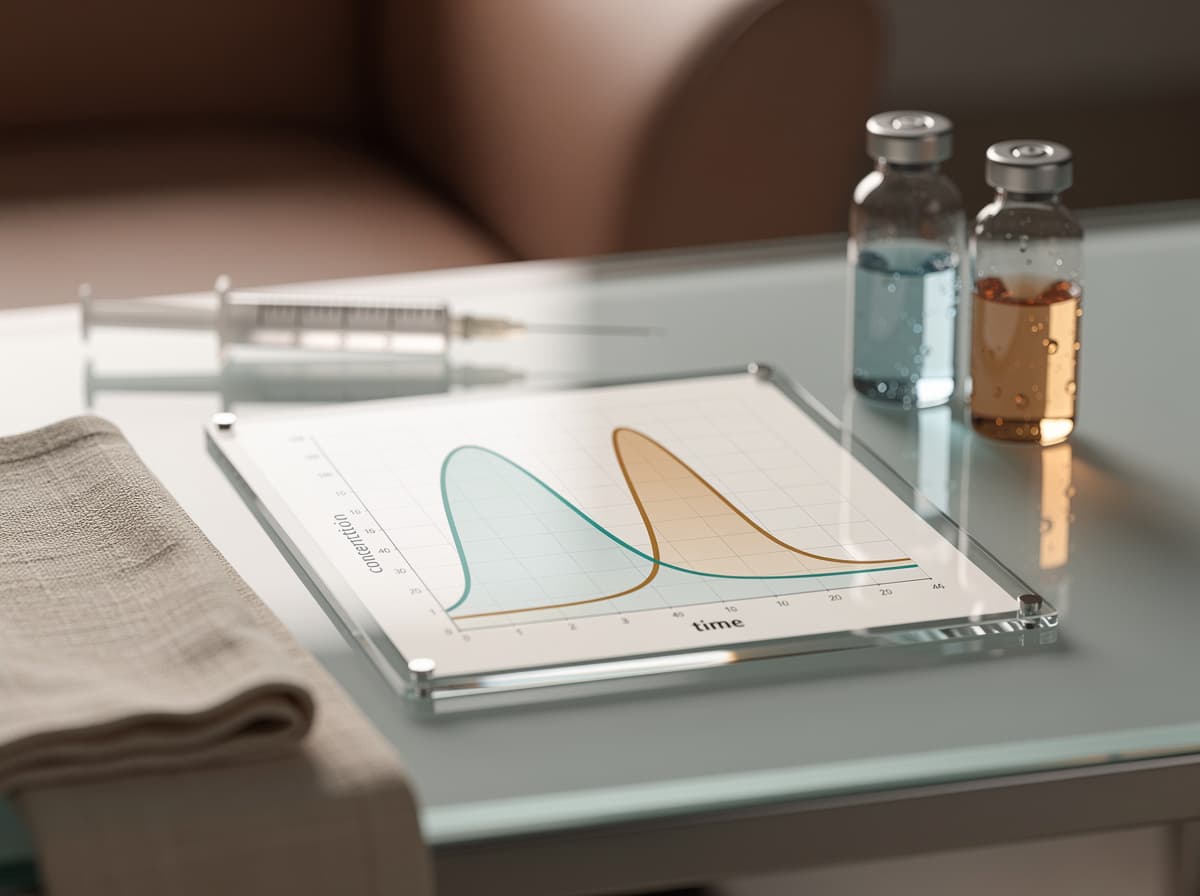
Critically, research has shown that the pulsatile architecture of endogenous GH secretion is preserved even under this continuous receptor stimulation. The companion 2006 study by Ionescu and Frohman in JCEM documented that GH pulses persist during CJC-1295 administration, with somatostatin counter-regulation intact. This matters because tonic GH elevation (the pattern produced by exogenous rhGH) is metabolically distinct from amplified pulsatile release.
How sermorelin works#
Sermorelin is GHRH(1-29)NH2: the first 29 amino acids of endogenous human GHRH, which constitute the shortest fully bioactive fragment. It binds the same GHRHR with comparable affinity to native GHRH and triggers identical downstream cAMP signaling in pituitary somatotrophs. There is no half-life extension, no albumin binding, no DPP-IV resistance. Plasma half-life is roughly 10 to 15 minutes.
This short pharmacokinetic window is the entire design rationale. A nightly subcutaneous injection at bedtime aligns the GHRH signal with the natural overnight GH pulse, amplifying physiological release rather than overriding it. Sermorelin's action is regulated by endogenous somatostatin feedback, which makes runaway GH elevation mechanistically difficult and has been associated with a milder side-effect profile than direct rhGH administration. Preliminary evidence from the original Geref pediatric trials documented meaningful height-velocity gains in GH-deficient children, with effect sizes smaller than rhGH but with a softer adverse-event signal.
Dosing: CJC-1295 vs sermorelin#
Research protocols differ sharply between the two compounds, and only published ranges should anchor any protocol design.
CJC-1295 with DAC. The pivotal Teichman 2006 dose-escalation work gave four ascending single subcutaneous doses in the first trial and two or three weekly or biweekly doses in the second, across 28 and 49-day study windows; it was best tolerated at 30 or 60 μg/kg. Research protocols generally use weekly subcutaneous administration; the once-weekly cadence is the structural payoff of the DAC modification.
Sermorelin. Under the historical Geref pediatric label, therapeutic dosing was 30 μg/kg/day subcutaneously at bedtime, with the diagnostic single-dose protocol set at 1 μg/kg IV. Adult research and off-label compounding practice has generally followed the same nightly cadence to ride peak natural GH output, though specific adult research doses are not standardised in the same way.
Note the asymmetry. CJC-1295 has a published dose-tolerable range in healthy adults; sermorelin's adult dosing is extrapolated from pediatric data and compounding-pharmacy convention. Klarovel's peptide calculator handles the per-injection arithmetic, but the protocol-level decisions belong upstream of the syringe.
Evidence: what the studies actually show#
The published human evidence for each compound is uneven, and any honest comparison has to acknowledge it.
CJC-1295. The pivotal human PK/PD data come from Teichman et al., 2006, in JCEM: two randomized, placebo-controlled, double-blind ascending-dose trials in healthy adults aged 21 to 61. Studies have shown CJC-1295 increased mean plasma GH concentrations 2 to 10-fold for 6 days or more, and mean plasma IGF-1 concentrations 1.5 to 3-fold for 9 to 11 days, with a dose-tolerable range of 30 to 60 μg/kg. The companion Ionescu and Frohman paper demonstrated preserved pulsatile GH secretion during continuous stimulation. Beyond these Phase I/II trials, extended efficacy data in humans are limited, and commercial development reportedly halted after a participant death deemed unrelated to study drug.
Sermorelin. The historical evidence base is broader. The FDA approved Geref for treatment in 1997, after a diagnostic approval in 1990, for pediatric idiopathic GH deficiency at 30 μg/kg/day SC, supported by pivotal trials showing meaningful IGF-1 standard-deviation-score gains and height velocity increases. The FDA's 2013 determination that Geref was not withdrawn for safety or effectiveness reasons preserves the safety record as a regulatory artefact. Adult-population randomized data are thinner, with most evidence extrapolated from pediatric trials and compounding-pharmacy case series.
The asymmetry to internalise: sermorelin has more years of human exposure and a regulatory paper trail; CJC-1295 has tighter modern PK/PD characterization but a far smaller human sample and zero approval. Both have been associated with favorable short-term tolerability in their respective trial populations.
Side effects and contraindication profile#
The adverse-event profiles overlap heavily because the downstream biology is identical: both compounds raise GH and IGF-1 by activating the pituitary GHRHR.
Shared signals across both compounds include injection-site reactions (the most common adverse event in both trial sets), transient facial flushing, headache, and dose-dependent water retention. Both raise IGF-1, and chronic IGF-1 elevation is epidemiologically associated with modest increases in certain cancer risks, though whether short-term research-induced elevation carries the same risk is unknown. Neither compound should be used by individuals with active malignancy, severe diabetic retinopathy, or known hypersensitivity.
Where they diverge: CJC-1295's multi-day receptor occupancy means side-effect onset and offset are slower; if a user develops paresthesia or fluid overload, washout takes a week, not hours. Sermorelin's short half-life makes adverse-event management mechanically simpler: skip the next dose and the signal is gone by morning. Sermorelin also carries the WADA prohibited-substances flag as a GHRH analog (S2 class), as does CJC-1295. Neither belongs in a tested athlete's stack.
When to choose CJC-1295#
CJC-1295 with DAC fits research contexts where:
- Injection frequency is the primary friction point and a once-weekly cadence materially improves protocol adherence.
- The research question requires sustained IGF-1 elevation over multi-day windows rather than nightly pulses.
- The user has tolerated short-acting GHRH analogs and the protocol is escalating duration of receptor exposure deliberately.
- Bloodwork (IGF-1, fasting glucose, HbA1c) is being tracked at 8 to 12-week intervals to catch the slower-onset adverse-event signals.
When to choose sermorelin#
Sermorelin is the better starting point when:
- The protocol prioritizes mimicry of natural nocturnal GH pulses over multi-day plateau elevation.
- The user wants the option to abort fast; a missed dose washes out in under an hour rather than a week.
- A regulatory paper trail matters (prior FDA approval, documented pediatric safety record), even though current use is off-label compounded. Unlike CJC-1295, sermorelin can still be lawfully compounded by 503A pharmacies on prescription.
- The user is new to GHRH analogs and clinicians prefer a shorter-acting probe before committing to multi-day receptor occupancy.
Can you stack them?#
Stacking CJC-1295 with sermorelin is not standard practice because the two molecules compete for the same GHRHR binding site. Once CJC-1295 with DAC saturates receptor occupancy for a week, adding nightly sermorelin contributes no additional pituitary stimulus; the upstream signal is already maximal. The more common research-protocol pairing is a GHRH analog (either CJC-1295 or sermorelin) with a separate GHRP or ghrelin-receptor agonist (such as ipamorelin), because those hit a complementary receptor (GHSR-1a) and the combined response is amplified through two distinct pathways. Pairing two GHRH analogs is mechanistically redundant.
Verdict#
For most research protocols in healthy adults, sermorelin is the more conservative starting point. It carries the only FDA approval history in this pairing, has a published pediatric safety record spanning roughly two decades, and its short half-life makes adverse-event management straightforward. The dosing inconvenience (nightly subcutaneous injection) is real but operationally manageable.
CJC-1295 with DAC earns its place when injection burden is the binding constraint or when the research question specifically requires sustained multi-day IGF-1 elevation. Its modern PK/PD characterization is excellent within the Teichman trial window, but the absence of regulatory approval, the small human sample, and the multi-day washout in case of adverse events all argue for caution. It is the more pharmacologically aggressive choice, not the more evidence-rich one.
Neither compound is the right answer for users without a clear protocol objective and bloodwork plan. Klarovel's framing on these compounds is detailed in our research-positioning disclosures.
Make the decision on data, not marketing#
The honest version of the CJC-1295 vs sermorelin question is not which is better; it is which is right for a specific protocol, health profile, and injection-tolerance budget. Run your numbers through Klarovel's peptide calculator, and if you want a structured way to map your goals against your health profile before committing to either compound, walk through the questionnaire. Both molecules deserve more respect than the wellness marketing gives them, and both deserve more skepticism than the supplier marketing gives them. The decision rule sits in the middle.
Frequently asked questions
Keep reading
Peptides for Inflammation: Mapping BPC-157, KPV, and Thymosins
Peptides for inflammation compared by mechanism and evidence stage: BPC-157, KPV, thymosin alpha-1, and thymosin beta-4, with FDA status and safety notes.
Mounjaro vs Zepbound: Same Drug, Two Different FDA Labels
Mounjaro and Zepbound are the same drug, tirzepatide, at the same doses. The difference is the FDA label: diabetes for Mounjaro, weight loss for Zepbound.
Rybelsus for Weight Loss: Not Approved, and the Pill That Is
Rybelsus is not FDA-approved for weight loss and moves the scale only a little. The oral semaglutide approved for weight loss is the Wegovy pill at 25 mg.